(4) Adr is the form of the ADR (adrenal) point that the teaching uses to raise blood sugar. It is given on the middle of the back while you lie face down, and because it raises sugar it is never given in diabetes or in cancer.
Overview
What is (4) Adr?
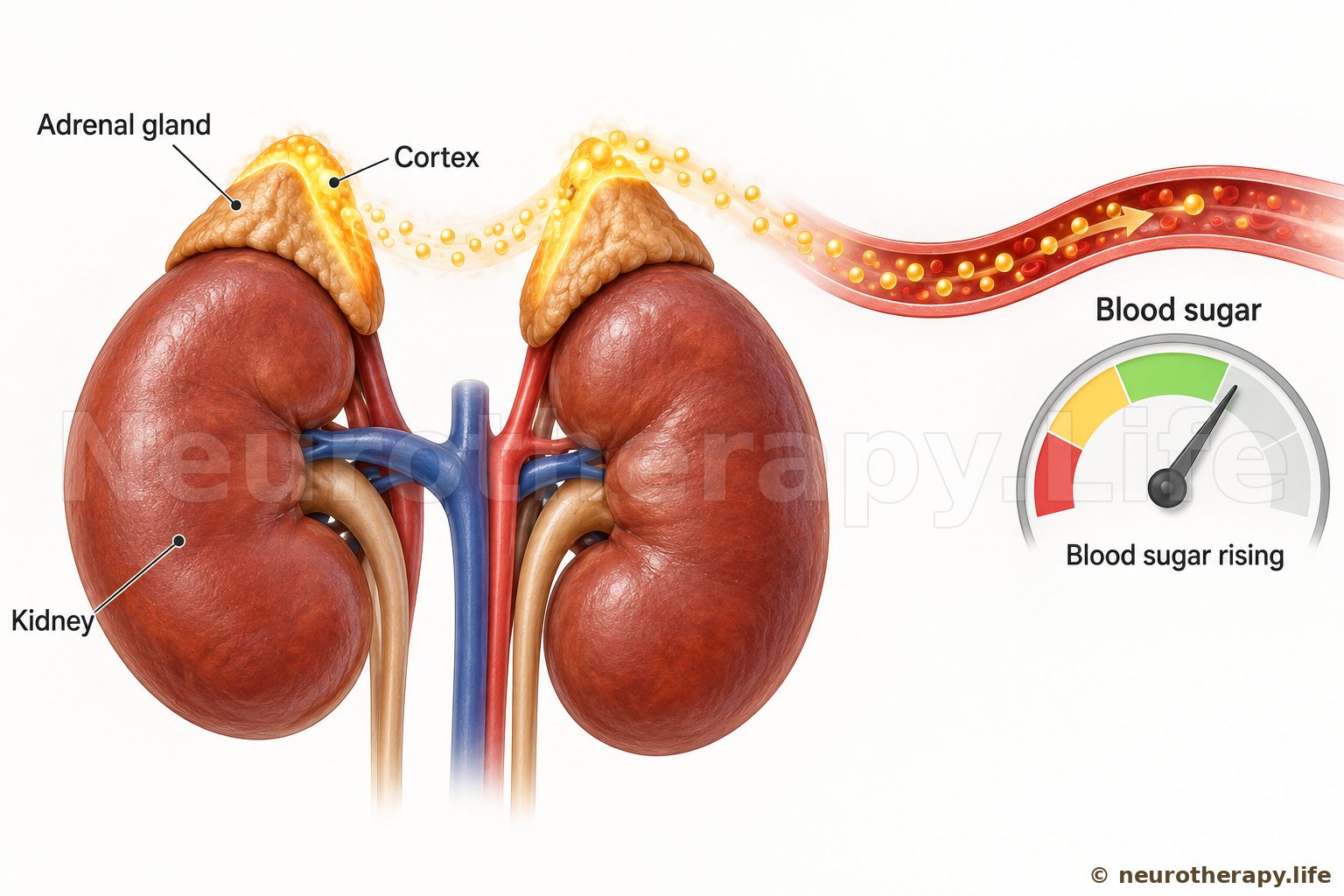
The adrenal glands, sitting on top of the kidneys, help keep the blood sugar from falling too low. Their outer layer (the cortex) makes cortisol, which raises sugar between meals and in stress.
(4) Adr is the ADR treatment the teaching writes 'to raise blood sugar'. The number four names this treatment. It is not a stronger (2) Adr or a weaker (6) Adr — it is a separate treatment, with its own bar.
Its most common place is inside the formula for very long-standing constipation (LSTF), where it is given beside the thyroid point.
The adrenal glands help stop blood sugar from falling too low. (4) Adr is the ADR treatment written to raise sugar.
Where it is given
Where is (4) Adr given?
PositionLying face down
Body areaMiddle of the back beside the spine (T6 level), lying face down
At the same place as every ADR treatment: you lie face down with one and a half pillows under the chest and chin, and the therapist works on the middle of the back, close beside the sixth bone of the upper back (T6).
Because most of the constipation formula is given lying on the back, (4) Adr is the step that needs the patient to turn over. For the comfort of the elderly and of patients with back or heart trouble, the formula is written so that the patient turns only once.
How it is given
How is (4) Adr given?
How this point is given — the tool, the pressure, the count and the exact movement — is deliberately not described here. A demonstration video for this point is being prepared; until it is on this page, learn the method hands-on from a trained Neurotherapist before giving it. Please do not give any point from a written description alone: a point given in the wrong place or the wrong way can do harm.
The number written before a point's name is not a strength setting. Each numbered form is a separate named treatment with its own method and timing, taught hands-on in the course.
Aimed atRaising blood sugar
The exact technique is taught hands-on in the Neurotherapy (LMNT) course. See the course →
What it does
What does (4) Adr do?
The teaching writes (4) Adr 'to raise blood sugar by way of glucagon'. In body science, glucagon is made by the pancreas, while the adrenal cortex raises sugar mainly through cortisol; either way, the direction is the same — sugar goes up. How a hand on the back reaches the gland is the therapy's own explanation, from clinical experience.
Raises blood sugar.
Forms the adrenal step of the formula for very long-standing constipation, given beside the thyroid point — the teaching prefers the adrenal before the thyroid, because the adrenal tends to quieten the thyroid.
The formula for very long-standing constipation, bamboo spine and pains of the left side of the body.
Safety: when it is held back
Diabetes: never. It raises sugar. Where Pan is needed, (10) Pan may be given in its place. Diabetes
Cancer: never. Raised sugar can feed cancer cells. In cancer the therapy also never gives (10) Pan, Thymus, Pit, Lu+Sh, Rt.Ov/Lt.Ov or (30) Medulla. Cancer care: Neurotherapy (LMNT) support
Children get light treatment. Sudden weakness, sweating or confusion from low sugar is an emergency — give sugar and get medical help. How to tell a patient to see a doctor
Common questions
I am diabetic. Could (4) Adr be on my card?
No. It is blocked in diabetes because it raises sugar. It should be marked as blocked on your card from the first visit.
Why is an adrenal point in a constipation formula?
The formula works step by step on the large bowel, the water balance, the thyroid and the infection that sluggish stool can breed; (4) Adr is its adrenal step, given beside the thyroid.
Is (4) Adr stronger than (2) Adr?
No. The numbers select different treatments — salt for (2), sugar for (4), inflammation for (6).
Surprising facts
1Your brain runs on sugar
The brain uses glucose as its main fuel and has almost no store of its own, which is why the body has several hormones whose job is to stop sugar from falling too low.
Source: Guyton & Hall, Textbook of Medical Physiology, 14th ed., glucose regulation.
2Many hands raise sugar, one lowers it
Glucagon, cortisol, adrenaline and growth hormone can all raise blood sugar; insulin is the main hormone that lowers it.
Source: Guyton & Hall, Textbook of Medical Physiology, 14th ed.
3Why steroids raise sugar
Cortisol helps the liver make new glucose. That is why steroid medicines, copies of cortisol, can push up blood sugar.
Source: Guyton & Hall, Textbook of Medical Physiology, 14th ed., glucocorticoids.
This page explains what a Neurotherapy (LMNT) treatment is for; it is not a self-treatment guide and does not diagnose. Neurotherapy (LMNT) works alongside your medical care — keep taking the medicines your doctor prescribed.
Ready to begin?
Send COURSE for course details, or your name, age and health issue for a consultation.