Two small caps on top of your kidneys are really two glands in each wrapper — an outer rind that makes cortisol and aldosterone for the long haul, and an inner core that fires adrenaline in seconds. In Guruji's teaching, (6) Adr at the upper back is the chief treatment for inflammation.
Overview
What are the adrenal glands?
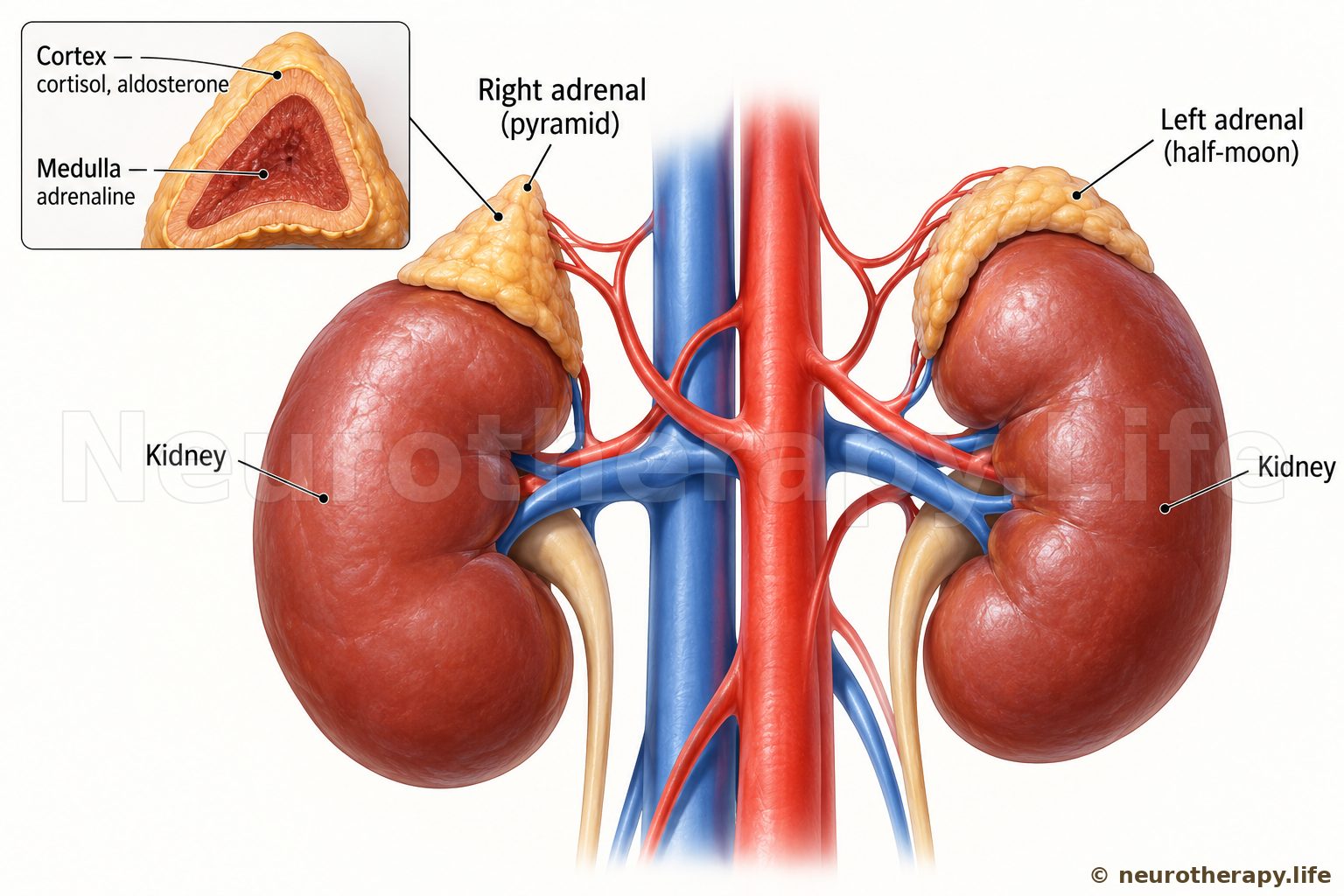
The adrenal glands are two small, flat glands, one sitting on top of each kidney. Each one is really two glands in one wrapper: an outer layer, the cortex (Latin for 'bark'), and an inner core, the medulla (Latin for 'marrow').
The cortex makes slow, long-acting hormones: cortisol, which keeps sugar and blood pressure up under stress and calms inflammation; aldosterone, which holds salt and water; and small amounts of male-type hormones. The medulla makes the fast 'fright' hormones, adrenaline and noradrenaline, which prepare the body for danger in seconds.
Adrenal diseases are uncommon but important. Too little cortisol (Addison's disease) can be life-threatening; too much (Cushing's syndrome) is most often caused by long-term steroid medicines. A gland making too much aldosterone is a hidden cause of some hard-to-control high blood pressure.
A cap on each kidney: the right is a pyramid, the left a half-moon. Inside, a yellow rind and a darker core — two glands in one.
Function
What do the adrenal glands do?
The two parts of each adrenal gland work on two different clocks. The medulla works in seconds, like an alarm bell. The cortex works over minutes, hours and the whole day, keeping the body supplied and steady.
Adrenaline and noradrenaline speed the heart, raise blood pressure, open the airways and release sugar for the muscles — within seconds.
Cortisol keeps blood sugar up between meals and under stress, supports blood pressure, and damps down inflammation and the immune response.
Cortisol also follows a daily clock — highest soon after waking, lowest around midnight.
Aldosterone tells the kidneys to keep salt and water and pass out potassium, which keeps up blood volume and pressure.
Small amounts of male-type hormones help start body hair at puberty, especially in girls.
Together they help the body get through illness, injury and surgery.
Pressure or salt falls
After sweating in the sun, or losing blood, the kidneys sense that pressure and salt are low and release an enzyme called renin.
Angiotensin is made
Renin starts a chain in the blood, finished largely in the lungs by the 'converting enzyme', that makes angiotensin II.
The adrenal answers
Angiotensin II tightens the blood vessels and tells the outer layer of the adrenal cortex to release aldosterone.
The kidneys hold on
Aldosterone makes the kidneys keep salt — and water follows the salt.
Pressure comes back up
Blood volume and pressure rise; renin falls, and the chain switches off. Too much aldosterone keeps the pressure high.
How do the adrenal glands work with other organs?
Pituitary gland — Sends ACTH, which tells the cortex to make cortisol.
Kidneys — The adrenals sit on them; aldosterone tells them to keep salt, and the kidneys' renin sets the aldosterone chain going.
Nervous system and brain — Alarm nerves run straight to the medulla, which is why adrenaline arrives in seconds.
Heart — Adrenaline makes the heart beat faster and harder.
Lungs — Adrenaline opens the airways; the lungs finish making the angiotensin that calls for aldosterone.
Thymus — Cortisol quietens the immune system and the thymus; LMNT teaching uses Adr where the thymus is thought to be over-active.
Thyroid — In LMNT teaching the adrenal tends to slow the thyroid, so Adr is ideally given before Thrd.
Anatomy
What are the parts of the adrenal glands?
Each adrenal has a tough capsule, a thick outer cortex in three layers, and a small inner medulla.
Two glands in one
Capsule — A thin, tough covering, with the gland set in its own pad of fat.
Cortex — The yellow outer rind — about nine-tenths of the gland. It builds its hormones from cholesterol.
Medulla — The reddish-brown core. Its cells are nerve cells that release their message into the blood instead of down a nerve.
Three layers of the cortex — salt, sugar, sex
Medical students remember the three layers from outside in as 'salt, sugar, sex'.
Outer layer (zona glomerulosa) — Makes aldosterone — the salt hormone.
Middle layer (zona fasciculata) — The thickest layer. Makes cortisol — the sugar and stress hormone.
Inner layer (zona reticularis) — Makes small amounts of male-type hormones such as DHEA.
Blood supply
Three arteries — Each adrenal is fed by three small arteries, making it one of the richest-supplied tissues for its size.
One vein — Blood leaves through a single vein; on the right it is very short and runs straight into the body's largest vein.
Where are the adrenal glands located?
The adrenals sit on the upper inner edge of each kidney, deep at the back of the upper abdomen, just under the diaphragm and roughly level with the lowest ribs. The right one lies behind the liver, close to the body's largest vein; the left one lies behind the stomach, near the pancreas and the spleen.
They are wrapped in their own fat and covering, separate from the kidney, so a kidney can be removed without taking the adrenal.
In Guruji's teaching the gland is too deep to reach, so the hand goes to its wiring instead. (6) Adr is rubbed with gathered palms beside the T6 bead of the upper back, with the patient face down. The teaching itself marks its statement about the nerve supply 'below T6?' with a question mark, because it came from reading and inference. Swt is given beside the T6–T12 beads.
The two glands are not the same shape. The right one is a small pyramid; the left one is a flatter half-moon that curves down the inner edge of the kidney.
Cut open, each shows a bright yellow outer layer — yellow because it is rich in the fat and cholesterol it uses to make hormones — around a thin, darker reddish-brown core.
How big are the adrenal glands?
Each adult adrenal is about 5 cm long, 2–3 cm wide and less than 1 cm thick, and weighs about 4–5 grams.
At birth the adrenals are strikingly large for the baby's size, because of an extra layer that works during pregnancy. That layer shrinks away in the first months of life.
Conditions and disorders
What conditions and disorders affect the adrenal glands?
The adrenals can make too little hormone — Addison's disease, usually from the immune system attacking the cortex, or a pituitary that no longer sends ACTH. They can make too much — Cushing's syndrome (too much cortisol, most often from steroid medicines), primary aldosteronism (too much aldosterone, causing high blood pressure), or, rarely, a phaeochromocytoma (a tumour of the medulla that makes bursts of adrenaline). Small lumps found by chance on scans are common and are usually harmless, but they are checked with blood tests.
Too little adrenal hormone
Low blood pressureLow cortisol and aldosterone bring low pressure, dizziness on standing and a craving for salt.
InflammationCortisol is the body's own brake on inflammation; steroid medicines copy it.
AllergyAn injection of adrenaline is the emergency treatment for a severe allergic reaction.
Where LMNT teaching uses Adr and Swt
Poisoning and snake or scorpion bites(6) Adr for poisoning, snake and scorpion bites — only while the person is being taken to hospital, never instead.
Knee pain(6) Adr for knee pain with heat and swelling.
Muscle cramps(2) Adr for cramps from salt loss — after heavy sweating in the sun or sport.
Diarrhoea (loose motions)(6) Swt and (6) Right Swt, which the teaching uses to slow the bowel in loose motions.
Varicose veins(6) Right Swt, for the swelling of the legs.
What are common signs of an adrenal problem?
Too little: great tiredness, weight loss, dizziness on standing, salt craving, nausea, darkening of the skin
Too much cortisol: a rounder face, weight on the belly, purple stretch marks, easy bruising, weak thighs
Too much aldosterone: high blood pressure that is hard to control, sometimes with cramps and weakness from low potassium
Too much adrenaline: attacks of pounding headache, sweating and a racing heart
In anyone on long-term steroids: collapse, vomiting or great weakness during an illness
What tests check the adrenal glands?
Morning cortisol — Taken early in the morning, when cortisol should be at its highest.
ACTH stimulation test — An injection that should make healthy adrenals release cortisol; a poor rise suggests Addison's disease.
Suppression and night-time tests — A small steroid dose at night, or a late-night saliva or 24-hour urine test, to look for too much cortisol.
Aldosterone and renin — Measured together in people with hard-to-control blood pressure or low potassium.
Metanephrines — Blood or urine breakdown products of adrenaline, raised in phaeochromocytoma.
Sodium, potassium and scans — Salt and potassium levels, and a CT or MRI of the adrenals.
How are adrenal conditions treated?
Hormone replacement — For too little: daily hydrocortisone, often with fludrocortisone, taken for life, with extra doses during illness ('sick-day rules').
Emergency hydrocortisone — An adrenal crisis is treated with an injection of hydrocortisone and fluids in hospital.
Surgery — Removing an adrenal gland with a tumour, often by keyhole surgery.
Medicines — Medicines that block aldosterone, or that lower cortisol, when surgery is not the answer.
Careful steroid use — The lowest steroid dose for the shortest time, and a slow, doctor-guided taper when stopping.
Neurotherapy (LMNT)
Guruji's teaching sees the adrenal as two glands in one wrapper, and gives each its own point. Adr is aimed at the rind — the cortex — and Swt at the core — the medulla. At each, the count changes what the point does, so the number is read before the point. The chief treatment, (6) Adr, was found by a plain question: when an insect bite turns red and swollen, who in the body calls the swelling off? The answer was cortisol from the adrenal cortex. But the gland lies deep at the back, above the kidneys, where no hand can reach. So Guruji went to its wiring. Reading that its nerve supply comes from 'below T6?' — and printing that question mark himself — he rubbed beside that bead of the upper back. The patient said he felt very good; after two more rounds most of the swelling had gone down. (6) Adr × 3 treatments became the teaching's most important treatment for inflammation. Later it was paired with (30) Medulla in the Inflammation Treatment Formula: (6) Adr works through the gland, (30) Medulla at the site. Because cortisol also quietens immunity, the teaching blocks (6) Adr wherever immunity is already low. This is support alongside your doctor's care, never a replacement for steroid or other medicines.
Points
ADR — Prone, with one and a half pillows under the chest. Fingers gathered, both palms flat and close together beside the T6 bead; rub from the middle outward at three places. Never more than 6 rubs at one place at one time.
(2) Adr — The teaching links it with aldosterone and salt — for cramps from salt loss after heavy sweating. Not in high blood pressure.
(4) Adr — The teaching says it raises blood sugar, so it is never given in diabetes.
(6) Adr — The teaching's chief point for inflammation: pain at Mu, mucus in the stool, a blocked nose, tonsil pain, diseases ending in '-itis', and a hot, swollen knee. Not where immunity is low, and not in high blood pressure.
SWT — Palms standing on their edge like a knife, beside the T6–T12 beads, pressing inward. Aimed at the adrenal medulla and the sweat glands.
(3) Swt — The mildest count: for the smell of sweat or urine, and for pimples.
(6) Left Swt — The 'opening' side: for a narrowed passage — difficulty breathing in, or swallowing, or a narrowed urine passage. Not in diabetes.
(6) Right Swt — The 'closing' side: loose motions, difficulty breathing out, leg swelling from varicose veins, and small leaks of urine on laughing or sneezing. Not in high blood pressure.
(30) Medulla — The partner of (6) Adr in the inflammation formula, given seated below the ears. Not in heart patients.
“Wherever there is a question mark, it is an indication that this is my own thinking, on which other people can now do research.”
— Dr. Lajpatrai Mehra
“Only they know the pain; you do not.”
— Dr. Lajpatrai Mehra
“This is exactly how it should be. And this itself is the secret of Neurotherapy (LMNT)'s success.”
— Dr. Lajpatrai Mehra, on why two people with one disease may need two different treatments
Never do this
Never stop steroid tablets suddenly after taking them for more than a few weeks — your own adrenals may have gone quiet. Carry a steroid card, and follow your doctor's 'sick-day rules'. Neurotherapy (LMNT) works alongside your medicines, never instead of them.
Emergency: sudden severe weakness, vomiting, stomach pain, dizziness or confusion in someone with Addison's disease or on long-term steroids — call 108/112. This is an adrenal crisis and needs a hydrocortisone injection. How to tell a patient to see a doctor
Poisoning, snake or scorpion bite, and appendicitis are races against time. (6) Adr may be given while the person is being taken to hospital — never instead of taking them. Poisoning and snake or scorpion bites
(6) Adr is never given where immunity is already low — septicaemia, HIV/AIDS or cancer — and not in high blood pressure. (6) Adr
In heart patients the inflammation formula is changed: (30) Medulla is not given, and (6) Adr is given only with the patient seated, if the therapist decides it is needed. ITF
The ceiling: at one place, never more than 6 rubs at one time. A larger number means more passes down the back, never a longer stay in one spot. ADR
Cancer: if the person has cancer, (10) Pan, Thymus, Pit, Lu + Sh, Rt. Ov / Lt. Ov and (30) Medulla are never given — and the teaching's cancer list also closes (4) Adr and (6) Adr. The therapist changes the plan. Cancer care: Neurotherapy (LMNT) support
Care
How can I keep my adrenal glands healthy?
Healthy adrenals mostly need a life that lets the alarm switch off between emergencies.
Keep a regular sleep clock
Cortisol follows your sleep. Go to bed and wake at similar times, and get daylight in the morning.
Give stress an off-switch
A few minutes of slow breathing, a walk, prayer or quiet time each day helps the stress response settle.
Move, but recover
Regular activity is good for stress hormones; very hard training without rest is not.
Go easy on late caffeine
Tea and coffee late in the day can keep the alarm system switched on at night.
Replace salt after heavy sweating
After long work in the sun, a little salt with water helps prevent cramps — unless your doctor has told you to limit salt.
If you take steroids
Know your dose, carry a card, never stop suddenly, and tell every doctor and therapist you see.
Common questions
Is 'adrenal fatigue' real?
It is not a recognised medical diagnosis. A careful review of the studies found no proof that stress 'wears out' the adrenals. Real adrenal failure (Addison's disease) exists and is diagnosed with blood tests. Constant tiredness deserves a proper check for its real cause.
Why can't steroid tablets be stopped suddenly?
When you take a steroid for weeks, the pituitary stops asking your adrenals for cortisol, and they go quiet. Stop the tablet suddenly and there may be too little cortisol for days — which can cause collapse. Doses are reduced slowly under a doctor's guidance.
Is adrenaline bad for me?
No — it is what lets you jump out of the way of a bus. The trouble comes when the alarm keeps ringing for weeks with no danger to run from.
Can an adrenal problem cause high blood pressure?
Yes, in a small but important share of people — usually from too much aldosterone. It is worth checking if blood pressure is very hard to control, started young, or comes with low potassium.
What is the difference between Adr and Swt?
In Guruji's teaching, Adr is aimed at the outer cortex (cortisol, aldosterone) and is rubbed with gathered palms beside T6. Swt is aimed at the inner medulla and the sweat glands, and is pressed with the edge of the hands beside T6–T12. The left and right forms of Swt do opposite things.
Can Neurotherapy (LMNT) be taken with steroid medicines?
Yes, alongside them — never as a reason to stop them. Tell the therapist about your steroid dose, blood pressure, sugar and any infection, because they decide which adrenal points are given.
What should I ask my doctor or therapist?
Could my tiredness, low pressure or hard-to-control high pressure be coming from my adrenals?
Which test do I need, and at what time of day should it be done?
If I take steroids: how long, what dose, and how should I stop?
What are my sick-day rules, and do I need an emergency injection at home?
Is this adrenal lump on my scan harmless, and does it need follow-up?
(To the therapist) Which Adr or Swt points are right for me, and which are blocked because of my pressure, sugar or immunity?
Surprising facts
1Two organs that grew up apart
The adrenal cortex and medulla come from completely different tissues in the unborn baby. The cortex grows from the same tissue that forms the kidneys and sex glands. The medulla grows from nerve tissue — its cells are nerve cells that never grew a long fibre and release their message straight into the blood instead.
Source: Moore KL, Persaud TVN. The Developing Human — cortex from mesoderm, medulla from neural crest; Guyton & Hall — adrenal medulla as a modified sympathetic ganglion.
2Adrenaline was the first hormone ever purified
In 1901 the Japanese chemist Jokichi Takamine, working in the United States, isolated adrenaline in pure crystal form from adrenal glands — the first hormone ever purified. It is still used today in emergencies, from cardiac arrest to severe allergic reactions.
Source: Takamine J. The isolation of the active principle of the suprarenal gland. J Physiol 1901;27(Suppl):xxix–xxx; Bennett MR. One hundred years of adrenaline: the discovery of autoreceptors. Clin Auton Res 1999;9:145–159.
3A newborn's adrenals are huge for its size
Before birth the adrenal glands carry an extra 'fetal zone' that works with the placenta to make hormones for the pregnancy. Relative to body weight, a newborn's adrenals are many times larger than an adult's. After birth the extra zone shrinks away over the first months.
Source: Moore KL, Persaud TVN. The Developing Human — fetal adrenal cortex (10–20 times larger than adult relative to body weight; involution after birth).
4Your cortisol has an alarm clock
Cortisol is lowest around midnight and starts climbing in the early morning. Then, within about 30–45 minutes of waking, it jumps by roughly half again — the 'cortisol awakening response' — helping you get going. That is why cortisol blood tests are usually taken early in the morning.
Source: Fries E, Dettenborn L, Kirschbaum C. The cortisol awakening response (CAR): facts and future directions. Int J Psychophysiol 2009;72(1):67–73.
5Steroid tablets can put your own adrenals to sleep
When cortisol-like tablets are taken for more than a few weeks, the pituitary sees plenty of cortisol and stops sending ACTH. The adrenal cortex, no longer asked to work, goes quiet and can even shrink. Stop the tablets suddenly and the body may be left without enough cortisol for days — which is why steroids are always tapered.
Source: Bornstein SR, et al. Diagnosis and treatment of primary adrenal insufficiency: an Endocrine Society clinical practice guideline. J Clin Endocrinol Metab 2016;101(2):364–389; NHS, 'Steroids' (do not stop suddenly).
6A US President lived with Addison's disease
John F. Kennedy had Addison's disease — his adrenal glands did not make enough hormone — and he took daily replacement tablets throughout his presidency. With the right treatment, people with Addison's disease can live full, active lives.
Source: Mandel LR. Endocrine and autoimmune aspects of the health history of John F. Kennedy. Ann Intern Med 2009;151(5):350–354.
7'Adrenal fatigue' is a myth
Many websites say long stress 'burns out' the adrenals. A systematic review of all the studies found no evidence that this condition exists. Constant tiredness is real — but its causes include poor sleep, anaemia, a slow thyroid, low mood and many others that can be tested for.
Source: Cadegiani FA, Kater CE. Adrenal fatigue does not exist: a systematic review. BMC Endocr Disord 2016;16(1):48.
8One fright hormone can lower the bottom blood-pressure number
Adrenaline and noradrenaline are close cousins, but they differ. Adrenaline also opens the blood vessels inside working muscles, so while the top blood-pressure number rises, the bottom number can actually fall. Noradrenaline narrows vessels and raises both. Guruji's teaching splits Swt the same way: the left side 'can reduce the diastolic pressure', while the right side is refused to people with high blood pressure.
Source: Guyton & Hall, Textbook of Medical Physiology — effects of epinephrine vs norepinephrine (β2 vasodilation in muscle). LMNT lines: §25.2 Table 2 ((6) Left Swt, (6) Right Swt).
A day in the life of your adrenal glands
Secondsfor adrenaline to reach the blood in a fright
~30–45 minafter waking — cortisol's morning peak
~10–20 mgof cortisol made in a normal day
Around midnightcortisol at its lowest
3layers in the cortex — salt, sugar, sex
4–5 gthe weight of each gland
Yoga
Bhrāmarī — the humming-bee breath Bhrāmarī prāṇāyāma
Benefits
The long, humming out-breath slows breathing and helps switch off the alarm response.
Many people find it calming before sleep.
How to do it
Sit comfortably with a straight back and close your eyes.
Gently press the small flaps in front of the ears closed with the index fingers.
Breathe in slowly through the nose.
Breathe out slowly while making a soft, steady humming sound, like a bee.
Repeat 5 to 7 times, then sit quietly for a minute.
Take care
Keep the hum soft and never force the breath. Do not press hard on the ears. Skip it with an ear infection, and stop if you feel dizzy.
Viparīta Karaṇī — legs up the wall Viparīta Karaṇī
Benefits
A deeply restful, supported pose that needs no effort.
Eases tired legs after a long day of standing.
How to do it
Sit sideways with one hip against the wall.
Lie back and swing both legs up the wall, keeping the hips close to it.
Place a folded blanket under the hips if comfortable.
Rest the arms by the sides, palms up, and breathe slowly for 3 to 5 minutes.
Bend the knees, roll to one side and sit up slowly.
Take care
Avoid it with glaucoma, uncontrolled high blood pressure, heart failure, late pregnancy or a recent neck or back injury. Come up slowly.
Śavāsana — the resting pose Śavāsana
Benefits
Gives the stress system a few minutes with nothing to react to.
Relaxes the muscles and slows the breath.
How to do it
Lie on your back, with a thin pillow under the head if needed.
Place the arms a little away from the body, palms up; let the feet fall apart.
Close the eyes and breathe slowly.
Relax the body part by part, from the toes up to the face.
After 5 to 10 minutes, turn onto the right side and get up slowly.
Take care
If lying flat makes you breathless, or you are in late pregnancy, lie propped up on pillows or on your left side instead.
Watch
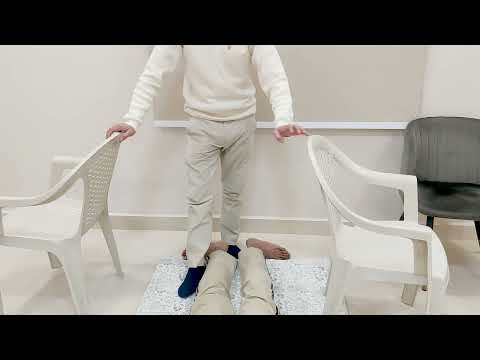
UTI PROLONGED - WITH INFLAMATION - LMNT Neurotherapy
A Hindi demonstration of the treatment given when a urine infection has gone on long enough to become inflamed: Liv° and Mu°, Chest Only, 20 Round Arrow along the spine, then (6) Adr on the back.
A urine infection — especially with fever, loin pain or blood in the urine — needs a doctor first. (6) Adr is not given with high blood pressure or when immunity is already low; the video does not say this.
बिना दवा गहरी नींद कैसे पाएं? | LMNT Serotonin Treatment for Sleep Disorders | Insomnia Root Cause
Shows the Serotonin treatment for sleep: (8) Medulla below the ears, 1 Gas 'I' at six points on the shin, (6) Adr on the upper back, and gentle massage behind the knees and at the back of the head. It is given to support deep, natural sleep.
Note: (8) Medulla is not given in high BP, inflammation or cancer; (6) Adr is not given in high BP, diabetes, cancer or HIV.
Test yourself
Research
Strong evidence
A review of the 'cortisol awakening response': cortisol rises sharply in the first 30–45 minutes after waking, on top of its daily rhythm.
The Endocrine Society's guideline on adrenal failure: how it is diagnosed, how hormones are replaced, and how to prevent a life-threatening adrenal crisis.
This page explains how the body works; it does not diagnose. Neurotherapy (LMNT) works alongside your medical care — keep taking the medicines your doctor prescribed, and see a doctor for any new or severe symptom.
Ready to begin?
Send COURSE for course details, or your name, age and health issue for a consultation.