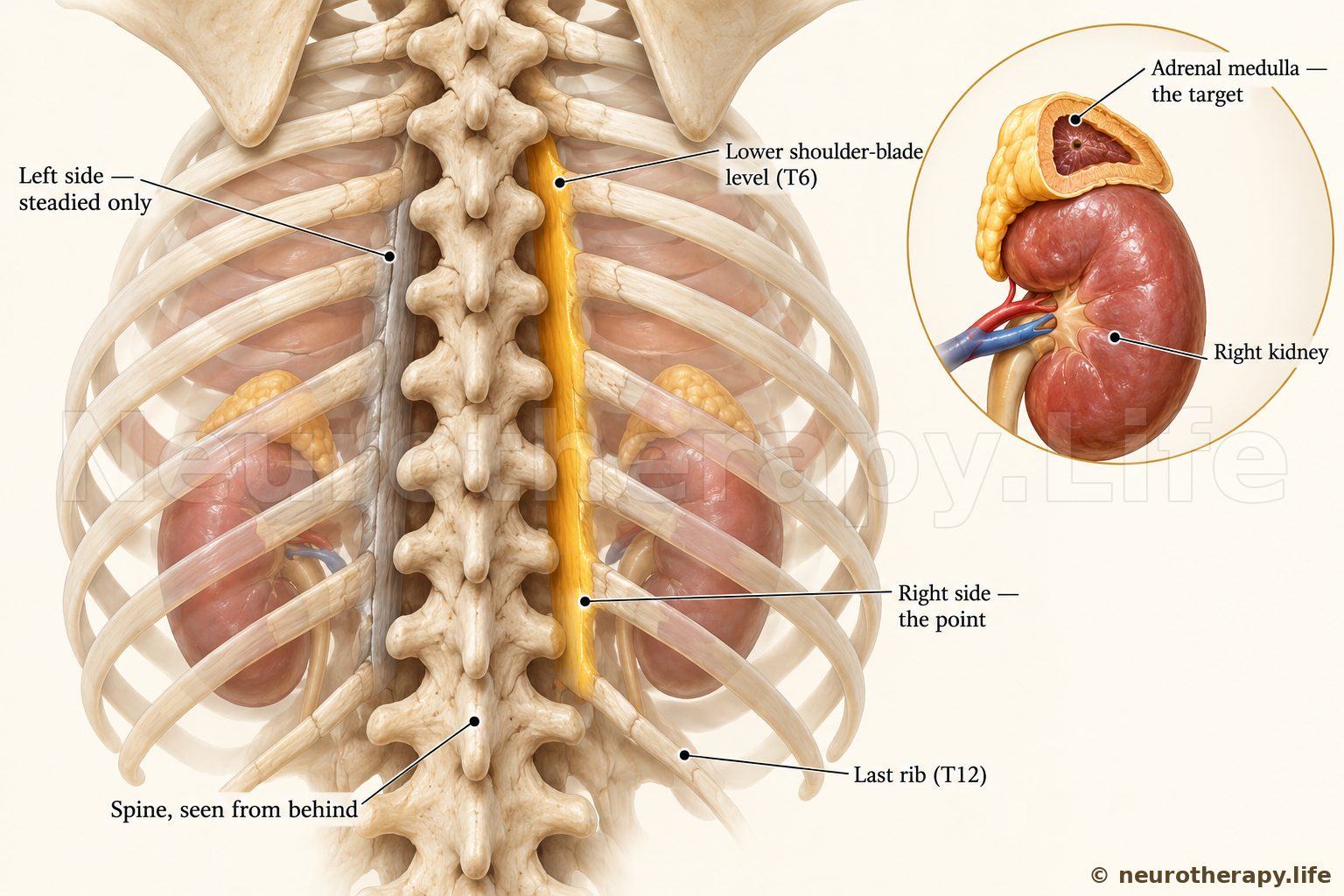
(6) Right Swt is the right-sided form of the Swt point, given face down beside the middle and lower back. LMNT teaching names it as the treatment for bronchial asthma, that is bronchitis — and insists that the side is part of the treatment, because the right and left forms do opposite things.
Overview
What is (6) Right Swt?
Swt is the point aimed at the inner core of the adrenal gland, the adrenal medulla, and at the sweat glands. The adrenal medulla makes the fast 'alarm' hormones, adrenaline (epinephrine) and noradrenaline (norepinephrine). Different written forms of Swt do different jobs.
In LMNT teaching, the side changes the instruction. Right Swt, together with Right Medulla, makes rings of muscle (sphincters), valves and vessels narrow or tighten. Left Swt, with Left Medulla, makes them open. A card that says only 'Swt' without a side has not said which of two opposite things is meant.
It is taught as a treatment that stands on its own, in the same part of LMNT teaching as the formulas for inflammation and infection. The reasoning starts from the eosinophils, a kind of white blood cell: lung infection raises them, and the chemicals they release narrow the airways.
(6) Right Swt is given face down on the right side beside the spine, and is aimed at the adrenal medulla.
What it is for
What is (6) Right Swt used for?
For bronchial asthma, that is bronchitis — the use LMNT teaching names for it.
To tighten a sphincter, valve or duct that has become slack or widened.
Where a stretched bladder muscle makes some women or older people pass a few drops of urine on laughing or sneezing.
As part of a larger formula — for example the second erythropoietin formula, which uses both the right and left forms.
Points it works through
Which point does it work through?
(6) Right Swt
It is one point given on one side. The exact hand placement and method are taught hands-on in the Neurotherapy (LMNT) course. This page lists the points of the formula and what each one contributes; it does not describe how any point is given. For the method, watch the demonstration video of each point on its own page and learn hands-on from a trained Neurotherapist. Please do not give a formula from a written description alone.
The parent Swt point, aimed at the adrenal medulla and the sweat glands. Each written form — (3) Swt, (6) Swt, Left and Right — is a separate treatment.
Position:Lying face down (prone), with pillows under the chest so the chin rests and the neck stays straight.
The exact technique is taught hands-on in the Neurotherapy (LMNT) course. See the course →
How it works
How does it work, and why does the side matter?
The patient lies face down with pillows under the chest. For a one-sided Swt, one of the therapist's hands steadies the spine while only the other works, so the pressure goes straight down rather than inward. It is given on the right side only — not both sides, and not the left.
LMNT teaching links Right Swt with noradrenaline, which tightens smooth muscle and vessels. That same action is why it is not given to people with high blood pressure.
The asthma patient may also meet a second, quite separate treatment: (30) Medulla, which LMNT teaching reports gives quick relief in asthma through the prostaglandins. The two are different treatments from different families, and neither is a version of the other.
Its family
Which treatments are related?
Right Swt stands alone as a treatment, but it sits among close relatives that must not be confused with it.
(6) Adr × 3 treatments — The adrenal cortex treatment for inflammation — the outer layer of the same gland, a different job.
Erythropoietin formula II — A formula that uses Right Swt and then Left Swt, after (30) Medulla, for making erythropoietin.
Oxygen formula — The Oxygen formula, another LMNT treatment used for asthma and low oxygen.
VTF (Mild) — The mild Viral Treatment Formula, taught alongside it for infections.
What it is used for
When is it given?
It is chosen from the patient's findings on the day. These are the situations LMNT teaching links it with.
Lungs and breathing
AsthmaBronchial asthma, that is bronchitis — alongside the doctor's treatment
An asthma attack with severe breathlessness, blue lips or difficulty speaking is an emergency — call 108 / 112 and use the prescribed inhaler. Never stop asthma medicines on your own. Asthma
LMNT teaching names Right Swt for bronchial asthma (bronchitis) and is firm that the side is part of the point. The same teaching also uses Left Swt for some breathing-in difficulty in asthma. Which one a patient needs is decided by a trained therapist.
Is Swt the same as Adr?
No. Both aim at the adrenal gland, but Adr aims at the outer cortex (slow hormones like cortisol) and Swt at the inner medulla (fast hormones like adrenaline).
Why is it called Swt?
The name comes from 'sweat': the point is also linked with the sweat glands. A milder form, (3) Swt, is used to reduce the smell of sweat or urine.
Can it replace my inhaler?
No. Neurotherapy (LMNT) works alongside medical care. Keep your inhaler and medicines exactly as your doctor advised.
Surprising facts
1The body's own inhaler
Adrenaline from the adrenal medulla relaxes the airways through beta-2 receptors. Many asthma reliever inhalers work by copying exactly that signal.
Source: Guyton & Hall, Medical Physiology, 14th ed. — adrenergic receptors and bronchial smooth muscle.
2A nerve that became a gland
The adrenal medulla is made of the same kind of cells as nerve endings. Instead of passing a signal to the next nerve, it pours adrenaline straight into the blood.
Source: Guyton & Hall, Medical Physiology, 14th ed. — the adrenal medulla.
3A small army with a big role
Eosinophils make up only a few per cent of white blood cells, yet they are key players in allergy, asthma and the fight against parasites.
Source: Guyton & Hall, Medical Physiology, 14th ed. — eosinophils.
This page explains what a Neurotherapy (LMNT) treatment is for; it is not a self-treatment guide and does not diagnose. Neurotherapy (LMNT) works alongside your medical care — keep taking the medicines your doctor prescribed.
Ready to begin?
Send COURSE for course details, or your name, age and health issue for a consultation.