The arrow treatments: strokes along the spine, given face down
The arrow family is a set of Neurotherapy (LMNT) strokes that run along or beside the spine with the patient face down: Back Arrow, H Arrow, On the Spine, Beside the Spine, Round Arrow, the shorthand Three Arrows, and Organ Clearance. They differ in the tool used, the path, the direction and how they are written.
Overview
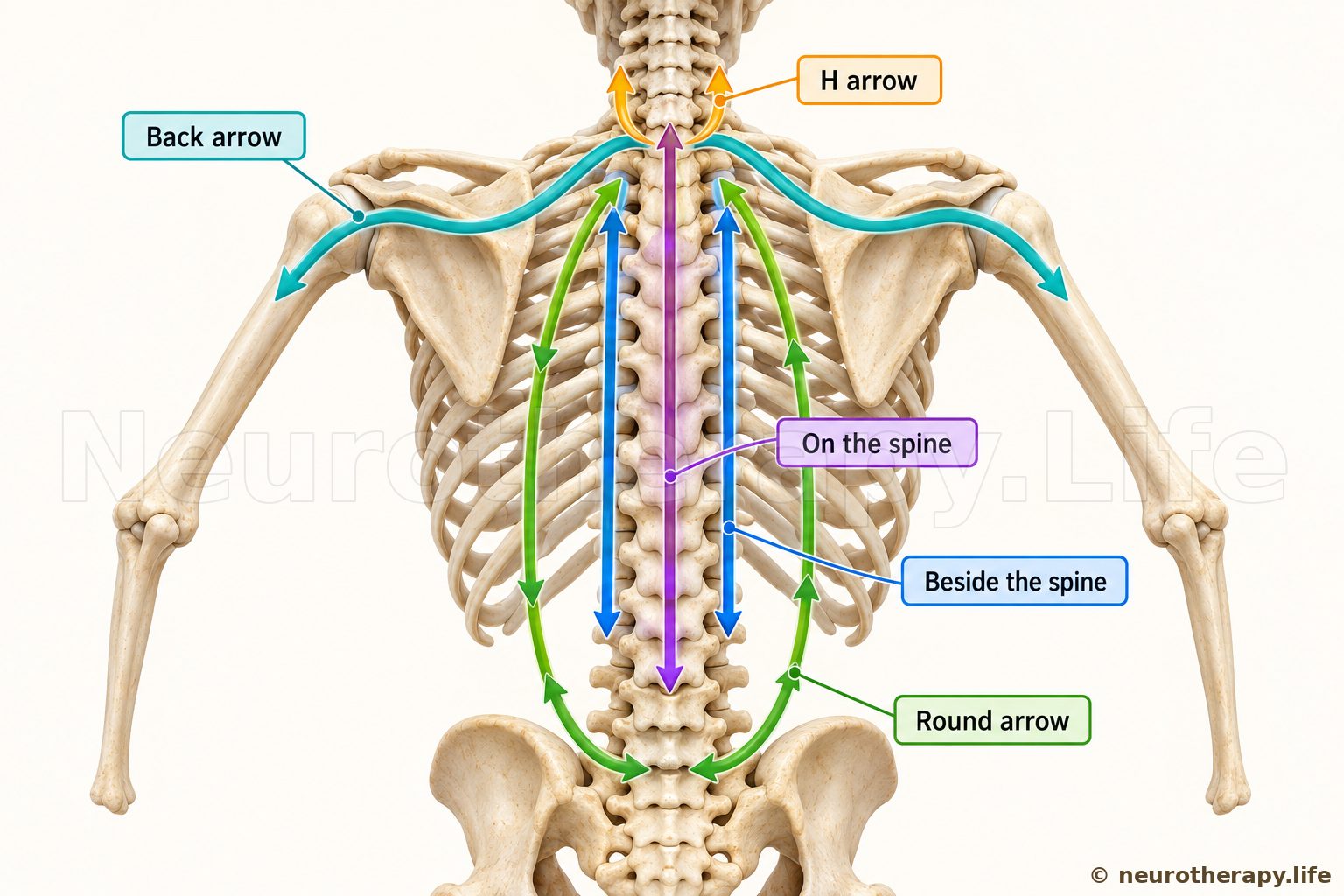
All the arrow treatments are given face down, with pillows under the chest. Back Arrow, also called Blood supply to lungs, is a light sweep with the soft pad of the sole from the middle of the back out over the shoulder to the upper arm, left side first. It is given in breathing-related diseases. H Arrow is an upward rub on both sides of the big bone at the base of the neck.
On the Spine rides the bones of the spine with the edge of the thumb, and is used where there is a slight unevenness between the vertebrae. Beside the Spine uses two fingers that straddle the spine, so the bones run between them; its aim is the spinal nerves that leave the spine in pairs on both sides. Round Arrow goes down one side of the spine and up the other in one loop, with the pressure always on the side of each bone, never on top of it. When all three are written together, the card says Three Arrows.
Steady, gentle, repeated pressure along this strip reliably eases how much pain a person feels, both locally and further away. One more back treatment, Sudhakar, is named for moving the muscles around every vertebra back into place, for the neck, the back and all pains, but no method for it is written down; it is given only as shown hand to hand. The exact methods are taught hands-on in the course.
Key points
- The arrow family is given face down, with pillows under the chest.
- Back Arrow is a light sweep to the shoulders, given in breathing-related diseases.
- On the Spine rides the bones; Beside the Spine and Round Arrow work the grooves beside them.
- Pressure falls on the side of the bones, never on top of them.
- Sudhakar has no written method and is never reconstructed from its description.
Go deeper
Back Arrow
Back Arrow, for breathing-related diseases
H Arrow
H Arrow at the base of the neck
On the Spine
On the Spine, for slight unevenness between the vertebrae
Beside the Spine
Beside the Spine and the spinal nerves
Round Arrow
Round Arrow, down one side and up the other
Organ Clearance: the gentle whole-back treatment, and how to read the arrow symbols
Organ Clearance and reading the arrow symbols
The arrow treatments along the spine, and Sudhakar
Sudhakar, the back treatment with no written method
Face Down: Treatments Given on the Back and Spine
The full guide to the face-down treatments
Read the full guide
This topic is part of: Face Down: Treatments Given on the Back and Spine
Safety: when it is held back
- In diabetes, the full Round Arrow is held back, because it is held to provoke both the thymus and the adrenal; there it is given only over the low back. Diabetes
- Back Arrow is given alongside a patient's inhaler and medicines, never instead of them. Only the soft pad of the sole is used, never the heel, and lightly. Asthma
- Thin bones, long steroid use, frailty or cancer that may have reached bone: only light contact over the spine, and none where bone is known to be affected. Osteoporosis
- The exact method is taught hands-on in the course, under a trained therapist. Please do not try it on yourself or others from this page.
This page explains what a Neurotherapy (LMNT) treatment is for; it is not a self-treatment guide and does not diagnose. Neurotherapy (LMNT) works alongside your medical care — keep taking the medicines your doctor prescribed.