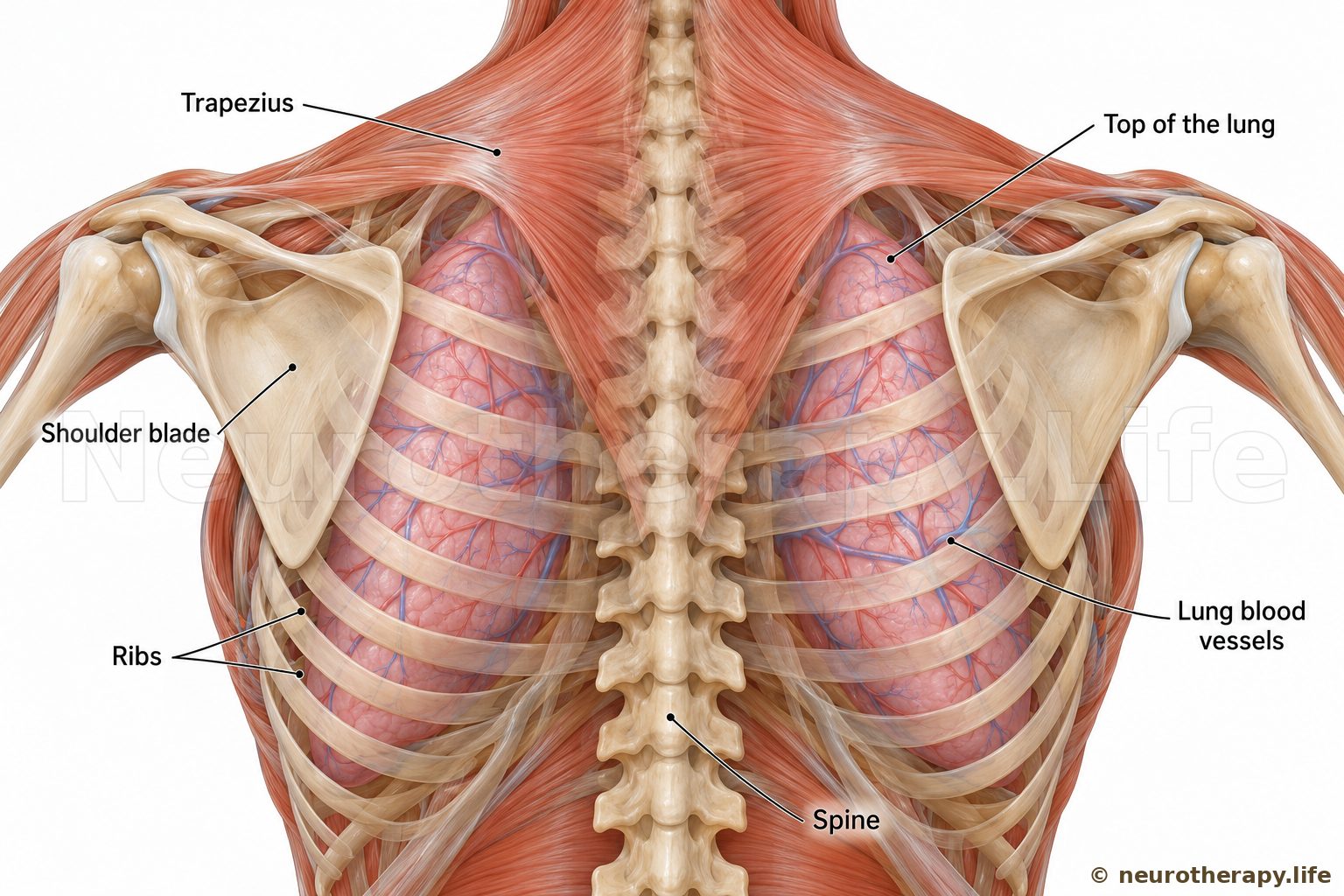
1Lungs higher than you think
The top of each lung rises a little above the collarbone, into the base of the neck — higher than most people picture.
Source: Gray's Anatomy, 41st ed., pleura and lungs.
Also called: Blood Supply to Lungs, बेक एरो, Back arrow point
Back Arrow, also called Blood Supply to Lungs, is a light rubbing treatment given while you lie face down, sweeping from the middle of the back out over the shoulder to the upper arm. The teaching uses it in all breathing-related diseases, alongside — never instead of — medical care.
Back Arrow is one of the arrow family — the spinal and back strokes of Neurotherapy (LMNT) that are often written on a card as small arrow symbols rather than words. Its own symbol is a small circle with two strokes leaning toward it.
Its other name says what it is for: Blood Supply to Lungs. The teaching says it increases blood circulation in the lungs, and it is given in all breathing-related diseases.
The tops of the lungs rise higher than most people expect — up behind the shoulder blades and above the collarbones — so the stroke passes over the upper chest wall that wraps them.
You lie face down with one and a half pillows under the chest — the chest on the upper pillow and the chin on the lower — which is compulsory in every face-down treatment of this group.
The stroke runs from the middle of the back out toward the shoulder, and then on from the shoulder to the middle of the upper arm, on both sides.
How this point is given — the tool, the pressure, the count and the exact movement — is deliberately not described here. A demonstration video for this point is being prepared; until it is on this page, learn the method hands-on from a trained Neurotherapist before giving it. Please do not give any point from a written description alone: a point given in the wrong place or the wrong way can do harm.
The exact technique is taught hands-on in the Neurotherapy (LMNT) course. See the course →
The teaching says Back Arrow increases blood circulation in the lungs. Body science sets the blood flow of the lungs by the heart and the lungs' own vessels; what a light sweep across the back can plainly do is loosen a chest wall and shoulder girdle that have been working hard to breathe. The claim about the lungs themselves is the therapy's own, from long clinical experience.
The arrow family is a set of back and spinal strokes, each written with its own small symbol.
The teaching names its use broadly: all breathing-related diseases. It is support, given alongside the patient's own medicines and inhalers.
The longest treatment of the therapy, often taught to a family; Back Arrow is among its opening back strokes.
The heart sets the blood flow of the lungs. The teaching says Back Arrow increases circulation there; what it plainly does is ease the back and shoulder muscles that help you breathe. Keep using your inhaler and medicines.
Because on a treatment card it is written as a small symbol of strokes and a circle, like the other strokes of the arrow family.
No. It is a light rub with the soft part of the sole. If it hurts, it is being given too hard.
The top of each lung rises a little above the collarbone, into the base of the neck — higher than most people picture.
Source: Gray's Anatomy, 41st ed., pleura and lungs.
With every heartbeat the whole output of the right side of the heart goes through the lungs — about five litres a minute at rest.
Source: Guyton & Hall, Textbook of Medical Physiology, 14th ed., pulmonary circulation.
When breathing is hard, as in asthma, the neck and shoulder muscles join in to lift the ribs. That is why breathless people often feel stiff and sore across the upper back.
Source: Guyton & Hall, Textbook of Medical Physiology, 14th ed., muscles of respiration.
This page explains what a Neurotherapy (LMNT) treatment is for; it is not a self-treatment guide and does not diagnose. Neurotherapy (LMNT) works alongside your medical care — keep taking the medicines your doctor prescribed.
Send COURSE for course details, or your name, age and health issue for a consultation.