Also called: Lungs + Shoulder, Lu+Sh, लंग्स + शोल्डर
Lu + Sh — Lungs plus Shoulder — is a Neurotherapy (LMNT) treatment given at the top of the chest and the shoulders while you lie on your back. It rouses the lungs and opens the chest muscles, and it is the lung step of the Angiotensin No. 2 formula for a blood pressure that has fallen suddenly. Because it raises blood pressure, it is not given in high blood pressure or heart disease.
Overview
What is Lu + Sh?
Lu + Sh is read as "Lungs plus Shoulder". It joins two contacts into one treatment: a very light touch just below the collar bones to rouse the lungs, and a firmer press above the shoulder joints that draws the shoulders outward to open the muscles of the chest.
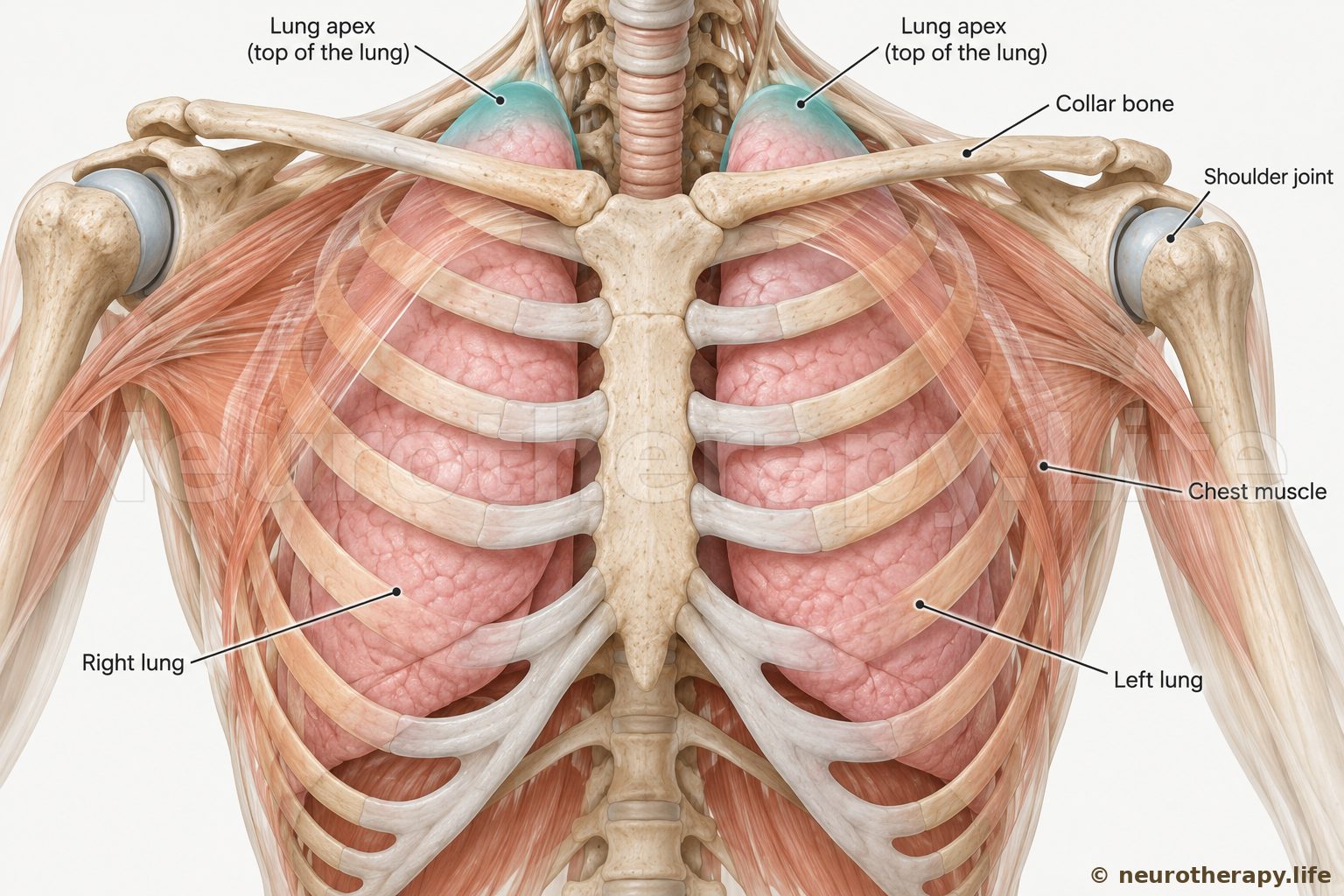
The top of each lung — the apex — rises just above the inner part of the collar bone. The teaching chose Lu + Sh for the Angiotensin No. 2 formula because, of the three lung treatments, it is the one that reaches this top part, where the converting enzyme ACE is made.
The top of each lung rises just above the collar bone — the part Lu + Sh is chosen to reach.
Where it is given
Where is Lu + Sh given?
PositionLying on the back
Body areaThe soft hollow just below each collarbone (where the top of the lung ends) and the top of each shoulder joint; lying on the back with the arms out
You lie flat on your back with the arms out to the sides. The two places on each side are the soft hollow just below the collarbone — the teaching calls it the apex of the lung — and the shoulder joint itself. Lung and shoulder together make one; the demonstration video shows the places, by hand and by foot.
How it is given
How is Lu + Sh given?
How this point is given — the tool, the pressure, the count and the exact movement — is deliberately not described here. Watch the demonstration video on this page, and learn the method hands-on from a trained Neurotherapist before giving it. Please do not give any point from a written description alone: a point given in the wrong place or the wrong way can do harm.
The number written before a point's name is not a strength setting. Each numbered form is a separate named treatment with its own method and timing, taught hands-on in the course.
The exact technique is taught hands-on in the Neurotherapy (LMNT) course. See the course →
What it does
What does Lu + Sh do?
The teaching says that when the shoulder is pressed, the chest muscles open and lung capacity increases. That the top of the lung is involved in making angiotensin II is textbook physiology; that Lu + Sh rouses it is the therapy's own reasoning.
Rouses the lungs; useful for breathing-related problems.
Opens the muscles of the chest, so lung capacity increases.
Taught to mothers of children who drool saliva all day — it reduces that.
Also reduces acidity and watering of the eyes; for hiccups, and for hiatus hernia of the upper stomach.
When a great deal of blood is suddenly lost, it is used in the Angiotensin No. 2 formula to raise the blood pressure.
Organs it reaches
Lungs — The top of the lungs, and the breathing capacity.
Low blood pressureAfter about half a litre or more of blood has been lost — accident, miscarriage, operation or very heavy periods — inside Angiotensin No. 2.
PneumoniaDouble pneumonia is named for the Angiotensin No. 2 formula.
Below the collar bone the pressure stays very light, with flat palms only. Tingling or numbness in the arm means stop at once.
A patient who is still actively bleeding needs a hospital, not a mat. Angiotensin No. 2 is support for recovery, never a substitute for emergency care. How to tell a patient to see a doctor
“ACE is made in the apex of the lungs — that is, the topmost part — and to stimulate this part we have only one treatment: it is Lu + Sh.”
— Dr. Lajpatrai Mehra
Common questions
I have high blood pressure. Can I have Lu + Sh?
No. It raises blood pressure, so it is blocked in high blood pressure and heart disease.
Why is the touch below the collar bone so light?
Because the big blood vessels and nerves of the arm pass through that narrow gap close under the skin.
Can I learn it for my child who drools?
The teaching does show it to mothers for this, under a therapist's guidance and with light treatment for the child.
Surprising facts
1The lungs make a blood-pressure hormone
Angiotensin-converting enzyme (ACE) on the inner lining of the lung's blood vessels turns angiotensin I into angiotensin II, one of the body's strongest vessel-tighteners.
Source: Guyton & Hall, Textbook of Medical Physiology (renin–angiotensin system).
2Your lungs reach above your collar bone
The apex of each lung rises two or three centimetres above the inner third of the collar bone, into the root of the neck.
Source: Gray's Anatomy, 41st ed. (pleura and lungs).
3Breathing has helper muscles at the shoulders
When breathing is hard, muscles that run from the neck and chest to the collar bone and shoulder girdle help lift the upper ribs — which is why a breathless person grips their knees and braces their shoulders.
Source: Guyton & Hall, Textbook of Medical Physiology (accessory muscles of inspiration).
Watch
LOW BP DUE TO HEADY BLEEDING DURING PERIODS
A demonstration of the Angiotensin No. 2 formula — (7) Liv, (7) Mu° and (6) Lu + Sh — for low blood pressure that comes on suddenly after very heavy bleeding in a period.
The video suggests using the formula at the moment of fainting. In LMNT teaching, a person who is still bleeding, cold, pale or fainting is taken to hospital first; this formula is for after the bleeding has been stopped. Lu + Sh is not given in cancer.
This page explains what a Neurotherapy (LMNT) treatment is for; it is not a self-treatment guide and does not diagnose. Neurotherapy (LMNT) works alongside your medical care — keep taking the medicines your doctor prescribed.
Ready to begin?
Send COURSE for course details, or your name, age and health issue for a consultation.