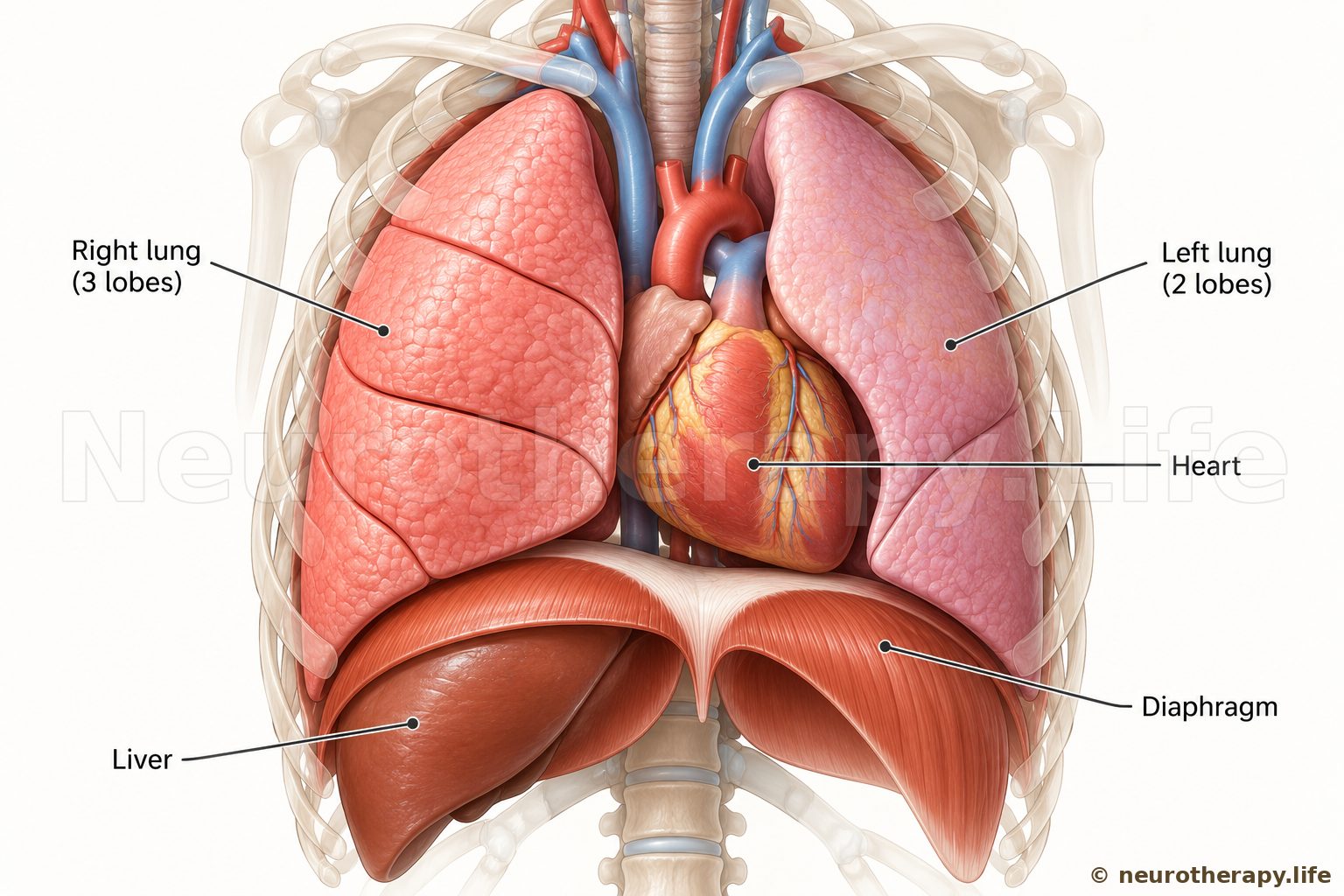
1The right lung is bigger
The right lung has three lobes and the left only two, because the left must make room for the heart.
Source: Gray's Anatomy, 41st edition, the lungs.
Also called: Rt. Ch. Only, Right Ch. Only, Rt. Chest only, राइट चेस्ट ओनली
Right Chest Only is the right-sided form of Chest Only: a very soft rub over the right chest alone, given lying on your back. It is taught to stimulate the right lung, reduce the symptoms of raised alkali and ease pain at Liv°, and it closes the Alkali Treatment Formula (ALTF).
Chest Only is a gentle rub over the chest, given on both sides when a card simply says 'Ch. Only'. When the card names a side, only that side is given. Right Chest Only — written Rt. Ch. Only — is given on the patient's right chest alone.
Teaching says it stimulates the right lung only, reducing the symptoms of alkali and the pain at Liv°, the right kidney point beside the navel. Its mirror, Left Chest Only, stimulates the left lung and reduces the symptoms of acid and the pain at Mu°.
Throughout Neurotherapy (LMNT), right is paired with alkali and left with acid. The whole chest balances; the half chest chooses a side.
You lie flat on your back with no pillow. The rub travels over the right side of the chest, from the chest up towards the right shoulder. The left side is not given.
You stay covered. In women the field crosses the breast, so the therapist explains where the contact will travel before it begins, keeps you covered and asks for your consent in words each session.
How this point is given — the tool, the pressure, the count and the exact movement — is deliberately not described here. Watch the demonstration video on this page, and learn the method hands-on from a trained Neurotherapist before giving it. Please do not give any point from a written description alone: a point given in the wrong place or the wrong way can do harm.
The exact technique is taught hands-on in the Neurotherapy (LMNT) course. See the course →
Teaching gives it one direction: towards less alkali.
The chest group shares one place. The side and the companion points change the treatment.
It is chosen when the examination points to the alkali side — Liv° tender — and never from a name alone.
The Alkali Treatment Formula ends on the right chest — the mirror of ATF's left chest.
The lighter form without Liv° keeps the right chest.
The lightest form keeps only Gal, Liv and the right chest.
Because your examination pointed to the alkali side — usually pain at Liv°. A card that names a side wants that side alone.
No. It is a very soft rub over the cloth. Nothing presses down on the ribs.
Teaching uses it for sudden sneezing with a running nose in children, provided it is given within the first few sneezes. A child with fever or breathing trouble should see a doctor.
The right lung has three lobes and the left only two, because the left must make room for the heart.
Source: Gray's Anatomy, 41st edition, the lungs.
Every breath out removes carbon dioxide, which forms acid in the blood. The lungs adjust the body's acid–alkali balance within minutes; the kidneys take hours to days.
Source: Guyton & Hall, Textbook of Medical Physiology, respiratory and renal regulation of acid–base balance.
The dome of the diaphragm is higher on the right, pushed up by the liver below it — so the right lung is a little shorter than the left.
Source: Gray's Anatomy, 41st edition, the diaphragm and lungs.

This page explains what a Neurotherapy (LMNT) treatment is for; it is not a self-treatment guide and does not diagnose. Neurotherapy (LMNT) works alongside your medical care — keep taking the medicines your doctor prescribed.
Send COURSE for course details, or your name, age and health issue for a consultation.