Conditions linked with the acid and the alkaline direction, and the acids carried in the blood
Neurotherapy (LMNT) groups the problems that travel with a tender Mu° (the acid side) into six families, and sets beside them the smaller, harder alkaline picture of a tender Liv°. It also explains which acids the blood carries and why the kidneys sit at the centre.
Overview
Where there is pain at Mu°, Neurotherapy (LMNT) sees six families of trouble. One: the results of too little water — hard constipation with piles, fissure or fistula, a blocked nose, a dry cough, yellow burning urine, itchy red eyes, pimples, hair fall and dandruff, dry skin. Two: organs that slip out of place because the muscles have gone loose — hernia, and prolapse of the womb or the rectum. Three: two problems of the blood vessels from the same looseness — varicose veins and low blood pressure.
Four: glands that run slow, because loose muscles cannot squeeze a gland's secretion out properly — the thyroid shows it first. A slow thyroid slows digestion, the residue sits longer in the large intestine, more water is taken back, and hard constipation follows. Five and six: bone and joint troubles in two opposite forms — wearing away, as in cervical or lumbar spondylitis, or calcium settling in the wrong place, as in bamboo spine and bone spurs.
The alkaline picture is smaller and sharper. It starts with pain at Liv°, a runny nose, loose motions, scanty periods, headache at the top or back of the head, and pains on the right side. Its main conditions include fits and epilepsy, stiff muscles (spasticity), cerebral palsy, high blood pressure, stammering, and growths such as tumours, fibroids and cysts. Sometimes the alkali only looks high because the stomach makes too little acid — then the Gas point is tender too, and undigested food shows in the stool.
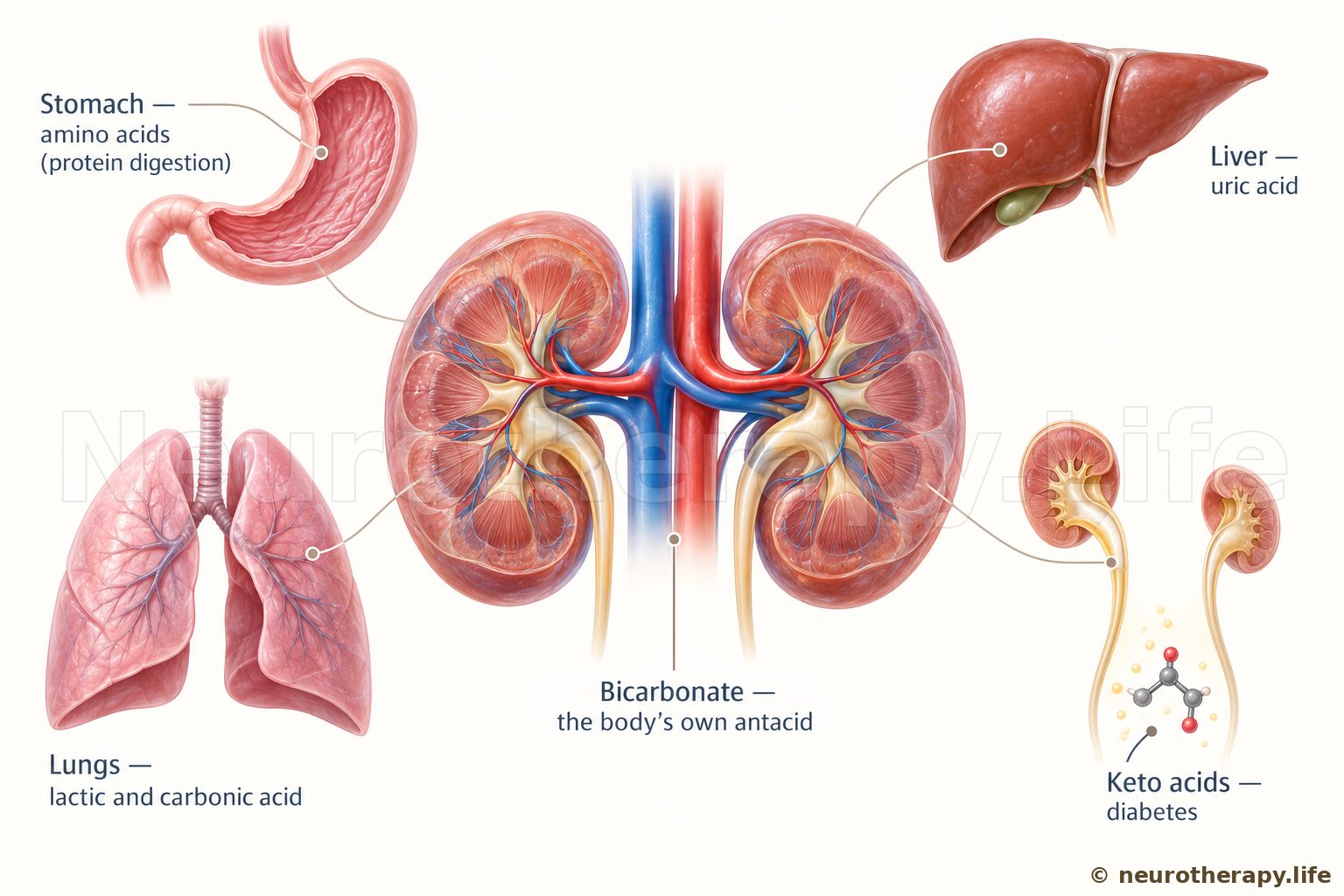
The blood's acidity is different from stomach acid. The blood carries amino, uric, lactic, carbonic, folic and keto acids, and the kidneys balance them all by sending out bicarbonate, the body's own antacid. That is why the kidney points sit at the centre of this system.
Key points
- A tender Mu° travels with six families: dryness, organs slipping, vessel problems, slow glands, and two kinds of bone and joint trouble.
- A slow thyroid can lead, link by link, to hard constipation.
- The alkaline picture is smaller, but its conditions take longer to correct.
- Alkali can look high simply because the stomach makes too little acid.
- Blood acidity is not stomach acid; the kidneys keep it in balance.
Go deeper
Alkalosis
Alkalosis
Acidosis
Acidosis
Hypothyroidism
Hypothyroidism — the slow thyroid
Varicose veins
Varicose veins
Spasticity (stiff, tight muscles)
Spasticity (stiff, tight muscles)
Kidneys
The kidneys, the body's acid balancers
The Two Kingdoms: Acidic and Alkaline Bodies
Guide: The Two Kingdoms
Read the full guide
This topic is part of: The Two Kingdoms: Acidic and Alkaline Bodies
Safety: when it is held back
- Fits, epilepsy, cancer, tumours and high blood pressure all need a doctor's care. Neurotherapy (LMNT) supports alongside that care and never replaces it; never stop or reduce prescribed medicines. Epilepsy (fits)
- In cancer, these are never given: (10) Pan, Thymus, Pit, Lu + Sh, Rt. Ov. / Lt. Ov., and (30) Medulla. Cancer care: Neurotherapy (LMNT) support
- Never give ATF in alkalosis or ALTF in acidosis. ALTF: the alkali formula, and why undigested food is checked first
This page explains what a Neurotherapy (LMNT) treatment is for; it is not a self-treatment guide and does not diagnose. Neurotherapy (LMNT) works alongside your medical care — keep taking the medicines your doctor prescribed.