Your nose is the front door of your breathing and the only sense organ wired almost straight into the brain. It warms, wets and filters every breath, takes turns resting one nostril at a time, and gives food most of its flavour.
Overview
What is the nose?
Your nose is the organ of smell and the main entrance to your airways. The part you see is a frame of bone and cartilage covered with skin. Behind it lies the nasal cavity, a tall, narrow air passage divided into left and right by a thin wall, the septum.
Its main jobs are to clean, warm and moisten the air before it reaches the lungs, and to smell. It is also a drain: the sinuses and the tear ducts empty into it, and the ear is connected to its back through the Eustachian tube.
Blocked and running noses are among the commonest complaints there are — from colds and allergies to sinus trouble. Losing the sense of smell, once rarely talked about, became familiar to millions during the COVID-19 pandemic.
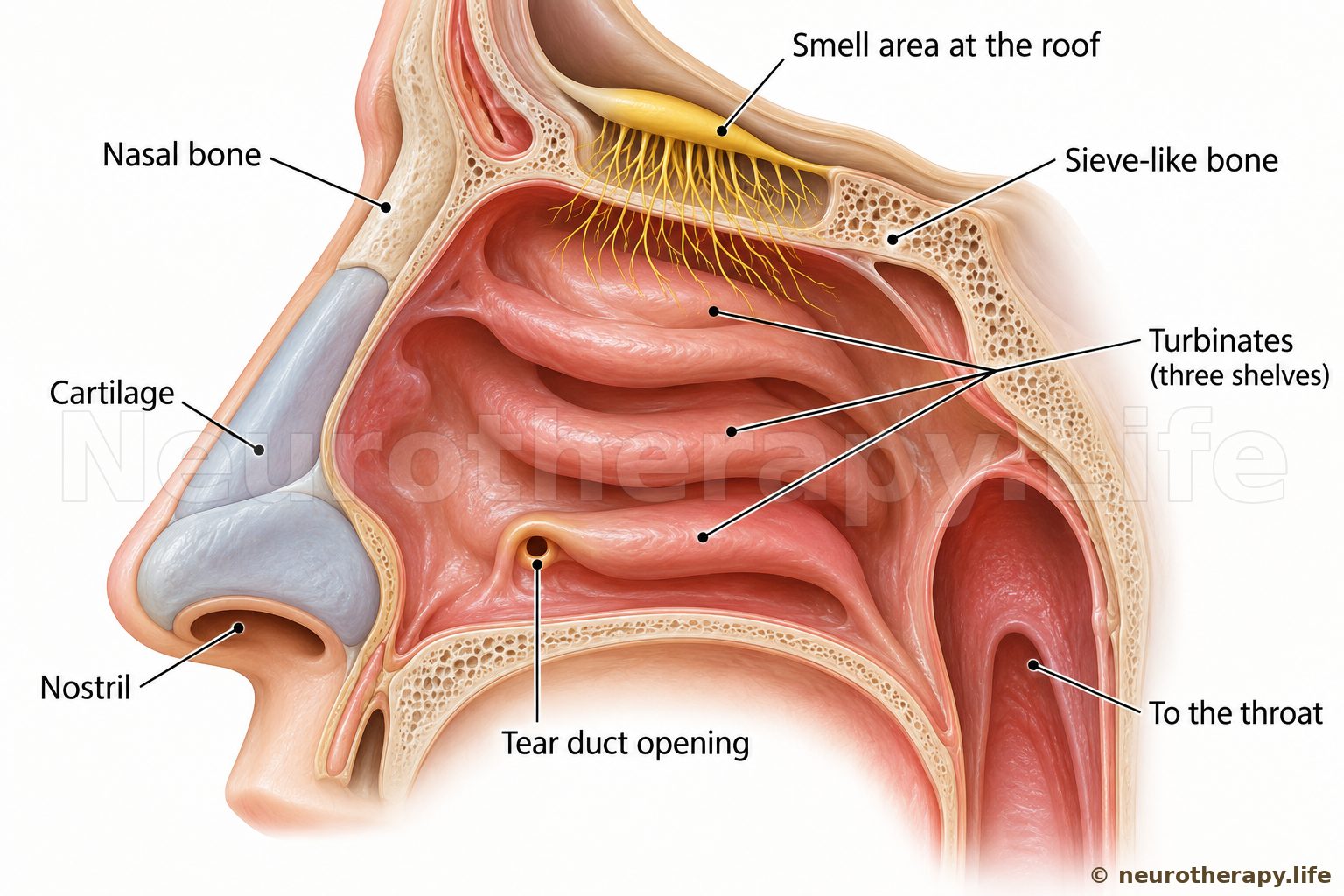
The nose from the side: a small outer frame, and behind it a tall passage lined with curled shelves that warm and clean the air.
Function
What does the nose do?
Every breath in through the nose passes over three curled shelves of bone covered in a moist, blood-rich lining. The air is warmed to near body heat, moistened and filtered. A small patch at the roof holds the smell cells, which send their signals straight up to the brain.
Warms and moistens the air, so the lungs receive air that is close to body temperature and nearly fully moist.
Filters dust, pollen and germs in its hairs and mucus; tiny beating hairs (cilia) sweep the mucus back to the throat to be swallowed.
Smells: warns of smoke, gas and spoiled food, and gives food most of its flavour.
Drains the sinuses and the tear ducts.
Shapes the sound of your voice — try speaking with the nose pinched.
Triggers sneezing to blow out irritants.
How does the nose work with other organs?
Lungs — The nose prepares the air the lungs will use; mouth-breathing skips this step.
Sinuses — The four pairs of sinuses drain into the side walls of the nose through small openings.
Eyes — Tears drain from each eye into the nose, which is why crying makes the nose run.
Ears — The Eustachian tube opens at the back of the nose; a blocked nose can block the ears.
Mouth — Smell and taste meet at the back of the throat to make flavour.
Brain — Smell signals go directly to brain areas for memory and emotion — why a smell can bring back a memory in an instant.
Lungs and breathing — The nose is the first part of the lungs-and-breathing system.
Anatomy
What are the parts of the nose?
The nose has an outer framework, an inner air passage with curled shelves, a smell area at the roof, and a lining that does most of the work.
The outer nose
Nasal bones — Two small bones form the hard upper bridge.
Cartilages — Springy plates shape the lower nose and the tip, so it can bend without breaking.
Nostrils (nares) — The two openings, lined near the entrance with coarse hairs that trap large particles.
Inside the nose
Nasal septum — The dividing wall of bone and cartilage. Few are perfectly straight; a badly bent one can block one side.
Turbinates (conchae) — Three curled shelves on each side wall that swirl the air over a warm, moist surface. They swell and shrink through the day.
Mucous membrane — A moist lining, rich in blood vessels, that makes mucus and carries millions of beating cilia.
Openings of the sinuses and tear duct — Small openings under the shelves drain the sinuses and the tears.
Nasopharynx — The space at the back where the nose meets the throat; the Eustachian tubes and, in children, the adenoids are here.
The smell system
Olfactory area — A patch of special lining, a few square centimetres, high in the roof of each side.
Smell cells — Millions of nerve cells with tiny hairs that catch scent molecules. They are renewed throughout life.
Cribriform plate — A thin sieve of bone in the roof. The smell nerves pass up through its holes; above it lies the brain.
Olfactory bulb and nerve — The first cranial nerve, which carries smell to the brain's smell and memory areas.
Where is the nose located?
The nose sits in the middle of the face. Its inner passage runs back about 7 to 8 cm to the throat. The eyes sit on either side of its upper part, the cheek sinuses beside it, the mouth below it separated by the hard palate, and the brain just above its roof.
In LMNT teaching the nose is often read from somewhere else entirely: from the low back. Which kidney point is tender — Mu° on the left or Liv° on the right — tells the therapist which way the body is leaning, and that explains whether the nose is blocked or running.
Outside, noses vary enormously in shape and size, set largely by the cartilage and the bridge. Inside, a healthy lining is moist and pink; it looks pale and swollen in allergy and red in infection.
The smell area is a slightly yellowish-brown patch high in the roof. The turbinates look like soft, rolled scrolls, and the one that is swollen changes every few hours as the nasal cycle swaps sides.
How big is the nose?
The nasal passage is about 7 to 8 cm long from nostril to throat and about 5 cm tall, but only a few millimetres wide between the shelves. The smell area covers only about 2 to 5 square centimetres on each side.
At rest an adult breathes about 10,000 litres of air a day, and most of it — when all is well — passes through the nose.
Conditions and disorders
What conditions and disorders affect the nose?
Most nose problems come from swelling of the lining — from germs, allergy or irritants — which blocks the passage or makes it run. Others affect smell, or the drainage of the sinuses and ears.
Headache and migraineBlocked sinuses can bring pressure headaches around the eyes and forehead.
Hearing loss (deafness)A blocked nose or a hard nose-blow can block the ear tube and dull the hearing.
ConstipationIn LMNT teaching a blocked nose and hard stools belong to the same 'acidic' picture.
What are common signs of a nose problem?
A blocked or stuffy nose, on one side or both
A running nose, sneezing or itching
Mucus dripping down the back of the throat
Loss or change of smell or taste
Nosebleeds
Snoring or breathing through the mouth at night
What tests check the health of the nose?
Anterior rhinoscopy — A light and a small speculum show the front of the nose, septum and lining.
Nasal endoscopy — A thin camera looks deep inside for polyps, pus or blockage at the sinus openings.
Allergy tests — Skin-prick or blood tests find what you are allergic to.
CT scan of the sinuses — Shows the bones, the sinuses and any lasting blockage, usually before surgery.
Smell test — Scratch-and-sniff cards or scent pens measure how well you smell.
How are nose conditions treated?
Salt-water rinses and steam — Rinsing with sterile or boiled-and-cooled salt water clears mucus and allergens gently.
Allergy control — Avoiding triggers, and anti-allergy tablets or steroid nasal sprays as a doctor advises.
Decongestant sprays — short term only — They open the nose quickly, but used for more than a few days they can cause rebound blockage.
Smell training — Sniffing a set of strong scents twice a day for months can help smell return after a virus.
Surgery — To straighten a badly bent septum, reduce swollen turbinates or remove polyps.
Neurotherapy (LMNT)
LMNT teaching asks one question before it touches a nose: which way is it going? A blocked nose and a running nose are treated almost as opposites. In its reading, a blocked nose belongs with hard stools and a tender Mu° on the left — the acidic side — while a streaming nose often comes with semi-solid stools and a tender Liv° on the right — the alkaline side. So the nose may be treated from the low back and the belly, and the points that would make a running nose run more are blocked. The Medulla numbers add work on the nose's own nerves: (5) for the nose's lining and skin and the cheek sinus, (7) for feeling in the nose and throat, and (1) for loss of smell.
Points
Medulla — (1) Medulla for loss of smell; (5) Medulla for the root, lining and skin of the nose and the cheek sinus; (7) Medulla for feeling in the nose and throat; (9) and (11) Medulla for breathlessness. Each given three times with a rest of a minute and a half.
Mu — Given for a blocked nose, but NOT for a running nose, because more mucus is already coming out.
(6) Adr — Opens a blocked nose — and so is not given when the nose is already running.
Spl — The teaching found that in some people Spl makes the nose run more; in them it is not given.
Down Arrow — Named as the point that will be of benefit in a cold with a running nose, in place of Mu.
Liv° — In a man whose nose streams every morning, with slightly soft stools and pain at Liv° but not at Mu°, the teaching stimulates the right kidney by way of Liv°, and the nose stops running — an observation it says can be shown again and again.
Sinus Point — A four-stage thumb circuit over the cheeks, the sides of the nose and the brows, given for the sinuses.
Mukha Dhauti — A long breath in through the nose and out through the mouth: mouth open with 'haa…' when Mu° hurts, closed with a whistling 'hoo…' when Liv° hurts.
The alkali treatment, given only through a gate: after some days of the UDF formula, if pain remains at Gal, Liv and Liv°. It is part of how the teaching treats the 'alkaline' running-nose picture.
“No such treatment may be given, knowingly or otherwise, which will worsen a patient's condition, even by a fraction of one percent.”
— Dr. Lajpatrai Mehra
“This is a matter of experience.”
— Dr. Lajpatrai Mehra
“Neurotherapy (LMNT) treats according to the condition of the body.”
— Dr. Lajpatrai Mehra
Never do this
Go to a doctor the same day for a nosebleed that will not stop after 20 minutes of pinching the soft part of the nose, a nosebleed after a head injury, or one in a person on blood thinners.
See a doctor, not the mat, for facial pain with fever, thick discharge, swelling around the eye, a bulging eye, double vision or any change in vision. How to tell a patient to see a doctor
A blocked nose on one side only that keeps getting worse, with bleeding or a bad smell, needs an ear-nose-throat check.
Never 'test' the theory by giving the wrong side on purpose. The teaching itself forbids the reversal demonstration on a patient who came for relief. Liv°
For a nose rinse use only sterile, distilled or boiled-and-cooled water, never water straight from the tap.
(6) Adr lowers immunity and is not given in high blood pressure. (6) Adr
The Medulla count is the treatment: a different number is a different treatment, not a stronger or weaker one. Only a trained therapist chooses the number, after examining you that day. Medulla, the graded series
Cancer: if the person has cancer, (10) Pan, Thymus, Pit, Lu + Sh, Rt. Ov / Lt. Ov and (30) Medulla are never given — the therapist changes the plan.
Keep taking the medicines, drops and treatments your doctor prescribed, and never stop or change them on your own. Neurotherapy (LMNT) works alongside your medical care, never instead of it.
Care
How can I keep my nose healthy?
A healthy nose is a moist, clear nose. Most care is about breathing through it, keeping it clean gently, and not irritating it.
Blow gently, both nostrils open
Guruji's rule: in a cold, do not clean the nose too hard. Forcing air out of one nostril with the other shut can push mucus into the ear tube and dull the hearing.
Ten minutes on the left side
Guruji's teaching: if the nose runs on waking from cold or allergy, lie on the left side for ten minutes before getting up; the teaching says this sets the right nostril (sūrya nāḍī) flowing and the running stops.
No cold water first thing
Guruji's teaching: on waking, drink water at room temperature or warm; cold water first thing provokes phlegm. And put your feet on slippers, not a cold floor, straight out of bed.
Breathe through the nose
Nose-breathing warms and cleans the air for the lungs. If you always breathe through your mouth or snore loudly, get the nose checked.
Avoid smoke and dust
Tobacco smoke, chulha smoke and strong fumes damage the lining and its cilia. Use a mask in dust and on high-pollution days.
Train your smell
If smell is lost after a virus, sniff four strong scents — for example rose, lemon, clove and eucalyptus — for about 20 seconds each, twice a day, for several months.
Common questions
Why is one nostril always more blocked than the other?
Usually it is the nasal cycle: the lining on one side swells while the other shrinks, and they swap every few hours. You mostly notice it when you have a cold or lie on one side. A side that is always blocked may be a bent septum or a polyp.
Why does food taste of nothing when I have a cold?
Because most of what we call flavour is actually smell, reaching the nose from the back of the mouth. When the nose is blocked, the tongue can still taste sweet, sour, salty and bitter, but the rich flavour is gone.
Are decongestant nose drops safe?
For a few days, yes. Used longer, they can cause 'rebound' blockage, so that the nose blocks again as each dose wears off and people end up using them for years. Ask a doctor if you need them for more than about three days.
Why would a therapist press my back for a nose problem?
In LMNT teaching the nose and the low back are connected through the kidneys. Which side is tender tells the therapist which way the body is leaning, and the way it leans explains whether the nose blocks or runs. Treating only the nose, the teaching says, brings relief for a few days and then the trouble returns.
Is loss of smell serious?
It is often temporary after a cold or virus. But it matters: without smell you may not notice gas, smoke or spoiled food. Smell that does not return in a few weeks, or goes without a cold, is worth a doctor's check.
What should I ask my doctor or therapist?
Is my blocked nose from allergy, infection, a bent septum or polyps?
Which spray should I use, how, and for how long?
Is a salt-water rinse right for me, and with what water?
Could my nose be affecting my asthma, sleep or ears?
(To the therapist) Is my nose on the blocked side or the running side, and which points are you holding back because of that?
Surprising facts
1Your nostrils take turns
Most people have a nasal cycle: the lining in one nostril swells while the other shrinks, and every few hours they swap. You rarely notice — but it is why one side often feels more blocked. The old yogis noticed the two nostrils too, and gave them different names and roles.
Source: Eccles R, 'Nasal airflow in health and disease', Acta Otolaryngol 2000 (nasal cycle); LMNT nose.md §3.10 (the two sides of the nose do different work).
2The nose is the closest the outside world gets to your brain
Smell nerves pass through a sieve of bone in the roof of the nose so thin you could push a pencil through it — and just above that sheet is the brain. Nowhere else does the outside come so near.
Source: Gray's Anatomy — cribriform plate of the ethmoid; LMNT nose.md §37.19 box.
3Your nose heats and wets every breath in a fraction of a second
By the time air breathed through the nose reaches the windpipe it is within about one degree of body temperature and almost fully moist — even on a cold, dry winter morning.
Source: Guyton & Hall — air-conditioning function of the nose (air warmed to within ~1 °F of body temperature and saturated to within 2–3%).
4Your smell cells are replaced all your life
Most nerve cells last a lifetime. Smell cells are an exception: they sit exposed to the outside air, wear out, and are replaced from stem cells every month or two. This is part of why smell can come back after a virus.
Source: Purves, Neuroscience — olfactory receptor neurons turn over every ~30–60 days from basal stem cells.
5Most of 'taste' is really smell
The tongue senses only a few basic tastes. The rich flavour of mango, coffee or ghee comes from smells rising from the back of the mouth into the nose. Hold your nose and a slice of apple and a slice of raw potato become hard to tell apart.
Source: Purves, Neuroscience; Shepherd GM, 'Smell images and the flavour system in the human brain', Nature 2006 (retronasal smell).
6Losing smell can be an early warning
Loss of smell is found in most people with Parkinson's disease and often appears years before the shaking. It was also one of the most typical signs of COVID-19.
Tears wash across the eye and drain through two tiny openings at the inner corner, down a duct that opens under the lowest shelf inside the nose. Cry hard, and the nose has to be wiped.
Source: Gray's Anatomy — nasolacrimal duct opening into the inferior meatus; LMNT nose.md §19.4-4.
Makes you aware of each nostril — useful when one side tends to block.
Calms the mind and eases the stress response.
How to do it
Sit with a straight back and relax the shoulders.
Close the right nostril with the right thumb and breathe in slowly through the left.
Close the left nostril with the ring finger, open the right, and breathe out slowly.
Breathe in through the right, switch, and breathe out through the left. That is one round.
Do 5 to 10 rounds without holding the breath.
Take care
Do not force air through a fully blocked nostril. Beginners, heart patients and people with high blood pressure should not hold the breath. Stop if you feel light-headed.
Kapālabhāti — gentle cleansing breath Kapālabhāti
Benefits
Traditionally used to clear the nasal passages and give a feeling of freshness.
Works the belly muscles lightly.
How to do it
Sit tall on an empty stomach, hands on the knees.
Breathe out with a short, light puff through the nose by drawing the belly in.
Let the breath in happen by itself as the belly relaxes.
Start with 10 to 20 slow puffs, then rest with normal breathing.
Take care
Do not do it with high blood pressure, heart disease, pregnancy, a hernia, recent belly or chest surgery, epilepsy, glaucoma, or during a nosebleed. Keep it gentle; stop if you feel dizzy. Learn it first from a trained teacher.
Test yourself
Research
Emerging evidence
People who had lost their sense of smell and sniffed four strong scents twice a day for 12 weeks improved their smell more often than people who did not train.
A review of research found that most people with Parkinson's disease have a reduced sense of smell, often years before movement problems appear, making smell testing a possible early clue.
A Cochrane review found that rinsing the nose with larger volumes of salt water improved symptoms of long-lasting sinus and nose inflammation compared with no rinsing.
This page explains how the body works; it does not diagnose. Neurotherapy (LMNT) works alongside your medical care — keep taking the medicines your doctor prescribed, and see a doctor for any new or severe symptom.
Ready to begin?
Send COURSE for course details, or your name, age and health issue for a consultation.