Loss of smell (anosmia)
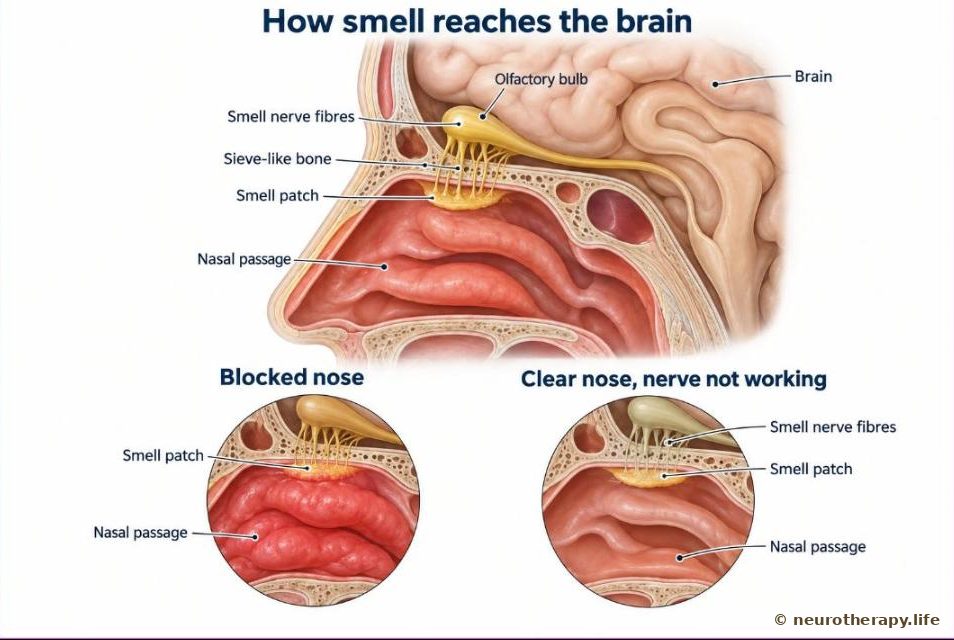
Anosmia means you cannot smell anything. Often it comes from a blocked nose after a cold, but sometimes the nose is perfectly clear and the smell nerve itself is not working.
- 1 to 2 in every 100 people in North America report a problem with their sense of smell
- It rises with age — nearly 1 in 4 men aged 60–69 had a smell problem, and about 11 in 100 women of that age
- About 5 to 7 in 100 people with a head injury notice their sense of smell has dropped
Source: National Institute on Deafness and Other Communication Disorders (NIH); StatPearls (NCBI); Cleveland Clinic
What is Loss of smell (anosmia)?
High inside your nose is a small patch of special nerve cells. When you breathe in, tiny particles from food, flowers or smoke land on this patch. Its nerve fibres pass up through a thin, sieve-like bone and carry the message straight to the brain. That is how you smell.
In anosmia, this message does not arrive. Either the nose is blocked, so the smell never reaches the patch, or the nerve cells and their path are damaged. It can come suddenly or slowly. Because most of the flavour of food is really smell, food also starts to taste bland.
What are the symptoms?
- Cannot smell food cooking, flowers or perfume
- Familiar smells seem weaker than before
- Food tastes bland or has little flavour
- Not noticing smoke, a gas leak or spoiled food
- Can start suddenly (often after a cold) or come on slowly
What causes it, and who is more likely to get it?
A blocked nose
The nerve or the brain
- A head injury
- Parkinson's disease, Alzheimer's disease or multiple sclerosis
- Being born without a sense of smell (rare)
Other causes
- Getting older
- Smoking, and breathing in strong chemicals
- Some medicines, and radiation treatment to the head
How is it found?
An ear, nose and throat (ENT) doctor first looks for the reason — a blocked nose or a nerve problem.
Nose examination
The doctor looks inside the nose, sometimes with a thin camera tube (endoscopy), for swelling or growths.
Smell test
You sniff a set of smells, some weak and some strong, and name or tell them apart.
CT or MRI scan
A scan of the head and sinuses shows blockages, injury or problems along the smell pathway.
Almost nobody complains of losing their smell — so in LMNT the therapist asks. Every patient with a head complaint is asked one simple question: can you smell your own food cooking?
How Neurotherapy (LMNT) sees Loss of smell (anosmia)
LMNT teaching gives each of the twelve nerves that leave the brain its own Medulla count. Smell belongs to nerve number one — the shortest of the twelve, and the only one that runs straight into the brain without a relay. When the nose is not blocked and still no smell, scent or fragrance comes through, LMNT reads it as the first nerve not working, and gives (1) Medulla.
How a smell reaches the brain
- Smell particlesFood, flowers or smoke send tiny particles into the air you breathe.
- Smell patchThe particles reach a small patch of nerve cells high in the nose — if the nose is open.
- Nerve number oneNerve fibres carry the message up through a thin, sieve-like bone.
- The brainThe message goes straight into the brain, with no relay, and you know the smell.
A clear nose is not the same as a working one. Neurotherapy (LMNT) aims to support the nerve's work alongside the ENT doctor's care — the cause of the smell loss still needs a doctor's check.
I am yet to understand the human body. My knowledge is hardly the tip of the iceberg. Neurotherapy (LMNT) is just in its infancy. There is a long way to go.
Neurotherapy (LMNT) treatment for Loss of smell (anosmia), step by step
Examine first
The therapist checks the diagnostic points Liv° and Mu°, asks directly about smell, and looks at the ENT doctor's findings — is the nose blocked, or clear?
(15) Medulla first
Before any Medulla treatment for one of the twelve nerves, (15) Medulla is given — seated, on both sides of the neck below the ears.
(1) Medulla × 3
(1) Medulla, three treatments, one and a half minutes apart. In Guruji's teaching, that is the whole treatment for loss of smell.
Points and formulas used
Medulla
(1) Medulla — the count for nerve number one, the smell nerve; three treatments, one and a half minutes apart.
Open →(15) Medulla
(15) Medulla — the acetylcholine treatment, given first, before any Medulla treatment for the twelve nerves.
Open →Never do this
- The Medulla count decides the treatment. Only a trained therapist gives it — (15) Medulla first, then (1) Medulla three times, one and a half minutes apart. Medulla
- See a doctor if smell does not come back after a cold ends. Go to a hospital at once if smell is lost after a head injury, or comes with a severe headache, fits, confusion, or sudden weakness or numbness.
- At home: keep a working smoke alarm, take extra care with gas, and write the opening date on food — you may not notice smoke, a gas leak or spoiled food.
- Cancer: if the person has cancer, (10) Pan, Thymus, Pit, Lu + Sh, Rt. Ov / Lt. Ov and (30) Medulla are never given — the therapist changes the plan.
- Keep taking the medicines your doctor prescribed. Neurotherapy (LMNT) works alongside your medical care, never instead of it.
From Ayurveda and the kitchen
“The nose is the doorway to the head”
The old physicians of India said: नासा हि शिरसो द्वारम् — the nose is the doorway to the head. From this grew nasya, in which medicated oils are put into the nostrils for complaints of the head, eyes, ears, voice and mind — not for the nose itself.
Test yourself
What research says
- Strong evidence
An international group of experts agreed on how smell loss should be checked: a full nose and head examination, a look inside the nose, and proper sniff tests. They also note that smell training can help people with smell loss.
- Strong evidence
The smell nerve fibres pass through the sieve-like bone to the olfactory bulb and on to the brain without the usual relay station. About 5 to 7 in 100 people with a head injury report reduced smell.
Branigan B, Tadi P. Physiology, Olfactory. StatPearls. StatPearls Publishing; updated 2023.
No clinical trial of Neurotherapy (LMNT) in loss of smell has been published yet. Improvements reported by neurotherapists are clinical observations.
For you
After a cold, flu or COVID-19
If your smell has not come back once the illness is over, see an ENT doctor.
Older adults and their families
Smell often fades quietly with age. Check smoke alarms and gas, and watch the dates on food.
After a head injury
Tell your doctor if smell has changed — a blow to the head can damage the smell nerves.
This page explains; it does not diagnose. Neurotherapy (LMNT) works alongside your medical care — keep taking the medicines your doctor prescribed, and see a doctor for any new or severe symptom.