A stalk of brain about 3 cm long, hidden where your skull meets your neck. It breathes for you, steadies your heartbeat, and guards your throat — every second, even in your deepest sleep.
Overview
What is the medulla?
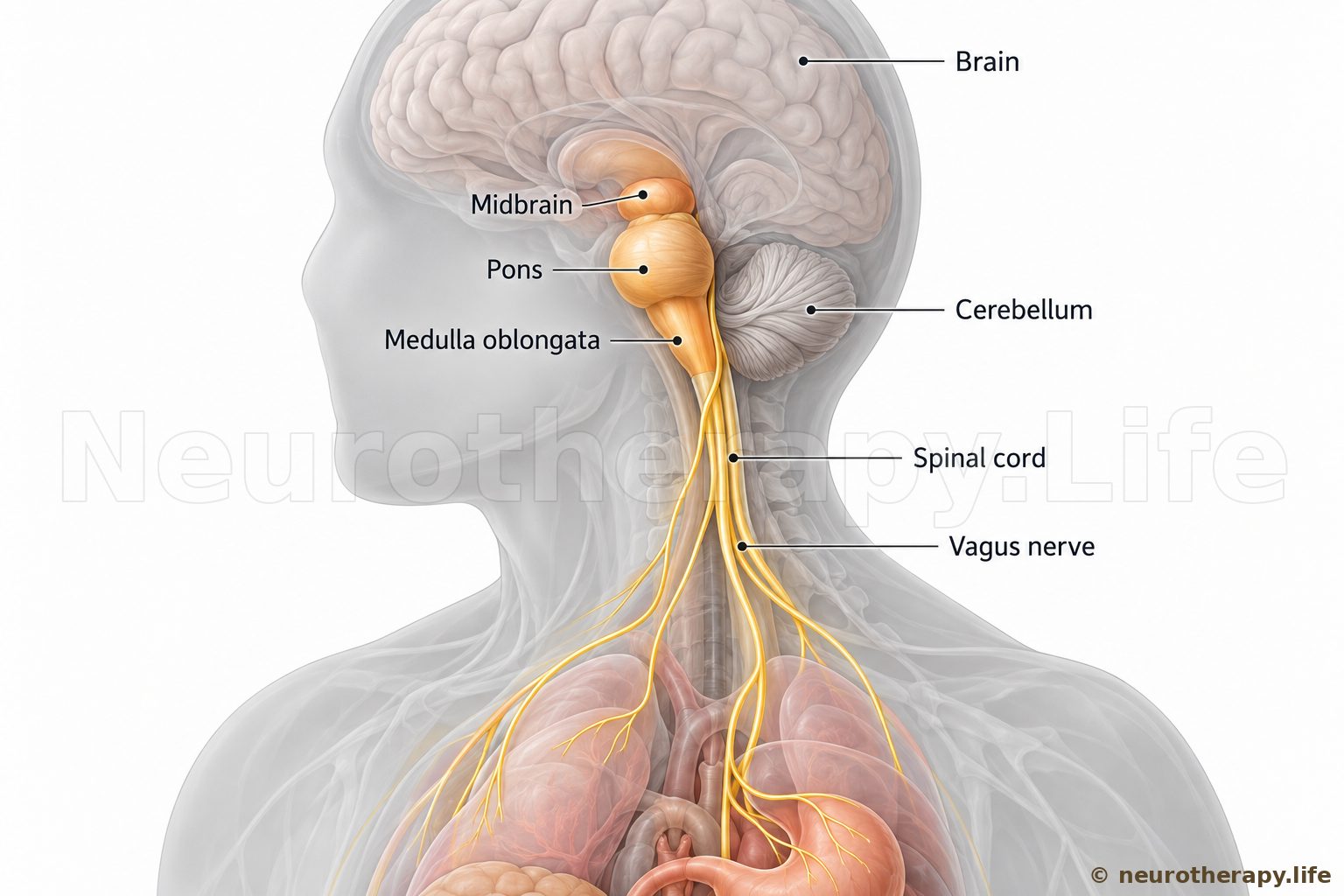
The medulla (full name: medulla oblongata, 'the long marrow') is the lowest part of your brainstem. The brainstem is the stalk that joins the brain to the spinal cord.
It is small, but it runs the jobs you cannot live without: breathing, the pace of your heart, your blood pressure, and the reflexes that guard your throat, such as swallowing, coughing and vomiting.
All of this happens automatically. You never have to think about it, and it carries on while you sleep.
In Neurotherapy (LMNT), 'Medulla' is also the name of a family of treatments given behind the ears and down the sides of the neck. They are named for the medulla; they do not touch it.
The medulla is the lowest part of the brainstem. Above it sit the pons and the midbrain; below it, the spinal cord begins.
Function
What does the medulla do?
The medulla is the body's automatic pilot. It reads sensors all over the body, compares them with safe levels, and sends out orders — without asking you first. Think of a railway junction with a control cabin on top. Every train between the brain and the body passes through the junction. In the cabin, a few steady workers keep the signals for breathing, heartbeat and blood pressure running all day and night.
Breathing: it sets the rhythm of every breath and makes you breathe deeper when carbon dioxide rises.
Heart rate: through the vagus nerve it slows the heart; through other nerves it speeds it up.
Blood pressure: it tightens or relaxes blood vessels, beat by beat — for example when you stand up.
Swallowing: it runs the part of the swallow you cannot stop, and closes the airway while food passes.
Protective reflexes: coughing, sneezing, gagging and vomiting.
Saliva and digestion: it orders saliva and, through the vagus, sends 'rest and digest' signals to the stomach and gut.
Message highway: every signal between brain and body passes through it, and most movement wires cross sides here.
Wakefulness and balance: part of the brainstem network that keeps you awake, and a relay for balance signals from the inner ear.
How does the medulla work with other organs?
Lungs and breathing — It drives the breathing muscles and reads the lungs' stretch sensors.
Heart, blood and circulation — It sets heart rate and blood pressure from pressure sensors in the neck arteries.
Digestive system — Through the vagus it stirs the stomach, gut and digestive glands.
Vagus nerve — Its longest messenger, reaching the heart, lungs and most of the gut.
Cranial nerves — Four of the twelve cranial nerves (9 to 12) start here.
Spinal cord — It continues straight down into the spinal cord.
Brain — It links the thinking brain above with the body below, and works closely with the cerebellum behind it.
Anatomy
What are the parts of the medulla?
The brainstem has three parts, top to bottom: the midbrain, the pons and the medulla. The medulla's parts are easiest to learn in four groups.
On the front
Pyramids — Two long ridges carrying the movement wires from the brain down to the spinal cord.
The crossing (pyramidal decussation) — At the bottom of the pyramids most of those wires cross to the other side. That is why each half of the brain moves the opposite half of the body.
Olives — Two olive-shaped bulges beside the pyramids. Inside, a folded group of cells sends timing signals to the cerebellum to keep movements smooth.
On the back
Floor of the fourth ventricle — The back of the upper medulla forms part of the floor of a fluid-filled space called the fourth ventricle. Brain fluid drains out of openings here.
Area postrema — A small patch with leaky blood vessels that checks the blood for poisons and can trigger vomiting.
Touch relay stations — Two pairs of small bumps (the gracile and cuneate nuclei) pass on touch and body-position signals from the body to the brain.
Stalks to the cerebellum — Thick cables on each side (the inferior cerebellar peduncles) link the medulla to the cerebellum for balance and coordination.
Centres inside
Inside, the medulla holds clusters of nerve cells called nuclei. Some work as control centres.
Breathing centre — Groups of cells, including the pre-Bötzinger complex, that set the rhythm and depth of breathing.
Heart and blood-pressure centre — Cells that keep blood vessels toned and adjust the heart rate through the vagus.
Vomiting centre — It coordinates the stomach, breathing muscles and throat to empty the stomach safely.
Nucleus ambiguus — Drives the muscles of the throat and voice box, for swallowing and speech.
Solitary nucleus — Receives taste and the reports from sensors in the heart, lungs and gut.
Reticular formation — A net of cells running up the whole brainstem that helps keep you awake and alert.
Cranial nerves 9 to 12
Cranial nerves come straight out of the brain, not the spinal cord. Four of them start at the medulla.
IX — Glossopharyngeal — Taste at the back of the tongue, feeling in the throat, the blood-pressure sensor in the neck, and one of the saliva glands.
X — Vagus — The voice box and throat, and 'rest and digest' signals to the heart, lungs and gut.
XI — Accessory — Two neck and shoulder muscles that turn the head and shrug the shoulders. Most of its fibres come from the top of the spinal cord.
XII — Hypoglossal — Moves the tongue, for speaking, chewing and swallowing.
Where is the medulla located?
Put a finger on the hollow at the back of your neck, just under the skull. The medulla lies a few centimetres deeper, inside the bone. It is the bottom of the brainstem, sitting on the large opening at the base of the skull.
Above it is the pons; behind it, the cerebellum, the 'little brain' that handles balance. Below, it narrows and becomes the spinal cord. So every message between the brain and the body passes through it.
In Neurotherapy (LMNT), the Medulla treatment is given on the skin behind the ears and down the sides of the neck. LMNT teaching is frank that no thumb reaches the medulla itself — the name records an intention, not an address.
It looks like a short, rounded cone or bulb — wider at the top where it meets the pons, narrowing at the bottom into the spinal cord. Old anatomists simply called it 'the bulb'.
On the front you can see the two pyramids running down the middle and the two olives bulging beside them. Its surface is pale and creamy, because it is mostly covered by nerve fibres.
How big is the medulla?
In an adult it is about 3 cm long and about 2 cm across at its widest — roughly the size of the top joint of your thumb.
For something so small it does a great deal: about 20,000 breaths and 100,000 heartbeats a day are timed or adjusted by it.
Conditions and disorders
What conditions affect the medulla?
Because so many vital jobs are packed into a small space, even a small problem here can cause big symptoms. Some conditions start in the medulla itself; others affect the nerves and muscles it controls.
HydrocephalusThe fluid of the brain drains out through openings beside the medulla; a block can let it build up.
ComaThe brainstem's wake-up network keeps us conscious; damage can cause coma.
What are the signs of a medulla or brainstem problem?
Trouble swallowing, or coughing and choking on drinks
A hoarse, weak or slurred voice
Sudden dizziness or spinning, with unsteady walking
Numbness of one side of the face with numbness of the opposite side of the body
Weakness of an arm or leg, or double vision
Hiccups that will not stop, or repeated vomiting without a stomach cause
Irregular breathing, or breathing that stops and starts in sleep
Dizziness or fainting on standing up
How do doctors check the medulla?
Neurological examination — The doctor checks the cranial nerves — swallowing, gag reflex, tongue, voice, face feeling — plus strength, balance and eye movements.
MRI scan — The best picture of the brainstem; it shows strokes, swelling, tumours and nerve damage.
CT scan and angiography — A fast scan in emergencies to look for bleeding; vessel scans check the arteries in the neck that feed the medulla.
Swallow study — An X-ray video or a thin camera shows whether food or drink slips into the airway.
Sleep study — Records breathing overnight to find pauses in breathing.
Nerve and muscle tests and blood tests — Nerve conduction studies, EMG and antibody tests help diagnose conditions such as GBS, MND and myasthenia gravis.
How are medulla problems treated?
Emergency stroke care — Clot-dissolving medicine or clot removal works best within the first few hours — which is why fast hospital arrival matters.
Swallowing and speech therapy — A speech and swallowing therapist teaches safe swallowing and may change food textures.
Physiotherapy and rehabilitation — Exercises to rebuild balance, strength and walking.
Medicines — For blood pressure, nausea, nerve inflammation or muscle weakness, depending on the cause.
Breathing support — From a CPAP mask at night to a ventilator in severe illness.
Surgery — Sometimes needed to relieve pressure, drain fluid with a shunt, or remove a growth.
Neurotherapy (LMNT)
In LMNT, Medulla is not one point but a whole family of treatments. The therapist stands on the patient's left, cups both sides of the neck, and rubs downward with the soft pads of the thumbs, from behind the ear to the shoulder, one side at a time and counting. The number before the name decides which treatment it is: up to (12) it points to one of the twelve cranial nerves; above twelve, to a body chemical. Different counts show different effects, so the count must never be mistaken.
Points
Medulla — The base technique: seated, thumbs behind the ears, downward rubs counted on each side. 'Left Medulla' or 'Right Medulla' means that side only.
(6) Medulla — The hypothalamus treatment — the very first Medulla treatment found. It heads M. Heparin, and hunger and thirst are felt soon after it.
(15) Medulla — The acetylcholine treatment, found in a breathing emergency. It is given before the cranial-nerve Medullas; LMNT teaching reports benefit in breath that stops in sleep, dry mouth, and in MND, GBS and myasthenia.
(10) Medulla — The vagus treatment. It stirs the whole digestive system except the descending colon, and the stomach's acid is said to rise three times. Also for a hoarse voice.
(8) Medulla — Linked with serotonin: deep sleep within a short while, low mood, giddiness and vertigo.
(2) Medulla — For the eyes and the retina, and with (8) Medulla for balance, since balance needs both the eyes and the inner ear.
(4) Medulla — The one member given clockwise, together with T1/T2.
(12) Medulla — For the tongue and a voice that has gone, and for fits that come in or just after sleep.
(20) Medulla — Listed for trembling of the hands and for fits.
(30) Medulla — Said to reduce swelling at once; also for the side effects of a medicine and heaviness before a period.
(6) Medulla (8) Pan (7) Liv (8) Ch. Only — for headache, brain diseases, paralysis after an infarct, Bell's palsy and memory. With a shunt, the neck is pressed gently.
“In the detailed knowledge of the functions of (6) Medulla and (10) Medulla, some further discovery remains to be made.”
— Guruji's teaching
“I am yet to understand the human body. My knowledge is hardly the tip of the iceberg. Neurotherapy (LMNT) is just in its infancy. There is a long way to go.”
— Dr. Lajpatrai Mehra
“Neurotherapy (LMNT) treats according to the condition of the body.”
— Dr. Lajpatrai Mehra
Never do this
Emergency: sudden trouble breathing, choking, a drooping face, slurred speech, a weak arm, or sudden severe dizziness with vomiting and unsteadiness may be a stroke or brainstem problem. Call an ambulance (108/112) at once. After a head or neck injury, do not move the neck — call for help.
The count is the treatment. A Medulla given at the wrong number is not a weaker version — it is a different treatment. The strokes run behind the ear and down the side of the neck only. Medulla
(10) Medulla is not given when stomach acid is raised, in diabetes, or in cancer. It is also blocked in constipation and in piles, fissure and fistula. In heart disorders, (10) Medulla on both sides is barred — nowadays (10) Left Medulla only is given instead. Every formula that contains (10) Medulla carries these bars with it. (10) Medulla
Heart disease: (20) Medulla and (30) Medulla are not given. High blood pressure: (20) Medulla and (8) Medulla are not given. (20) Medulla
(30) Medulla is not given in low blood pressure or in infections. (8) Medulla is not given in inflammation. (30) Medulla
Cancer: if the person has cancer, (10) Pan, Thymus, Pit, Lu + Sh, Rt. Ov / Lt. Ov and (30) Medulla are never given; LMNT teaching also bars (10) Medulla and (8) Medulla — the therapist changes the plan. Cancer care: Neurotherapy (LMNT) support
(6) Medulla is not given to boys and girls aged 13 to 20 who come to increase height, unless there is a special need. If a brain shunt is fitted, press the neck only lightly. (6) Medulla
Keep taking the medicines your doctor prescribed, exactly as told. Neurotherapy (LMNT) works alongside your medical care, never instead of it.
Care
How can I keep my medulla healthy?
You cannot exercise the medulla directly, but you can protect its blood supply, its breathing work and the neck it sits above.
Mind the breathing brakes
Alcohol, sleeping pills and strong painkillers all slow the breathing centre. Never mix them unless your doctor says it is safe.
Protect your neck
Wear a seat belt and a helmet. Avoid forceful neck cracking — the arteries that feed the medulla run through the neck bones.
Eat upright and slowly
Sit up, take small bites and don't talk with a full mouth. It gives the swallowing reflex time to close the airway.
Breathe out longer
A few minutes of slow breathing, with the out-breath longer than the in-breath, gently engages the vagus brake on the heart.
Guard your arteries
Keep blood pressure and sugar in check and don't smoke. This protects the small arteries that feed the brainstem.
Take loud snoring seriously
Loud snoring with pauses in breathing needs a doctor's check for sleep apnoea.
Common questions
Is the medulla the same as the brainstem?
No. The medulla is the lowest of the brainstem's three parts. The pons and the midbrain sit above it.
Can a person live without a working medulla?
Not on their own. It runs breathing and blood pressure, so severe damage is life-threatening and needs machines to support breathing. Doctors test its reflexes, such as cough and gag, when checking brainstem function.
What happens after a small stroke in the medulla?
It depends on the spot. A common pattern brings trouble swallowing, a hoarse voice, dizziness and numbness that is on one side of the face but the other side of the body. Many people improve with rehabilitation.
Why do I feel dizzy when I stand up quickly?
Blood drops into your legs, and the medulla needs a few seconds to tighten vessels and speed the heart. If it happens often or you faint, see a doctor.
Why does food sometimes 'go down the wrong way'?
If you talk, laugh or breathe in while swallowing, the airway may not close in time, and the medulla fires a cough to clear it. If it happens often, get a swallowing check.
Does the LMNT Medulla treatment press on the medulla?
No. LMNT teaching says clearly that the medulla lies inside the skull and no thumb reaches it. The treatment is a counted downward rub on the skin behind the ears and down the sides of the neck, named for what it aims at.
What should I ask my doctor or therapist?
Could my swallowing, voice or dizziness problem be coming from the brainstem?
Do I need an MRI, a swallow study or a sleep study?
Is it safe for me to eat normal food, or should the texture change?
Which warning signs mean I should call an ambulance?
(To your therapist) Which Medulla number is on my card, and why that one?
(To your therapist) With my heart condition, diabetes or blood pressure, which Medulla treatments are barred for me?
Surprising facts
1A tiny drummer keeps you breathing
You breathe about 20,000 times a day and remember almost none of them. The beat comes from a small cluster of nerve cells in the medulla called the pre-Bötzinger complex. Scientists only pinpointed it in 1991.
Source: Smith JC et al., Science 1991 (pre-Bötzinger complex); StatPearls, Neuroanatomy, Medulla Oblongata; American Lung Association (breaths per day)
2It is carbon dioxide, not lack of oxygen, that makes you gasp
Hold your breath, and the burning urge you feel comes mostly from carbon dioxide building up. Sensors on the surface of the medulla taste it in the fluid around the brain. If you held your breath until you fainted, the medulla would simply switch breathing back on. Never try this, especially in water.
Source: Guyton & Hall, Medical Physiology — chemical control of respiration (central chemoreceptors)
3Your heart would race without its brake
The heart makes its own beat, and left alone it would tick at about 100 beats a minute. The medulla presses a gentle brake through the vagus nerve, which keeps a resting heart nearer 70. People with a transplanted heart, whose nerves were cut, often have a faster resting pulse for this reason.
Source: Guyton & Hall — vagal control of heart rate; standard heart-transplant (denervated heart) physiology
4Stand up, and half a litre of blood falls — the medulla catches it
When you rise from bed, gravity pulls roughly half a litre of blood into your legs. Stretch sensors in the neck arteries report the drop to the medulla. Within seconds it tightens blood vessels and quickens the heart, so you stay on your feet instead of fainting.
Source: Guyton & Hall — baroreceptor reflex and vasomotor centre; StatPearls (carotid sinus reflex via the vagus)
5The great crossing: why your left brain moves your right hand
The movement wires from the brain run down through the medulla in two ridges called the pyramids. There, most of them cross to the other side. That is why a stroke on the left side of the brain can weaken the right arm and leg.
Most of the brain sits behind the blood-brain barrier, a tight wall that keeps chemicals out. One small patch on the medulla, the area postrema, has leaky vessels on purpose. It 'tastes' the blood for poisons and, if it finds one, sets off vomiting to throw it out.
Source: StatPearls, Physiology, Chemoreceptor Trigger Zone (MacDougall & Sharma, 2023)
7A swallow you cannot stop
Once food touches the back of your throat, the medulla takes over and the swallow cannot be halted. In about a second it seals the nose, shuts the voice box, pauses your breath and tips a small lid, the epiglottis, over the windpipe.
Source: StatPearls, Physiology, Swallowing (Panara et al., 2023); Guyton & Hall — swallowing centre in the medulla and lower pons
8The wandering nerve that stops two-thirds of the way
The vagus nerve starts in the medulla. Its name means 'wanderer', and it roams down to the heart, lungs, stomach and intestines. It reaches about two-thirds of the way across the transverse colon (the middle part of the large bowel), then hands over to nerves from the bottom of the spine.
Source: Gray's Anatomy — vagal parasympathetic supply to the midgut; pelvic splanchnic nerves (S2–S4) beyond
A day in the life of your medulla
≈20,000breaths, every one timed by the medulla
≈100,000heartbeats, paced up and down through the vagus brake
1–1.5 Lof saliva, released on orders from the brainstem
0times you have to remember to breathe
24 hon duty — it never sleeps, even when you do
Yoga
The counted breath at bedtime — 4, 8, 16 Sūrya–Candra Nāḍī breath
Benefits
Taught in LMNT at the time of sleeping, and for people who cannot fall asleep
Slow, long breaths — the teaching notes that sleep does not come from short or quick breaths
Takes about ninety seconds and needs no posture or teacher
How to do it
Lie in bed on your left side and take four easy breaths.
Turn to lie straight on your back and take eight breaths.
Turn onto your right side and take sixteen breaths.
If sleep has not come, keep your attention on the breath and make each breath long.
Take care
Breathe gently — never force or hold the breath. In late pregnancy, or if lying flat makes you breathless or dizzy, skip the 'lie straight' step and stay on your side. Loud snoring with pauses in breathing needs a doctor, not only a breathing practice.
Anulom-Vilom — the balancing breath Nāḍī Śodhana
Benefits
Classical hatha yoga places it at the centre of breath practice, to make the two sides run evenly
Slow, even breathing gently engages the vagus brake on the heart
Many people find it settles the mind before rest or meditation
How to do it
Sit upright and relaxed, on the floor or a chair.
Close the right nostril with the right thumb; breathe in slowly through the left.
Close the left nostril with the ring finger, open the right, and breathe out.
Breathe in through the right, switch, and breathe out through the left. That is one round.
Continue for 5 to 10 minutes.
Take care
Do it without holding the breath if you have high blood pressure, heart disease or are pregnant. Stop if you feel dizzy. Don't do it with a fully blocked nose or a fever; learn it first from a trained teacher.
Bhrāmarī — the humming-bee breath Bhrāmarī Prāṇāyāma
Benefits
Lengthens the out-breath in a simple, natural way
Many people find it quietens the mind before sleep
The vibration is felt in the throat and head, where the medulla's nerves work
How to do it
Sit comfortably with your eyes closed.
Rest your index fingers lightly on the small flaps in front of your ears (optional).
Breathe in through the nose.
Breathing out, keep the lips closed and make a steady, low 'mmm' like a bee until the breath is finished.
Do 5 to 7 rounds, breathing normally in between.
Take care
Keep it gentle; don't press hard on the ears if you close them. Skip it with an ear infection or right after ear surgery. Stop if you feel light-headed.
Watch
M HAPARIN FORMULA
A demo of the M. Heparin formula — the Heparin formula headed by Medulla ((6) Medulla, (8) Pan, (7) Liv, (8) Chest Only) — used for neck and shoulder pain and for headache that keeps coming back.
बिना दवा गहरी नींद कैसे पाएं? | LMNT Serotonin Treatment for Sleep Disorders | Insomnia Root Cause
Shows the Serotonin treatment for sleep: (8) Medulla below the ears, 1 Gas 'I' at six points on the shin, (6) Adr on the upper back, and gentle massage behind the knees and at the back of the head. It is given to support deep, natural sleep.
Note: (8) Medulla is not given in high BP, inflammation or cancer; (6) Adr is not given in high BP, diabetes, cancer or HIV.
Stop Vomiting in 1 Minute | उल्टी रोकने का सबसे तेज़ इलाज (15 Medulla) | @neurotherapylife
A short self-help demonstration for vomiting, including travel sickness: a finger strokes straight down the Medulla line just beside and below the ear, 30 strokes on the left and 30 on the right — (15) Medulla — with a one-minute gap, repeated two or three times. Talc or a little oil is used so the skin is not rubbed raw.
LMNT teaching lists (8) Medulla — not (15) — for giddiness with nausea and vomiting, and the first point it gives for nausea and vomiting is Gas Only. Vomiting with blood, severe belly pain, a stiff neck or signs of losing water needs a doctor first.
भयंकर Migraine और सिरदर्द से तुरंत आराम | Migraine Pain Relief | 15 Medulla & Head Massage Point
Shows (15) Medulla four times below both ears, a fingertip head massage in lines from the forehead to the back of the head, and gentle circles between the eyebrows. It is shared as self-care for relief in migraine and headache.
Note: the video gives (15) Medulla; the LMNT migraine treatment uses (5) Medulla. Follow your therapist's plan.
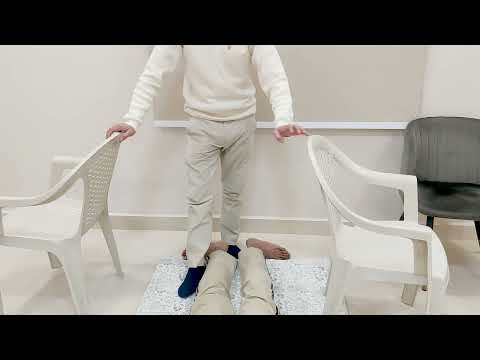
How to Give 4 Medulla, Raman & T1 T2 in Neurotherapy | LMNT Cervical, Shoulder pain & Numbness
This video shows the right way to give (4) Medulla, Raman and the T1–T2 point for neck and shoulder pain and numbness.
Test yourself
Research
Strong evidence
The landmark study that found the pre-Bötzinger complex — a small region of the lower medulla that generates the rhythm of breathing.
A clear medical overview: the medulla holds the roots of cranial nerves 9 to 12, the centres for breathing and blood pressure, the cough and gag reflexes, and the crossing of the movement pathways.
This page explains how the body works; it does not diagnose. Neurotherapy (LMNT) works alongside your medical care — keep taking the medicines your doctor prescribed, and see a doctor for any new or severe symptom.
Ready to begin?
Send COURSE for course details, or your name, age and health issue for a consultation.