Also called: 20 Medulla, the dopamine treatment, डोपामाइन ट्रीटमेंट
(20) Medulla is the member of the Medulla family linked to dopamine. Given behind the ears, it is used in Parkinson's disease, raised prolactin, fits, and — together with (8) Medulla — for growing children's height. Because dopamine can raise blood pressure, it is not given in high blood pressure or heart disease.
Overview
What is (20) Medulla?
(20) Medulla is one of the nine numbered Medulla treatments, all given at one place behind the ears. Above twelve, the number points not to a cranial nerve but to a body chemical; twenty points to dopamine.
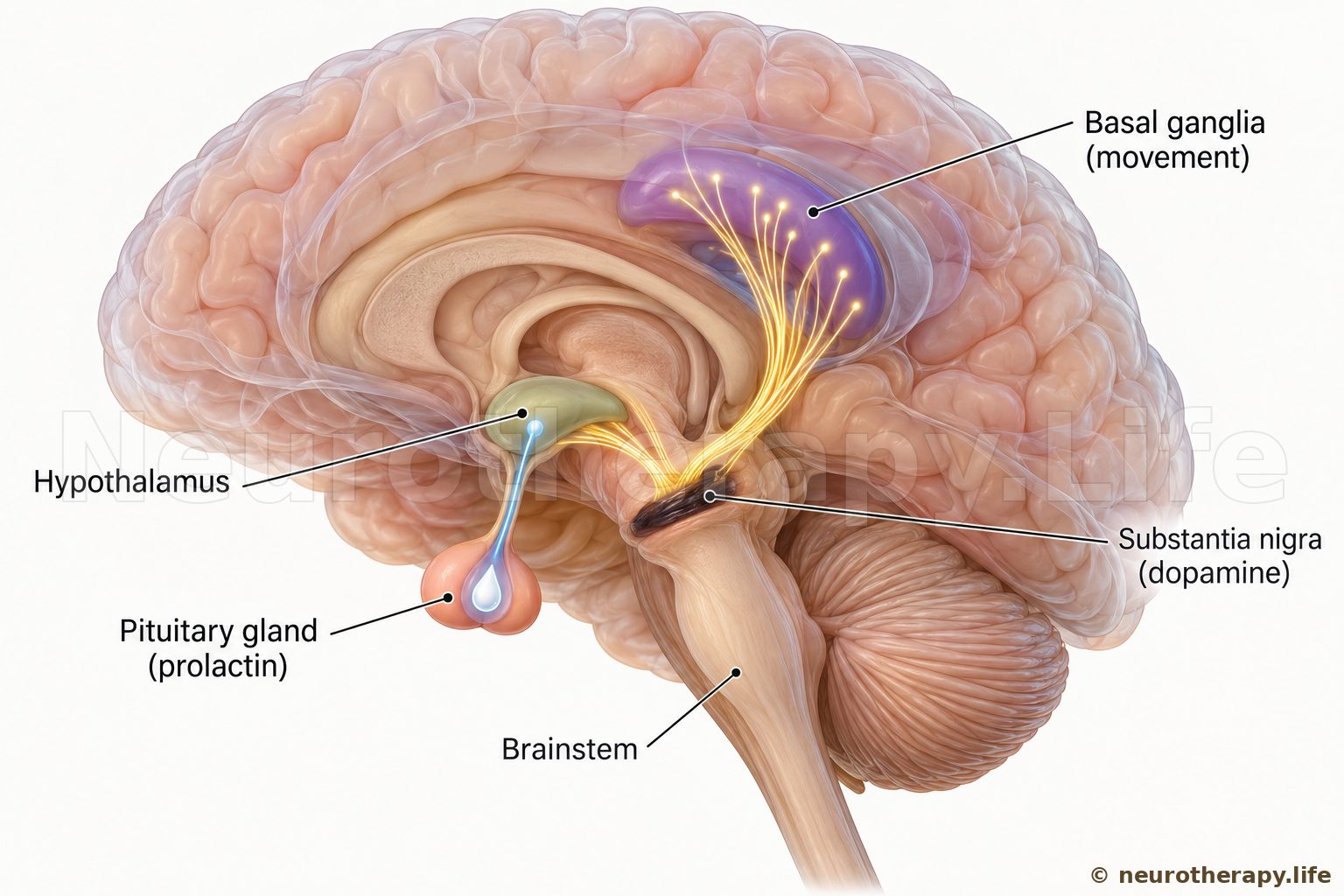
After it was given, patients of Parkinson's disease gained a great deal of benefit. From that it was inferred that it stimulates the substantia nigra — the small dark area of the midbrain where dopamine is made. Dopamine there works mainly as a brake that stops unwanted movements of the limbs.
Dopamine also holds back prolactin, the milk-making hormone. Women with raised prolactin were given (20) Medulla, and their prolactin levels were seen to fall. It is the one claim in the Medulla family that a blood test can check directly.
Dopamine steadies movement and holds back prolactin — the two jobs (20) Medulla is aimed at.
Where it is given
Where is (20) Medulla given?
PositionSitting
Body areaBoth sides of the neck, behind and below the ears
You sit on a firm chair, feet flat, back supported. A Parkinson's patient who is too weak or unsteady to sit can receive it lying down — this is expressly allowed.
It is given on both sides of the neck, one side at a time: behind each ear, just below the skull bone, and down the side of the neck towards the shoulder.
How it is given
How is (20) Medulla given?
How this point is given — the tool, the pressure, the count and the exact movement — is deliberately not described here. A demonstration video for this point is being prepared; until it is on this page, learn the method hands-on from a trained Neurotherapist before giving it. Please do not give any point from a written description alone: a point given in the wrong place or the wrong way can do harm.
The number written before a point's name is not a strength setting. Each numbered form is a separate named treatment with its own method and timing, taught hands-on in the course.
The exact technique is taught hands-on in the Neurotherapy (LMNT) course. See the course →
What it does
What does (20) Medulla do in the body?
LMNT teaching holds that (20) Medulla stimulates dopamine through the substantia nigra. Body science confirms that dopamine steadies movement, holds back prolactin and, with serotonin, raises growth hormone; the link from the neck is the therapy's own clinical finding.
Movement: dopamine acts in the basal ganglia to stop unwanted movements of the limbs — its use in Parkinson's disease.
Prolactin: dopamine holds it back; prolactin levels have been seen to fall after treatment.
Breast size: many women with breasts larger than normal have seen them reduce — perhaps because raised prolactin enlarges them.
Fits: because dopamine stops limb movement, it is also given for fits.
Height: dopamine and serotonin both increase growth hormone, so (20) and (8) Medulla are given together.
Organs it reaches
Brain — The substantia nigra and basal ganglia, the movement brake.
Pituitary gland — Where prolactin is made and where dopamine holds it back.
Blood vessels — Dopamine can raise the blood pressure — the reason for its bars.
Lungs — Pneumonia in children, and the ADK sequence for an old pneumonia.
Its family
Which treatments is it related to?
(20) Medulla shares its place and touch with the Medulla family, and has a relative in another family that does the same errand.
Medulla — The parent point — one place, nine treatments.
(8) Medulla — Serotonin — given with (20) Medulla for height.
(12) Gas 'I' — A calf point that works like (20) Medulla for dopamine — useful when one road is closed. Not given with loose motions.
(2) Medulla — The GABA member, also used in Parkinson's disease.
(6) Medulla — Held back from teenagers treated for height — the opposite of (20).
(30) Medulla — Given in place of (20) Medulla in high blood pressure.
What it is used for
What is (20) Medulla used for?
The therapist chooses it after checking blood pressure and heart history. These are uses where patients have reported benefit, alongside their doctor's care.
Movement and fits
Parkinson's diseasePatients have reported tremendous benefit, held to be through dopamine.
Epilepsy (fits)Many patients with fits have reported benefit.
High blood pressure: (20) Medulla makes dopamine and can raise the pressure, so it is not given. (30) Medulla or the Chole formula is given in its place. High blood pressure
Heart disease: (20) Medulla is on the blocked list for heart disorders. Only (2), (4) or (6) Medulla, and (10) Left Medulla, are given there. Heart
These bars come with it into every formula that contains it, including ADK. ADK
Milk from the breasts when not breastfeeding, or periods stopping, needs a doctor's check and a prolactin test — a pituitary cause must be ruled out. How to tell a patient to see a doctor
A teaching case, put together from several patients: a young schoolteacher came for trembling hands, and only later mentioned irregular periods and milk from the breasts that she had told nobody about. The tremor was worse at rest, which pointed beyond simple nerves. She was sent for a prolactin test through her doctor, and the therapist kept the dopamine line in mind — one picture, not several small complaints.
A composite case written to teach the reasoning — not one patient’s file.
Common questions
I have Parkinson's and high blood pressure. Can I have (20) Medulla?
No — high blood pressure bars it. Your therapist may use another road to the same chemical, such as (12) Gas 'I', or (2) Medulla for the shaking.
Can a blood test show whether it worked?
For prolactin, yes. It is the one Medulla claim that a lab report can check, so ask your doctor to repeat the test.
Why is (20) given for height but (6) held back?
Dopamine and serotonin raise growth hormone, so (20) and (8) Medulla are given together. (6) Medulla may stir somatostatin, which holds growth back.
Is (20) stronger than (10) Medulla?
No. The number chooses a different treatment. (20) is aimed at dopamine; (10) at the vagus and digestion.
Surprising facts
1The black substance
Substantia nigra is Latin for 'black substance' — its cells are dark with a pigment called neuromelanin. Parkinson's symptoms usually appear only after a large share of these cells has been lost.
Prolactin cells would pour out hormone on their own; dopamine from the hypothalamus keeps them held back. That is why a cut pituitary stalk raises prolactin.
Source: Ben-Jonathan N, Hnasko R. Endocrine Reviews 2001;22(6):724–763.
3Growth happens at night
The biggest pulse of growth hormone comes during the first hours of deep sleep — one reason sleep matters so much for growing children.
Source: Guyton & Hall, Textbook of Medical Physiology (14th ed.), growth hormone secretion.
Test yourself
Research
Strong evidence
A major review showing that dopamine from the hypothalamus is the main brake on prolactin: it holds back the prolactin-making cells of the pituitary, and this is the basis of treating raised prolactin.
This page explains what a Neurotherapy (LMNT) treatment is for; it is not a self-treatment guide and does not diagnose. Neurotherapy (LMNT) works alongside your medical care — keep taking the medicines your doctor prescribed.
Ready to begin?
Send COURSE for course details, or your name, age and health issue for a consultation.