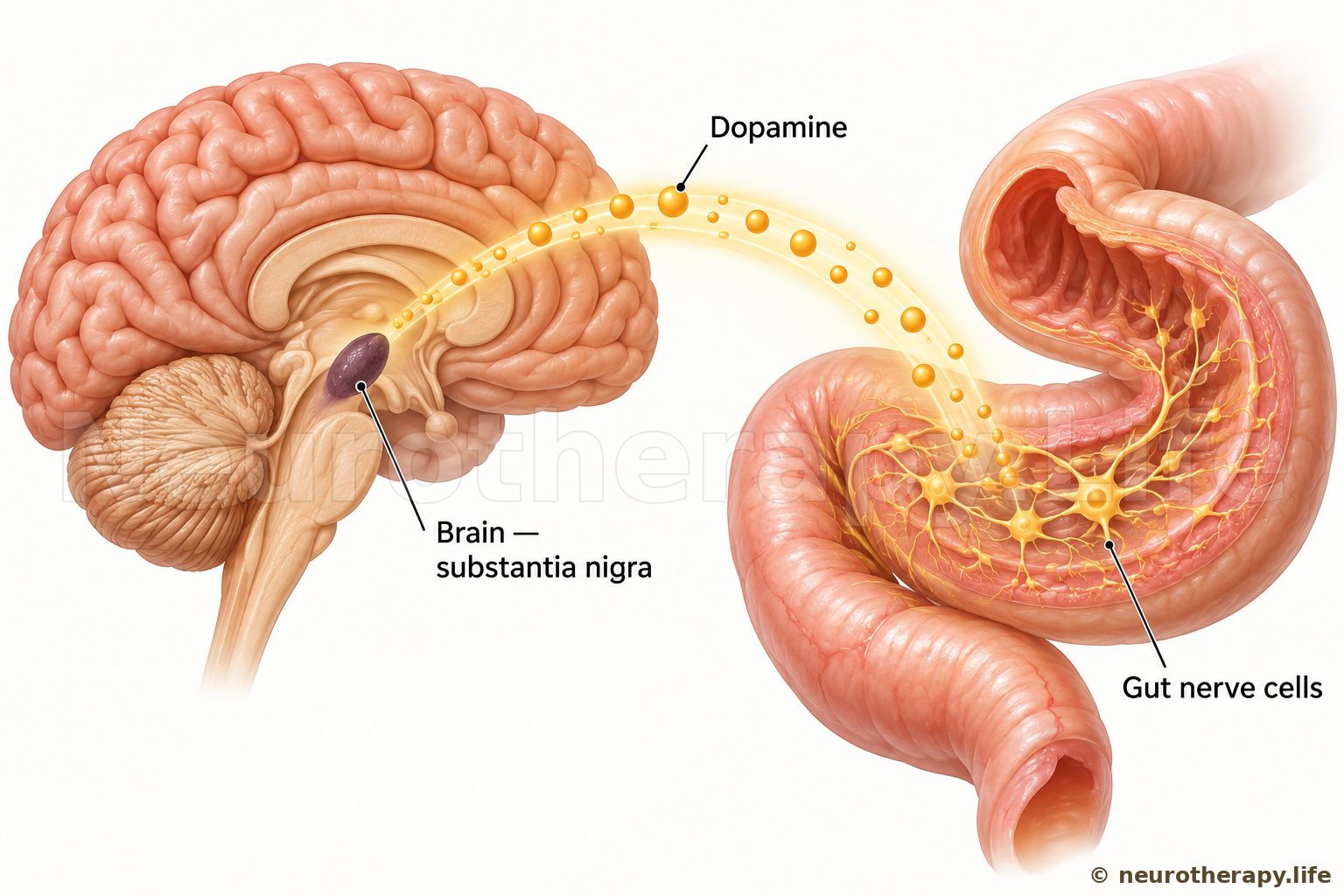
1The gut is a dopamine factory
Measurements during abdominal surgery found that the gut and nearby organs make about 42–46% of the body's dopamine.
Source: Eisenhofer G et al. J Clin Endocrinol Metab. 1997;82(11):3864–3871.
Also called: 12 Gas I, (12) gas eye, (12) गैस आई
(12) Gas 'I' is a named form of the intestine point Gas 'I', given down both calves. The teaching gives it in Parkinson's disease, holding that it helps the body make dopamine, and says it works like (20) Medulla — a second road to the same goal. It is never given when there are loose motions.
(12) Gas 'I' belongs to the Gas 'I' family — the small-intestine point given on the calves. Its bracket number names a separate treatment, the top rung of the Gas 'I' ladder.
Parkinson's disease comes from a shortage of dopamine, a chemical messenger that, among other jobs, helps stop unwanted movements of the limbs. The teaching points out that the gut's own nerve cells make, in smaller amounts, many of the same chemicals the brain makes — so a chemical can sometimes be asked for at the gut as well as at the head.
That is why the teaching says (12) Gas 'I' works like (20) Medulla. The two belong to different families and different positions — one lying down at the calves, one seated at the nape — but serve one errand: dopamine.
You lie face down with a pillow under the ankles so the feet hang free. The places are those of (6) Gas 'I' — down the back of each calf from just below the knee to just above the ankle, both calves together; the heel and the foot are never taken. The demonstration video shows the 6-point form; (12) is the longer form named on the card.
How this point is given — the tool, the pressure, the count and the exact movement — is deliberately not described here. Watch the demonstration video on this page, and learn the method hands-on from a trained Neurotherapist before giving it. Please do not give any point from a written description alone: a point given in the wrong place or the wrong way can do harm.
The number written before a point's name is not a strength setting. Each numbered form is a separate named treatment with its own method and timing, taught hands-on in the course.
The exact technique is taught hands-on in the Neurotherapy (LMNT) course. See the course →
This is the teaching's inference from a patient it treated; the science of gut dopamine is real, but the treatment itself has not been tested in trials.
A bar on one of the two roads does not bar the other.
Chosen from tenderness at Gas 'I', alongside the neurologist's treatment.
The ladder of Gas 'I' forms, of which this is the top rung.
Home of (20) Medulla, its partner.
“We do not give treatment for any one disease; rather we treat according to the condition of the body on that day.”
Recorded in the therapy's own account, without a name: a man with Parkinson's disease had a good deal of pain at Gas 'I', and the point was given for that finding, not for the diagnosis. After (12) Gas 'I', the trembling of his hand was very much less. The question 'why?' came afterwards — and led to the dopamine reasoning that built the whole Gas 'I' ladder.
A composite case written to teach the reasoning — not one patient’s file.No. It is given alongside your medicines, which only your doctor changes.
(12) Gas 'I' is closed to you while the loose motions last, but its partner (20) Medulla, given at the neck, remains open.
Yes — research has shown the gut makes a large share of the body's dopamine. Whether this treatment raises it is the therapy's inference from experience, not a tested fact.
Measurements during abdominal surgery found that the gut and nearby organs make about 42–46% of the body's dopamine.
Source: Eisenhofer G et al. J Clin Endocrinol Metab. 1997;82(11):3864–3871.
The nerve network in the gut wall runs digestion with many of the same chemical messengers the brain uses.
Source: Furness JB. Nature Reviews Gastroenterology & Hepatology. 2012;9(5):286–294.
In the movement circuits of the brain, dopamine helps hold back unwanted movement. When the cells that make it are lost, tremor and stiffness appear.
Source: Standard neurology of Parkinson's disease (loss of dopaminergic neurons of the substantia nigra).

A practical demonstration of where the Gas 'I' point lies down the calves, how the patient is positioned, and how the six-second presses are given.
The video shows the (1) Gas 'I' count. In Parkinson's the count is (12) Gas 'I' — still exactly six seconds at every place, and never with loose motions.
Measuring blood entering and leaving the gut during surgery, researchers found that the abdominal organs make about 42–46% of the body's dopamine.
This page explains what a Neurotherapy (LMNT) treatment is for; it is not a self-treatment guide and does not diagnose. Neurotherapy (LMNT) works alongside your medical care — keep taking the medicines your doctor prescribed.
Send COURSE for course details, or your name, age and health issue for a consultation.