Each Point in Use: What It Is For, and When It Is Held Back
Every Neurotherapy (LMNT) point has two sides: what it is used for, and who must not be given it. This guide shows how a therapist reads both sides, why the number in front of a point names a different treatment, and why the list of holds is read first.
Overview
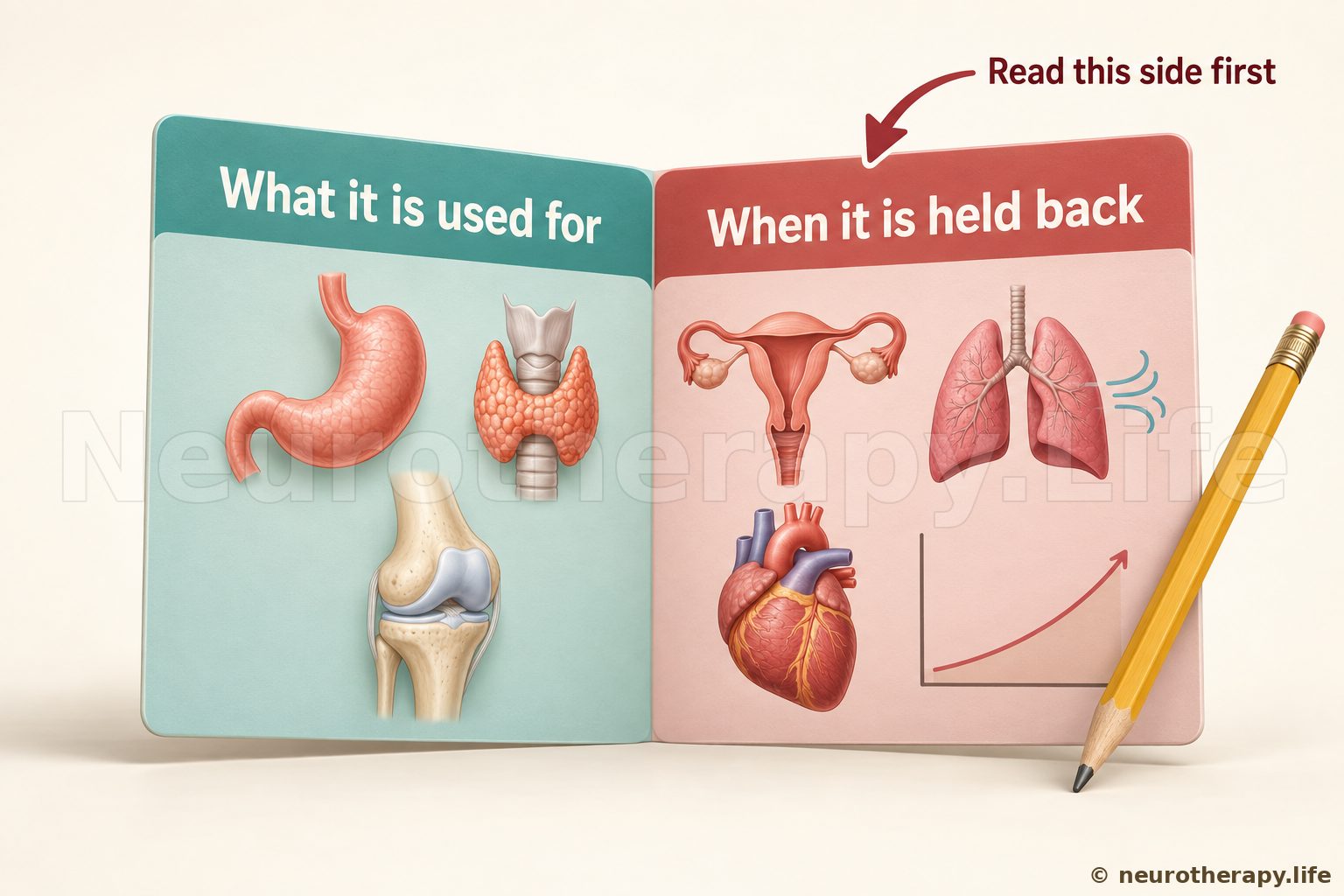
Every Neurotherapy (LMNT) point has two sides: what it is used for, and who must not be given it. This guide shows how a therapist reads both sides, why the number in front of a point names a different treatment, and why the list of holds is read first.
The card that was right in every line but one
A teaching case, put together from many evenings of training: a student examined a middle-aged man with long-standing constipation, scaling skin and thinning hair. She found tenderness at the right points and chose good treatments for his bowel, his skin and his hair. Her teacher read the card and asked one question: "Does he wheeze?" He did, since childhood — and two of her lines came off, because those points make asthma worse.
Nothing on her card was the wrong treatment for his skin or his bowel. It was the wrong treatment for him. That is the lesson of this whole guide: a point is chosen for a person, not for a disease name, and the person includes everything he has not yet told you.
Two kinds of point: chemical and physical
A chemical point is named after a substance the therapy works to move — Pan for the pancreas and what it makes, Adr for the outer layer (cortex) of the adrenal gland, Thrd for the thyroid, Para for the parathyroid, Ku for the cells of the blood. Its entry reads like a list of what that chemical does — and therefore who must not have more of it.
A physical point is named after a place, a movement or a person — Back Arrow, L5–S1 Ghisai, Giriraj, Shivaji, Vasanti. Its entry reads like engineering: tissue that has slipped down is pulled back up, a stiff joint is freed. So the reasons for holding back differ. A chemical point is usually held back because the body already makes too much of something. A physical point is held back because of what the pressure would do to a broken bone, an inflamed belly, a weak heart or a chest.
The number in front names a different treatment
The single most important habit: the number in brackets is a selector, not a strength. (2) Adr is used to help the body hold salt — for cramps from salt loss, as in athletes or after sweating in strong sun — so it is not given in high blood pressure. (4) Adr is used to raise blood sugar, so it is not given to a diabetic. (6) Adr is used to calm inflammation, so it is not given where immunity is already low, as in septicaemia, HIV or cancer.
These are three treatments, not three strengths of one, and a hold on one does not travel to the others. Pan shows the same thing: (2) Pan is held back from a child being treated for height, because it slows growth hormone, while (4) Pan is held back from a diabetic, because it raises sugar. The exact method of each variant is taught hands-on in the course.
Read the 'when not' column first
A therapist who reads the uses first will always find a reason to give a point; the uses are long and generous. The holds are short, and they decide the session. Some of the holds the source sets down:
- Gal — not in asthma, not in leukaemia or other raised-white-cell diseases, not to those passing little urine.
- Spl — not in cold, allergy or asthma. Mu — not with a running nose or a cold; another point is given in its place.
- Const — not with loose motions. Dys — only when there is pain above and to the right of the navel, and only for a day or two, because it works against the natural movement of the gut.
- Liv — not in liver cancer. Liv° and Mu° (the two kidney points) — not in kidney failure or kidney cancer.
- Thymus and Th + Ch — not in pregnancy, diabetes, rheumatoid arthritis, autoimmune disease, kidney disease, polio or heart disease.
- Lt. Ov. and Rt. Ov. — not in cancer, and not to a child being treated for height, because these hormones close the growth plates of the long bones early.
- Lu + Sh — not in high blood pressure or heart disease. Loveleen — not in heart disease, because the pressure falls on the chest. Folded Legs — not with inflammation in the abdomen. (6) L3, 4, 5 — not with a fracture in the low back. Shukla — not in osteoporosis.
Not today, and not with that
Some holds do not say never. They say not today, or not in that company. Pradeep, given for knee pain, pulls the muscles in the opposite direction to JJ⁺¹, so the two are not given together. BOF for pain in the soles and JJ⁺² also pull against each other; once the sole pain has gone, JJ⁺² can be given.
Other pairs run the other way — always together, never apart. Th + Ch goes with the Armpit point. Gas Only, in a patient with constipation, piles or fistula, goes with Gas 'I'. P point is always followed by WD, or the woman is left worse. Ton 'T' goes with the Sangam points. Classical Ayurveda knew the same idea as viruddha — two good things that are harmful together.
One disease, several points, one plan
Polio appears under four different points, and read together they make a plan, not a contradiction. (6) Adr is used because polio is an inflammatory disease. Blood Supply to Legs is used for the weak, numb legs. Thymus, Th + Ch and Armpit are held back. And for Spl the source leaves an honest open question — whether polio patients benefit is still to be tried. One inflammation to calm, one weak limb to supply, one group held back, one question still open.
Treat the pain you find — and keep every hold
The chemical points end with one line set large: whatever the disease, giving the right chemical point to clear the point where there is pain brings relief of itself. That is why almost every entry begins with a pain — to the right of the navel, to the left of it, in front of the hip bone — and not with a disease name.
But that line is not permission to stop asking. Most holds name something a village therapist can ask about or see without a laboratory: Is she pregnant? Is she having her period today? Is there sugar? Is there blood pressure? Does he wheeze in the cold? How much urine is coming? Is this child being treated for height?
Key points
- Every point has two sides — its uses and its holds — and the holds are read first.
- The number in brackets names a different treatment, not a stronger one; a hold on one variant does not travel to another.
- Chemical points are held back when the body already makes too much of something; physical points when the pressure itself could harm a bone, a belly, a heart or a chest.
- Some points must not be given on the same day; others must always be given together.
- One disease can call on several points, each doing its own job, with some held back.
- Treatment follows the tender point found today — and every hold still stands.
Topics in this guide
Go deeper
When the Hand Must Stop: Blocked Points and Safety in Neurotherapy (LMNT)
When a point must not be given at all
How a Formula Is Built: Points, Order and Rests
How single points are joined into a formula
The Shorthand: How Neurotherapy (LMNT) Treatments Are Written and Read
How points are written on a card
ADR
The adrenal cortex point and its three variants
Pan
The pancreas point, where each variant opens a different door
Gal
The gall bladder point and its three kinds of hold
Th + Ch
Thymus with chest — the longest list of holds
Polio and its after-effects
One disease, four points, one plan
Safety: when it is held back
- Never stop or change your medicines because you are taking Neurotherapy (LMNT). Any change in a dose is your own doctor's decision. How to tell a patient to see a doctor
- In cancer, these are never given: (10) Pan, Thymus, Pit, Lu + Sh, Rt. Ov. / Lt. Ov. and (30) Medulla. Cancer care: Neurotherapy (LMNT) support
- Tell the therapist before you lie down if you are pregnant or might be, if you have your period, diabetes, high or low blood pressure, asthma, heart disease or fits — each of these closes certain points. When the Hand Must Stop: Blocked Points and Safety in Neurotherapy (LMNT)
- Children get light treatment, and a child being treated for height is not given (2) Pan or the ovary points. The Child, the Elder and the Frail: Neurotherapy (LMNT) for Delicate Bodies
- In heart disease, points that put weight on the chest (Loveleen) or raise blood pressure (Lu + Sh) are not given. Angina (chest pain from the heart)
Guruji says
“The research is still to be done.”
Common questions
My neighbour gets more treatments than me. Is something being held back?
Yes — on purpose, for your safety. If, for example, you wheeze, several points that would help your skin or bowel would make your chest worse. What remains is chosen for you, not for the name of your complaint.
Does the number in front of a point mean how hard it is pressed?
No. It names a separate treatment with its own purpose and its own holds. (2) Adr and (4) Adr do different things and are refused to different people.
Is Neurotherapy (LMNT) safe in pregnancy?
Parts of it are and parts are not. Thymus and Th + Ch are not given to pregnant women, and some treatments are given with the hands instead of the feet. Tell the therapist before you lie down, not afterwards.
I have my period. Should I come?
For other problems, come next week. But do come during your period for bleeding that is too heavy or will not stop, very scanty bleeding, or pain with clots — those are treated during the period.
Why do you keep asking about my urine when I came about my back?
Because some points are held back from people passing too little urine and others from those passing too much. Your answer decides which points are safe for you today.
Watch

Shows how to find the Pan (pancreas) point in the fold at the top of both thighs, and how to give 1 Pan, 2 Pan, 2 Pan × 6 and 8 Pan with the feet, holding chairs for support. It is used to support the pancreas in diabetes and indigestion.

A practical demo by Dr. Diwakar Shukla on how to give 1, 2 and 8 Pan — the pancreas point — to support a weak pancreas.
Test yourself
Explore more
Organs
Body systems
Diseases
Points
Formulas
Topics
Read more
This page explains what a Neurotherapy (LMNT) treatment is for; it is not a self-treatment guide and does not diagnose. Neurotherapy (LMNT) works alongside your medical care — keep taking the medicines your doctor prescribed.