The Child, the Elder and the Frail: Neurotherapy (LMNT) for Delicate Bodies
Neurotherapy (LMNT) can be given from a one-day-old baby to a hundred-year-old. What changes for small children, the elderly and the frail is not the strength of the pressure but the decision: a different tool, a different position, named lighter formulas, and some points held back completely.
Overview
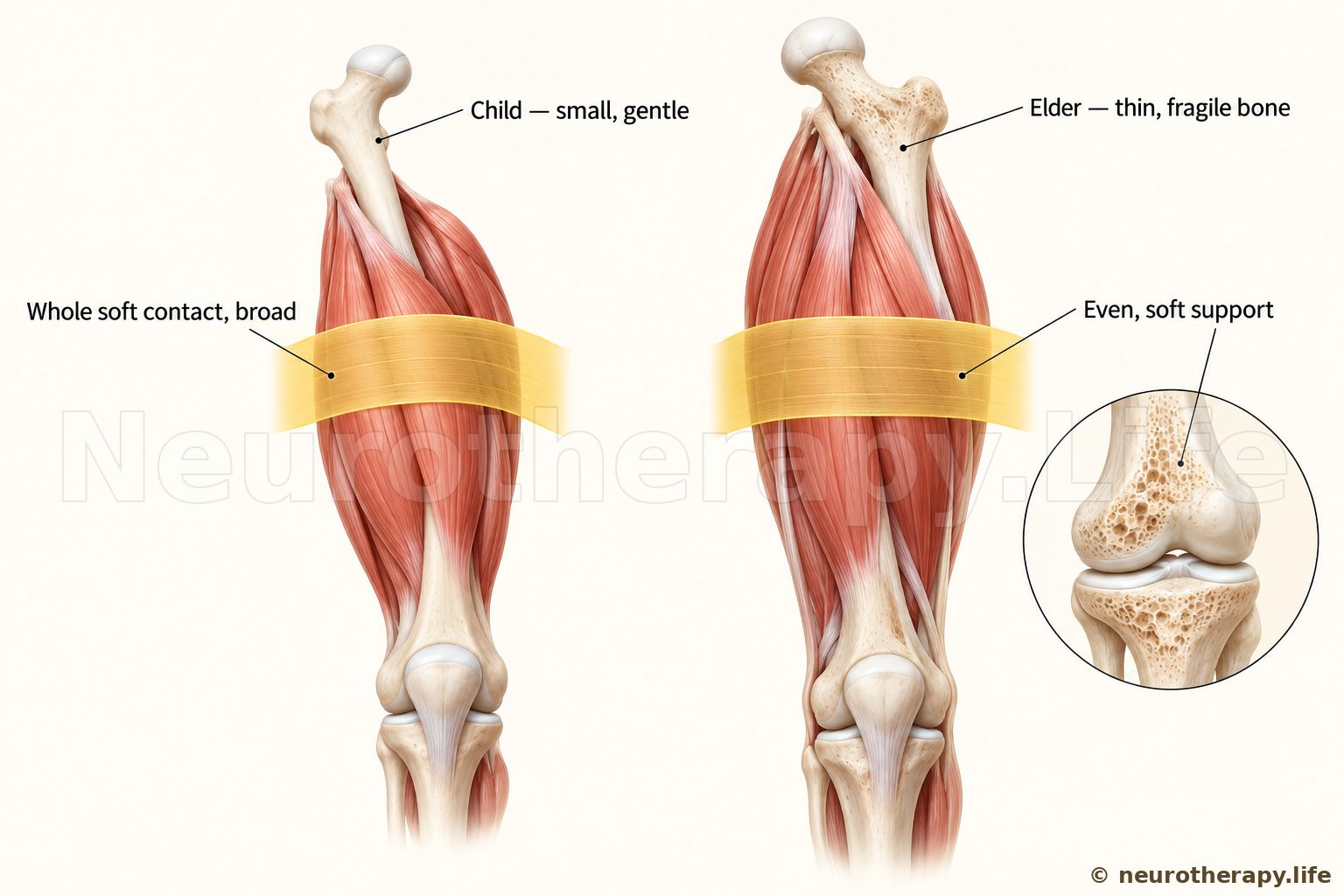
Neurotherapy (LMNT) can be given from a one-day-old baby to a hundred-year-old. What changes for small children, the elderly and the frail is not the strength of the pressure but the decision: a different tool, a different position, named lighter formulas, and some points held back completely.
Two patients nobody had prepared him for
A teaching case, put together from many such mornings: a young therapist opens his centre and finds two people waiting. One is a toddler with loose motions for three weeks. The other is a very old, very thin man who has not got up from the floor alone for years. The therapist had been trained well, but only on ordinary adult bodies.
He rightly sat down at the old man's level and did not use his foot on either of them. But with the child he pressed with the edge of his hand, because his palm looked too big for so small a leg. The child screamed and the mother took him home. His senior's comment sums up this whole guide: a small body does not need a smaller version of what you do to a big one — it needs a different decision.
Frailty is a finding, not a birthday
Age is a poor guide. An eighty-year-old who has walked every day of her life may take an ordinary adult treatment. A forty-year-old who has been on steroid tablets for years, or in bed for months, may be truly frail. So the therapist decides from what the patient and family say, what is seen, and what the hand feels — never from the birth year alone.
Typical questions: how does she get up in the morning, has she fallen, has any bone broken from a small knock, has a doctor ever said her bones are thin (osteoporosis — bones that have become porous and weak)? Small children, very weak people and anyone with osteoporosis are treated with the hand only, however well they look. And because neither a toddler nor a polite elder reports pain clearly, the therapist reads the face, the hands and the breath instead of waiting for words.
The ladder of tools
The first and biggest adjustment is which part of the therapist reaches the patient. Weight was never the thing that makes the therapy work — the right place is. So a lighter tool loses nothing; it only changes how the pressure arrives.
- The foot, between two chairs — the ordinary adult treatment, for people of fuller build.
- The hand — for very small children, old and weak people, and every patient with osteoporosis. For a small child the whole soft palm lies flat on the thigh, never the edge or the fingers, so the pressure is not even felt as pressure.
- Single points, given one at a time — for the bed-ridden and those in severe joint pain, who cannot bear a full formula yet. They give quick relief and act as starters, not as a full treatment.
- Feather Touch — a touch so light that powder on the skin is not wiped away. It is for the patient who can be given nothing else, such as a newborn or someone in the first days after a stroke.
What changes, and what does not
The position can change. Brain and neck treatments that are normally given seated may be given lying down if the patient is very ill or very weak. For an elderly patient, one written formula may be given in a slightly different order so that she turns over once instead of twice — the price, a day or two longer, is named honestly. A very weak body rests on an even support, best a folded sheet, and is taught to lie down and get up by rolling onto the side.
The timing of each press does not change. It is part of the identity of a treatment, the same for a newborn and a wrestler; a frail patient is never given a secretly shortened press. Instead, several formulas already exist in named lighter forms: the light Jeevan Dhara, which may be given at any age; VTF (Mild), suitable for small children; and Organ Clearance, which may be given to small children and the elderly every day. The exact method of each is taught hands-on in the course.
The newborn and the small child at home
The white, waxy coating a baby is born with is taught to be protective, guarding the skin against germs. So on the first day the baby is cleaned lightly with warm water, wrapped in a soft blanket, rested and given to the mother; the coating is cleaned away slowly over about a week. The quick full bath and scented powder of many nursing homes is called only 'perhaps not right' — something to think about, not a harm done. Warmth is the one urgent thing: a newborn loses heat fast, and a baby who is not breathing needs help at once.
A small child is always lifted with both hands. The belly is packed with no spare room, and a one-handed, sideways lift is taught to bring indigestion, constipation or loose motions. When the teeth are coming, fever or loose motions may come: half milk and half sago water is given to settle the loose motions, while a fever of a day or two is read as the liver asking for rest. A baby or very small child with diarrhoea, blood in the stool, a dry mouth, little urine, floppiness or a fever beyond a few days must be seen by a doctor the same day.
The growing years: points held back to protect height
A long bone grows at a plate of living cartilage near each end, the epiphyseal line (the growing edge of the bone). Once it closes, height cannot increase again. Because oestrogen and progesterone push this line to close early, Lt. Ov. and Rt. Ov. are not given to young people whose height is low, and WD is held back too. Ton 'P' and Ton 'T' are not given to young people because of a possible link with fertility. (2) Pan is not given to children being treated for height, since it stops growth hormone; (4) Pan or (10) Pan may be given instead. (6) Medulla is withheld from teenagers treated for height unless there is a special need.
One more question belongs to every child who comes for a long course, whatever the illness: during the pregnancy, did the mother's blood pressure rise, or did she have skin trouble or itching? If so, the New Gal formula is given first, on its own, for a short period before the rest of the plan. Families may honestly be told that parents of children with conditions such as intellectual disability and autism report considerable improvement — never that the condition will be cured, and never that a medicine for fits should be stopped.
Old age is not a disease
The examination is the same at eighty as at thirty; only the expectation shifts. Up to about the mid-thirties most people show pain at Mu° and get the diseases of acid, while with age the diseases of alkali begin to come — though not always. What differs is the care around the session: rising slowly by the side, sitting on the edge of the bed before standing, warm slippers on a cold floor, and asking whether she can still chew. The family, not the polite patient, is asked how she was that evening.
Key points
- Every person from a newborn to a hundred-year-old can take Neurotherapy (LMNT); what changes is the decision, not the force.
- Frailty is read from the body — falls, fractures, steroid use, time in bed, what the hand feels — not from age.
- Small children, very weak people and anyone with osteoporosis are treated with the hand only.
- The tool ladder runs foot, hand, single points, Feather Touch — start on the rung the body chooses.
- The timing of a press never shrinks; instead, named lighter formulas such as the light Jeevan Dhara and VTF (Mild) are used.
- In the growing years, points that could close the growth plate or slow growth hormone are held back.
- Lift a small child with both hands; keep a newborn warm; never stop a child's medicine on a therapist's word.
Topics in this guide
Go deeper
Frail and elderly patients (gentle care)
Gentle care for frail and elderly patients
Osteoporosis
Why thin bones change the whole treatment
Low height in children (short stature)
Low height in children, and the points held back
Feather Touch
The lightest treatment there is
Jeevan Dhara, light version
The light Jeevan Dhara, for any age
Organ Clearance (as a daily treatment)
Organ Clearance, even daily for children and elders
New Gal
New Gal — when the mother's pregnancy had high BP or itching
When the Hand Must Stop: Blocked Points and Safety in Neurotherapy (LMNT)
Every condition and the points it closes
Treating Women: Periods, Pregnancy and Care
Treating women, periods and pregnancy
Safety: when it is held back
- Small children, very weak persons and any patient with osteoporosis are treated with the hand only — never with the foot. Osteoporosis
- Techniques that carry a jerk or a good deal of force are not given to a frail, osteoporotic or bed-ridden patient, not even 'more gently'. Frail and elderly patients (gentle care)
- In osteoporosis, Shukla is not given (it may increase the pain), and (4) Para is never given alone — the full 1,25 DCC formula is used instead. (4) Para
- Young people whose height is low are not given Lt. Ov., Rt. Ov. or WD; Ton 'P' and Ton 'T' are not given to young people. Low height in children (short stature)
- (2) Pan is not given to children treated for height — (4) Pan or (10) Pan may be given instead; but (4) Pan is never given to anyone with diabetes, as it raises blood sugar. (2) Pan
- VTF (Mild) is not given where there is an autoimmune disorder; the Triangle for piles is not given to those who pass little urine. VTF (Mild)
- Never stop or reduce a child's medicine — especially a medicine for fits — because Neurotherapy (LMNT) has begun. That decision belongs to the prescribing doctor. Epilepsy (fits)
- A baby with diarrhoea, blood in the stool, signs of drying out, floppiness, a rash that does not fade, a stiff neck, a fit, fast breathing, or fever in the first months of life goes to a doctor the same day. How to tell a patient to see a doctor
Guruji says
“Every person, from a one-day-old infant up to the age of a hundred years, can take this treatment.”
Common questions
Will the treatment hurt my small child?
It should not. It is given with the whole soft part of the palm laid flat and spread wide, which is exactly why it does not sting. If the child cries, tell the therapist at once — it means how the hand is laid needs changing.
My father is very old. Is he too old for Neurotherapy (LMNT)?
No. What changes is how it is given: with the hands, in positions he can hold, with fewer turns, and often in shorter, more frequent sessions. Tell the therapist honestly about falls, thin bones and how he felt each evening.
My grandson's teeth are coming and he has loose motions and a little fever. What should we do?
Half milk and half sago water is given to settle the loose motions, and a fever of a day or two at this time is not taken as a bad sign. But a baby or very small child with diarrhoea, a dry mouth, little urine or unusual drowsiness should be seen by a doctor that same day.
Why are some points not given to my teenage daughter for her period pain?
Because she is still growing. Some points that help period problems may push the growing edge of the bones to close early. If her height is low, the therapist will explain the choice to you both and write the decision on her card.
Watch
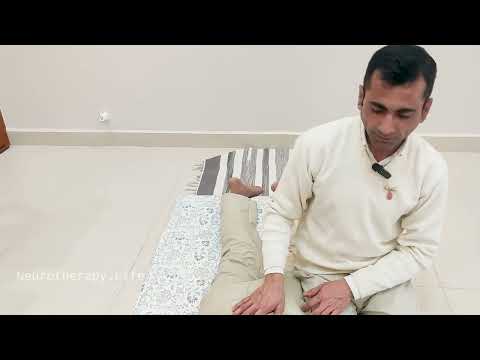
A short Hindi demonstration of Organ Clearance: the patient lies face down on two pillows, and the therapist's open hands work over the whole back in overlapping strokes — first up and down, then side to side — twice each, leaving no area out.

A short Hindi podcast with a senior neurotherapist: what cerebral palsy is, its four types, early signs, causes before, during and after birth, and how Neurotherapy (LMNT) aims to support circulation to the brain and the master glands.
The talk calls Neurotherapy (LMNT) an “alternative medicine”. In LMNT teaching it works inside the child's team — doctor, physiotherapy, braces and medicines — never instead of it, and it does not reverse the brain injury.
Test yourself
Research
- Strong evidence
A man born with an oestrogen receptor that did not work kept growing taller into adult life, because the growth plates at the ends of his bones never closed. This showed that oestrogen is the signal that closes the growth plate, in men as well as women.
Explore more
Organs
Body systems
Diseases
Points
Formulas
Topics
Read more
This page explains what a Neurotherapy (LMNT) treatment is for; it is not a self-treatment guide and does not diagnose. Neurotherapy (LMNT) works alongside your medical care — keep taking the medicines your doctor prescribed.