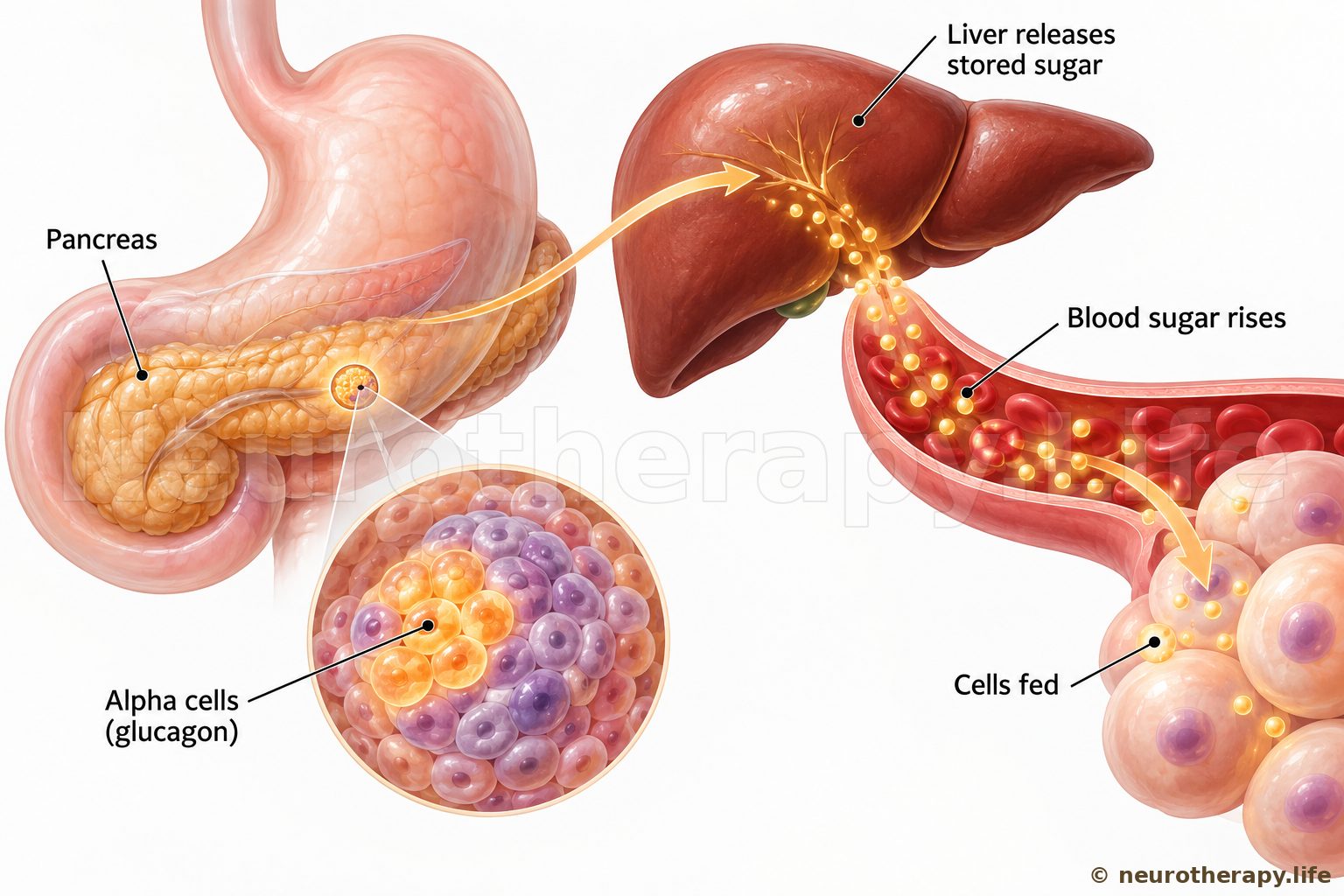
(4) Pan is the form of the Pan point aimed at glucagon, the hormone that raises blood sugar and feeds the cells. It is used for weakness that comes from a lack of sugar, and in small children for appetite and height — but never in diabetes or cancer.
Overview
What is (4) Pan?
Pan is short for pancreas, the gland behind the stomach that makes digestive juice and the hormones that steer blood sugar. Guruji taught that stimulating the pancreas in different numbers produces different effects.
(4) Pan is the form aimed at glucagon. Glucagon is the hormone that raises blood sugar when it runs low, by telling the liver to release its stored sugar. In the therapy's words, glucagon gives nourishment to the cells.
That one fact explains both its uses and its bars. It helps the tired body that is short of sugar, and the small child who needs to eat and grow. But for the same reason it is closed to the diabetic, whose sugar is already high, and to the cancer patient, whose unwanted cells would be fed too.
Glucagon raises blood sugar by releasing the liver's store — the hormone (4) Pan is aimed at.
Where it is given
Where is (4) Pan given?
PositionLying on the back
Body areaFront of both thighs, middle of each thigh, just below the thigh–hip crease
You lie flat on your back, with one pillow under both thighs and nothing under the head or the waist. (4) Pan is given on the front of both thighs together, in the middle of each thigh, just below the crease where the thigh meets the hip.
This is exactly the same spot as every other form of Pan. The place does not change from one number to the next — only the treatment does. The middle of the thigh is chosen on purpose: further inward lies the groin, where the main artery, vein and nerve of the leg run close under the skin.
Why the thigh, when the pancreas lies deep in the belly? The Neurotherapy (LMNT) map works by a crossing rule: pressure on the legs answers pains above the navel. The point is named for what it is meant to move, not for the place it is given on.
A small child is treated lying on a mat on the floor, with the mother within sight. The therapist kneels at the child's level and uses the soft, flat palm, so the pressure is hardly felt as pressure.
How it is given
How is (4) Pan given?
How this point is given — the tool, the pressure, the count and the exact movement — is deliberately not described here. A demonstration video for this point is being prepared; until it is on this page, learn the method hands-on from a trained Neurotherapist before giving it. Please do not give any point from a written description alone: a point given in the wrong place or the wrong way can do harm.
The number written before a point's name is not a strength setting. Each numbered form is a separate named treatment with its own method and timing, taught hands-on in the course.
The number before itNames the treatment; it is not a strength setting
The exact technique is taught hands-on in the Neurotherapy (LMNT) course. See the course →
What it does
What does (4) Pan do in the body?
In Neurotherapy (LMNT) teaching, (4) Pan rouses the pancreas to make glucagon. Body science confirms what glucagon does; how a press on the thigh reaches the gland is the therapy's own explanation, offered from clinical experience.
To correct weakness that arises from a lack of sugar.
In small children, to increase appetite and height, because glucagon gives nourishment to the cells.
For a child being treated for height, it is one of the two forms given in place of (2) Pan.
For players who tire soon after playing it 'may perhaps be beneficial' — the teaching's own hedge, with research still going on.
Liver — Glucagon's main target: the liver releases its stored sugar into the blood.
Blood — Blood sugar rises — welcome in weakness, harmful in diabetes.
Its family
What are the other forms of Pan?
Every number of Pan is given at the same place, and each is its own treatment with its own uses and its own cautions. A caution written against one number does not travel to the others — but the general Pan cautions apply to all.
Pan — The parent Pan point — the pancreas point and its five numbered forms.
(2) Pan — Somatostatin — to check what is overactive and unwanted growth. Not for children treated for height.
(8) Pan — Digestive enzymes and bicarbonate — the everyday form that opens the Normal and Heparin formulas.
(10) Pan — Insulin — for diabetes, long-standing joint pain and eye disease.
(18) Pan — The highest number — to reduce prolactin in women; cataract and eye disease; opens F. Heparin.
What it is used for
What is (4) Pan used for?
(4) Pan has a short list of uses and a strict list of bars. The bars are checked first.
Blocking comes first. Before any treatment, the points not to be given for the patient's disease are marked on the diagnosis card. Where a caution and a use both apply, the caution wins. Conditions that block certain points: the six families
Diabetes: (4) Pan raises blood sugar, so it is never given to a diabetic. (10) Pan is given in its place. Diabetes
Cancer: (4) Pan is blocked, because glucagon nourishes all cells, cancer cells included. (2) Pan is given in its place, with exact timing. Nothing in this therapy treats cancer; it is support alongside the oncologist. Cancer care: Neurotherapy (LMNT) support
Weakness can have many causes. If tiredness is new, severe, or comes with weight loss, fainting or thirst, see a doctor first. How to tell a patient to see a doctor
Never stop or change your medicines because of Pan. Neurotherapy (LMNT) works alongside your doctor's care; any change of dose is the doctor's decision.
Guruji says
“By Pan we stimulate the pancreas. Stimulating in different numbers produces different effects.”
— Dr. Lajpatrai Mehra
Common questions
I am diabetic and always tired. Will I get (4) Pan?
No. (4) Pan raises blood sugar, so it is blocked in diabetes. The therapist uses (10) Pan and other suitable treatments instead.
Is (4) Pan safe for my small child?
It is one of the forms named for appetite and height in small children, given lightly with the palm. The therapist first checks that none of its bars apply.
Is (4) Pan double (2) Pan?
No. The number chooses the treatment. (2) Pan brakes; (4) Pan raises sugar and feeds the cells. They are opposites given at the same spot.
Surprising facts
1The other half of the tug-of-war
Insulin lowers blood sugar and glucagon raises it. Healthy sugar is the two held in balance — which is why (10) Pan and (4) Pan are opposite treatments.
Source: Röder PV et al., Pancreatic regulation of glucose homeostasis, Exp Mol Med 2016;48:e219.
2The liver's sugar store
The liver keeps sugar packed as glycogen. Between meals, glucagon tells it to break that store down and send sugar into the blood.
Source: Guyton & Hall, Textbook of Medical Physiology (glucagon: glycogenolysis and gluconeogenesis in the liver).
3A rescue hormone
Glucagon is so good at raising sugar that a glucagon injection is used in emergencies to rescue a person with dangerously low blood sugar.
Source: Standard emergency treatment of severe hypoglycaemia (e.g. American Diabetes Association Standards of Care).
Test yourself
Research
Strong evidence
A review of how the pancreas controls blood sugar: glucagon from the alpha cells raises blood sugar, insulin from the beta cells lowers it, and the two are held in balance.
This page explains what a Neurotherapy (LMNT) treatment is for; it is not a self-treatment guide and does not diagnose. Neurotherapy (LMNT) works alongside your medical care — keep taking the medicines your doctor prescribed.
Ready to begin?
Send COURSE for course details, or your name, age and health issue for a consultation.