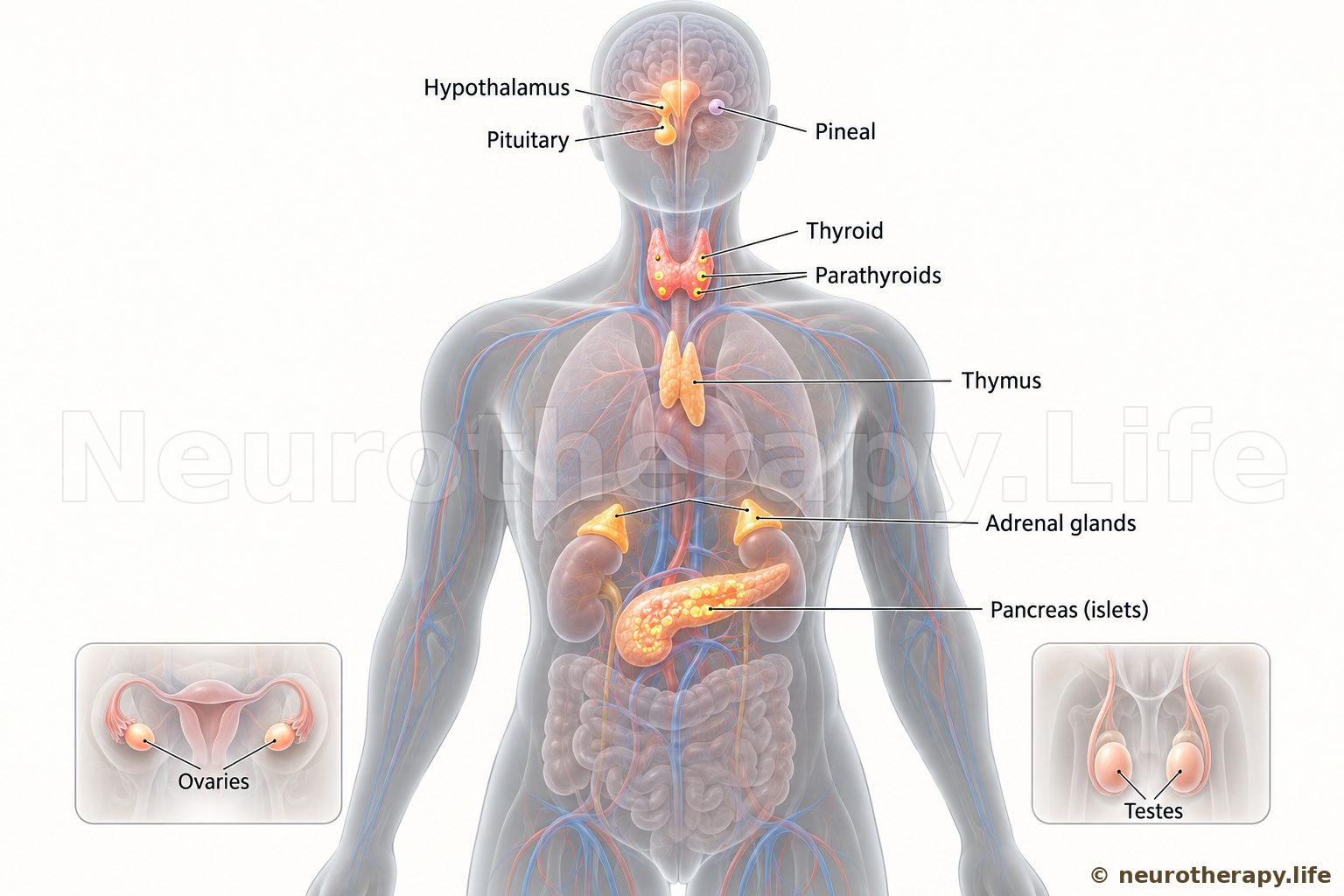
A handful of small glands, most of them no bigger than a grape, post chemical letters into your blood that set your growth, energy, sugar, salt, sleep and stress. In Guruji's teaching they are the body's own pharmacy — and every one of them draws its raw material from digestion.
Overview
What is the endocrine system?
The endocrine system is the group of glands that make hormones and release them straight into the blood. A hormone is a chemical messenger: one gland makes it, the blood carries it everywhere, and only the cells that have the right 'lock' (receptor) for it read the message and act on it.
The main glands are the pituitary and the hypothalamus in the head, the thyroid and the four parathyroids in the neck, the thymus in the chest, the two adrenal glands on top of the kidneys, the hormone-making islands inside the pancreas, and the ovaries or testes. Many organs that are not called glands — the stomach and intestines, the kidneys, the heart and even body fat — also make hormones.
Hormone problems are very common. Diabetes and thyroid disorders are two of the commonest long-term conditions in India — a national study in 2023 estimated that more than 10 crore Indians have diabetes. Many hormone problems grow slowly and quietly, so simple blood tests catch them early.
The hormone glands are scattered from the head to the pelvis. They do not touch each other — the blood is the only road between them.
Function
What does the endocrine system do?
Nerves are the body's telephone: fast, wired, and point to point. Hormones are the body's post: slower, but one letter can reach millions of cells at once and keep working for minutes, hours or even weeks. Together the two systems keep the inside of the body steady while the outside world keeps changing.
Controls growth and development, from a baby's brain to a teenager's height.
Sets your metabolism — how fast your body burns fuel and makes heat.
Keeps blood sugar in a safe range, before and after meals.
Balances salt and water, and with them the blood pressure.
Holds blood calcium in a narrow band, so nerves, muscles and the heart work properly.
Prepares the body for danger and helps it recover from stress.
Runs puberty, periods, pregnancy, breastfeeding and fertility.
Keeps the daily rhythm of sleep and waking.
The brain senses
The hypothalamus, a small part at the base of the brain, keeps checking the blood — its temperature, its salt, its hormone levels.
An order to the pituitary
If something is low, it sends a 'releasing hormone' a very short way down to the pituitary gland just below it.
The pituitary passes it on
The pituitary sends its own stimulating hormone into the blood — for example TSH, which is addressed to the thyroid.
The target gland works
The thyroid (or adrenal, ovary or testis) makes its own hormone and releases it into the blood.
The message is read
Cells all over the body with the right receptor respond — burning more fuel, making protein, holding salt, and so on.
Enough — switch off
When the level is right, the hormone itself tells the hypothalamus and pituitary to ease off. Doctors call this negative feedback. It is why a slow thyroid shows up as a high TSH: the pituitary is 'shouting' at a gland that is not answering.
How does the endocrine system work with other systems?
Nervous system and brain — The hypothalamus is where the nerves and the glands meet. Fright, sleep, hunger and temperature all reach the glands through it.
Digestive system — Digestion supplies the raw materials of every hormone, and the stomach and intestines are themselves a large hormone-making organ.
Blood — Blood is the postal road. Every hormone travels in it, and many ride on carrier proteins.
Liver — The liver makes cholesterol (the base of steroid hormones), starts activating vitamin D, and breaks down used hormones.
Kidneys — The kidneys obey salt and water hormones, finish making active vitamin D, and make erythropoietin, the hormone that orders new red blood cells.
Reproductive system — The ovaries and testes are glands too, and they take their orders from the pituitary.
Lymph and immunity — Cortisol from the adrenal glands calms the immune system; the thymus trains immune cells in childhood.
The system is not one organ but a family of separate glands, plus hormone-making cells tucked inside other organs.
Two kinds of gland
A gland is simply a maker. What matters is where it sends what it makes.
Duct glands (exocrine) — Pour their product down a tube to one place — saliva into the mouth, sweat onto the skin, digestive juice into the intestine.
Ductless glands (endocrine) — Have no tube. They release hormones straight into the blood, which carries them everywhere. The pancreas is both kinds at once.
Lymph nodes are not hormone glands — In Hindi one word, ग्रंथि, covers both. But a lymph node is a filter and a guard-post for the immune system; it makes no hormone.
The control centre in the head
Hypothalamus — An almond-sized part of the brain that links the nervous system to the glands. It makes releasing hormones for the pituitary, and ADH (vasopressin) and oxytocin.
Pituitary gland — The pea-sized 'master gland' hanging below the hypothalamus. It instructs the thyroid, adrenal glands, ovaries and testes, and makes growth hormone and prolactin.
Pineal gland — A tiny pine-cone-shaped gland deep in the brain that releases melatonin in the dark, helping to set the sleep rhythm.
Glands of the neck and chest
Thyroid — A butterfly-shaped gland at the front of the neck. Its hormones T4 and T3 set the body's speed; it also makes calcitonin.
Parathyroids — Usually four rice-grain-sized glands behind the thyroid. Their hormone, PTH, raises blood calcium when it falls.
Thymus — Behind the breastbone. In childhood it trains T cells, a key part of immunity; after puberty it slowly shrinks and turns to fat.
Glands of the abdomen
Adrenal glands — Two small caps on top of the kidneys. The outer cortex makes cortisol and aldosterone; the inner medulla makes adrenaline and noradrenaline.
Pancreas (islets) — Scattered through the pancreas are about a million tiny 'islands' of cells that make insulin and glucagon to control blood sugar.
Glands of reproduction
Ovaries — Two almond-sized glands in the pelvis that make oestrogen and progesterone and release an egg each cycle.
Testes — Two glands that make testosterone and sperm.
Organs that also make hormones
Stomach and intestines — Scattered hormone cells in the gut lining make gastrin, secretin, ghrelin (the hunger hormone) and GLP-1, which tells the pancreas a meal has arrived.
Kidneys — Make erythropoietin, renin and the active form of vitamin D.
Heart and fat — The stretched heart releases ANP, which helps the kidneys pass salt. Body fat releases leptin, which tells the brain how much energy is stored.
The journey
The alarmA split second
The brain notices danger — a speeding bus, a barking dog — and the hypothalamus raises the alarm.
AdrenalineSeconds
Nerves fire straight into the adrenal medulla, which pours adrenaline into the blood: the heart races, breathing quickens, sugar is released for the muscles.
The slower letterMinutes
The hypothalamus sends CRH to the pituitary, and the pituitary sends ACTH through the blood to the adrenal cortex.
CortisolPeaks about 20–40 minutes after the stress starts
Cortisol keeps fuel available, steadies blood pressure and calms inflammation.
Switching offAbout an hour or more
Cortisol itself tells the hypothalamus and pituitary to stop. When stress never ends, this tap never quite closes — which is one reason long stress wears the body down.
Where are the endocrine glands located?
Unlike the digestive tube, the hormone glands are not joined to one another. They are spread out from the base of the brain to the pelvis: the hypothalamus, pituitary and pineal in the head; the thyroid and parathyroids low in the front of the neck; the thymus behind the breastbone; the adrenal glands on top of the kidneys, high at the back of the abdomen; the pancreas across the upper belly behind the stomach; and the ovaries in the pelvis or the testes below it.
In LMNT teaching none of these glands is pressed directly. The points named after them — Pit, Thrd, Para, Adr and the rest — are given on the arms, the throat and the back, and the teaching explains them through the blood and nerve supply rather than touch on the gland.
Each gland has its own shape. The pituitary is a small round bean on a stalk. The thyroid is a reddish butterfly wrapped around the windpipe. The parathyroids look like yellowish-brown grains of rice. The adrenal glands are flat, yellowish caps — the right one shaped like a pyramid, the left one like a half-moon. The pineal is a tiny pine cone.
The hormone-making islets of the pancreas cannot be seen by eye at all — they are scattered like islands in the rest of the gland. Hormone glands are some of the best-supplied tissues in the body, packed with fine blood vessels so that what they make goes straight into the blood.
How big are the endocrine glands?
Most are surprisingly small. The pituitary weighs about half a gram — a pea. Each parathyroid is about the size of a grain of rice. Each adrenal gland weighs about 4–5 grams. The thyroid weighs about 15–25 grams. The islets make up only about 1–2% of the pancreas.
Yet their hormones work in tiny amounts — often a few billionths of a gram, or less, in each millilitre of blood. A very small change in a gland's output can change how the whole body feels.
Conditions and disorders
What conditions and disorders affect the endocrine system?
Most hormone problems are either too much of a hormone or too little. They can come from the gland itself, from the pituitary that controls it, from the immune system attacking a gland, or from a lump (usually harmless) in a gland. Some well-known ones — an overactive thyroid, Cushing's syndrome from too much cortisol, Addison's disease from too little — are explained on the gland pages.
When blood sugar control fails
DiabetesThe pancreas makes too little insulin, or the body stops responding to it, and sugar builds up in the blood.
ObesityExtra weight changes how insulin, leptin and other hormones work — and hormone problems can also add weight.
When the thyroid runs slow
HypothyroidismToo little thyroid hormone: tiredness, weight gain, feeling cold, dry skin, slow bowels.
Autoimmune disordersThe commonest thyroid diseases, type 1 diabetes and Addison's disease all begin with the immune system attacking a gland.
InflammationCortisol is the body's own brake on inflammation.
What are common signs of a hormone problem?
Tiredness that rest does not fix
Weight gain or weight loss without a clear reason
Feeling too cold or too hot when others feel fine
Great thirst and passing a lot of urine
Irregular periods, trouble conceiving, or changes in sex drive
A swelling at the front of the neck
Slow growth in a child, or puberty much too early or too late
Mood changes, anxiety, low mood, poor sleep
What tests check the endocrine system?
Hormone blood tests — For example TSH and T4 for the thyroid, cortisol, prolactin, FSH and LH, testosterone. Some must be taken at a set time of day.
Blood sugar and HbA1c — Fasting and after-meal sugar show today; HbA1c shows the average of the last three months.
Calcium, PTH and vitamin D — Checked together to understand the parathyroid glands and bone health.
Stimulation and suppression tests — A gland is given a small push or brake, and blood is tested to see how it answers — used for the adrenals and pituitary.
Scans — Ultrasound for the thyroid; CT or MRI for the adrenal glands and the pituitary.
How are endocrine conditions treated?
Replacing a missing hormone — For example thyroxine tablets, insulin, or hydrocortisone — often taken for life and adjusted by blood tests.
Calming an overactive gland — Medicines that slow hormone making, radioactive iodine for the thyroid, or blocking the hormone's effect.
Surgery — To remove a lump or part of a gland — the pituitary is often reached through the nose.
Lifestyle — Food, activity, sleep and weight are part of the treatment in diabetes and many other hormone problems.
Regular follow-up — Hormone doses often need small changes over the years, guided by repeat tests.
Neurotherapy (LMNT)
Guruji's teaching begins with one sentence: the body can make, within itself, every chemical it needs to stay well. So LMNT does not supply the hormone from outside — it tries to support the gland that makes it. Two ideas follow. First, the raw material of all hormones comes from only three things — cholesterol, the amino acid tyrosine, and proteins — so the digestion is set right first; that is why a course of treatment spends its first days on the belly. Second, the pituitary is the foreman that instructs the other glands, and the teaching works through it. The teaching also gives a six-step chain: poor blood or nerve supply changes the body's fluids, which tightens the muscle around a gland, which changes what the gland releases, which lays the foundation of disease. The points are named after the glands whose work they aim to support. The teaching itself says honestly that these names rest on physiology and on what patients reported, not on laboratory measurement. This is support alongside your doctor's care, never a replacement for it.
Points
Pit — Named for the pituitary. Given on both arms together, near the elbows and then the shoulders — four six-second contacts make one. Blocked in diabetes, high blood pressure, cancer and fits.
Thrd — Named for the thyroid. Broad, flat palms at the hollow of the throat — a light push, released at once. Never a fingertip.
Thrd 'P' — Given on the left arm only. The teaching aims it at the front part of the pituitary, mainly growth hormone.
Para — Given on the right arm. At a count of 4 the teaching links it with the parathyroid and blood calcium; at a count of 2, with vasopressin.
ADR — Gathered palms beside the T6 bead of the upper back, patient face down. Aimed at the adrenal cortex; (6) Adr is the teaching's chief treatment for inflammation.
SWT — Palms on edge beside the T6–T12 beads. Aimed at the adrenal medulla and the sweat glands.
(6) Medulla — Below the ears at the back of the neck. The teaching links it with the hypothalamus and, through it, with the pituitary's orders to the other glands.
Pan — The pancreas point on the thighs, and one of the first places checked for pain around the navel.
Lt. Ov. — An ovary point given on the forearm; the teaching links Lt. Ov. with oestrogen.
Th. Only — The thymus point. Blocked in autoimmune disorders and diabetes.
“It is not enough that one eats proteins. The important thing is to digest them.”
— Dr. Lajpatrai Mehra
“We cannot provoke the organs in an order of our own choosing.”
— Dr. Lajpatrai Mehra
“In this therapy we do not treat the disease; rather, we improve the body.”
— Dr. Lajpatrai Mehra
Never do this
Never stop, skip or cut down a thyroid tablet, insulin, diabetes tablet or steroid on your own. Stopping steroid tablets suddenly after long use can be dangerous, because the body's own adrenal glands have gone quiet. Neurotherapy (LMNT) works alongside your doctor's care, never instead of it.
Emergency: confusion, great drowsiness, fainting, fast deep breathing, vomiting with very high or very low sugar, or collapse in someone who takes steroids — call 108/112 at once. How to tell a patient to see a doctor
High blood pressure: Pit, Swt, (2) Adr and (6) Adr are not given, and (2) Para is never given. Pit
Fits and epilepsy: Pit and Pan are not given — the teaching's own rule is 'do not give Pit to a Fit'. Epilepsy (fits)
Bamboo spine (ankylosing spondylitis), heel spur or any unwanted bone growth: Thrd and Thrd 'P' are not given. Thrd 'P'
Osteoporosis: (4) Para is never given alone — only inside the full 1,25 DCC formula — and the patient is treated with the hand only, never the foot. (4) Para
Young people aged 13 to 20 treated for height: Lt. Ov., Rt. Ov. and (6) Medulla are not given unless there is special need, because a closed growth plate cannot open again. Low height in children (short stature)
Low immunity — septicaemia, HIV/AIDS or cancer: (6) Adr is not given, because it lowers immunity. (6) Adr
The throat points are given with a broad palm, lightly, released at once — never a dig, and never on a neck that is hot, swollen or tender. Thrd
Cancer: if the person has cancer, (10) Pan, Thymus, Pit, Lu + Sh, Rt. Ov / Lt. Ov and (30) Medulla are never given — the therapist changes the plan. Cancer care: Neurotherapy (LMNT) support
Care
How can I keep my glands healthy?
Hormone glands respond to how you eat, sleep, move and handle stress. Small daily habits matter.
Eat enough protein — and digest it
Dal, milk, curd, paneer, eggs or pulses give the building blocks of many hormones. Eat sitting down, chew well and do not rush — Guruji's teaching is that what counts is what you digest.
Use iodised salt — but not too much
The thyroid needs iodine. Iodised salt is the simplest source; the WHO advises less than 5 grams of salt a day in total.
Sleep 7 to 9 hours
Growth hormone, cortisol and melatonin all follow the sleep clock. Keep a regular bedtime and a dark room.
Take the gentle morning sun
Sunlight on the skin starts the making of vitamin D. Guruji's teaching advises 10 to 15 minutes of gentle morning sun on the back every day.
Move every day
Activity helps insulin work better and keeps weight in check. The WHO advises at least 150 minutes a week for adults.
Know your numbers
Check blood sugar regularly after 30, or earlier if diabetes runs in the family. Ask for a thyroid test if you have tiredness, weight change or period changes.
Common questions
Are the 'glands' in my neck that swell with a cold part of this system?
No. Those are lymph nodes, part of the immune system. They filter germs and make no hormone. In Hindi both are called ग्रंथि, which causes the mix-up.
Can stress really change my hormones?
Yes. Stress releases adrenaline in seconds and cortisol within minutes. Short bursts are useful; stress that never ends keeps cortisol raised and can upset sleep, sugar, weight and periods.
Can hormone problems cause weight gain?
Sometimes — a slow thyroid, too much cortisol or polycystic ovaries can add weight. But most weight gain comes from food, activity and sleep. A doctor can check with simple blood tests.
Why does a thyroid report show TSH when TSH is not a thyroid hormone?
TSH comes from the pituitary and tells the thyroid to work. When the thyroid is slow, the pituitary 'shouts louder' and TSH rises; when the thyroid is overactive, TSH falls. So TSH is often the earliest sign.
Can Neurotherapy (LMNT) be taken with thyroid tablets or insulin?
LMNT is given alongside medical care, never instead of it. The therapist reads your reports and blocks the points that are not given in your condition. Your own doctor decides any change in dose, based on repeat tests.
Why does LMNT start with digestion for a hormone problem?
Guruji's teaching is that every gland builds its hormones from what digestion supplies — cholesterol, tyrosine and proteins. Picture one kitchen feeding a hundred houses: when it runs at half strength, the weakest house shows it first.
What should I ask my doctor or therapist?
Which hormone tests do I need, and should any be done at a set time or fasting?
What do my results mean, and what range should they be in?
Is my problem in the gland itself, or in the pituitary that controls it?
How long will I need this medicine, and how often should it be rechecked?
Which warning signs mean I should come back at once?
(To the therapist) Which points are blocked for me because of my sugar, pressure or other conditions?
Surprising facts
1The first hormone ever found came from the gut
In 1902 two London scientists, William Bayliss and Ernest Starling, found that the lining of the small intestine releases a chemical into the blood that tells the pancreas to pour out its juice. They called it secretin. Three years later Starling coined the word 'hormone', from a Greek word meaning 'to set in motion'. The very first hormone was a digestive one.
Source: Bayliss WM, Starling EH. J Physiol 1902;28:325–353 (secretin); Starling EH, Croonian Lectures, Lancet 1905 (the word 'hormone').
2Your gut is a hormone organ in disguise
Scattered one by one through the lining of the stomach and intestines are hormone-making cells. Each is tiny, but there are so many that together the gut is often called the body's largest hormone-making organ. They tell the brain you are hungry or full, and tell the pancreas that food has arrived — which fits Guruji's teaching that every gland's story runs through digestion.
Source: Gribble FM, Reimann F. Enteroendocrine cells: chemosensors in the intestinal epithelium. Annu Rev Physiol 2016;78:277–299.
3Your heart makes a hormone
When the upper chambers of the heart are stretched by too much blood, they release a hormone called ANP (atrial natriuretic peptide). It tells the kidneys to pass more salt and water, which lowers the load on the heart. It was discovered in 1981, when an extract of heart tissue made rats pass a flood of salty urine.
Source: de Bold AJ, Borenstein HB, Veress AT, Sonnenberg H. Life Sci 1981;28(1):89–94.
4Body fat talks to the brain
Fat is not just a store. In 1994 scientists found that fat cells release a hormone, leptin, that tells the brain how much energy is stored. It showed that fat tissue is itself a hormone-making organ.
Source: Zhang Y, Proenca R, Maffei M, et al. Positional cloning of the mouse obese gene and its human homologue. Nature 1994;372:425–432.
5A few billionths of a gram can change your day
Many hormones circulate at a few nanograms (billionths of a gram) or even picograms (trillionths of a gram) in each millilitre of blood. Because the amounts are so small, a gland that is only a little slow or a little fast can still make you feel very different.
Source: Guyton & Hall, Textbook of Medical Physiology — hormone concentrations in blood (picograms to micrograms per mL).
6More than 50 hormones — and counting
Scientists have identified more than 50 hormones in the human body, and new hormone signals are still being discovered in organs nobody used to call glands — bone, muscle, fat and gut.
Source: Cleveland Clinic Health Library, 'Hormones' and 'Endocrine System' (over 50 hormones identified).
7An almond-sized bridge between mind and body
The hypothalamus is only about the size of an almond, yet it links thought and feeling to the glands. It is why a fright makes your heart race, why long worry can upset periods, and why a sleepless night leaves you hungry.
Source: Cleveland Clinic Health Library, 'Hypothalamus' (about the size of an almond); Guyton & Hall, hypothalamic control of the pituitary.
8Insulin turned a death sentence into a daily injection
Before 1922, a child with type 1 diabetes usually died within months. In January 1922, in Toronto, a 14-year-old boy named Leonard Thompson became the first person to be treated with purified insulin — and he lived. It was one of the great turning points of medicine.
Source: Banting FG, Best CH, Collip JB, et al. Pancreatic extracts in the treatment of diabetes mellitus. Can Med Assoc J 1922;12(3):141–146; Bliss M, The Discovery of Insulin (1982).
A day in the life of your hormones
~30 minafter waking — cortisol reaches its daily high
Minutesfor insulin to rise after a meal
Eveningdarkness switches on melatonin
1st deep sleepthe biggest pulse of growth hormone
Around midnightcortisol at its lowest
50+hormones identified so far
Yoga
Slow alternate-nostril breathing Anuloma-Viloma
Benefits
Slow breathing calms the stress response that drives adrenaline and cortisol.
The old yogic teaching, which Guruji's material also notes, is that the two nostrils do different work and alternating them restores balance.
Simple enough to do sitting on a chair.
How to do it
Sit comfortably with a straight back, on the floor or a chair.
Close the right nostril with the right thumb and breathe in slowly through the left.
Close the left nostril with the ring finger, open the right, and breathe out slowly.
Breathe in through the right, switch, and breathe out through the left. That is one round.
Continue for 5 to 10 minutes, keeping the breath slow and quiet.
Take care
Never force or hold the breath. People with high blood pressure or heart disease should avoid breath-holding (kumbhaka) unless their doctor agrees. Stop if you feel dizzy.
Vajrāsana after meals Vajrāsana
Benefits
Guruji's teaching names vajrāsana as the good way to sit for twenty minutes after eating, instead of walking about.
It gives digestion — the source of every hormone's raw material — a calm start.
How to do it
Kneel on a folded blanket with the knees together.
Let the big toes touch and sit back onto the heels.
Keep the back straight and rest the hands on the thighs.
Start with 5 minutes and build up to 20 minutes after meals.
To come out, lean forward onto the hands and straighten one leg at a time.
Take care
Skip it, or sit on a chair instead, if you have knee or ankle pain or a recent knee operation. Get up slowly.
Balāsana — the child's pose Balāsana
Benefits
A gentle resting pose that helps the body shift out of the 'alarm' mode.
Stretches the lower back and hips softly.
How to do it
Kneel on the mat and sit back on the heels.
Breathe out and fold forward until the forehead rests on the mat or a cushion.
Rest the arms beside the body, palms up.
Breathe slowly for 1 to 3 minutes.
Come up slowly, one bead of the spine at a time.
Take care
Avoid it with knee injury, late pregnancy, or high blood pressure that makes head-down positions uncomfortable; keep the knees apart and a cushion under the head if needed.
Watch
Hypothyroidism के लिए LMNT Neurotherapy Treatment | Step-by-Step Training in Hindi |
A step-by-step training demo of a hypothyroidism formula: Half Kundli for 40 seconds on the edge of a chair, (6) Medulla on both sides of the neck, 4 Thyroid-P near the elbow and shoulder, and 4 Thyroid at the base of the neck. It is given in one go, without gaps, to support a slow thyroid.
Note: LMNT teaching gives Thrd with the flat of the palm, never a fingertip, and no neck work with goitre. Keep taking your thyroid tablet.
ESTROGEN FORMULA - LMNT Neurotherapy
A demonstration of the oestrogen formula: (½) Ku for 40 seconds, (6) Medulla, (4) Thrd 'P', (4) Thrd and (6) Lt. Ov.
Ku is not given during the period or with low blood pressure; ovary points are not given to teenagers or in cancer.
(2) Para vs (4) Para — One Point, Two Powerful Actions | LMNT Neurotherapy Explained
This video explains the Para point and how (2) Para differs from (4) Para, in relation to low calcium, bone pain and blood pressure.
Test yourself
Research
Strong evidence
The classic experiment that discovered secretin — a chemical message sent through the blood from the small intestine to the pancreas. It founded the whole idea of hormones.
This page explains how the body works; it does not diagnose. Neurotherapy (LMNT) works alongside your medical care — keep taking the medicines your doctor prescribed, and see a doctor for any new or severe symptom.
Ready to begin?
Send COURSE for course details, or your name, age and health issue for a consultation.