About 1.4 kg of soft, folded tissue inside your skull that thinks, remembers, feels and moves you. It uses a fifth of your body's energy and never fully switches off, even in sleep.
Overview
What is the brain?
The brain is the control centre of the nervous system. It sits inside the skull and is joined to the spinal cord through the brainstem at its base.
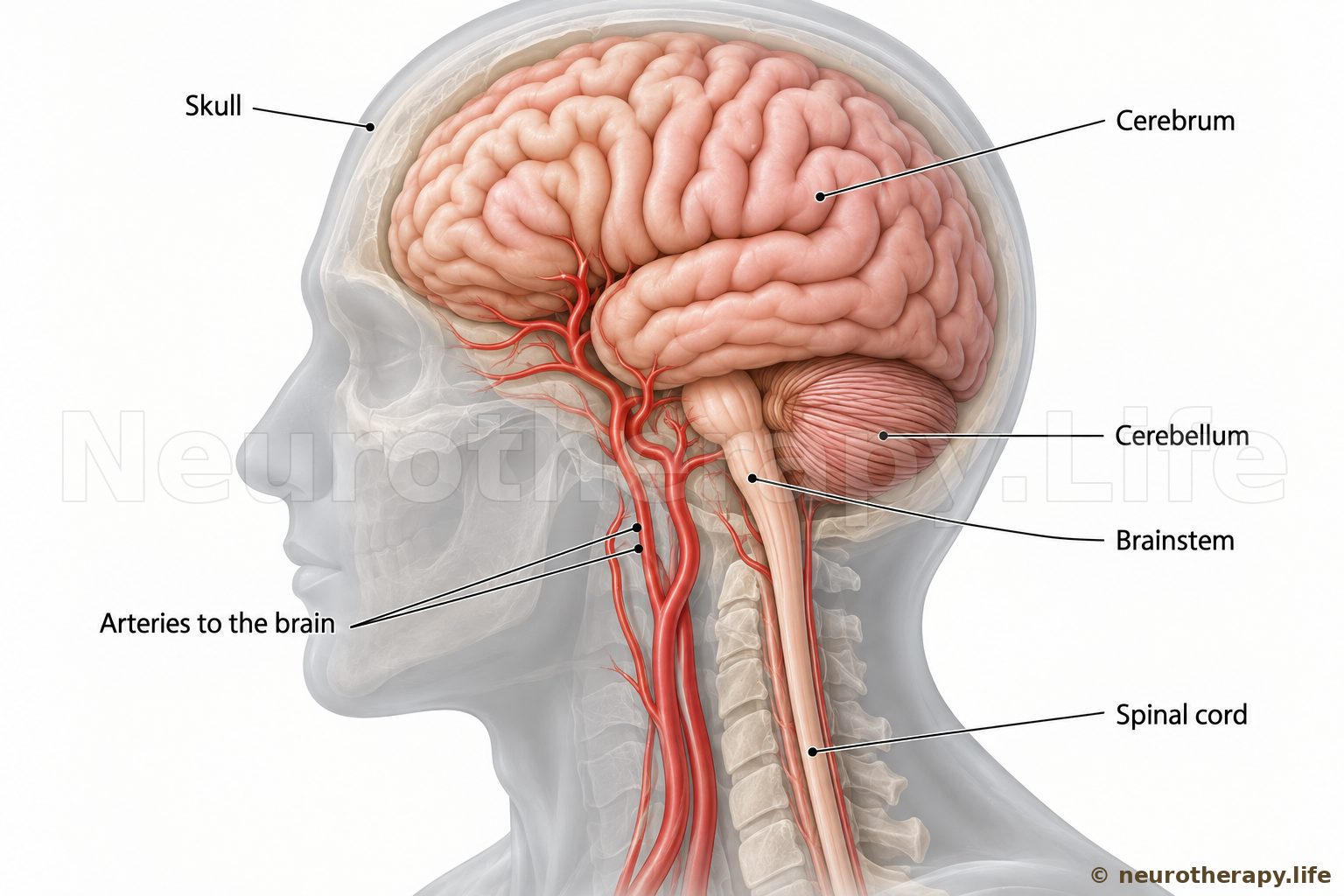
It has three main parts: the large, folded cerebrum on top, which thinks, feels and plans; the cerebellum at the back, which keeps movement smooth and balanced; and the brainstem, which runs breathing and heartbeat.
Every sight, sound, word, memory and movement passes through it. Deep inside, small centres also control hunger, thirst, body temperature, sleep and the body's hormone glands.
The brain cannot store fuel, so it needs a steady flow of blood every second. A few minutes without it can cause lasting damage — which is why a stroke is an emergency.
The three main parts of the brain: cerebrum on top, cerebellum at the back, brainstem below.
Function
What does the brain do?
Think of the conductor of a very large orchestra. Thousands of reports arrive every second from the eyes, ears, skin and organs. The brain reads them, compares them with what it remembers, decides, and sends out orders — often before you are aware anything has happened.
Thinking and deciding: planning, judging, solving problems and controlling impulses — mostly in the front of the brain.
Memory and learning: storing new facts and skills, and bringing them back when needed.
The senses: making sense of sight, hearing, touch, taste and smell.
Movement: starting every voluntary movement and, through the cerebellum, keeping it smooth and balanced.
Speech and language: in most people, the left side of the brain forms words and understands them.
Emotion and behaviour: fear, pleasure, mood and social behaviour come from networks deep inside.
The inner household: the hypothalamus sets body temperature, hunger, thirst and sleep, and commands the pituitary gland.
Life support: the brainstem keeps breathing, heartbeat and blood pressure running automatically.
How does the brain work with other organs?
Spinal cord — Its main cable to the body, carrying orders down and reports up.
Medulla (brainstem) — The lowest part of the brainstem, which keeps breathing and heartbeat going.
Cranial nerves — Twelve pairs of nerves that leave the brain directly to serve the eyes, face, ears, throat and tongue.
Pituitary gland — The pea-sized 'master gland' hanging below the brain, directed by the hypothalamus.
Eyes — The retina is an outgrowth of the brain; sight is finally made at the back of the head.
Heart — About 15% of every heartbeat's blood goes to the brain.
Blood vessels — Two carotid arteries in the neck and two vertebral arteries in the neck bones feed it.
Glands and hormones — Through the hypothalamus and pituitary, the brain steers thyroid, adrenal, growth and reproductive hormones.
Anatomy
What are the parts of the brain?
The brain is easiest to learn in four groups: the cerebrum and its lobes, the deep centres, the cerebellum and brainstem, and the coverings that protect and feed it.
The cerebrum and its four lobes
The cerebrum is split into left and right halves, joined by a thick bridge of fibres called the corpus callosum. Each half has four lobes.
Frontal lobe — Behind the forehead. Planning, judgement, personality and the orders for movement. On the left, Broca's area forms speech.
Parietal lobe — At the top. Touch, pain, temperature and the sense of where the body is.
Temporal lobe — Behind the temples. Hearing, understanding language and forming memories.
Occipital lobe — At the back of the head. Vision — including Brodmann's areas 17 and 18, which turn signals from the eyes into sight.
Cortex — the grey outer layer — A folded sheet only 2–4 mm thick that holds most of the thinking cells.
The deep centres
Thalamus — The relay station. Almost every sense stops here before going on to the cortex — smell is the one exception.
Hypothalamus — Only about the size of an almond, it sets body temperature, hunger, thirst and sleep, and sends orders to the pituitary.
Pituitary gland — A pea-sized gland on a stalk below the hypothalamus that directs many other glands.
Hippocampus — A curved, seahorse-shaped structure that turns today's events into lasting memories.
Amygdala — An almond-shaped centre for fear and strong emotion.
Basal ganglia — Clusters that smooth and start movements; they depend on dopamine, which is lost in Parkinson's disease.
The cerebellum and the brainstem
Cerebellum — The 'little brain' at the back. Balance, posture and smooth, well-timed movement.
Midbrain — The top of the brainstem. Eye movements, reflexes to sound and light, and part of the body's own pain-dampening system.
Pons — The 'bridge' in the middle of the brainstem, linking the cerebrum and cerebellum and giving rise to several face and eye nerves.
Medulla — The lowest part, running breathing, heart rate, blood pressure, swallowing and coughing.
Coverings, fluid and blood supply
Skull — A bony box of fused plates that protects the brain.
Meninges — Three wrappings: the tough dura, the web-like arachnoid, and the thin pia that hugs the brain.
Ventricles and brain fluid (CSF) — Four connected chambers make a clear fluid that cushions the brain and carries away waste.
Blood–brain barrier — Tightly sealed vessel walls that keep most chemicals and germs in the blood out of the brain.
Arteries of the brain — Two carotid and two vertebral arteries join in a ring under the brain, so blood can reroute if one narrows.
Where is the brain located?
The brain fills the skull. The front of the cerebrum lies behind your forehead and above your eyes; the back lies under the bump at the back of your head.
The cerebellum tucks in low at the back, just above the nape of the neck. The brainstem runs down the middle and passes through a large opening at the base of the skull to become the spinal cord.
Just below the brain sit the pituitary gland, in a small bony cup behind the nose, and the nerves to the eyes, which cross just in front of it.
A living brain is pinkish-grey and soft — about as firm as set curd or soft tofu. Its surface is folded into ridges and grooves, which pack a large sheet of cortex into a small skull.
A deep groove runs front to back, dividing it into two halves that look almost the same. The cerebellum at the back has much finer, closely packed folds, like the tightly packed gills of a mushroom.
Cut open, it shows a grey outer rim (the cortex) and a paler white core — the insulated cables linking one area to another.
How big is the brain?
An adult brain weighs about 1.3 to 1.4 kg — around 2% of body weight — and is roughly the size of two fists held together.
It holds about 86 billion nerve cells. Surprisingly, about 69 billion of them are packed into the small cerebellum at the back.
Size alone does not decide intelligence: healthy adult brains vary a good deal in weight, and a larger head does not mean a cleverer person.
Conditions and disorders
What conditions affect the brain?
Brain problems can come from a blocked blood supply, bleeding, infection, injury, the way the brain developed before or around birth, or slow wear over the years. Where the problem sits decides the symptoms.
Blood supply and bleeding
Paralysis and strokeA clot or a burst vessel cuts off part of the brain; weakness of one side, speech loss or facial droop follow.
Sudden weakness or numbness of the face, arm or leg, especially on one side
Sudden trouble speaking or understanding
The worst headache of your life, or a headache that wakes you or keeps getting worse
A fit, fainting spell or blank episode
Confusion, drowsiness or memory loss
Sudden loss of balance or co-ordination
Double vision or sudden loss of vision
Changes in personality or behaviour
Headache with repeated vomiting, fever or a stiff neck
How do doctors check the brain?
Neurological examination — Tests of strength, feeling, reflexes, balance, eye movements, speech and thinking.
CT scan — A fast X-ray scan, often the first test in an emergency, to look for bleeding.
MRI scan — A detailed picture that shows small strokes, tumours, MS patches and inflammation.
EEG — Records the brain's electrical waves through small sensors on the scalp.
Scans of the blood vessels — Doppler ultrasound, CT or MR angiography check the arteries in the neck and brain.
Lumbar puncture — A small sample of brain fluid from the low back, to check for infection or bleeding.
Memory and thinking tests — Simple question-and-answer tests that track memory and attention over time.
How are brain problems treated?
Emergency stroke care — Clot-busting medicine or clot removal, best within the first hours — the sooner, the more brain is saved.
Medicines — For fits, Parkinson's disease, migraine, infection, swelling or mood, depending on the cause.
Surgery — To remove a clot or growth, stop bleeding, or place a shunt to drain extra fluid.
Rehabilitation — Physiotherapy, speech therapy and occupational therapy help the brain rewire and regain skills.
Psychological care — Counselling and specialist psychiatric care for mood, anxiety and thinking disorders.
Protecting the blood vessels — Treating blood pressure, sugar and cholesterol to prevent further strokes.
Neurotherapy (LMNT)
The Medulla family began with the brain. Children the families called 'slow of mind' improved in body when their digestion was set right, but their parents said the mind had not changed much. Guruji went to find out how the brain is supplied with blood. He learned that the great arteries to the brain rise past the side of the ear, and that every nerve between brain and body passes through the medulla, low at the base of the brain. Both come nearest the surface at one patch of skin between the ear and the neck. He rubbed there with his thumbs, and in several of those children something changed. LMNT teaching is frank that no thumb reaches the brain: the treatments are named for what they aim at. Over the years the count was found to matter — a different number of strokes, a different effect.
Points
(6) Medulla — The hypothalamus treatment, the first one found: hunger, thirst and body temperature; LMNT teaching reports benefit in meningitis, fits and paralysis.
(2) Medulla — Listed for the eyes and speech, balance and posture, ataxia, the cerebellum and Parkinson's disease.
(8) Medulla — Linked with serotonin: deep sleep, low mood, vertigo and giddiness; the index also gives it for the cerebellum and for the brain's arousal system in coma.
(12) Medulla — Linked with the hippocampus: fits that come during sleep or just after waking.
(20) Medulla — Linked with dopamine: Parkinson's disease and fits.
(15) Medulla — Linked with acetylcholine: given first, before any cranial-nerve Medulla; taught for MND, GBS, myasthenia gravis and MS.
Brodmann's Area 17 & 18 Ghisai — Rubbing the scalp at the back of the head, over the two visual areas, for troubles of the brain, the eyes and speech. The areas are inside the skull; only the scalp is rubbed.
Hammering — Light tapping all round the head with a soft hammer or finger pads, through a cloth, never over the ear — for speech, paralysis and brain diseases. The side crosses: left side of the head for speech, right side for a weak left limb.
Speech Point — Tapping above the left temple, over the area of the brain that forms speech, for people whose speech is unclear after paralysis.
Feather Touch — The lightest touch in the therapy, taught as very beneficial in paralysis, stiffness, pain and all diseases of the brain.
Mesencephalon — A counted rub beside the neck bones, named for the midbrain.
(6) Medulla (8) Pan (7) Liv (8) Ch. Only — for headache, brain diseases, paralysis after an infarct, meningitis, encephalitis, hydrocephalus, dullness of intellect and memory. LMNT teaching reports much benefit in paralysis patients over forty years.
“I am yet to understand the human body. My knowledge is hardly the tip of the iceberg. Neurotherapy (LMNT) is just in its infancy. There is a long way to go.”
— Dr. Lajpatrai Mehra
“Every person, from a one-day-old infant up to the age of a hundred years, can take this treatment.”
— Dr. Lajpatrai Mehra
Never do this
Emergency — think FAST: Face drooping, Arm weak, Speech slurred — Time to call an ambulance (108/112). Also call at once for the worst headache of your life, a first fit, or sudden loss of sight or balance. Clot treatment works only in the first hours.
After a knock to the head, go to hospital if there is vomiting, drowsiness, confusion, a worsening headache, fluid from the nose or ear, or a fit. Nothing is given at the head or neck in the meantime.
Hammering is always light, through a cloth, and never over the ear. It is withheld after a recent head injury, over a plate, shunt or skull defect, and where fits are poorly controlled. Hammering
Fits: Pan and Pit are not given in Normal treatment ('Do not give Pit to a Fit!'); Pan may be given only inside the Heparin formula. Never advise stopping or reducing fit medicines. Epilepsy (fits)
Schizophrenia: Pan is not given in Normal treatment, because some patients began to hear bells in the ear after it; it may be given inside the Heparin formula. Explain before every touch, and never treat improvement as a reason to reduce medicine. Schizophrenia
(20) Medulla is not given in heart disease or high blood pressure; (8) Medulla is not given in high blood pressure or in inflammation. (20) Medulla
(6) Medulla is not given to boys and girls aged 13 to 20 who come to increase height, unless there is a special need. With a brain shunt, the neck is pressed only lightly. (6) Medulla
Keep taking the medicines your doctor prescribed, exactly as told. Neurotherapy (LMNT) works alongside your medical care, never instead of it.
Care
How can I keep my brain healthy?
What is good for your heart and blood vessels is good for your brain — and the brain also needs sleep, learning and company.
Control blood pressure
High blood pressure is the leading cause of stroke. Check it regularly after 30.
Sleep well
Deep sleep helps the brain store memories and clear away waste.
Keep moving
Brisk walking most days improves blood flow to the brain.
Keep learning and talking
New skills, reading, music and time with people keep brain networks busy.
Protect your head
Wear a helmet on two-wheelers and a seat belt in cars.
Eat for the brain
Vegetables, fruit, whole grains, pulses and nuts; enough vitamin B12; less salt and sugar.
Avoid tobacco and limit alcohol
Both damage blood vessels and brain cells.
Get hearing and eyesight checked
Treating hearing loss keeps the brain engaged with the world.
Common questions
Do we really use only 10% of our brain?
No — that is a myth. Brain scans show activity across all parts of the brain over a day, and damage to almost any area causes some loss of function.
Can the brain repair itself after a stroke?
Dead brain cells are not replaced, but nearby areas can learn to take over. This 'rewiring' is strongest in the first months, which is why early and regular rehabilitation matters.
Why does a stroke on one side affect the other side of the body?
Most of the movement and feeling pathways cross over at the base of the brain. So the left brain controls the right side of the body, and the right brain the left.
Is a headache a sign of a brain tumour?
Almost never. Most headaches come from muscles, blood vessels, sinuses, eyes or migraine. See a doctor if a headache is new after age 50, keeps getting worse, wakes you, or comes with vomiting, weakness or vision change.
Can the brain feel pain?
The brain tissue itself has no pain sensors. Headache comes from the coverings, blood vessels, muscles and nerves around it. This is why some brain operations can be done with the patient awake.
Does Neurotherapy (LMNT) treat the brain directly?
No hand reaches the brain. LMNT works on the skin and muscles of the neck, scalp, spine and limbs, and on the digestion, and names treatments for their aim. It is given alongside neurological care, never instead of it.
What should I ask my doctor or therapist?
Which part of my brain is affected, and what does that part do?
Do I need a CT, MRI or EEG, and what will it show?
What can I do to lower my risk of a stroke?
Which rehabilitation should start now, and how often?
(To your therapist) With my fits, blood pressure or shunt, which points are barred for me?
(To your therapist) How will we record whether the treatment is helping?
Surprising facts
12% of your weight, 20% of your energy
Your brain weighs only about 2% of your body, yet it uses about 20% of the energy you burn at rest — even while you sleep.
Source: Raichle ME, Gusnard DA. PNAS 2002;99(16):10237–10239 (the brain's energy budget)
2The 'little brain' holds most of the cells
The cerebellum at the back is only about a tenth of the brain's size, but it holds about 69 of the brain's 86 billion nerve cells — four out of every five.
Source: Azevedo FAC et al., J Comp Neurol 2009; Herculano-Houzel S, Front Hum Neurosci 2009
3The brain feels no pain of its own
There are no pain sensors in brain tissue itself. That is why surgeons can operate on some parts of the brain while the patient is awake and talking, to check that speech and movement are safe.
Source: Standard neurophysiology (brain parenchyma lacks nociceptors; pain arises from meninges and vessels); awake craniotomy practice — StatPearls, Awake Craniotomy
4Sleep washes the brain
In studies in mice, the spaces between brain cells widened during sleep and brain fluid flushed waste out much faster than when awake. It is one reason a good night's sleep leaves the mind clearer.
Source: Xie L et al., Science 2013;342(6156):373–377 (sleep drives metabolite clearance)
5You see with the back of your head
The eyes are at the front, but sight is made at the very back of the brain, in the visual area (Brodmann's area 17). This is one reason a hard blow to the back of the head can make you 'see stars'. LMNT's Brodmann's area 17 & 18 rubbing is given on the scalp over exactly this place.
Source: Kandel ER et al., Principles of Neural Science — primary visual cortex (V1, Brodmann area 17); LMNT sec. 19.2-1
6The man who could say only 'tan'
In 1861 a Paris doctor, Paul Broca, studied a patient who understood speech but could say only one syllable, 'tan'. After his death, damage was found low in the front of the left brain. That area — Broca's area — still carries his name, and it is why LMNT's speech tapping is given on the left side of the forehead.
Source: Broca P., Bulletins de la Société Anatomique de Paris, 1861 (patient 'Tan', Leborgne); LMNT sec. 19.2-2, 25.16
7Time is brain
In a major untreated stroke, the brain loses about 1.9 million nerve cells every minute. That is why doctors say 'time is brain', and why every minute saved on the way to hospital counts.
Source: Saver JL. Time is brain—quantified. Stroke. 2006;37(1):263–266
8A brain that floats
Your brain makes about half a litre of clear fluid a day and renews it several times over. The brain floats in it, so its 1.4 kg acts like only a few dozen grams — otherwise it would be crushed under its own weight.
Source: Guyton & Hall — cerebrospinal fluid formation (~500 mL/day) and buoyancy (effective brain weight ~25–50 g)
A day in the life of your brain
≈20%of your resting energy used
≈750 mLof blood flowing through it every minute
≈500 mLof clear brain fluid made
≈86 billionnerve cells at work
≈1/3of the day asleep — while it sorts memories and cleans up
Yoga
Vṛkṣāsana — the tree pose Vṛkṣāsana
Benefits
Trains balance, which uses the cerebellum, the inner ear and the eyes together
Holding still on one point is a gentle exercise in focus
Strengthens the ankles and legs
How to do it
Stand straight, feet together. Fix your eyes on a point ahead.
Shift your weight to the left foot.
Place the right sole on the inside of the left calf or thigh — never on the knee.
Join the palms in front of the chest and breathe calmly for 20–30 seconds.
Come down slowly and repeat on the other side.
Take care
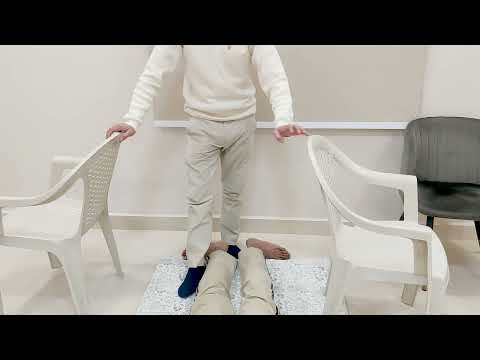
Stand next to a wall or chair and hold it if your balance is weak, if you have vertigo, or after a stroke. Keep the raised foot low (at the ankle) if the hip or knee hurts.
Viparīta Karaṇī — legs up the wall Viparīta Karaṇī
Benefits
A restful, easy pose that many people use to wind down before sleep
Rests tired legs after a day of standing
Needs no strength or flexibility
How to do it
Sit sideways next to a wall with a folded blanket nearby.
Lie back and swing both legs up the wall, hips close to it, blanket under the hips if comfortable.
Rest the arms at your sides and breathe slowly for 3–5 minutes.
Bend the knees, roll to one side and sit up slowly.
Take care
Avoid it with glaucoma, a detached retina, recent eye surgery, uncontrolled high blood pressure, heart failure, or a brain shunt, unless your doctor agrees. Come down if you feel pressure in the head or tingling in the legs.
Sukhāsana with quiet attention Sukhāsana (Dhyāna)
Benefits
Training attention on the breath is a simple mental exercise
Many people find a few quiet minutes ease stress and help sleep
Can be done on a chair by anyone
How to do it
Sit cross-legged on a folded blanket, or upright on a chair with feet flat.
Rest your hands on your knees and close your eyes.
Breathe normally and notice each breath going in and out.
When the mind wanders, gently bring it back to the breath. Start with 5 minutes.
Take care
If sitting on the floor hurts your knees or back, use a chair. People with severe depression, trauma or psychosis should practise with guidance and keep their doctor informed.
Watch
M HAPARIN FORMULA
A demo of the M. Heparin formula — the Heparin formula headed by Medulla ((6) Medulla, (8) Pan, (7) Liv, (8) Chest Only) — used for neck and shoulder pain and for headache that keeps coming back.
Cerebral Palsy in India: Challenges, Solutions & Role of Neurotherapy सेरेब्रल पाल्सी
A short Hindi podcast with a senior neurotherapist: what cerebral palsy is, its four types, early signs, causes before, during and after birth, and how Neurotherapy (LMNT) aims to support circulation to the brain and the master glands.
The talk calls Neurotherapy (LMNT) an “alternative medicine”. In LMNT teaching it works inside the child's team — doctor, physiotherapy, braces and medicines — never instead of it, and it does not reverse the brain injury.
भयंकर Migraine और सिरदर्द से तुरंत आराम | Migraine Pain Relief | 15 Medulla & Head Massage Point
Shows (15) Medulla four times below both ears, a fingertip head massage in lines from the forehead to the back of the head, and gentle circles between the eyebrows. It is shared as self-care for relief in migraine and headache.
Note: the video gives (15) Medulla; the LMNT migraine treatment uses (5) Medulla. Follow your therapist's plan.
बिना दवा गहरी नींद कैसे पाएं? | LMNT Serotonin Treatment for Sleep Disorders | Insomnia Root Cause
Shows the Serotonin treatment for sleep: (8) Medulla below the ears, 1 Gas 'I' at six points on the shin, (6) Adr on the upper back, and gentle massage behind the knees and at the back of the head. It is given to support deep, natural sleep.
Note: (8) Medulla is not given in high BP, inflammation or cancer; (6) Adr is not given in high BP, diabetes, cancer or HIV.
रात को नींद न आए तो 5 मिनट करें ये काम | Insomnia Self Treatment | भयंकर अनिद्रा का पक्का समाधान
Shows a five-minute self-routine before bed: (8) Medulla below the ears three times, pressure while sitting in Vajrasana, massage just below the knees and at the back of the head, plus tips on screens and dim light. It is shared to support better sleep.
Test yourself
Research
Strong evidence
The human brain has about 86 billion nerve cells, most of them in the cerebellum — our brain is a scaled-up primate brain, not a special exception.
In mice, sleep widened the spaces between brain cells and sped up the clearing of waste such as beta-amyloid — a clue to why sleep matters for brain health.
This page explains how the body works; it does not diagnose. Neurotherapy (LMNT) works alongside your medical care — keep taking the medicines your doctor prescribed, and see a doctor for any new or severe symptom.
Ready to begin?
Send COURSE for course details, or your name, age and health issue for a consultation.