Also called: Hammering for speech, बोली के लिए Hammering, स्पीच पॉइंट
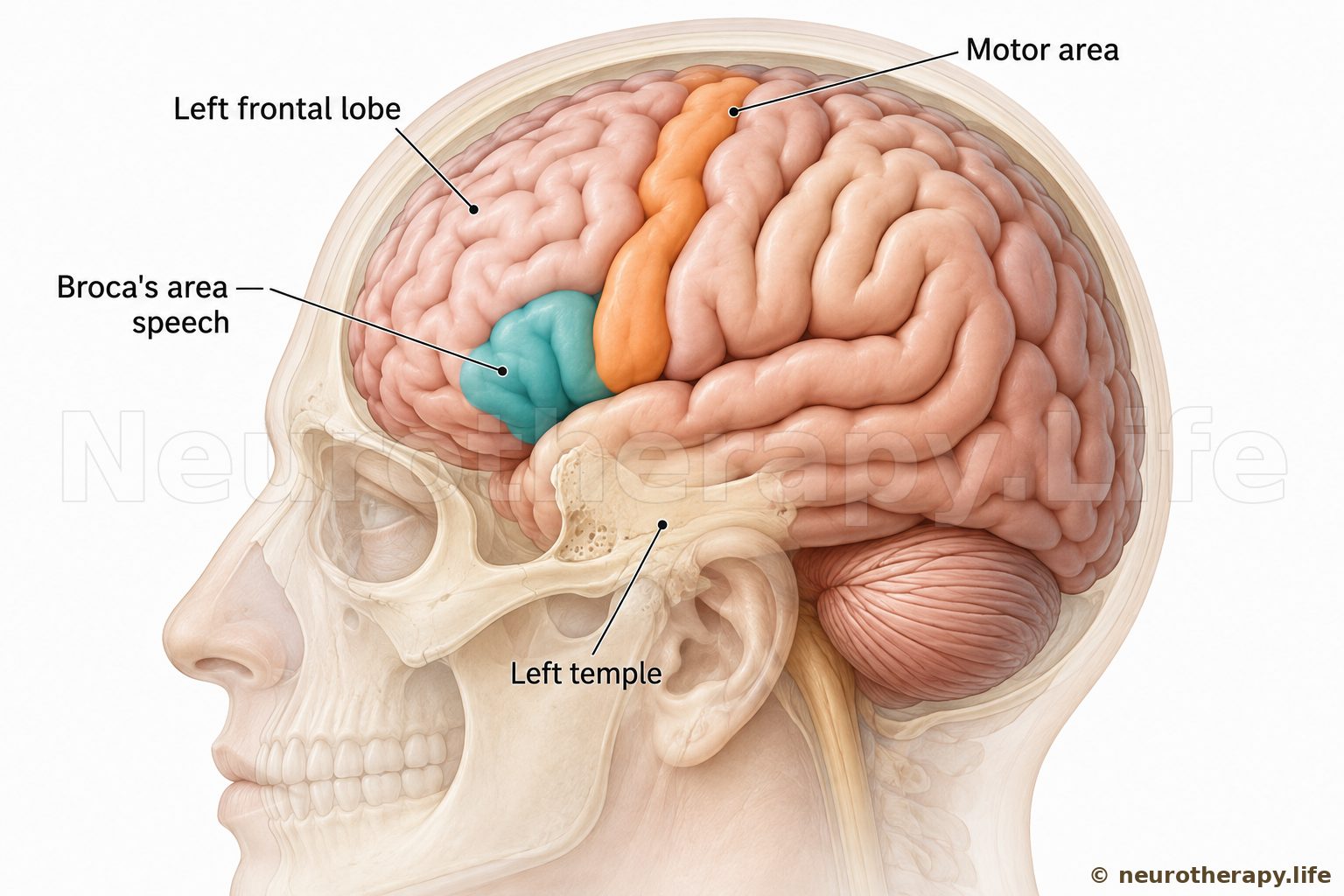
The Speech Point is the form of Hammering used for speech. In paralysis, when a person cannot speak clearly, the left side of the forehead above the temple is tapped lightly through a soft cloth, to increase blood circulation in the brain's speech area, called Broca's area.
Overview
What is the Speech Point?
The Speech Point is not a separate technique but a choice of side within Hammering — the treatment in which the head is tapped lightly through a cloth to increase blood circulation inside the brain. For speech, the tapping is given especially on the left side of the forehead, above the left temple.
Why the left? In most people, the part of the brain that turns thoughts into spoken words — Broca's area — lies at the front of the left side of the brain. It was named after a Paris surgeon who, in the 1860s, found damage there in a patient who understood everything but could say almost nothing.
In Neurotherapy (LMNT) the side crosses: the left side of the head is tapped for speech, while a person who has difficulty moving the left hand or leg is treated on the right side of the head.
Broca's area, which turns thoughts into speech, lies at the front of the left side of the brain in most people.
Where it is given
Where is the Speech Point given?
PositionSitting
Body areaLeft side of the forehead, above the left temple, through a soft cloth
You sit on a firm chair, with a soft cotton cloth or towel laid on your forehead. If you are very weak, seated treatments may also be given lying down.
The area is the left side of the forehead, above the left temple. The ear is always kept clear.
How it is given
How is the Speech Point given?
How this point is given — the tool, the pressure, the count and the exact movement — is deliberately not described here. A demonstration video for this point is being prepared; until it is on this page, learn the method hands-on from a trained Neurotherapist before giving it. Please do not give any point from a written description alone: a point given in the wrong place or the wrong way can do harm.
SideLeft side of the forehead
Feels likeLight, rapid tapping through a cloth
The exact technique is taught hands-on in the Neurotherapy (LMNT) course. See the course →
What it does
What does the Speech Point do?
The teaching says it increases the circulation of blood inside the brain above the left temple and stimulates Broca's area, the part of the brain that controls speech and pronunciation. That Broca's area governs speech is well established; that tapping over it helps is the therapy's own clinical observation.
Is used in paralysis when the person cannot speak clearly or distinctly.
Aims at Broca's area, which controls pronunciation.
Organs it reaches
Brain — Broca's area, at the front of the left side of the brain.
Mouth — Where the speech that Broca's area plans is finally shaped.
Blood vessels — The treatment aims to increase blood circulation inside the brain.
Its family
How is it related to Hammering?
The Speech Point is Hammering given on the left side for speech. Its sister points work on the head and face.
Hammering — The parent treatment: light tapping all round the head for speech, paralysis and other brain diseases.
Vocal Point — For the voice box — hoarseness or a voice that will not come out.
Bell's Palsy — For the twisted mouth of facial paralysis.
Sudden face droop, an arm that will not hold up, or speech gone thick or confused is a stroke emergency — call emergency services (108/112) at once; it is not a session. Paralysis and stroke
The ear is never struck: a tap over the ear-hole can tear the eardrum. Ears
Not given after a recent head injury, over a plate, a shunt or any known defect in the skull, or where fits are poorly controlled. Epilepsy (fits)
Nails never touch the patient — most important on thin or elderly skin and in anyone on blood-thinning tablets. A family member watches the face of a patient who cannot flinch. Hammering
“For those whose speech is impaired, hammering is to be done especially on the left side of the forehead, to stimulate their Broca's area.”
— Dr. Lajpatrai Mehra
Common questions
Why is the left side tapped for speech?
Because in most people the speech area of the brain, Broca's area, is on the left side.
My father's right side is paralysed and he cannot speak. Which side is treated?
For speech, the left side of the head. Right-sided weakness and speech loss often go together, because both are controlled from the left side of the brain.
Can it replace speech therapy?
No. Speech returns mostly through practice and the brain's own recovery. Neurotherapy (LMNT) works alongside the doctor and the speech therapist.
Surprising facts
1The patient called 'Tan'
In 1861 the French surgeon Paul Broca studied a man who could say only the syllable 'tan'. After his death, Broca found damage in the left frontal lobe — the first strong evidence that speech lives in a particular part of the brain.
Source: Dronkers NF et al. Paul Broca's historic cases: high resolution MR imaging of the brains of Leborgne and Lelong. Brain. 2007;130:1432–1441.
2Mostly on the left
Language is controlled mainly by the left side of the brain in about 95% of right-handed people and most left-handed people too.
Source: Knecht S et al. Handedness and hemispheric language dominance in healthy humans. Brain. 2000;123:2512–2518.
3Speech can keep improving
Speech and language difficulty after a stroke (aphasia) often keeps improving for months, and intensive speech therapy helps.
Source: Brady MC et al. Speech and language therapy for aphasia following stroke. Cochrane Database Syst Rev. 2016;(6):CD000425.
This page explains what a Neurotherapy (LMNT) treatment is for; it is not a self-treatment guide and does not diagnose. Neurotherapy (LMNT) works alongside your medical care — keep taking the medicines your doctor prescribed.
Ready to begin?
Send COURSE for course details, or your name, age and health issue for a consultation.