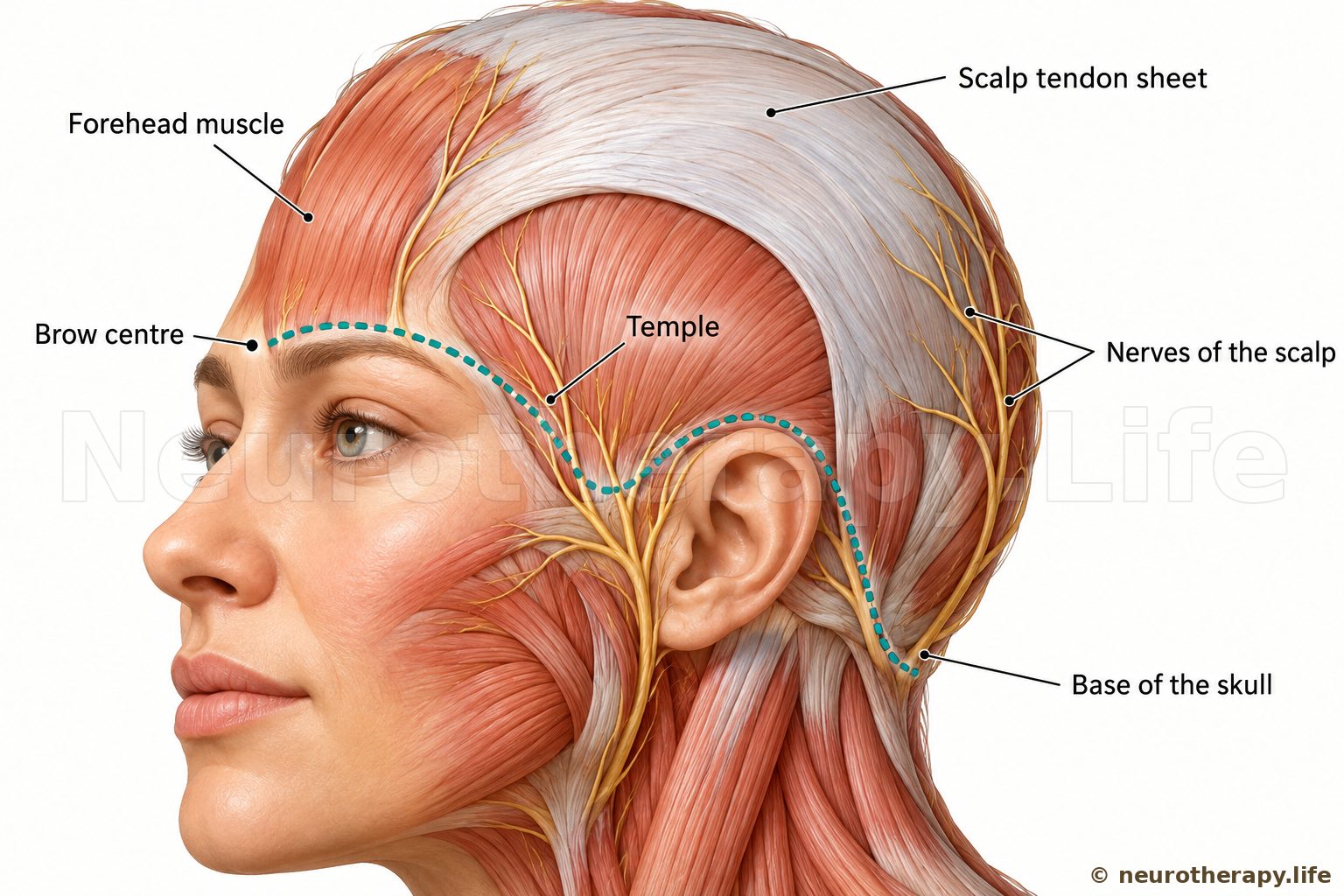
Satnam is a seated Neurotherapy (LMNT) treatment that draws the soft tissue of the head in one unbroken line — from the centre of the brow, out over the temples, round the back of the skull and down to the neck. It is described as very effective for headache and beneficial for the eyes.
Overview
What is Satnam?
Satnam means 'the true name'. It is one of the seated treatments for the head and face, and the teaching calls it very effective for headache. It is also described as very beneficial for the eyes.
It starts at the brow centre — the spot between and just above the eyebrows, which yoga calls the Ājñā chakra. From there the tissue is drawn up toward the hair, out along the brows to the temples, and then back along the ridge where the skull ends, all the way to the top of the neck.
Why does a treatment that begins at the eyebrow end at the neck? Over the top of the skull lies one broad, flat sheet of tendon, with a muscle in the forehead at the front and another above the nape at the back. It is one continuous sheet, so the route of Satnam follows a real plane of tissue — passing the nerves that leave above the eyebrows, in front of the ear and at the back of the scalp.
Satnam follows one continuous sheet of tissue — from the brow centre, past the temples, to the base of the skull.
Where it is given
Where is Satnam given?
PositionSitting
Body areaBrow centre and forehead, out to the temples, round the base of the skull to the back of the neck
You sit well back on a firm, straight-backed chair, feet flat, hands loose in your lap and head level. The therapist stands behind you, and your head rests back against the therapist's body so the draw has something to work against.
The area is the forehead and brows, the temples, the ridge at the back of the skull and the top of the neck at the back. Nothing presses on the front or the sides of the neck. Because Satnam depends on sitting, it is not adapted for a patient who must lie down.
How it is given
How is Satnam given?
How this point is given — the tool, the pressure, the count and the exact movement — is deliberately not described here. A demonstration video for this point is being prepared; until it is on this page, learn the method hands-on from a trained Neurotherapist before giving it. Please do not give any point from a written description alone: a point given in the wrong place or the wrong way can do harm.
Feels likeA slow, steady drawing of the forehead and scalp toward the back of the head
The exact technique is taught hands-on in the Neurotherapy (LMNT) course. See the course →
What it does
What does Satnam do?
The teaching says Satnam is very effective for headache and very beneficial for the eyes. The continuous sheet of scalp tissue and the nerves it crosses are real anatomy; that drawing this sheet eases headache is the therapy's own observation from clinical practice.
Eases tightness across the forehead, the temples and the base of the skull — the band where many everyday headaches sit.
Is used for headache, and patients have reported relief.
Is described as beneficial for the eyes, where tight brows and a strained forehead go together.
Organs it reaches
Muscles — The forehead and nape muscles joined by the scalp's tendon sheet.
Eyes — Named directly: Satnam is very beneficial for the eyes.
Cranial nerves — The draw passes the nerve exits above the eyebrows and in front of the ear.
Neck — The route ends at the back of the neck, where nerves of the face and neck meet.
Its family
Which treatments are close to Satnam?
Satnam belongs to the seated treatments for the head and face.
Sinus Point — A four-stage circuit of the face from the front; it may be given before Satnam in headache.
Lacrimal Point — The tear-duct point, for watering eyes — alongside eye care, never instead of it.
Shivaji — Another seated treatment that, like Satnam, cannot be given lying down.
A face that has suddenly drooped, especially with a weak or drifting arm, slurred speech or confusion, is an emergency. No face, head or neck treatment is given — call emergency services (108/112) and note the time it started. Paralysis and stroke
Never stop eye drops because a headache has not improved. Drops from an eye clinic are often for a silent pressure inside the eye (glaucoma) that takes sight slowly. Eye problems
A sudden, severe or 'worst ever' headache, or headache with fever and a stiff neck, goes to a doctor the same day. How to tell a patient to see a doctor
“This is very beneficial for headache and for the eyes.”
— Dr. Lajpatrai Mehra
A teaching case
Teaching case: the headache and the stopped eye drops
A teaching case, put together from several patients: a retired teacher in his sixties came with a year of daily headache across the brow, and mentioned that he had stopped his eye drops because they had not helped the headache. Nothing was given that first day except an explanation: the drops were for pressure inside the eye, not for headache, and he restarted them and saw his eye clinic. Only then did the headache work begin, with Satnam alongside his eye care.
A composite case written to teach the reasoning — not one patient’s file.
Common questions
Why is it called Satnam?
Satnam means 'the true name'. The source gives the name without explaining why it was chosen.
Can I have Satnam lying down?
No. Satnam depends on the seated position, with the head supported against the therapist. If you cannot sit, your therapist will choose other head and face treatments that can be adapted.
Will it pull my hair?
It should not. The hands draw the skin and tissue, not the hair, and the pads of the fingers are used, never the nails.
Can Satnam replace my headache tablets?
Neurotherapy (LMNT) works alongside your medical care. Keep any medicine your doctor has given you, and let your doctor decide changes.
Surprising facts
1Your scalp is one sheet
A flat tendon called the galea aponeurotica covers the top of the skull and links the forehead muscle to the muscle at the back of the head. Together they act as a single muscle, the occipitofrontalis.
Source: Gray's Anatomy, 41st ed., Scalp.
2The most common headache
Tension-type headache — a band-like pressure on both sides of the head — is the most common headache in the world, affecting a large share of adults at some time.
Source: World Health Organization, Headache disorders fact sheet.
3Glaucoma steals sight quietly
The common form of glaucoma usually causes no pain and no early symptoms; side vision is lost slowly and cannot be restored. Regular drops keep the eye pressure down.
This page explains what a Neurotherapy (LMNT) treatment is for; it is not a self-treatment guide and does not diagnose. Neurotherapy (LMNT) works alongside your medical care — keep taking the medicines your doctor prescribed.
Ready to begin?
Send COURSE for course details, or your name, age and health issue for a consultation.