Sinus Point and Satnam: seated treatments for the sinuses and headache
Sinus Point is one gentle circuit over the cheeks, nose and brows for the sinuses. Satnam is a continuous hold from the brow, round the temples, to the back of the neck, and is used for headache and for tired eyes.
Overview
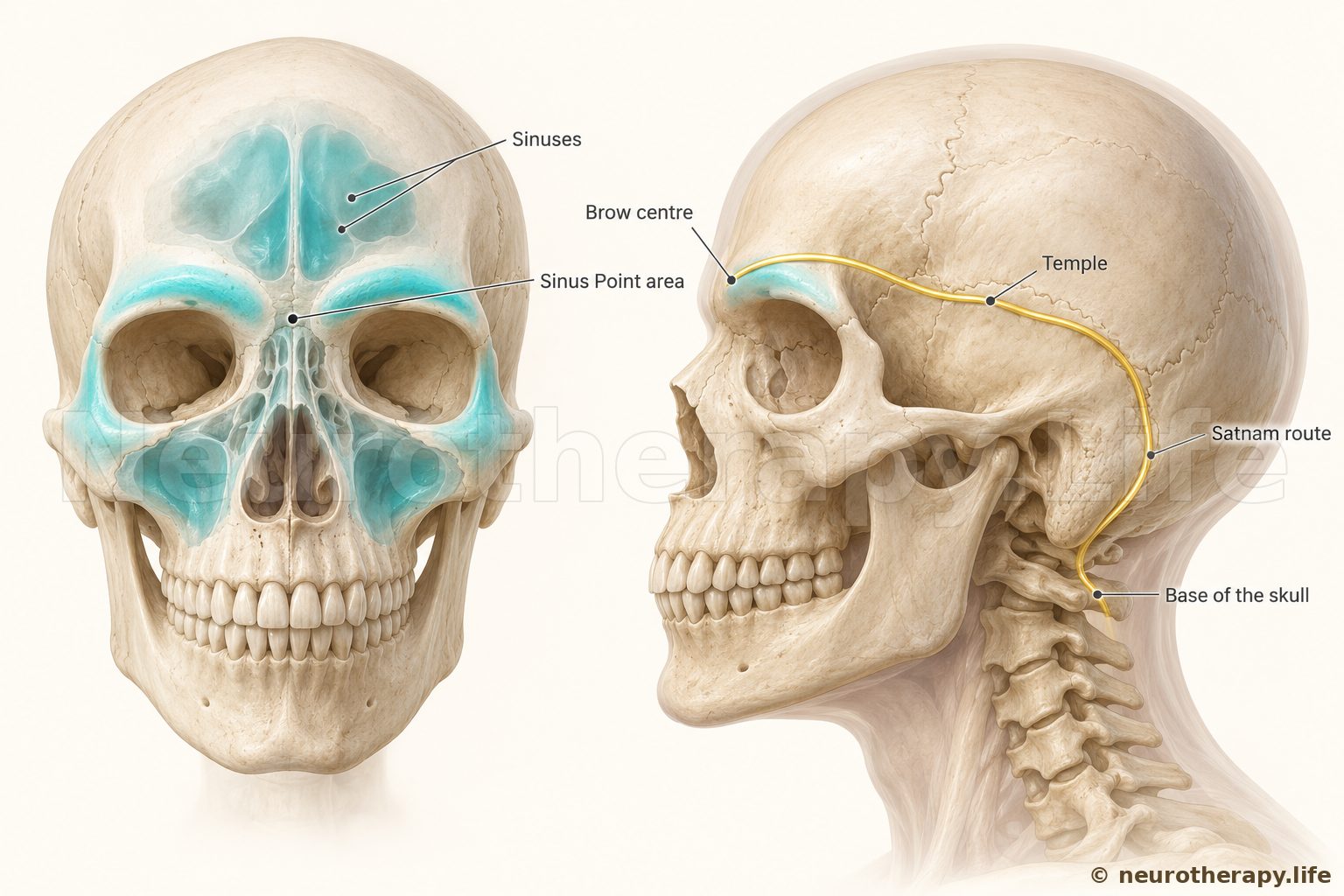
Both treatments are given with the patient seated. For the Sinus Point the therapist stands in front, palms resting on the face, and the thumbs move the skin in one loop: from beside the nose towards the ears, up the sides of the nose, out along the brows to the outer corners of the eyes, and back down to the sides of the nose and across the cheeks. It is one circuit, not four separate points.
The sinuses are air-filled spaces inside the bones of the face, and each drains through a tiny opening deep in the bone. No thumb can drain one. What the circuit does pass over are the small holes where the nerves that carry feeling from the front of the face come out of the bone.
For Satnam the therapist stands behind, with the patient's head resting against the therapist's body. The hands cover the head like a cap and draw the tissue backward: from the centre of the brow up towards the hair, out along the brows to the temples, then round along the edge of the skull to the neck, without letting go until the neck is reached. A broad sheet of tendon covers the skull from brow to nape, which is why a treatment that starts at the eyebrow ends at the neck. A second form is also very helpful for headache and for the eyes.
Satnam, 'the true name', comes from the Sikh tradition, and the brow centre is the place called the Ājñā chakra. The exact method is taught hands-on in the course.
Key points
- Sinus Point is one loop of skin movement over the cheeks, nose and brows.
- Satnam runs from the brow, round the temples, to the back of the neck, without letting go.
- Satnam is used for headache; its second form also helps the eyes.
- Facial pain with fever, and any warning-sign headache, go to a doctor first.
Go deeper
Satnam
The full page on Satnam
Sinus Point
The full page on the Sinus Point
Headache and migraine
Headache and migraine
Sinusitis, blocked nose and cold
Sinusitis, blocked nose and cold
Sinuses
The air spaces inside the face bones
Lacrimal Point
The Lacrimal Point, for watering eyes
The face points: Bell's palsy, toothache, jaw pain and watering or dry eyes
The other face points
Seated Treatments II: The Face, Jaw, Ear and Sinuses
The full guide to the seated head and face treatments
Read the full guide
This topic is part of: Seated Treatments II: The Face, Jaw, Ear and Sinuses
Safety: when it is held back
- Facial pain with fever, thick discharge, swelling round the eye or eyelid, a bulging eye, double vision or any change in vision: Sinus Point is held back and the patient sees a doctor the same day. Sinusitis, blocked nose and cold
- A headache that is the first bad one ever, that reaches full strength within seconds, or that comes with fever, weakness, numbness, drowsiness or a change in vision is checked by a doctor, not treated by hand. Headache and migraine
- Eye drops from an eye doctor are never stopped because a headache has not improved. Drops for glaucoma protect sight and have nothing to do with the headache. Eye problems
- The exact method is taught hands-on in the course, under a trained therapist. Please do not try it on yourself or others from this page.
Watch

Shows (15) Medulla four times below both ears, a fingertip head massage in lines from the forehead to the back of the head, and gentle circles between the eyebrows. It is shared as self-care for relief in migraine and headache.
Note: the video gives (15) Medulla; the LMNT migraine treatment uses (5) Medulla. Follow your therapist's plan.
This page explains what a Neurotherapy (LMNT) treatment is for; it is not a self-treatment guide and does not diagnose. Neurotherapy (LMNT) works alongside your medical care — keep taking the medicines your doctor prescribed.