1Four pairs of caves
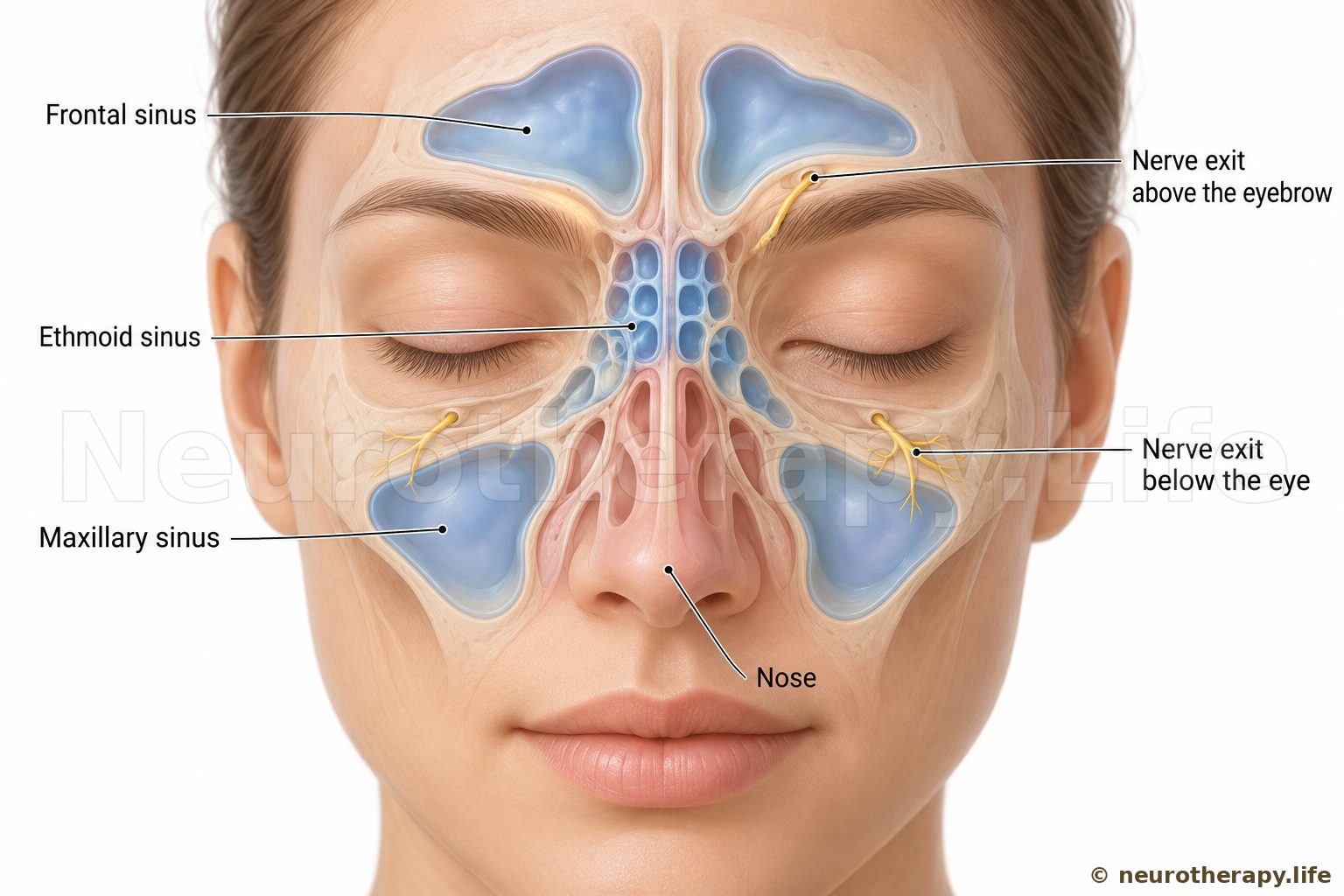
Your face holds four pairs of sinuses — frontal, ethmoid, sphenoid and maxillary. The maxillary sinuses behind the cheeks are the largest.
Source: Gray's Anatomy, 41st ed., Paranasal sinuses.
Also called: Sinus, साइनस पॉइंट
The Sinus Point is a seated Neurotherapy (LMNT) treatment given with the thumbs on the face. It is one continuous circuit — from beside the nose out toward the ears, up the sides of the nose, along the eyebrows to the outer eye and back to the cheeks — used for the sinuses.
The sinuses are air-filled spaces inside the bones of the face — beside the nose, behind the cheeks and above the eyes. They are lined with a thin moist membrane and drain into the nose through tiny openings. When the lining swells, the openings block, and the face feels full, heavy and sore.
The Sinus Point is the Neurotherapy (LMNT) treatment written for the sinuses. Although it is called a point, it is really a circuit: one loop over the face that begins and ends beside the nose.
To be honest about what it does: a thumb on the cheek cannot drain a sinus, whose opening lies deep inside rigid bone. What the circuit does pass over are the small holes in the bone — below the eye, above the inner eyebrow and beside the nose — where the nerves that carry feeling from the front of the face come out.
You sit back on a firm, flat-seated chair with your feet flat. The therapist stands in front of you and rests the palms lightly on your face, fingers near the temples, thumbs just below the eyes beside the bone of the nose.
The area is the face on both sides: the cheeks below the eyes, the sides of the nose, the eyebrows and the outer corners of the eyes.
How this point is given — the tool, the pressure, the count and the exact movement — is deliberately not described here. A demonstration video for this point is being prepared; until it is on this page, learn the method hands-on from a trained Neurotherapist before giving it. Please do not give any point from a written description alone: a point given in the wrong place or the wrong way can do harm.
The exact technique is taught hands-on in the Neurotherapy (LMNT) course. See the course →
The teaching names the sinus cavity directly as the target. Body science adds an honest note: the circuit cannot drain a sinus, but it does pass over the nerve exits of the face — and patients with a full, sore face have reported comfort from it.
It belongs to the seated treatments for the head and face.
The sinus cavity is named directly. Facial pain with warning signs goes to a doctor first.
Not directly — a sinus drains through an opening deep inside the bone, which no thumb can reach. Patients have reported that the face feels lighter and less sore; it works alongside your doctor's care.
No. That combination needs a doctor the same day. The Sinus Point is withheld until you have been seen.
Many Neurotherapy (LMNT) 'points' are really short routes. The Sinus Point is one loop that starts and ends beside the nose.
Your face holds four pairs of sinuses — frontal, ethmoid, sphenoid and maxillary. The maxillary sinuses behind the cheeks are the largest.
Source: Gray's Anatomy, 41st ed., Paranasal sinuses.
The opening of each maxillary sinus sits high on its inner wall — so it cannot drain by gravity when you stand, and depends on the tiny beating hairs of its lining.
Source: Gray's Anatomy, 41st ed., Maxillary sinus.
Most short-lived sinus infections follow a common cold and settle on their own within two to three weeks.
Source: NHS, Sinusitis (sinus infection); NICE guideline NG79, Sinusitis (acute): antimicrobial prescribing, 2017.
This page explains what a Neurotherapy (LMNT) treatment is for; it is not a self-treatment guide and does not diagnose. Neurotherapy (LMNT) works alongside your medical care — keep taking the medicines your doctor prescribed.
Send COURSE for course details, or your name, age and health issue for a consultation.