1Small but mighty
For its size, the masseter is one of the strongest muscles in the body; together the jaw muscles can bite with a force of several hundred newtons at the back teeth.
Source: Gray's Anatomy, 41st ed., muscles of mastication.
Also called: Jaw point, जॉ पॉइंट्स
Jaw Points are a Neurotherapy (LMNT) treatment given seated, on both cheeks near the angle of the jaw, for pains of the teeth and the gums. They offer comfort while a dentist is arranged — they do not replace one.
Jaw Points are a physical point of the face. On a treatment card they are drawn as a front-facing head with dots along the cheeks and jawline. The teaching calls them excellent for pains of the teeth and the gums.
They sit on the thick muscle that closes the jaw, running from the cheekbone to the angle of the jawbone — the commonest place in the head for the ache of clenching. Muscle work can quieten a jaw; it cannot treat a gum.
Do not confuse them with Teeth Points. Teeth Points are taught to the patient to give on themselves, on the painful side only, and only after the appropriate Heparin treatment; Jaw Points are a marked station given by the therapist on both cheeks.
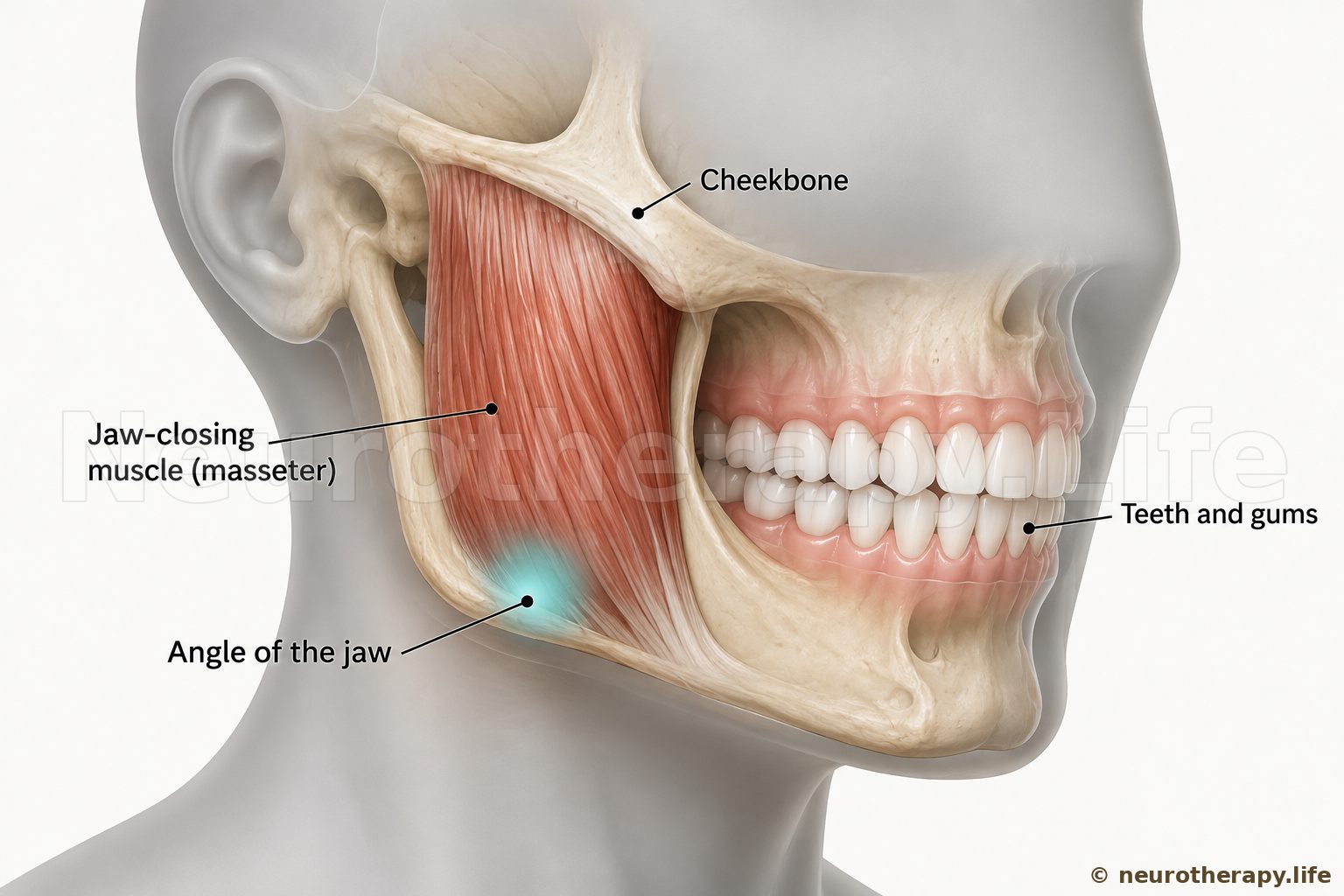
You sit on a chair. The therapist tells you before touching the face, because a face that has not been warned flinches and tightens.
The points are on both cheeks, near the jawbone — at the angle of the jaw.
How this point is given — the tool, the pressure, the count and the exact movement — is deliberately not described here. A demonstration video for this point is being prepared; until it is on this page, learn the method hands-on from a trained Neurotherapist before giving it. Please do not give any point from a written description alone: a point given in the wrong place or the wrong way can do harm.
The exact technique is taught hands-on in the Neurotherapy (LMNT) course. See the course →
The teaching gives one use: pains of the teeth and the gums. Body science confirms that the jaw-closing muscle often aches with clenching and grinding, and that pain from this muscle is commonly felt in the teeth — so easing it can bring comfort, while the tooth or gum itself still needs a dentist.
The face points are given seated, with the same rules: tell the patient first, pads never nails.
As comfort while the dentist is being arranged — and the patient is told so in those words.
No. They can ease the pain while you arrange to see a dentist, who treats the cause.
No. Jaw Points are given by the therapist on both cheeks. Teeth Points are taught to you to do yourself, on the painful side, after a Heparin treatment.
Because Jaw Points are written as a station on both cheeks. Only Teeth Points are limited to the painful side.
For its size, the masseter is one of the strongest muscles in the body; together the jaw muscles can bite with a force of several hundred newtons at the back teeth.
Source: Gray's Anatomy, 41st ed., muscles of mastication.
Tender spots in the masseter can send pain into the upper and lower back teeth, so a tired jaw muscle can feel exactly like a toothache.
Source: Standard texts on myofascial pain of the jaw muscles (temporomandibular disorders).
The lower jaw is the only bone of the skull that moves freely, hinging and gliding at the joint just in front of each ear.
Source: Gray's Anatomy, 41st ed., mandible and temporomandibular joint.
This page explains what a Neurotherapy (LMNT) treatment is for; it is not a self-treatment guide and does not diagnose. Neurotherapy (LMNT) works alongside your medical care — keep taking the medicines your doctor prescribed.
Send COURSE for course details, or your name, age and health issue for a consultation.