The face points: Bell's palsy, toothache, jaw pain and watering or dry eyes
Four seated Neurotherapy (LMNT) treatments work on the face: the Facial Point for Bell's palsy, Teeth Points and Jaw Points for tooth and gum pain, and the Lacrimal Point for dry or watering eyes. Each is given alongside medical and dental care, never in its place.
Overview
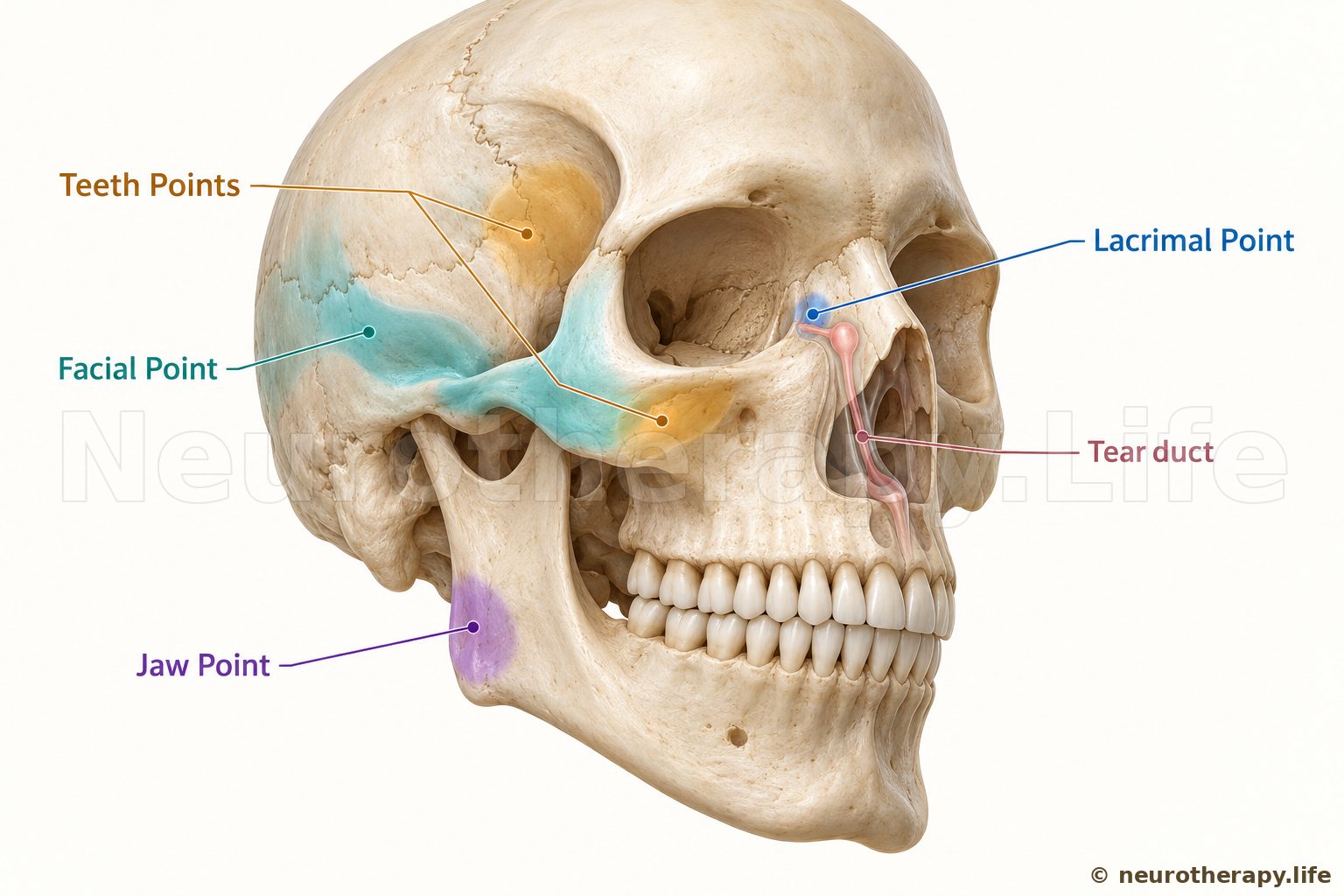
The Facial Point, also called the Bell's Palsy point, is given with the soft pads of both thumbs, never a nail. The tissue of the face is drawn gently from the side that still works, where the eye closes and the mouth pulls, across to the weak side, and finally up behind the hairline. A symbol on the treatment card records which side it starts from, so no mistake is made. The face is unusual: its muscles are anchored into the skin, so moving the skin really does move the muscle.
Teeth Points are shown to the patient so they can use them at home, on the same side as the aching teeth: near the temple and below the eye for the upper teeth, below the chin and jaw for the lower teeth. Jaw Points are given by the therapist on both cheeks, near the angle of the jawbone, for pain of the teeth and gums. Pain from a tight, clenching jaw muscle is very often felt as toothache.
The Lacrimal Point is at the inner corner of the eye, beside the nose, where tears drain into the nose. It is pressed gently through a soft, clean handkerchief, with the eyes closed. It is used for dry eyes and for eyes that water all the time. The exact methods are taught hands-on in the course.
Key points
- New weakness of one side of the face is seen by a doctor the same day, before any treatment.
- The Facial Point works from the side that still works towards the weak side.
- Teeth and Jaw Points give comfort while the dentist is arranged; they do not treat decay.
- The Lacrimal Point is given alongside the eye doctor; glaucoma drops are never stopped.
Go deeper
Bell's Palsy
The Facial (Bell's Palsy) Point in full
Bell's palsy
Bell's palsy, and how it differs from a stroke
Teeth Points
Teeth Points for upper and lower tooth pain
Jaw Points
Jaw Points at the angle of the jaw
Toothache (tooth, gum and jaw pain)
Toothache, gum and jaw pain
Lacrimal Point
The Lacrimal Point at the inner corner of the eye
Dry eyes
Dry eyes
Seated Treatments II: The Face, Jaw, Ear and Sinuses
The full guide to the seated head and face treatments
Read the full guide
This topic is part of: Seated Treatments II: The Face, Jaw, Ear and Sinuses
Safety: when it is held back
- A face that has newly drooped is a medical emergency until a doctor has seen it. If it comes with weakness of an arm or leg, slurred speech, sudden confusion or loss of vision, call emergency services at once. Note the time the face changed. Paralysis and stroke
- Severe pain in or behind the ear, blisters in the ear or mouth, fever, or an eye that cannot close all need a doctor first. An eye that will not close dries out and can be damaged. Bell's palsy
- Swelling of the face or under the jaw, fever, a jaw that will not open, or difficulty swallowing with a toothache: see a dentist or doctor the same day. Toothache (tooth, gum and jaw pain)
- The Lacrimal Point is never given on a red, painful eye, after an eye injury or recent eye surgery, or in sudden loss of vision. Nothing ever presses on the eyeball. Sudden severe eye pain with blurring, haloes and vomiting is an emergency. Eye problems
- The exact method is taught hands-on in the course, under a trained therapist. Please do not try it on yourself or others from this page.
This page explains what a Neurotherapy (LMNT) treatment is for; it is not a self-treatment guide and does not diagnose. Neurotherapy (LMNT) works alongside your medical care — keep taking the medicines your doctor prescribed.