1Why crying makes your nose run
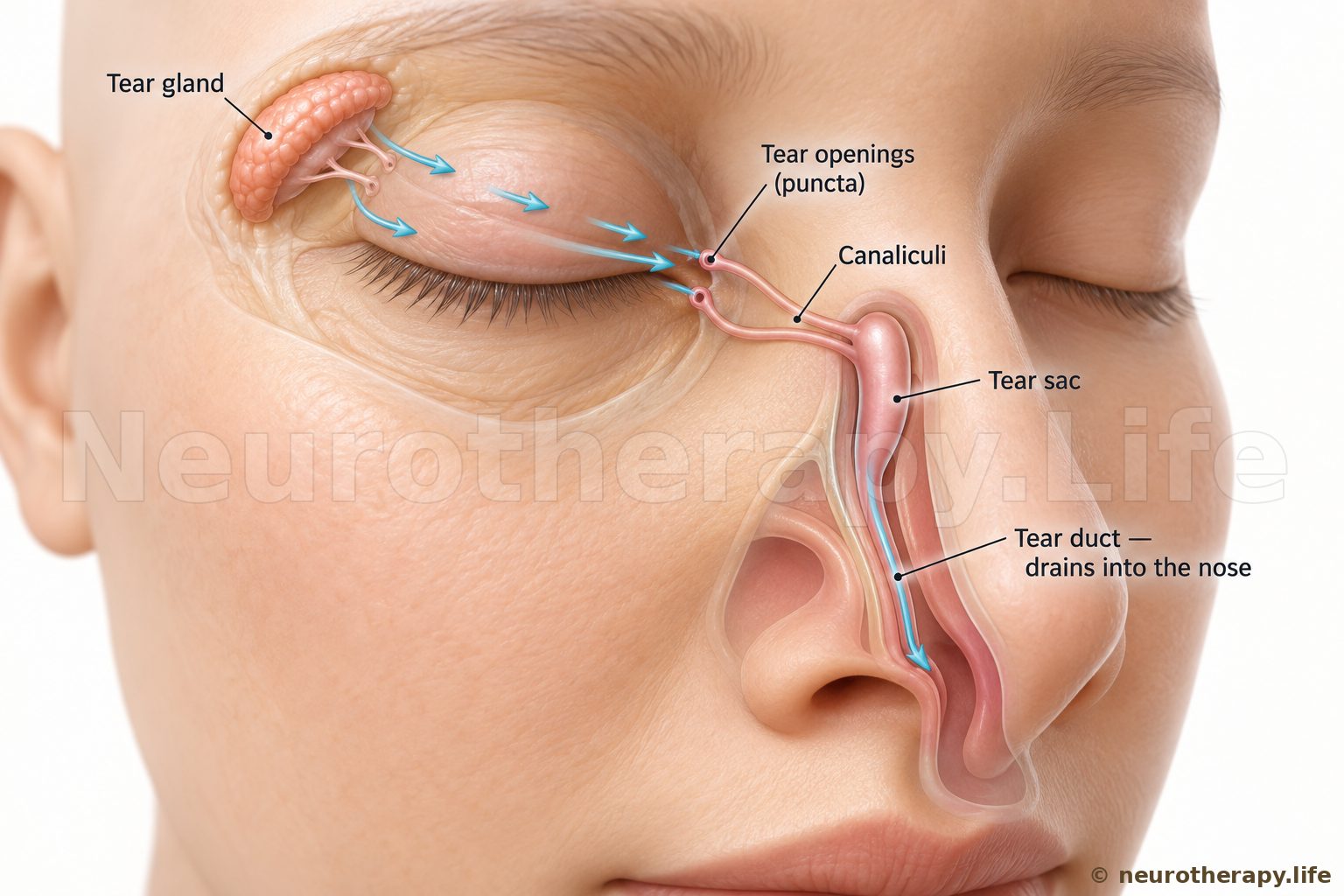
Tears drain into the nose through the tear duct, which opens under a shelf inside the nostril — so hard crying floods the nose too.
Source: StatPearls. Lacrimal Duct System Anatomy.
Also called: (30) Lacrimal duct, Lacrimal duct, Tear duct point, लैक्रिमल पॉइंट
The Lacrimal Point is a gentle Neurotherapy (LMNT) treatment at the inner corner of each eye, beside the nose, where tears drain away. It is given with the eyes closed, through a soft handkerchief, and is used for dry eyes and for eyes that water all the time — always alongside the eye doctor, never instead.
'Lacrimal' means to do with tears. Tears are made by a gland above the outer corner of the eye, wash across the eye, and drain away at the inner corner through two tiny openings. From there they pass along small channels into a little sac beside the nose, and down a duct into the nose itself.
The Lacrimal Point is given at that inner corner, on the part beside the nose next to the upper eye. On the card it is written (30) Lacrimal duct — the number in brackets is part of the point's written name.
LMNT calls it an excellent remedy for dryness in the eyes and for water constantly coming from the eyes. It is one of the face treatments, and it shares the 'caring for a tired eye' idea with the Satnam treatment for headache and the eyes.
You sit with your eyes closed. The point is the part beside the nose, next to the upper eye — the inner corner of each eye — on both sides. The eyeball itself is never touched.
How this point is given — the tool, the pressure, the count and the exact movement — is deliberately not described here. A demonstration video for this point is being prepared; until it is on this page, learn the method hands-on from a trained Neurotherapist before giving it. Please do not give any point from a written description alone: a point given in the wrong place or the wrong way can do harm.
The exact technique is taught hands-on in the Neurotherapy (LMNT) course. See the course →
LMNT uses it as a caring treatment for a tired eye and its tear system. These are the therapy's own clinical observations.
It is one of the seated face treatments.
It is given alongside the eye doctor's care. Keep every drop and appointment you have been given.
No. The eyes are closed, the eyeball is never touched, and the fingers are wrapped in a soft cloth. Tell the therapist if anything feels wrong.
No. Glaucoma is damage to the nerve of the eye from pressure inside it; the sight it takes is lost painlessly and permanently. Keep your drops and appointments.
Both are troubles of the tear film. Watery eyes can even be a sign of irritation from dryness. LMNT uses the same point for both.
Tears drain into the nose through the tear duct, which opens under a shelf inside the nostril — so hard crying floods the nose too.
Source: StatPearls. Lacrimal Duct System Anatomy.
The two tear openings at the inner corner are only about 0.2–0.3 mm across.
Source: StatPearls. Lacrimal Duct System Anatomy.
Up to about one in nine newborns has a blocked tear duct, which usually shows as a constantly watering eye.
Source: StatPearls. Lacrimal Duct System Anatomy.
The tear film has an oily outer layer, a watery middle and a mucus layer next to the eye — dry eye can come from trouble in any of them.
Source: TFOS DEWS II Definition and Classification Report. The Ocular Surface. 2017;15(3):276–283.
A reference review of the tear drainage system — the tiny openings at the inner corner, the channels, the tear sac and the duct into the nose. It explains the anatomy this point is named for; it does not test Neurotherapy (LMNT).
StatPearls. Lacrimal Duct System Anatomy. StatPearls Publishing.
This page explains what a Neurotherapy (LMNT) treatment is for; it is not a self-treatment guide and does not diagnose. Neurotherapy (LMNT) works alongside your medical care — keep taking the medicines your doctor prescribed.
Send COURSE for course details, or your name, age and health issue for a consultation.