The seated head and face treatments: what they are and the five rules for touching a face
After the neck, the seated work of Neurotherapy (LMNT) moves onto the head and the face: the back of the head, light tapping, the shoulder, the face, teeth, jaw, eyes, sinuses and ears. All of them follow the seated rules, plus five rules of their own for the face.
Overview
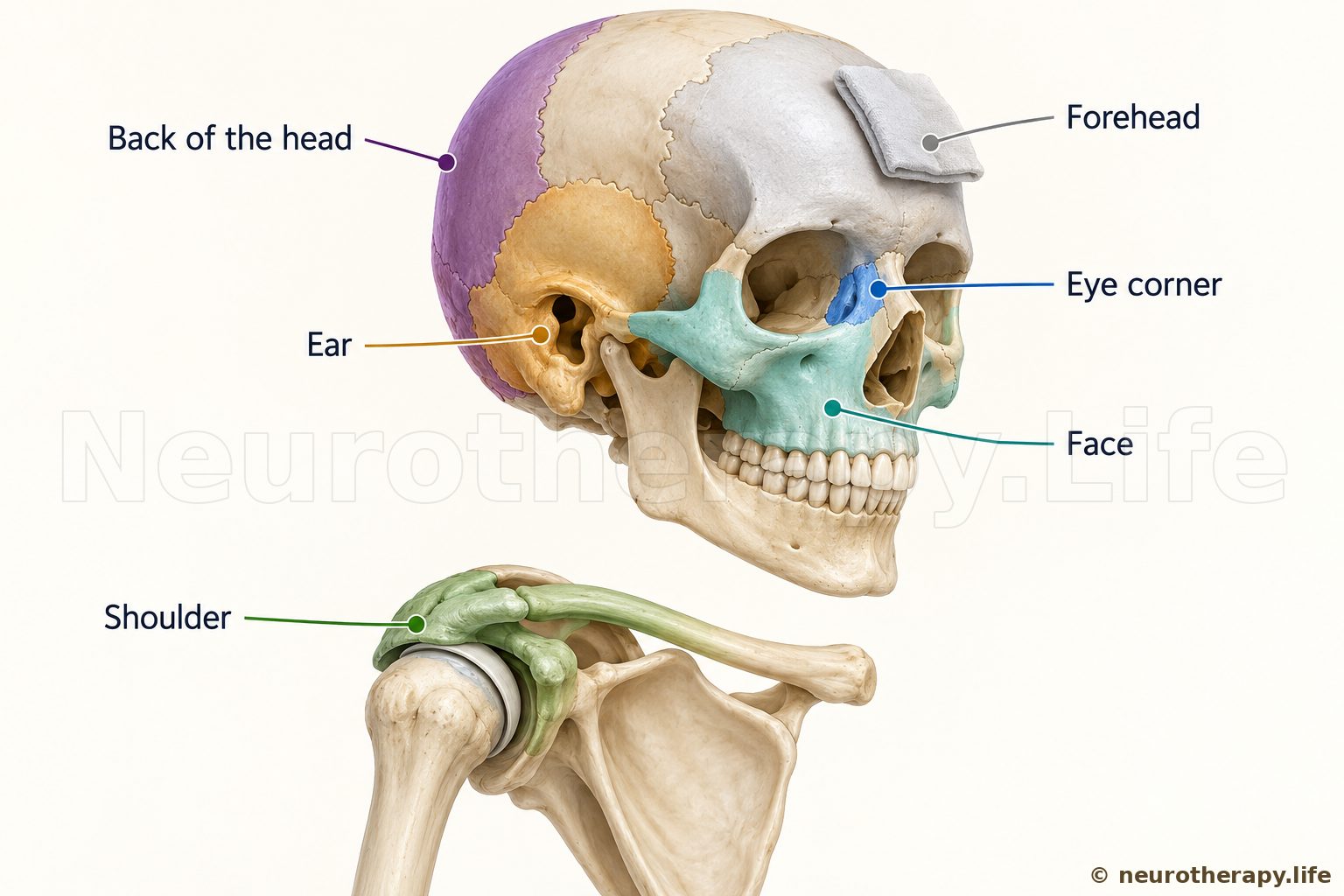
The head and face group is given on the same firm chair as the neck treatments. It includes Brodmann's Area 17 & 18 Ghisai, a gentle rubbing at the back of the head over the brain's seeing area, for the brain, the eyes and speech; Hammering, a light tapping all round the head through a soft cloth, for speech, paralysis and other brain disorders; Shivaji for a stiff shoulder; the Facial Point for Bell's palsy; Teeth and Jaw Points; the Lacrimal Point for the eyes; the Sinus Point and Satnam; and the Ear Points.
The seated rules all still apply: a slow glide, never a thrust, and no pressure on the front of the neck. The face adds five more. Tell the patient before you touch the face. Use the soft pads of the fingers, never the nails. Clear the face first. The steadying hand only steadies, it never pushes. And the hair is a limit: it is never pulled.
Many complaints of the face need a doctor before any treatment: a face that has newly drooped, facial pain with fever, a red painful eye, sudden hearing loss, or a toothache with swelling. These are listed below. After the seated work, the patient lies on the side for the next group of points. The exact methods are taught hands-on in the course.
Key points
- The head and face points are given on a firm chair, like the neck points.
- Tell the patient first, use pads not nails, and never pull the hair.
- The hand on the head only steadies it.
- Several face complaints go to a doctor before any treatment.
Go deeper
Brodmann's Area 17 & 18 Ghisai
Brodmann's Area 17 & 18 Ghisai at the back of the head
Hammering
Hammering: light tapping round the head
Shivaji: the seated treatment for a stiff shoulder and neck
Shivaji, for a stiff shoulder
The face points: Bell's palsy, toothache, jaw pain and watering or dry eyes
The face, teeth, jaw and eye points
Sinus Point and Satnam: seated treatments for the sinuses and headache
Sinus Point and Satnam
Ear Points: the seated treatment around the outer ear
The Ear Points
Lying on the side: the pillow rules that come before every side-lying point
What comes next: the side-lying points and their pillows
Seated Treatments II: The Face, Jaw, Ear and Sinuses
The full guide to the seated head and face treatments
Read the full guide
This topic is part of: Seated Treatments II: The Face, Jaw, Ear and Sinuses
Safety: when it is held back
- New weakness of one side of the face is seen by a doctor the same day, before anything is given. With arm or leg weakness, slurred speech or loss of vision, call emergency services. Bell's palsy
- During Hammering the ear is never struck, and the nails never touch the head. Hammering
- Facial pain with fever or eye swelling, a red painful eye, sudden hearing loss, and toothache with facial swelling all need a doctor or dentist the same day. How to tell a patient to see a doctor
- The exact method is taught hands-on in the course, under a trained therapist. Please do not try it on yourself or others from this page.
This page explains what a Neurotherapy (LMNT) treatment is for; it is not a self-treatment guide and does not diagnose. Neurotherapy (LMNT) works alongside your medical care — keep taking the medicines your doctor prescribed.