Brodmann's Area 17 & 18 Ghisai (the visual-area rubbing)
Also called: the visual-area rubbing, देखने वाले इलाक़े की घिसाई, Brodmann area ghisai
Brodmann's Area 17 & 18 Ghisai is a gentle rubbing at the back of the head of a seated patient, over the area of the skull that covers the brain's seeing centre. It is used alongside other treatments in eye and sight problems, and it has no count: it stops when the muscles under the skin relax, before the hair is pulled.
Overview
What is Brodmann's Area 17 & 18 Ghisai?
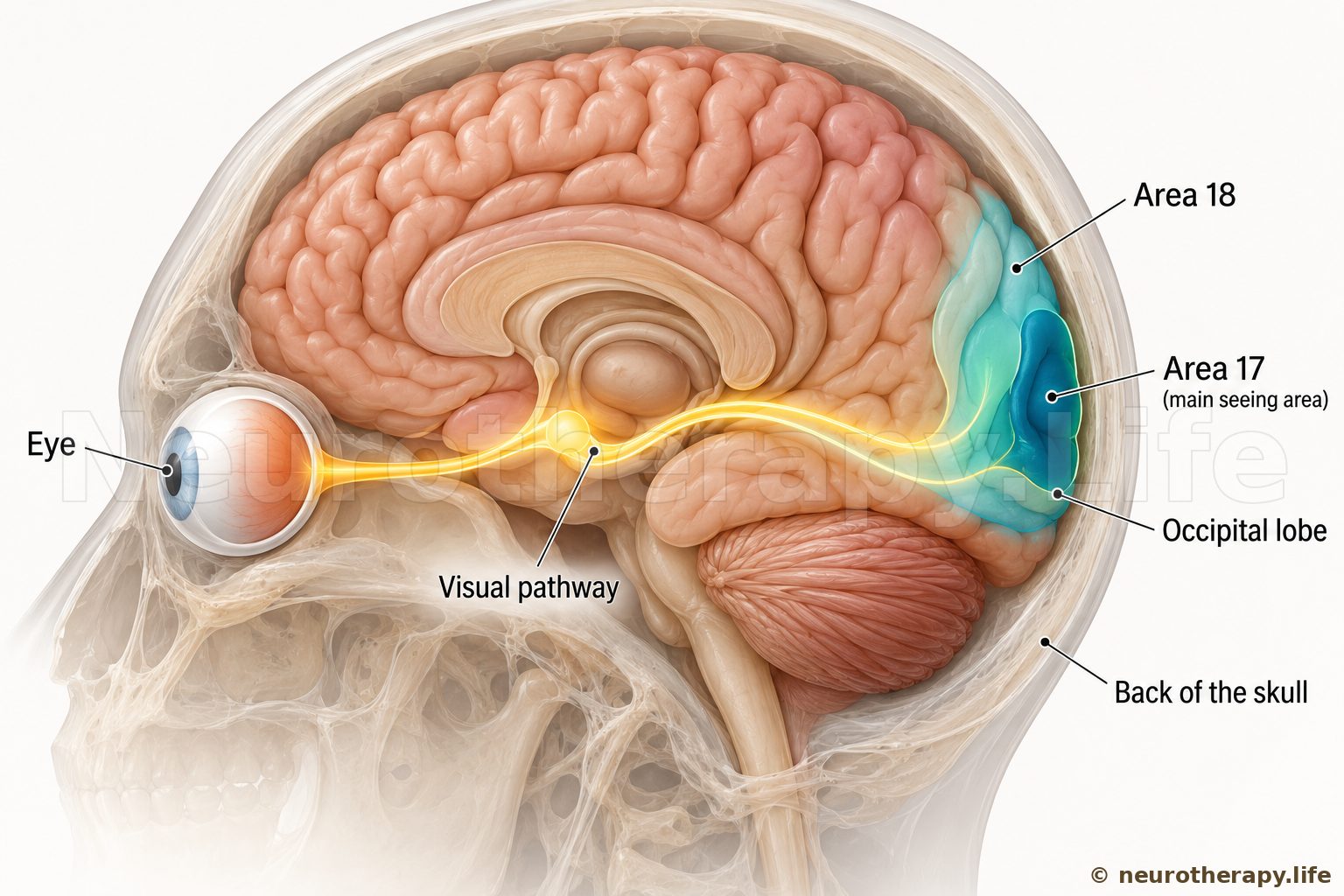
Your eyes catch light, but you actually see with the back of your brain. The first stop for signals from the eyes is a strip of brain at the very back of the head, in the occipital lobe. Scientists number brain regions by the map Korbinian Brodmann drew; the main seeing area is Area 17, and Area 18 lies around it.
In Neurotherapy (LMNT), Brodmann's Area 17 & 18 Ghisai is a rubbing (ghisai, घिसाई — the rub, not the press) given on the back of the head over these two areas: an inner circle (17) and the circle outside it (18), just above the neck.
It is one of the seated group of points for the head and face. In recorded observations it has been given together with a Medulla treatment and work to set the abdomen, in a patient with severe eye disease.
We see with the back of the brain. Areas 17 and 18 receive and sort what the eyes send.
Where it is given
Where is it given?
PositionSitting
Body areaBack of the head, just above the neck — an inner circle and the circle around it
The patient sits on a firm chair with the head level, and the therapist works from behind. If the patient is very ill or weak, the seated points may be given lying down.
The area is the back of the head, just above the neck: two circles, one inside the other, over the brain's seeing centre.
How it is given
How is it given?
How this point is given — the tool, the pressure, the count and the exact movement — is deliberately not described here. A demonstration video for this point is being prepared; until it is on this page, learn the method hands-on from a trained Neurotherapist before giving it. Please do not give any point from a written description alone: a point given in the wrong place or the wrong way can do harm.
The number written before a point's name is not a strength setting. Each numbered form is a separate named treatment with its own method and timing, taught hands-on in the course.
The exact technique is taught hands-on in the Neurotherapy (LMNT) course. See the course →
What it does
What does it do in the body?
The ghisai relaxes the muscles and scalp over the back of the head. LMNT practice places it over the brain's seeing centre and uses it alongside other treatments in eye disease; the link between rubbing here and sight is the therapy's own observation, not a proven pathway.
Relaxes the muscles under the skin at the back of the head.
Given with a Medulla treatment in eye and sight problems.
In one recorded long-term patient with severe eye disease, slight improvement in sight was reported over months — recorded as an observation, not offered as a cure.
Organs it reaches
Brain — The visual areas at the back of the brain.
Eyes — The eyes send their signals to these areas.
Cranial nerves — The optic nerve, the second cranial nerve, carries sight.
Hair — The scalp hair sets the limit of the rubbing.
Its family
Which points sit beside it?
It is one of the seated head-and-face points, and in eye work it travels with a Medulla treatment.
(2) Medulla — The Medulla form linked to the optic nerve and the retina; given with this ghisai in a recorded eye case.
Hammering — Another seated head point, given on the forehead.
Lacrimal Point — The tear point beside the nose, for the eye.
Satnam — A seated draw over the forehead and head.
What it is used for
What is it used for?
It is used within a plan for the eyes, never on its own and never in place of eye care.
Eyes and sight
Eye problemsGiven with a Medulla treatment and digestive work in eye and sight problems.
Double vision (diplopia)Sight problems that arise in the brain's visual system call for urgent medical assessment first.
Safety: when it is held back
Sudden loss of sight, sudden double vision, a painful red eye, or flashes and a curtain over vision are emergencies — see an eye doctor the same day, before any treatment. How to tell a patient to see a doctor
Never stop eye drops (for example for glaucoma) or other eye treatment because Neurotherapy (LMNT) has started. Neurotherapy (LMNT) works alongside the eye doctor. Eye problems
The hair is the limit: stop before the hair is pulled or damaged. Pads and thumb edge only — nails never touch the patient.
A new, severe or 'worst ever' headache, or a recent head injury, is sent to a doctor before the head is touched. Headache and migraine
Because the brain's seeing centre lies at the back of the head, not behind the eyes. Neurotherapy (LMNT) places this ghisai over that area and uses it alongside other treatments.
How long does it last?
There is no fixed count. It continues until the muscles under the skin relax, and stops before the hair is pulled.
Can it restore my sight?
No promise can be made. It is a supporting treatment given with others, alongside your eye doctor's care. Keep all your eye check-ups and medicines.
Surprising facts
1You see with the back of your head
The main visual area of the brain sits in the occipital lobe at the very back of the head — about as far from the eyes as the brain goes.
Source: Standard neuroanatomy: Gray's Anatomy (41st ed.), occipital lobe and primary visual cortex.
2A map from 1909
The German neurologist Korbinian Brodmann divided the brain's surface into numbered areas by looking at its cells under a microscope. His numbers — Area 17 for the main seeing area — are still used today.
Source: Brodmann K. Vergleichende Lokalisationslehre der Grosshirnrinde, 1909; standard neuroanatomy texts.
3Healthy eyes, yet blind
If both visual areas at the back of the brain are damaged, as after some strokes, a person can lose sight even though both eyes are healthy. This is called cortical blindness.
This page explains what a Neurotherapy (LMNT) treatment is for; it is not a self-treatment guide and does not diagnose. Neurotherapy (LMNT) works alongside your medical care — keep taking the medicines your doctor prescribed.
Ready to begin?
Send COURSE for course details, or your name, age and health issue for a consultation.