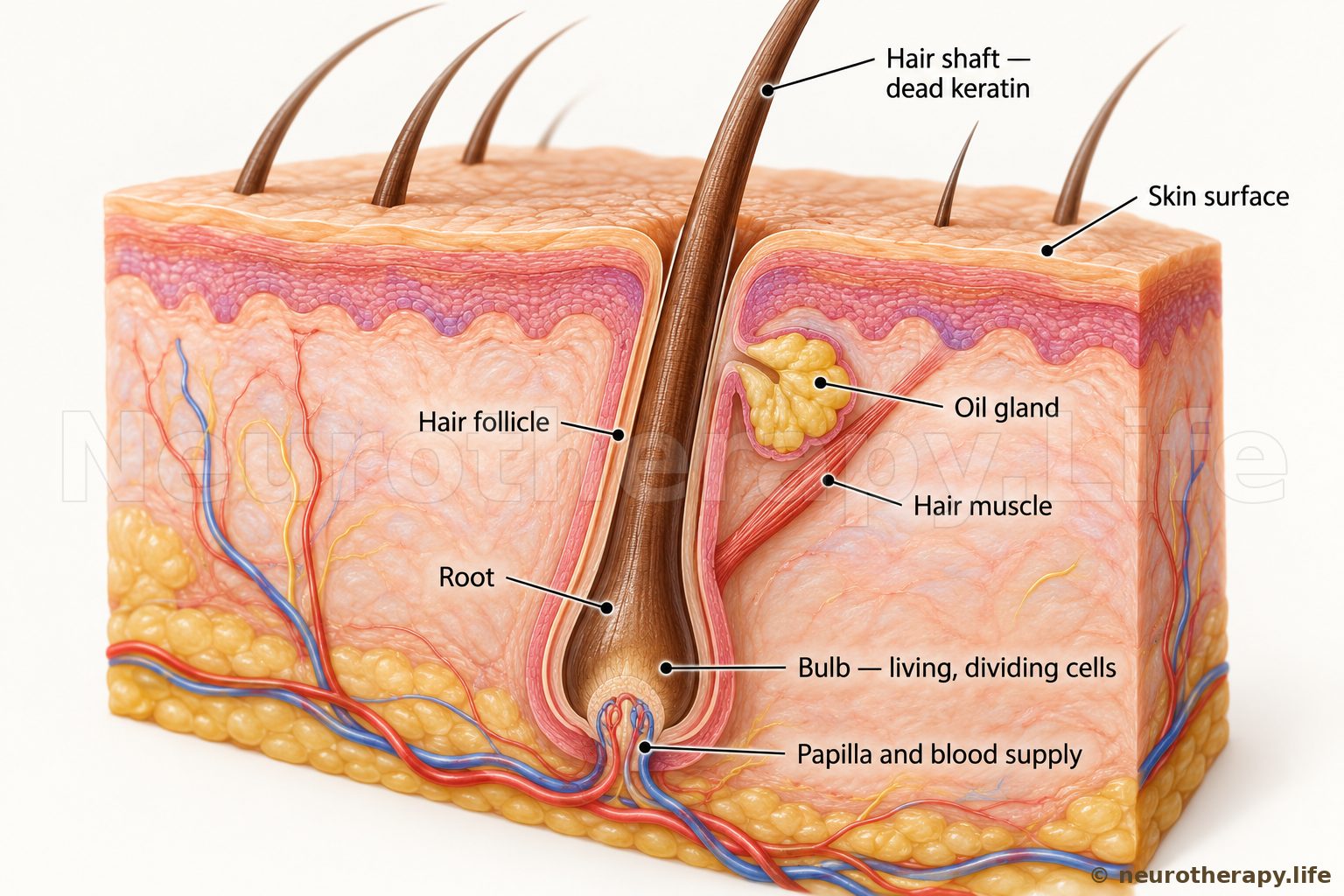
The hair you comb is dead — only its root, deep in the skin, is alive. Your scalp holds about a hundred thousand of these roots, each running its own cycle of growing, resting and falling, so losing 50 to 100 hairs a day is normal. Because hair is built from protein and fed by blood, it is often one of the first places where a shortage inside the body shows.
Overview
What is hair?
A hair is a thin strand of a tough protein called keratin — the same protein as in your nails and the outer skin. It grows from a small pocket in the skin called a hair follicle, which has its own blood supply, oil gland and tiny muscle.
Hair is part of the skin and hair system. It protects the scalp from sun and injury, helps keep the head warm, and — as eyebrows, eyelashes and the hairs in the nose and ears — keeps sweat, dust and insects away from the eyes and airways. Each hair is also a fine touch sensor.
In LMNT teaching, hair is a reporter. Falling hair, dandruff, dry hair and hair going white early are listed among the signs of a body short of water and running acidic, and the teaching records patients treated for digestion who mention weeks later that their hair has stopped falling.
Only the bulb at the bottom of the follicle is alive; everything above the skin is dead keratin pushed out from below.
Function
What does hair do, and how does it grow?
At the bottom of each follicle, living cells in the bulb divide very fast, fed by a tiny blood vessel. As new cells are made they push the older ones upward; these fill with keratin, die and harden into the hair shaft. Each follicle does this in cycles: it grows for years, rests, sheds the old hair and starts again.
Protects the scalp from sunburn, cold and knocks.
Helps keep body heat in, especially from the head.
Eyebrows and eyelashes keep sweat, dust and light out of the eyes.
Hairs in the nose and ears trap dust and small insects.
Each hair acts as a touch sensor — you feel even a light brush against it.
Oil from the glands beside each hair keeps the hair and scalp supple.
Growing (anagen)
On the scalp this lasts about 2 to 7 years. Most scalp hairs — around 85 to 90 in every hundred — are in this phase at any time.
Stopping (catagen)
A short pause of about two to three weeks, when the follicle shrinks and the hair is cut off from its blood supply.
Resting (telogen)
About three months in which the old hair sits loosely in place while a new one begins below it.
Shedding and restarting
The old hair falls out — often while combing or washing — and the new hair takes its place. Because follicles are out of step with each other, you never shed all at once.
How does hair work with other organs?
Skin — Every hair grows from the skin; the scalp's health is the hair's health.
Skin — Hair, skin, nails and their glands together make the skin and hair system.
Blood — The follicle depends on blood for oxygen, iron and protein; anaemia is a common cause of hair fall.
Digestive system — Hair is made of protein, so digestion matters. Guruji's teaching: it is not enough to eat protein — it must be digested.
Glands and hormones — Sex hormones shape hair patterns — beard growth, pattern baldness, and extra hair in some hormone problems in women.
Nervous system and brain — Nerves around each follicle make hairs sensitive to touch; automatic nerves raise them in cold or fear.
Anatomy
What are the parts of a hair?
A hair has two parts — the shaft you see and the root inside the skin — and it sits in a follicle with its own small team of helpers.
The hair itself
Shaft — The part above the skin: dead, hardened keratin in three layers — a scaly outer cuticle, a thick middle cortex that holds the colour, and sometimes a soft central core (medulla).
Root — The part inside the follicle, below the skin surface.
Bulb — The swollen base of the root where living cells divide and pigment cells add colour.
The follicle and its helpers
Hair follicle — A tube-shaped pocket of skin that makes and holds the hair. Its shape decides whether hair is straight, wavy or curly.
Dermal papilla — A small knob of tissue at the base, with blood vessels that feed the growing hair and signals that control its cycle.
Oil (sebaceous) gland — Coats the hair and scalp with sebum, a natural conditioner.
Arrector pili muscle — A thread-thin muscle that pulls the hair upright in cold or fright — goosebumps.
Stem cells and pigment cells — Reserve cells in the follicle restart growth each cycle; pigment cells colour the new hair. When the pigment cells run out, hair grows grey or white.
Kinds of hair
Terminal hair — Thick, long, coloured hair — on the scalp, eyebrows, eyelashes, and after puberty in the armpits and on the body.
Vellus hair — Fine, short, pale 'peach fuzz' that covers most of the body.
Lanugo — Very fine hair that covers a baby in the womb and is usually shed before or soon after birth.
Where does hair grow?
Hair grows almost everywhere on the skin. Only a few places have none at all — the palms of the hands, the soles of the feet, the lips and a few other small areas. Most of the body is covered with fine, pale vellus hair that is easy to miss.
The thickest growth is on the scalp. Eyebrows guard the eyes from sweat, eyelashes from dust, and the hairs just inside the nose and ears act as filters. After puberty, hormones bring thicker hair to the armpits, the face in men, and other areas.
On the scalp, LMNT works through the skin while treating the hair as a limit: in Brodmann's Area 17 & 18 Ghisai the edge of the thumb rubs the back of the head so the muscles under the skin relax, but no hair is pulled or damaged. With thick or oiled hair, the therapist parts it or works through a thin dry cloth.
Under a microscope a hair looks like a thin rod covered with overlapping scales, like roof tiles. When the scales lie flat, hair looks smooth and shiny; when they are lifted by heat, harsh products or rough handling, it looks dull and breaks easily.
Hair colour comes from two kinds of melanin: a brown-black one and a red-yellow one. Round follicles tend to make straight hair and flattened follicles curly hair. Grey or white hair simply has no pigment — the air inside it makes it look white.
How much hair do we have, and how fast does it grow?
You have about 5 million hair follicles on your body, and about 100,000 of them on your scalp. You are born with all the follicles you will ever have; no new ones form after birth.
Scalp hair grows about 1 cm a month — roughly 15 cm a year. A single hair is only about 0.05 to 0.1 mm thick. Losing about 50 to 100 scalp hairs a day is normal.
Conditions and disorders
What conditions affect the hair and scalp?
Hair problems are usually one of three kinds: too much hair falling or too little growing, trouble with the scalp skin, or changes in colour and texture. Many of them are signs of something happening elsewhere in the body.
When hair falls or thins
HypothyroidismA slow thyroid gives dry, coarse, thinning hair, often with thinning of the outer eyebrows.
AnaemiaLow iron is one of the commonest causes of hair fall, especially in women.
Fever and viral feverAfter a high fever or serious illness, many hairs switch to resting at once and fall two to three months later.
Pregnancy careHeavy shedding a few months after childbirth is common and usually settles within a year.
Autoimmune disordersIn alopecia areata the defence system attacks the follicles, leaving round bald patches.
Much more hair than usual on the comb, pillow or in the drain
A widening parting or a receding hairline
Round, smooth bald patches that appear suddenly
Itchy, flaky, scaly or red scalp
A painful, swollen or pus-filled patch of scalp with hair loss
Dry, brittle hair that breaks easily
Hair going grey or white very early
New, thick hair on the face or body in a woman, especially with irregular periods
What tests check the health of the hair?
Scalp examination and trichoscopy — A skin doctor looks at the scalp and hairs, often with a magnifying device, to see the pattern of loss.
Pull test — A small bunch of hairs is gently pulled to see how many come out — a quick check for active shedding.
Blood tests — Blood count and ferritin (iron stores), thyroid tests, vitamin D and B₁₂, and in women with irregular periods, hormone tests.
Fungal scraping — Scales and broken hairs are checked for fungus when ringworm of the scalp is suspected.
Scalp biopsy — A tiny sample, taken under local anaesthetic, when the cause is unclear or scarring is suspected.
How are hair and scalp problems treated?
Treating the cause — Correcting low iron, a slow thyroid or a vitamin shortage often lets hair recover over several months.
Medicated shampoos — Anti-dandruff and antifungal shampoos for flaking and itching.
Lotions and tablets for hair loss — For example minoxidil lotion for pattern hair loss, and other medicines chosen by a doctor.
Treatment for alopecia areata — Steroid creams or injections into the patches, and newer immune medicines for severe cases.
Hormone treatment — For conditions such as PCOS that cause extra facial hair or scalp thinning.
Hair transplant — Moving follicles from the back of the scalp to thinning areas, for long-standing pattern baldness.
Neurotherapy (LMNT)
LMNT teaching does not treat hair as a separate problem. It reads falling hair, dandruff, dry hair and early greying as part of a larger picture — most often a body short of water and running acidic, with hard stools and pain at Mu°. Its composite teaching cases show why: a patient with tiredness, a slow thyroid, a slow bowel, dry skin and thin hair is read as one supply running short and 'four households reporting it', and digestive work is given first. Hair is built from protein, and Guruji's teaching insists that eating protein is not enough — it has to be digested. On the scalp itself, the hair is treated as a limit: the skin beneath is worked, but no hair is ever pulled.
Points
Mu° — The anchor finding for the acid picture. Only when Mu° is more painful than Liv° is the Acid Treatment Formula given.
(4) Thrd — The teaching names (4) Thrd for dandruff, scaling, lice and hair falling at a young age, saying the thyroid, the gall bladder and the female hormones together look after skin and hair. Not for heart patients (give (2) Thrd), nor in bamboo spine, spur or asthma.
Brodmann's Area 17 & 18 Ghisai — A rub with the edge of the thumb over the back of the head, for troubles of the brain, eyes and speech. It has no count — it stops when the muscles under the skin relax, and short of any pulling of the hair.
Satnam — A headache treatment in which the fingers draw the skin of the forehead up toward the hairline and back to the neck — the hair again marking the working area.
Medulla — In its list of proposals marked with a question mark, the teaching suggests (5) Medulla for hair that is dry and lifeless, because the fifth cranial nerve carries feeling from the skin of the upper forehead. A question mark means a hypothesis for research, not an instruction.
Gal — Pain at Gal is the common finding in skin problems; the scalp is skin, so the same digestive-first reading applies to dandruff and an itchy scalp.
The Acid Treatment Formula, for the picture that includes falling hair, dandruff and early greying — given only when there is more pain at Mu° than at Liv°.
Written for skin problems with pain at Gal — and the scalp is skin. Stomach first, then the gall bladder; it works best after the Vater formula. It contains (10) Medulla, so it is not given in diabetes or cancer.
“It is not enough that one eats protein. The thing that matters is that it is digested.”
— Dr. Lajpatrai Mehra
“Wherever there is a question mark, it is an indication that this is my own thinking, on which other people can now do research.”
— Dr. Lajpatrai Mehra
“The patient has to try it for himself and see. Every single thing will not have the same effect on every person.”
— Dr. Lajpatrai Mehra
Never do this
Emergency: swelling of the face, eyelids or scalp, or difficulty breathing after using hair dye — call 108/112. Some people are strongly allergic to dye chemicals; a patch test before every dyeing is wise. Allergy
Sudden patches of hair loss, heavy shedding with tiredness or weight loss, or new facial hair with irregular periods needs a doctor and blood tests — thyroid, iron and hormones are common, treatable causes. How to tell a patient to see a doctor
A red, swollen, painful or pus-filled scalp patch with broken hairs — especially in a child — needs a doctor soon. Scalp fungus needs tablets, and pressure or rubbing is never given over infected skin. Ringworm
ATF is given only when Mu° is more painful than Liv°. Its form (a) ends in (6) Adr, which is not given in high blood pressure, septicaemia, HIV or cancer. ATF, form (a)
(4) Thrd is not given to heart patients ((2) Thrd is given instead), nor in bamboo spine, spur or asthma. (4) Thrd
On the head and face: the hair is a limit — no pulling, no damage; nails never touch the patient; and no pressure is ever given on the front or sides of the neck. Brodmann's Area 17 & 18 Ghisai
Cancer: if the person has cancer, (10) Pan, Thymus, Pit, Lu + Sh, Rt. Ov / Lt. Ov and (30) Medulla are never given — and no one is advised to delay chemotherapy to protect their hair. Cancer care: Neurotherapy (LMNT) support
Keep taking the medicines your doctor prescribed — thyroid tablets, iron and others. Neurotherapy (LMNT) works alongside your medical care, never instead of it.
Care
How can I keep my hair healthy?
Healthy hair starts inside — with protein that is digested, enough water and iron — and is kept healthy by gentle handling outside.
Eat enough protein — and digest it
Pulses, milk, curd, paneer, nuts and seeds supply the building blocks of keratin. Eat on time, chew well and sit quietly after meals so it is digested.
Keep iron up
Green leafy vegetables, pulses and other iron-rich foods help; women with heavy periods should get their iron checked.
Drink enough water
In LMNT teaching, dry hair, dandruff and falling hair belong with a body short of water.
Handle gently
Use a wide-toothed comb, do not brush wet hair hard, and avoid very tight plaits and ponytails that pull at the roots.
Go easy on heat and chemicals
Frequent straightening, bleaching and dyeing lift the hair's scales and make it brittle. Guruji's daily rules go further and ask patients to stop hair dye; if you do dye, always do a patch test first.
Oil the hair if you like
Oiling coats the hair shaft and can reduce breakage; it does not feed the roots, which are fed by the blood.
Sleep and manage stress
Severe stress and illness can trigger heavy shedding a few months later.
Common questions
How many hairs is it normal to lose in a day?
About 50 to 100 scalp hairs a day is normal, and you may see more on days you wash or comb thoroughly. See a doctor if you are losing clearly more than usual for several weeks, notice bald patches, or see your parting widen.
Does cutting hair make it grow faster or thicker?
No. Hair grows from the living root under the skin, which does not know when the dead tip has been cut. A trim removes split ends, so hair may look healthier, but it does not change the speed or thickness of growth.
Why did my hair fall out months after a fever or childbirth?
A shock to the body — high fever, surgery, childbirth, a crash diet or severe stress — can push many follicles into the resting phase at once. They shed together about two to three months later. This kind of shedding usually recovers by itself within six to nine months once the cause has passed.
Can stress turn hair grey?
Research in mice has shown that sudden severe stress can use up the pigment stem cells of the hair, turning new hair grey. In people, early greying is mostly inherited, though thyroid problems and B₁₂ shortage can play a part. LMNT teaching lists hair going white early among the signs of the acid picture.
Is hair dye harmful?
Some people are allergic to dye chemicals such as PPD, and reactions can be severe — so do a patch test every time. Research on long-term risks is mixed. Guruji's daily rules advise patients to stop hair dye, reasoning that its chemical enters the blood through the skin and the kidneys must work to clear it; the teaching gives this as something for each person to weigh, not as a condition of treatment.
Does oiling help hair grow?
Oil does not reach or feed the roots — they are fed by the blood. But oiling coats the hair shaft, can reduce the loss of protein from the hair during washing, and makes it less likely to break, so hair may keep more of its length.
What should I ask my doctor or therapist?
What kind of hair loss is this, and is it likely to grow back?
Should I have my blood count, iron (ferritin), thyroid, vitamin D and B₁₂ checked?
Could a medicine I am taking be causing it?
Which shampoo or treatment suits my scalp, and for how long?
Is my scalp problem infectious to others in the family?
(To the therapist) Is my Mu° or Liv° painful, and what does that say about my hair?
Surprising facts
1The hair you see is dead
The shaft of every hair is made of dead, hardened keratin — which is why a haircut does not hurt. Only the bulb at the bottom of the follicle, deep in the skin, is alive, and it is one of the fastest-dividing tissues in the body.
Source: Gray's Anatomy — structure of the hair and follicle; Paus R, Cotsarelis G, N Engl J Med 1999;341:491–497.
2You were born with every follicle you will ever have
About 5 million hair follicles form before birth, around 100,000 of them on the scalp. No new ones are made afterwards; what changes through life is the kind of hair each follicle grows.
Source: Paus R, Cotsarelis G, N Engl J Med 1999; Cleveland Clinic, 'Hair'.
3Each hair keeps its own calendar
A scalp hair grows for 2 to 7 years before resting and falling; an eyebrow hair grows for only a few months. That is why scalp hair can grow long while eyebrows stay short — and because follicles keep different calendars, you never shed all at once.
Source: Paus R, Cotsarelis G, N Engl J Med 1999 (hair cycle: anagen, catagen, telogen); American Academy of Dermatology.
4Hair falls months after the shock
After a high fever, childbirth, surgery or a crash diet, many follicles switch to resting at the same moment. Nothing seems to happen — then, two to three months later, hair comes out in handfuls. Most people never connect the two events, yet the hair usually grows back.
Source: American Academy of Dermatology, 'Hair shedding' (telogen effluvium).
5About a centimetre a month
Scalp hair grows about 1 cm a month, roughly 15 cm a year. Because it grows so steadily, a long hair is like a diary: laboratories can test its segments to learn about exposures months in the past.
Source: American Academy of Dermatology (growth about half an inch a month); Society of Hair Testing — segmental hair analysis.
6Stress really can turn hair grey — in mice
In 2020 researchers showed that sudden severe stress in mice fires the nerves around hair follicles so hard that they use up the pigment stem cells. With no pigment cells left, new hair grows white — and stays white.
Source: Zhang B et al., Nature 2020;577:676–681.
7Grey hair has no grey pigment
There is no white or grey colour in a white hair. The pigment cells in its follicle have stopped working, so the hair grows without melanin, and the air and light inside it make it look white. A head of 'grey' hair is usually a mix of coloured and white hairs.
Source: Gray's Anatomy — hair pigmentation; Paus R, Cotsarelis G, N Engl J Med 1999.
Your hair in numbers
~100,000hairs on the scalp
~5 millionfollicles on the whole body, all formed before birth
~1 cmof growth a month
50–100hairs shed on a normal day
2–7 yearsgrowing phase of a scalp hair
Yoga
Vajrāsana after meals Vajrāsana
Benefits
Guruji's teaching names it as the good way to sit for twenty minutes after eating, so that digestion gets its share of blood.
Supports digestion — and hair is built from the protein that digestion releases.
Encourages an upright, relaxed posture.
How to do it
Fold a blanket and kneel on it with your knees together.
Let the big toes touch and the heels part slightly; sit back onto your heels.
Keep the back straight and rest your hands on your thighs.
Breathe normally. Start with 5 minutes and build up to 20 minutes after meals.
To come out, lean forward onto your hands and straighten one leg at a time.
Take care
Skip it, or sit on a chair, if you have knee or ankle pain, a recent knee injury or surgery, or aching varicose veins. Get up slowly.
Downward-facing dog Adho Mukha Śvānāsana
Benefits
Stretches the back, shoulders, hamstrings and calves.
Brings the head below the heart for a short time, which many people find refreshing.
Builds strength in the arms and shoulders.
How to do it
Start on hands and knees, hands under the shoulders and knees under the hips.
Tuck the toes under and, breathing out, lift the hips up and back.
Keep the knees a little bent if the back of the legs is tight; press the hands into the mat.
Let the head hang relaxed between the arms. Hold for 3 to 5 slow breaths.
Come down onto the knees and rest.
Take care
Do not do it with uncontrolled high blood pressure, glaucoma, a recent eye operation, dizziness, a shoulder or wrist injury, or in late pregnancy. Come out at once if you feel light-headed.
Alternate-nostril breathing Anuloma-Viloma
Benefits
Slows the breath and calms the mind; severe stress can trigger heavy hair shedding months later.
Helps sleep and steadiness.
Can be done sitting on a chair.
How to do it
Sit comfortably with a straight back.
Close the right nostril with the right thumb and breathe in slowly through the left.
Close the left nostril with the ring finger, open the right and breathe out slowly.
Breathe in through the right, switch, and breathe out through the left. That is one round.
Continue for 5 to 10 minutes, keeping the breath slow and even.
Take care
Never force or hold the breath. People with heart disease or high blood pressure should avoid breath-holding. Skip it with a blocked nose, and stop if you feel dizzy.
Watch
शरीर में Acid बढ़ जाए तो क्या करें? | Blood pH Balance Treatment | LMNT Acid Treatment Formula
Shows the Acid Treatment formula step by step: (8) Pan, (3) Gal, (5) Mu°, 3 Acid on the side of the right thigh, (4) Chest Only, and (6) Adr on the upper back, given without breaks. It is used to support the body's acid–alkali balance when acid is raised.
Note: the Acid Treatment formula is given only when the Mu° point is tender, and (6) Adr is not given in high BP, diabetes, cancer or HIV — the therapist checks first.
Test yourself
Research
Strong evidence
This review explains how each hair follicle is a small organ that cycles through growth, regression and rest throughout life, driven by stem cells and signals from the dermal papilla — the basis for understanding hair loss and greying.
In mice, acute stress activated the sympathetic nerves around hair follicles, which released noradrenaline and drove the pigment stem cells to be used up — so new hair grew permanently white. The link in humans is still being studied.
A review of the evidence on vitamins and minerals in hair loss found that iron and vitamin D deficiency are commonly linked with hair loss and are worth testing, while taking supplements without a proven deficiency has little support and some can even cause hair loss in excess.
This page explains how the body works; it does not diagnose. Neurotherapy (LMNT) works alongside your medical care — keep taking the medicines your doctor prescribed, and see a doctor for any new or severe symptom.
Ready to begin?
Send COURSE for course details, or your name, age and health issue for a consultation.