Acid or alkaline? The two body types in Neurotherapy (LMNT), compared symptom by symptom
Neurotherapy (LMNT) sorts most patients into one of two directions: acidic (tender Mu°, on the left) or alkaline (tender Liv°, on the right). This page sets the two pictures side by side — stool, urine, skin, periods, blood pressure and more.
Overview
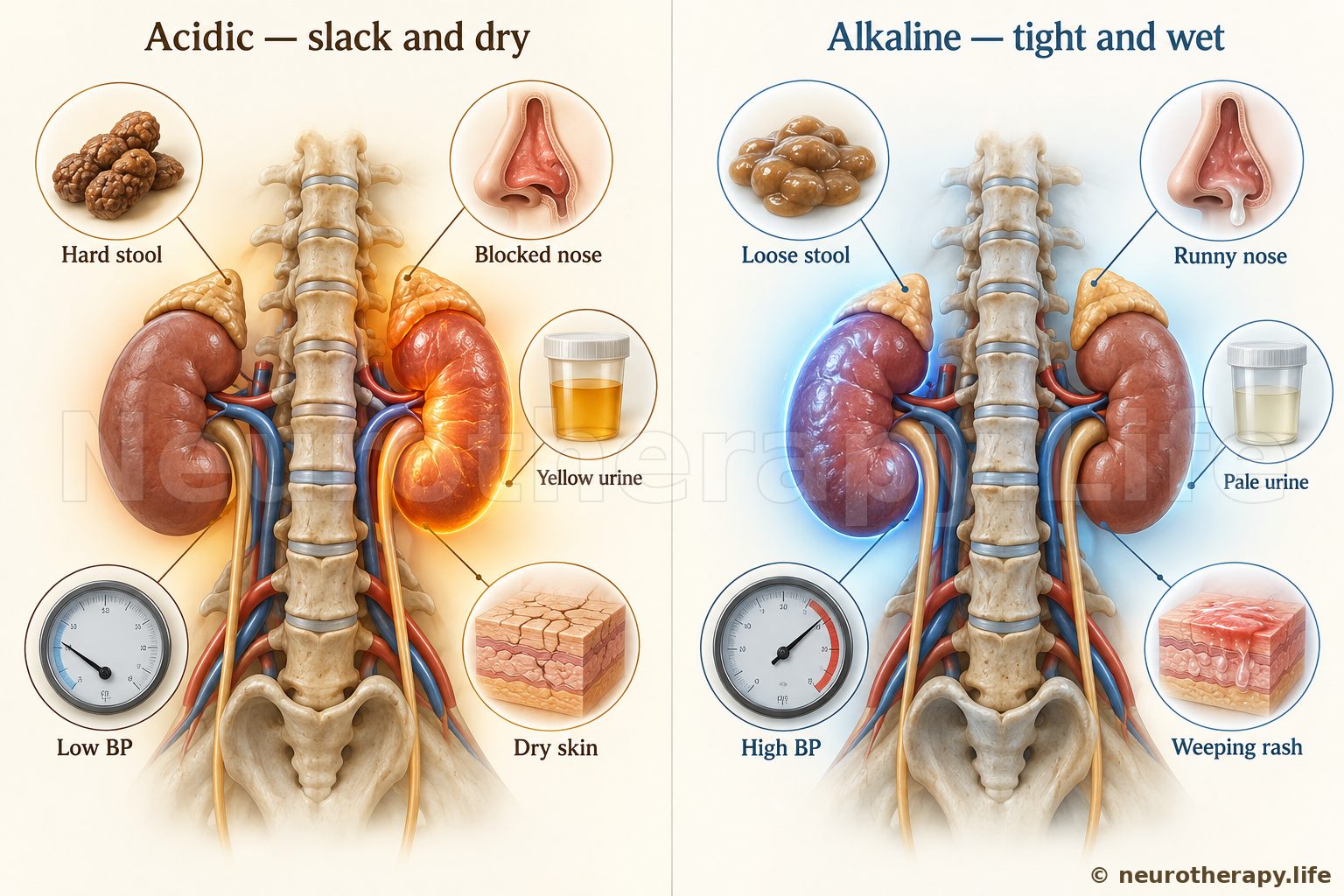
This comparison comes from more than half a century of close observation by Guruji, Dr. Lajpatrai Mehra. The acidic patient has pain at Mu° and at the Acid point; the alkaline patient at Liv°, often with pain at the Gas and Fluid points too. The acidic picture grows from too little water in the body; the alkaline from too much water held somewhere, as swelling (oedema).
The acidic body tends to be slack and dry: hard stools and constipation, a blocked nose, a dry cough or hard yellow phlegm, yellow urine with burning, scaly skin and dry hair, heavy periods lasting longer than four days, migraine at the temples, loose muscles, a slow thyroid, low blood pressure, and pains mostly on the left side of the body. Its illnesses wear things down, and it is common up to about the age of thirty-five.
The alkaline body tends to be tight and wet: loose or frequent stools, often with undigested food, a runny nose, a watery white cough, pale urine, weeping rashes, scanty periods of two or three days, headache on the top or back of the head, tight cramping muscles, a fast thyroid, high blood pressure, and pains mostly on the right. It brings fewer conditions, but they take longer to correct, and it becomes more common with age.
Nobody has a whole column. The anchor is always the tender flank point; a tender point plus two or more matching symptoms makes a reading. Each direction has its own matched family of treatments, such as ATF for the acid side and ALTF or UDF work for the alkaline side, chosen by a trained therapist.
Key points
- Acidic: Mu° tender, left side — slack and dry.
- Alkaline: Liv° tender, right side — tight and wet.
- A reading needs the tender flank point plus two or more matching symptoms.
- Acid problems are many but easier to set right; alkaline problems are fewer but slower.
- Examine first, then ask questions — never diagnose from one symptom.
Go deeper
Acidosis
Acidosis
Alkalosis
Alkalosis
Mu° pain (examination sign)
Pain at Mu° — the acid sign
Liv° pain (examination sign)
Pain at Liv° — the alkaline sign
ATF, form (a)
ATF — the acid treatment formula
ALTF (chief form)
ALTF — the alkali treatment formula
The Two Kingdoms: Acidic and Alkaline Bodies
Guide: The Two Kingdoms
Correcting the Two Kingdoms: Acid and Alkali Formulas
Guide: Correcting the Two Kingdoms
Read the full guide
This topic is part of: The Two Kingdoms: Acidic and Alkaline Bodies
Safety: when it is held back
- Never give ATF (the acid formula) in alkalosis, and never give ALTF (the alkali formula) in acidosis. The flank points must be checked before every treatment. ATF: the acid formula, given only when Mu° hurts
- The table is not a lookup list. High blood pressure, headache or a long period each have many ordinary causes. Press the flanks and write both grades before opening the questions.
- Never stop or change medicines for blood pressure, thyroid or anything else because of this reading. Neurotherapy (LMNT) works alongside your doctor's care.
Watch

Shows the Acid Treatment formula step by step: (8) Pan, (3) Gal, (5) Mu°, 3 Acid on the side of the right thigh, (4) Chest Only, and (6) Adr on the upper back, given without breaks. It is used to support the body's acid–alkali balance when acid is raised.
Note: the Acid Treatment formula is given only when the Mu° point is tender, and (6) Adr is not given in high BP, diabetes, cancer or HIV — the therapist checks first.
This page explains what a Neurotherapy (LMNT) treatment is for; it is not a self-treatment guide and does not diagnose. Neurotherapy (LMNT) works alongside your medical care — keep taking the medicines your doctor prescribed.