Liv° pain (examination sign)
Liv° is the right-kidney point of LMNT. When it hurts more than Mu°, the body seems to lean to the alkali side — but LMNT teaching first asks whether the stomach is digesting properly, because a weak stomach can make the alkali side look bigger than it is.
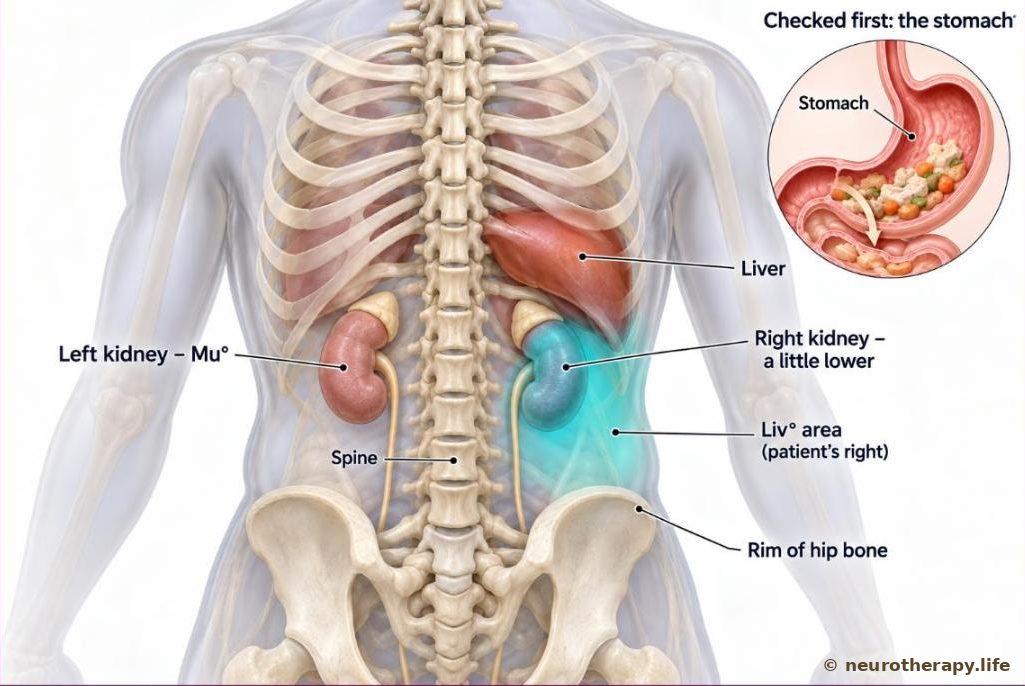
- The right kidney sits a little lower than the left, pushed down by the liver
- Each kidney is about the size of a fist, just below the rib cage near the middle of the back
- The kidneys filter about 180 litres of fluid every day
Source: StatPearls (Garza & Leslie, 2025); MedlinePlus
What is Liv° pain (examination sign)?
Liv° (say “Liv zero”) is not a disease. It is a pain point the neurotherapist presses during the examination — the point LMNT links with the right kidney. It is checked beside the navel on the right, and on the back it lies in the right flank, about half a bone lower than the left side because the liver sits above it.
In Guruji's teaching, pain at Liv° — more than at Mu° — points to the alkali side, which LMNT links with too much water in the blood or in some part of the body. But a tender Liv° is not yet a reason to treat the alkali side. First the therapist asks whether the stomach is making its acid. If food is passing undigested, the apparent alkali may only be the shadow of a weak stomach.
What are the symptoms?
- Pain when Liv° is pressed, more than at Mu° — often with pain at the Gas point and in the ring finger of the right hand
- Soft, thin or frequent stools, loose motions, or undigested food in the stool
- Swelling (oedema); pale, colourless urine
- A watery running nose, or a cough with thin white mucus
- In women, scanty periods lasting less than 4 days
- Tight, hard muscles, and complaints mainly on the right side of the body
What causes it, and who is more likely to get it?
What LMNT links with the alkali side
Complaints often seen with it
Other reasons for pain in the right flank (medical)
How is it found?
Liv° pain is found by the therapist's hand. Pain in the right flank can also come from the kidney, the gall bladder, the liver or the spine, so a doctor's check is needed when it is new, strong or does not settle.
Urine test
Looks for blood, infection or signs of a stone.
Blood tests
Kidney and liver function tests.
Ultrasound or CT scan
Pictures of the kidneys, liver and gall bladder to find a stone, a swelling or another cause.
The therapist grades Liv° and Mu°, presses the Gas point, and asks one plain question: does anything come out in the stool looking as it went in — tomato or bhindi seeds, leaves of spinach or methi, whole groundnut, gram, peas or corn? One tender point with two or more matching signs is a reading; one sign alone is only a hint.
How Neurotherapy (LMNT) sees Liv° pain (examination sign)
For Liv° pain, LMNT teaching gives a staged plan spread over days, not a single formula. The key rule is “not ALTF yet”: the Alkali Treatment Formula waits until digestion has been set right.
From a tender Liv° to ALTF — the stages
- Liv° tenderMu° quiet or much less; both grades written — not yet a reason for ALTF
- Check Gas and the stoola tender Gas point or undigested food means the stomach comes first
- UDF for some daysnot one session, but some days
- Look for changethe stool comes properly and the Gas pain goes; re-examine every day
- The gateonly if Gal, Liv and Liv° still hurt is ALTF given
Many people never reach the last stage. If the right-side points go quiet together with Gas, there is nothing more to give — in LMNT teaching that is the plan working, not a step being skipped. “If any organ has no need, it should not be provoked.”
The coming of UDF is itself a chief cause of the coming of the great diseases.
Neurotherapy (LMNT) treatment for Liv° pain (examination sign), step by step
Examine first
The therapist grades Liv° and Mu°, presses the Gas point, and asks about the stool, swelling, urine, periods, blood pressure and every medicine and report.
Not ALTF yet — UDF first
If Gas is tender or undigested food is coming, the UDF treatment is given for some days, with Gas Only as its compulsory part. The Medulla step is left out in diabetes and in cancer.
Re-examine every day
The therapist watches for two changes: the stool coming properly, and the Gas pain going away.
Only then, ALTF
If Gal, Liv and Liv° still hurt, the Alkali Treatment Formula is given — three rounds, once or twice a day, with ninety seconds between rounds. If Liv° no longer hurts, a reduced form is used; if Rt. Ov. is quiet too, a smaller form still.
Points and formulas used
General UDF formula
Helps the body digest food that is passing through undigested — always given before ALTF when Gas is tender or undigested food is coming.
Open →ALTF (chief form)
The Alkali Treatment Formula — (1) Gal (1) Liv – 3 points (1) Rt. Ov. (1) Liv° (2) Rt. Ch. Only × 3 treatments; works the right-side organs, and unlike most formulas it does not open with Pan.
Works through
Open →ALTF, reduced form 1
A smaller ALTF for when Liv° no longer hurts — an organ that has no need is not provoked.
Open →Never do this
- Check Liv° against Mu° before every treatment. Never give ALTF on the acid side (more pain at Mu°), and never give ATF on the alkali side. Liv°
- ALTF is never the first step. Gas tenderness and the stool question come first, and UDF is given until digestion is right. General UDF formula
- Ninety seconds between the ALTF rounds. If an organ has no need, it is not provoked — the reduced forms exist for that. ALTF (chief form)
- In diabetes or cancer, the (10) Medulla step of UDF is not given. (10) Medulla
- Right flank pain with high fever, chills, vomiting, or red or brown urine needs a doctor the same day. So does new swelling with breathlessness or very little urine.
- Cancer: if the person has cancer, (10) Pan, Thymus, Pit, Lu + Sh, Rt. Ov / Lt. Ov and (30) Medulla are never given — the therapist changes the plan.
- Keep taking the medicines your doctor prescribed. Neurotherapy (LMNT) works alongside your medical care, never instead of it.
Watch

Dr. Diwakar Shukla explains and demonstrates the Liv° point — where it lies on the right side and how it is pressed to examine the body.

A step-by-step demo of the full UDF (undigested food) treatment: 15 Medulla, Parkhoo at both hips, Half Kundli, 10 Medulla with 1 Gas Only and 1 Gas 'I', then the Gal, Spleen, Liver and Mucus points and Ajay Normal on the thighs and forearms. It is given to support digestion when food passes through undigested.

An overview of LMNT's diagnostic pain points — the places around the navel that the therapist presses to read the body before choosing a treatment.
How Liv° is found and pressed, the UDF treatment that comes first, and the diagnostic pain points around the navel. The UDF video shows the older, fuller form; your therapist chooses the form, and leaves out Medulla in diabetes or cancer.
From Ayurveda and the kitchen
Test yourself
What research says
- Strong evidence
The kidneys lie beside the spine between T12 and L3, and the right kidney usually sits a little lower than the left because the liver pushes it down.
Garza FA, Leslie SW. Anatomy, Abdomen and Pelvis: Kidneys. StatPearls. 2025.
- Strong evidence
Pain from an inner organ is often felt on the body wall far from the organ, because nerves from both meet on the same nerve cells in the spinal cord.
No clinical trial of Neurotherapy (LMNT) examination or treatment at Liv° has been published yet. Improvements reported by neurotherapists are clinical observations.
For you
People with high blood pressure
LMNT links high BP with the alkali side. Keep taking your BP medicines and keep checking your pressure — never stop a tablet on your own.
Anyone with loose or frequent stools
Look at your stool for a few days and tell the therapist honestly if food comes out looking as it went in. It changes the whole plan.
People with diabetes
Say so at every visit — the Medulla step of UDF is left out, and your sugar medicines stay as your doctor set them.
This page explains; it does not diagnose. Neurotherapy (LMNT) works alongside your medical care — keep taking the medicines your doctor prescribed, and see a doctor for any new or severe symptom.