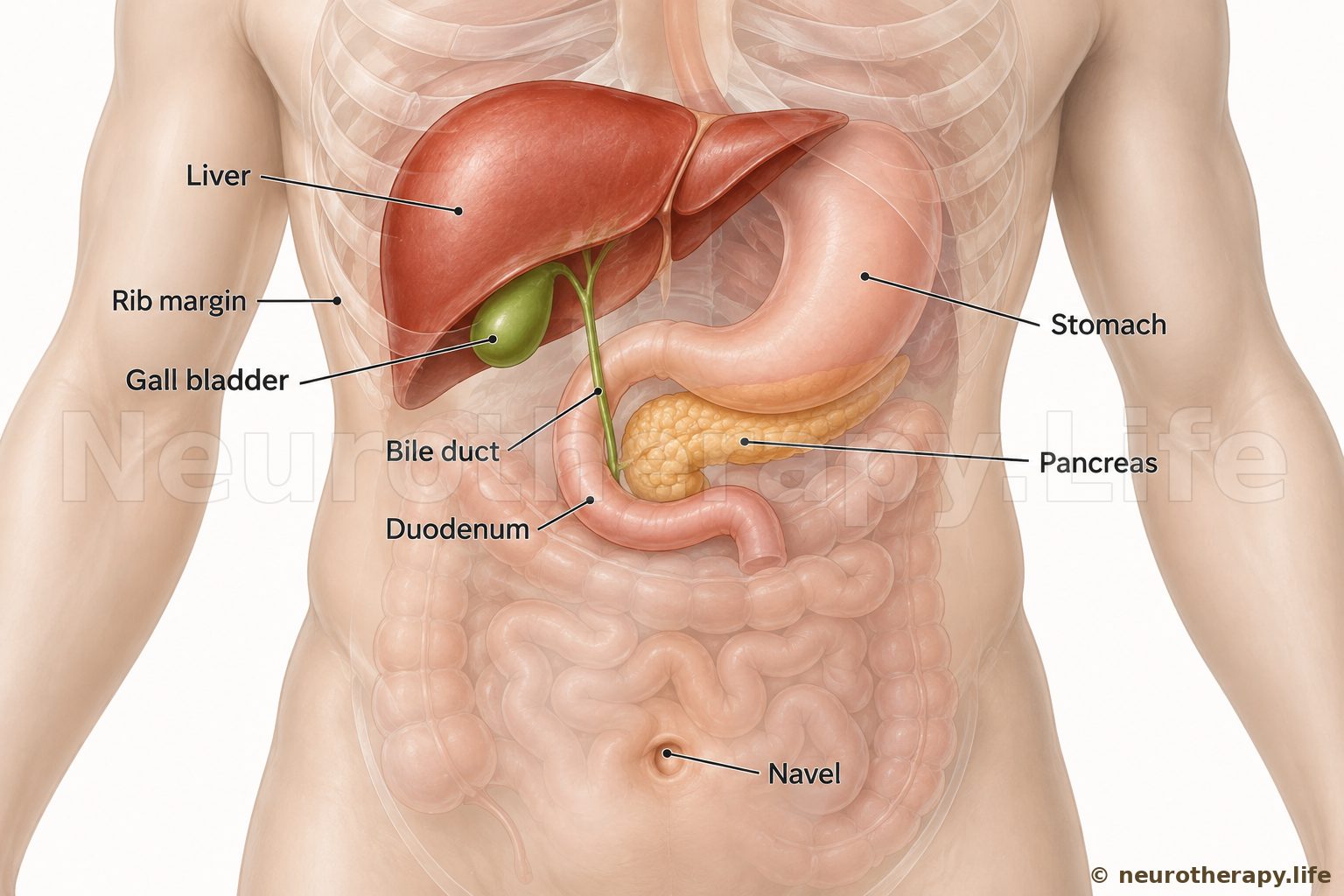
A small, pear-shaped pouch under the liver that stores bile, concentrates it, and squeezes it out when fatty food arrives. In Guruji's teaching it is 'the godown of the liver' — and a slow gall bladder, not extra acid, is often why the chest burns after fried food.
Overview
What is the gall bladder?
Your gall bladder is a small, hollow, pear-shaped organ tucked into a hollow on the underside of your liver, in the upper right part of your belly. It stores bile — a greenish-yellow digestive juice that the liver makes — and releases it into the small intestine to help digest fat.
Between meals it quietly draws water out of the bile, making it several times stronger. When a meal containing fat reaches the intestine, a hormone called CCK tells it to squeeze. You can live without a gall bladder: bile then trickles straight from the liver into the gut.
Guruji's teaching calls the gall bladder 'the godown of the liver'. It credits bile with two chief qualities — it protects against germs and it keeps the bowel moving — and it found that people with skin trouble often have tenderness at the gall bladder point, many of them with constipation too.
A small green pouch under the liver, with one duct down to the intestine.
Function
What does the gall bladder do?
The liver makes bile all day and night, but you need most of it only after a meal. The gall bladder bridges that gap: it stores, strengthens and releases.
Stores bile between meals — about 30 to 60 ml at a time.
Concentrates it by taking out water and salts, usually about five times, sometimes much more.
Squeezes bile into the duodenum when fat and protein arrive from the stomach.
Its bile salts act like washing soap on fat, breaking it into tiny droplets that enzymes can digest.
Helps the body absorb the fat-soluble vitamins A, D, E and K.
Carries waste out of the body — bilirubin from old red cells, and extra cholesterol.
Bile acids also help keep down the number of germs in the small intestine.
The liver makes bile
Liver cells make bile all the time — about 600 to 1,000 ml a day — and send it down the bile ducts.
The door is shut, so bile backs up
Between meals a ring of muscle at the duct's opening into the intestine (the sphincter of Oddi) stays closed. Bile backs up into the gall bladder instead.
It is concentrated
The lining soaks water and salts back out, so the stored bile becomes thick and strong.
A meal sends the signal
When fat and protein from the stomach reach the duodenum, its lining releases the hormone cholecystokinin (CCK) into the blood.
Squeeze and open
CCK makes the gall bladder contract and the sphincter relax, so bile pours into the intestine. It also calls up the pancreas's enzymes at the same time.
Recycled
Most bile salts are soaked back up at the far end of the small intestine and return to the liver in the blood, to be used again.
How does the gall bladder work with other organs?
Liver — Makes all the bile; the gall bladder only stores and strengthens it.
Pancreas — Its duct shares the same small opening into the duodenum, and the same hormone, CCK, calls both into action.
Intestines — The duodenum sends the CCK signal; the last part of the small intestine takes the bile salts back.
Stomach — If bile is slow, the intestine will not accept the next part of the meal, and food waits in the stomach.
Vagus nerve — Gives the gall bladder a gentle squeeze at the start of a meal, before CCK takes over.
Bowel — Bile pigment gives stool its brown colour; pale, clay-coloured stool means bile is not getting through.
Anatomy
What are the parts of the gall bladder?
The gall bladder is a pouch with a rounded end, a body and a neck, joined to a branching tree of ducts that carry bile to the intestine.
The pouch
Fundus — The rounded bottom end, which peeks out below the edge of the liver at the right rib margin.
Body — The main part, lying against the underside of the liver and close to the duodenum.
Neck — The narrow end leading into the cystic duct — a place where stones can get stuck.
Wall — A folded inner lining that soaks up water, a thin layer of muscle that squeezes, and a smooth outer covering.
The bile ducts
Cystic duct — A short, twisting duct from the gall bladder's neck; bile flows in and out through it.
Common hepatic duct — Brings bile down from the liver.
Common bile duct — Formed where the two meet; it runs behind the duodenum and through the head of the pancreas.
Ampulla of Vater and sphincter of Oddi — The bile duct and the pancreas's duct join for the last few millimetres and open into the duodenum through one small doorway, guarded by a ring of muscle.
What is in bile
Water and salts — Most of fresh bile; much of it is removed in the gall bladder.
Bile salts — The soap-like part that breaks up fat.
Bilirubin — A yellow pigment from old red cells; it gives bile and stool their colour.
Cholesterol and lecithin — Fats carried out in the bile. Too much cholesterol for the bile salts to hold can form stones.
Mucus — Made by the gall bladder's lining; it protects the lining from the strong bile.
Where is the gall bladder located?
The gall bladder lies in the upper right part of your belly, in a shallow hollow on the underside of the liver. Its rounded tip reaches the lower edge of the right ribs, roughly where the outer edge of the straight belly muscle crosses the rib margin.
The liver lies above and around it. The first part of the small intestine (duodenum) and the bend of the large intestine lie just below and beside it, the stomach to its left, and the right kidney behind.
This is the very spot where LMNT reads the Gal point — and it is also the spot a doctor presses when checking for an inflamed gall bladder. Two traditions arrive at the same square inch from opposite directions. In treatment, Gal is given on the patient's left thigh.
It looks like a small, soft pear or a deflated balloon, greenish or bluish-grey from the bile showing through its thin wall. When full, between meals, it is plump and rounded; after a fatty meal it is small and flattened.
Inside, the lining is velvety, with a honeycomb of fine folds. Bile inside is dark green-yellow and thick.
How big is the gall bladder?
In an adult it is about 7 to 10 cm long and about 3 cm wide — roughly the size of a small pear. It holds about 30 to 60 ml of bile, a few tablespoons.
The common bile duct is normally only a few millimetres wide — narrow enough that a stone the size of a lentil can block it.
Conditions and disorders
What conditions and disorders affect the gall bladder?
Gallstones are by far the commonest gall bladder problem. Many people have them without knowing; trouble starts when a stone blocks the way out.
Stones and blockage
GallstonesHard lumps, mostly of cholesterol, that form in the bile; they can block the duct and cause pain, inflammation or jaundice.
Abdominal painGallstone pain is felt in the upper right or middle belly, often after a fatty meal.
HepatitisJaundice can come from the liver itself — or from a stone blocking the bile duct; tests tell them apart.
High cholesterolBile is the body's main way of getting rid of cholesterol.
Where LMNT uses the Gal point
Skin diseaseGuruji found Gal tender in many people with skin trouble, often with constipation too.
PsoriasisOne of the skin diseases for which the single-point Gal treatment is used.
ItchingThe Chole treatment eased itching only for hours — which led to the New Gal treatment.
ConstipationThe teaching credits bile with a laxative quality; New Gal is used for very hard constipation.
Sprain and injuryGal and Liv together form the backbone of the LMNT Injury treatment.
WrinklesListed among the uses of Gal — given after checking for pain.
Where Gal is not given
Leukaemia (blood cancer)Not given in leukaemia or other diseases with a raised white-cell count.
AsthmaThe teaching says Gal increases the trouble in asthma.
InflammationGal and Spl are taken out of treatments for an inflamed abdomen.
Urinary problemsUsed for frequent urination, but not given to those passing little urine.
What are common signs of a gall bladder problem?
Often none — most gallstones are found by chance on an ultrasound
Steady pain in the upper right or middle belly, lasting from half an hour to several hours, often after a fatty meal or at night
Pain spreading to the right shoulder blade or back
Nausea or vomiting with the pain
Heaviness, sour burps or burning a while after fried food or heavy protein
Fever with the pain, yellow eyes or skin, dark urine or pale stool — see a doctor the same day
What tests check the gall bladder?
Ultrasound — The main test: it shows stones, a thickened wall and a widened bile duct, with no needle and no radiation.
Blood tests — Liver tests, bilirubin and a blood count show blockage or infection; amylase or lipase checks the pancreas.
HIDA scan — A tracer shows how well the gall bladder fills and empties.
MRCP — A special MRI that maps the bile ducts and finds stones inside them.
ERCP — A camera passed through the mouth to the duodenum can see the ducts and remove stones from them.
How are gall bladder problems treated?
Watchful waiting — Stones that cause no symptoms are usually left alone.
Keyhole surgery (laparoscopic cholecystectomy) — The usual treatment for painful stones: the gall bladder is removed through small cuts, often with a short hospital stay.
ERCP — Stones stuck in the bile duct can be pulled out through an endoscope.
Antibiotics, fluids and pain relief — For an inflamed or infected gall bladder, often before surgery.
Stone-dissolving tablets — Occasionally used for small cholesterol stones; they work slowly and the stones often come back.
Neurotherapy (LMNT)
Guruji's teaching calls the gall bladder 'the godown of the liver', and much of its digestive work turns on it. Three pieces of reasoning stand out. First, the burning: when a patient says the chest burns a while after fried food, the teaching holds that the acid is often normal — the gall bladder or liver is slow, the fat in the duodenum is not dealt with, the intestine will not accept the next part of the meal, and the stomach's gate stays shut, so the meal and its acid sit and burn. The first answer is a preparatory pair, (3) Gal (7) Liv, and then the Chole treatment, whose three points were chosen for the three jobs of the hormone CCK. Second, the doorway: when relief came and then the pain returned with Gal and Liv tender, Guruji inferred a blockage at the ampulla of Vater, and built the Vater treatment to open it — with a dose of Gal and Liv decided fresh each day by the pain found that day. Third, what bile is: its two chief qualities, the teaching says, are that it is antiseptic and laxative. That led to the New Gal treatment for skin trouble with Gal pain, given after Vater — first open the door, then stimulate the gall bladder. It also led to taking Gal out of treatments for an inflamed abdomen. The Gal point is read under the right ribs and given on the left thigh. All of this works alongside your doctor's care; decisions about stones and surgery belong with your doctor.
Points
Gal — The gall bladder point: the therapist's right sole down the patient's left thigh, three or four stations from hip to knee, six seconds each. For pain under the right ribs, bile flow, cholesterol, healing a blow, and skin disease with constipation.
(1) Pt. Gal × 6 treatments — The same stations taken one at a time, a minute apart: for skin diseases — especially with constipation — and viral fever with pain at Gal.
(9) Gal — The high count, aimed at temperament: to reduce excessive anger, and to settle restlessness in children. The teaching says 'anger spoils the gall bladder'.
Liv — The liver point, paired with Gal in the preparatory treatment and in Vater.
(10) Medulla — In Chole and Vater, to stimulate the vagus nerve, whose work includes calling up CCK.
(15) Medulla — Given before (10) Medulla in New Gal, for acetylcholine.
(6) Gas 'I' — In Chole, to increase the movement of the small intestine so food moves on and secretin and CCK are released.
ONS — In Vater, to set the navel, in case repeated trouble means it has slipped.
(½) Ku – 40 secs — In Vater, one forty-second hold at the base of the spine, for the pineal gland.
'103, 408, 10' — (10) Medulla (3) ONS (½) Ku – 40 secs (8) Gal (max.), then (10) Liv (max.). To open the doorway the bile comes through; the dose comes down as the pain goes, and stops when it is gone.
Five formulas as one: digestion first, then absorption, then the gall bladder itself, then Chole. For skin disease with Gal pain and for very hard constipation; given after Vater.
“We cannot provoke the organs in an order of our own choosing.”
— Dr. Lajpatrai Mehra
“In this therapy we do not treat the disease; rather, we improve the body.”
— Dr. Lajpatrai Mehra
“Whether or not the patient gets immediate benefit from our treatment, let no harm reach him through our carelessness — attend to this.”
— Dr. Lajpatrai Mehra
Never do this
Gal is not given in leukaemia, blood cancer or other diseases with a raised white-cell count; not in asthma, where it increases the trouble; and not to those passing little urine — 'a matter of experience', the teaching says. Gal
Gal and Spl are not provoked in an inflamed abdomen: bile is antiseptic, and the spleen makes white cells and antibodies, so the inflammation could increase. APR class A, revised
In the Vater treatment, 'max.' is a ceiling, not an order. Gal and Liv are checked before every session, the count is lowered as the pain falls — (3) Gal in place of (8) — and the treatment stops when the pain has gone and the symptoms are right. Vater Treatment
Heart patients first receive the Angina treatment only, for two to four days. After that the heart form of Vater may be given: (10) Left Medulla, with Gal and Liv cut to (1). Angina / Athero treatment
(10) Medulla, which heads Chole and Vater, is not given in diabetes or cancer. The Chole treatment is not given in kidney failure. Chole Treatment
The forty-second (½) Ku in Vater is not for thin bones, long-term steroid users, a wasted or bed-bound patient, broken skin over the sacrum, or anyone who cannot feel the pressure. ONS is not given with low back pain running below the knee, a suspected disc, recent belly or pelvic surgery, pregnancy, or a hip replacement. ONS
Keep taking prescribed medicines. Decisions about gallstones and surgery belong with your doctor or surgeon.
See a doctor the same day for pain under the right ribs lasting more than a few hours, pain with fever or shivering, yellow eyes or skin, or dark urine with pale, clay-coloured stool. Numbness in the saddle area, new trouble passing urine, or weakness in both legs during treatment is an emergency. How to tell a patient to see a doctor
Care
How can I keep my gall bladder healthy?
Stones form when bile holds more cholesterol than it can carry, or when it sits still for too long. Regular, balanced eating helps on both counts.
Eat regular meals
Each meal empties the gall bladder. Long gaps and skipped meals leave bile standing still.
Lose weight slowly, if you need to
Being overweight raises the risk of stones — but so do crash diets and very fast weight loss. Aim for steady, gradual loss.
Plenty of fibre
Vegetables, fruit, dal and whole grains are linked with fewer gallstones.
Some fat, not a lot — and not none
A little healthy fat at meals helps the gall bladder empty. Heavy fried meals are what usually bring on pain.
Stay active
Regular physical activity is linked with a lower risk of gallstones.
Notice what brings it on
If you get heaviness or burning, note which food it follows and how long after. That one detail helps both your doctor and your therapist.
Common questions
Can I live without a gall bladder?
Yes. The liver keeps making bile, which then trickles straight into the intestine instead of being stored. Most people eat normally afterwards; some find very fatty meals harder, or have looser stools for a while.
Do gallstones always need an operation?
No. Stones found by chance that cause no symptoms are usually left alone. Surgery is advised when stones cause attacks of pain, inflammation, jaundice or pancreatitis — because once they start causing trouble, they tend to do it again.
Why do fried foods upset me?
Fat is the strongest signal for the gall bladder to squeeze. If there are stones, that squeeze can press a stone against the outlet and cause pain. Guruji's teaching adds that when bile is slow, the fat is not dealt with, the meal waits in the stomach, and the waiting acid burns — even though the acid itself is normal.
Can a 'gall bladder flush' clear my stones?
Home flushes with oil and juice are not a proven way to remove stones; the soft green lumps people pass afterwards have been shown to be soap-like balls made from the oil itself. They can also trigger an attack. Talk to your doctor about stones.
Is the Gal point the same place a doctor presses?
Very nearly. LMNT finds Gal where the outer edge of the straight belly muscle crosses the right rib margin — over the tip of the gall bladder. That is also where a doctor presses, asking you to breathe in, to check for an inflamed gall bladder.
Why is Gal given on the left thigh when the gall bladder is on the right?
In LMNT, pressure on the left limbs relieves pain on the right of the navel, and the legs are used for pain above the navel. So the gall bladder, above and to the right, is reached through the left thigh.
What should I ask my doctor or therapist?
Is my pain coming from the gall bladder, or from something else such as the stomach, pancreas or heart?
How many stones do I have, how big are they, and is any in the bile duct?
Do my stones need surgery now, or can we wait and watch?
Which warning signs mean I should come back at once?
What should I eat after my gall bladder is removed?
For my therapist: are Gal and Liv tender, and is Gal blocked for me — for example because of asthma?
Surprising facts
1It makes bile several times stronger
While bile waits in the gall bladder, the lining draws out water and salts. Stored bile is usually about five times as concentrated as the bile the liver sends — and can reach far higher.
Source: Guyton & Hall, Medical Physiology — gall bladder bile normally concentrated about 5-fold, up to about 20-fold at most
2A few spoonfuls of storage for a litre of bile
Your liver makes up to a litre of bile a day, yet the gall bladder holds only about 30 to 60 ml. It copes by squeezing out the water — storing strength rather than volume.
Source: Guyton & Hall, Medical Physiology — bile secretion 600–1,000 ml/day; gall bladder capacity 30–60 ml
3A hormone named for moving the gall bladder
In 1928 two American scientists, Andrew Ivy and Eric Oldberg, showed that the intestine releases a substance into the blood that makes the gall bladder contract. They named it cholecystokinin — Greek for 'the thing that moves the gall bladder'. Guruji's Chole treatment is named after it.
Source: Ivy AC, Oldberg E. A hormone mechanism for gall-bladder contraction and evacuation. Am J Physiol 1928;86:599–613. LMNT: wiki_db 27.7
4Your bile salts go round and round
About 94% of the bile salts poured into the intestine are soaked back up near its end and returned to the liver to be used again. A bile salt makes this round trip about 17 times, on average, before it is finally lost in the stool.
Source: Guyton & Hall, Medical Physiology — enterohepatic circulation: about 94% of bile salts reabsorbed; recirculate about 17 times before excretion
5Bile really does kill germs
Bile acids can dissolve the outer coats of many bacteria, and bile helps keep germs in the small intestine in check. Guruji's teaching calls bile antiseptic — and used that very quality to take Gal out of treatments for an inflamed abdomen.
Source: Begley M, Gahan CGM, Hill C. The interaction between bacteria and bile. FEMS Microbiol Rev 2005;29:625–651. LMNT: wiki_db 30.4
6Most gallstones never cause trouble
Gallstones are found in roughly 10 to 15% of adults in Western countries, and are common in India too — especially in the north. Most people who have them never feel a thing; these 'silent' stones are usually left alone.
Source: Stinton LM, Shaffer EA. Epidemiology of gallbladder disease: cholelithiasis and cancer. Gut Liver 2012;6:172–187; NIDDK, 'Symptoms & Causes of Gallstones'
7Bile is why stool is brown
The brown colour of stool does not come from food. It comes from bile pigment, made from old red blood cells and changed by gut bacteria on the way down. That is why pale, clay-coloured stool is a warning that bile is not getting through.
Source: Guyton & Hall, Medical Physiology (bilirubin → urobilinogen → stercobilin). LMNT: wiki_db 10.4 ('brown is a report that bile is arriving')
8Keyhole gall bladder surgery is only about 40 years old
The first gall bladder removal through small keyhole cuts was performed in Germany in 1985 by the surgeon Erich Mühe. Within a few years it had become the standard way the operation is done around the world.
Source: Reynolds W Jr. The first laparoscopic cholecystectomy. JSLS 2001;5(1):89–94
A day in the life of your gall bladder
600–1,000 mlof bile arrives from the liver
30–60 mlheld at any one time
~5×stronger than the liver's bile
~94%of bile salts returned to the liver
~17round trips for a bile salt, on average
Yoga
Pavanamuktāsana — the wind-releasing pose Pavanamuktāsana
Benefits
Helps release trapped wind and eases a heavy stomach.
Gently presses and releases the upper belly, where the gall bladder lies on the right.
Traditionally begun with the right leg, which presses the right side of the belly first.
How to do it
On an empty stomach, lie on your back with legs straight.
Breathing out, draw the right knee to the chest and hold the shin with both hands. Breathe slowly 3–5 times.
Release, then do the same with the left knee.
Finally draw both knees in together, head resting down, then release slowly.
Take care
Not after meals, and never during an attack of gallstone pain — see a doctor instead. Avoid in pregnancy, with a hernia, after recent belly surgery, or with a slipped disc.
Supta Matsyendrāsana — the lying twist Supta Matsyendrāsana
Benefits
A gentle twist that needs no strength and puts little load on the back.
Stretches the sides of the belly and the lower back.
Relaxing — a good way to end a short practice.
How to do it
Lie on your back and stretch the arms out at shoulder level.
Bend both knees, feet on the mat.
Breathing out, let both knees fall slowly to the left; turn the head gently to the right.
Stay for 5 slow breaths, keeping both shoulders down. Return to the centre and repeat on the other side.
Take care
Not after meals or during pain. Avoid with a slipped disc, severe back pain, recent belly or spine surgery, or in later pregnancy. Go only as far as is comfortable.
Calms the breath and the mind — useful for anyone whose digestion upsets with worry or anger.
Needs no pressure on the belly, so it suits most people, even with gall bladder trouble.
Guruji's teaching links anger with the gall bladder; a calm breath is a simple daily counterweight.
How to do it
Sit comfortably with a straight back.
Close the right nostril with the right thumb and breathe in through the left.
Close the left with the ring finger, open the right, and breathe out.
Breathe in through the right, switch, and breathe out through the left. That is one round.
Continue for 5–10 minutes, slowly and evenly.
Take care
Keep it gentle, with no breath-holding, if you have heart disease or high blood pressure or are pregnant. Stop if you feel dizzy. Do not do it with a blocked nose.
Watch
Gal Point (Gallbladder) - How to Give 1 Gal, 3 Gal & 1 Point Gal | Practical Training for Students
A practical training demo on the Gal (gall bladder) point: how to give 1 Gal, 3 Gal and 1 Point Gal, used to support bile flow and digestion.
Gal and One Point Gal to Yourself | Master the LMNT Gal Point | Neurotherapy Student Tutorial
Shows how to give yourself the Gal (gall bladder) point on the left thigh: 1, 2 and 3 Gal pressed without a break, and 1 Point Gal × 6 with a one-minute gap each time. It is used to support bile flow and ease gas and heaviness after meals.
Chole Treatment in Neurotherapy | LMNT Formula for Digestion, Acidity & Fat Metabolism
A demo of the Chole treatment ((10) Medulla, (6) Gas 'I', (3) Gal), shared for acidity, heavy meals and the digestion of fats.
Vitamin B12 Treatment in Neurotherapy | LMNT Formula for Anaemia, RBC & Nerve Health
Shows the Vitamin B12 treatment: (3) Gal and (7) Liv on the thigh and forearm, then (8) Left Parkhoo at the left hip with the patient lying on their side. It is given to support the body's absorption of vitamin B12.
Test yourself
Research
Strong evidence
A review of how bile and bacteria meet: bile acids damage the outer coats of many bacteria, and the body's bile flow helps keep the small intestine's germs in check.
A worldwide review of gallstones: common in adults everywhere, more so with age, in women, with extra weight and after rapid weight loss — and most never cause symptoms.
This page explains how the body works; it does not diagnose. Neurotherapy (LMNT) works alongside your medical care — keep taking the medicines your doctor prescribed, and see a doctor for any new or severe symptom.
Ready to begin?
Send COURSE for course details, or your name, age and health issue for a consultation.