Also called: Gal–Liv preparatory treatment, preparation for the Chole treatment
This is a small two-point treatment of the gall bladder and liver, given first — before the Chole treatment — to put right the digestion of fats. The teaching records that many patients get a good deal of relief from it at once.
Overview
What is the preparatory gall bladder and liver treatment?
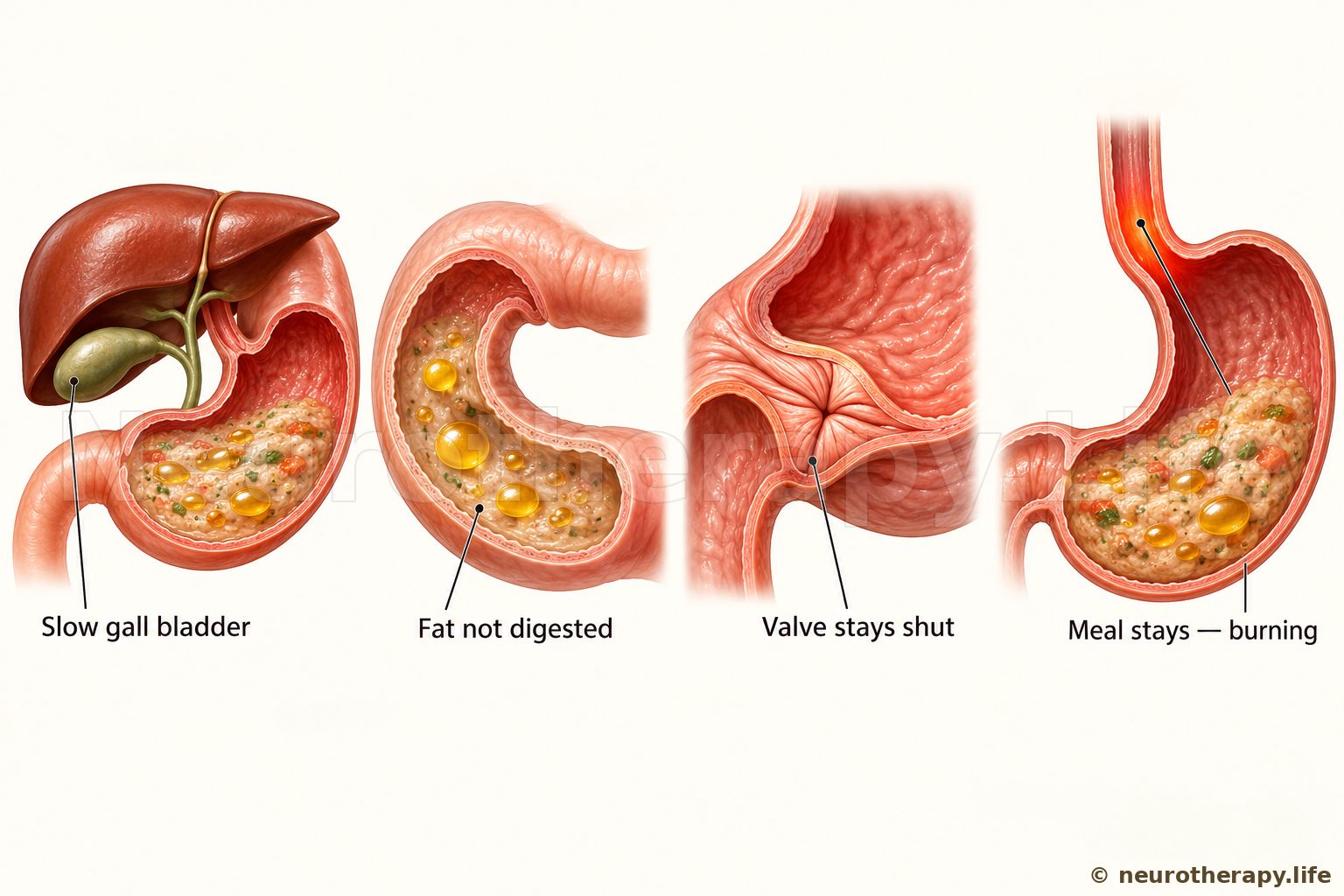
Many people say that after eating fried food they feel a burning in the chest. It is usually blamed on too much stomach acid. Guruji's teaching gives another cause: the liver or the gall bladder is sluggish — working too slowly — so fat is not dealt with and the meal stays in the stomach.
The first answer to this is not the full Chole treatment. It is this preparatory pair of points — Gal for the gall bladder and Liv for the liver — given before anything else. It belongs to the digestive formulas and works as their warm-up.
Why fried food can burn: when bile is slow, fat is not dealt with, the meal stays in the stomach, and its own acid stays with it.
What it is for
What is it used for?
To put right the digestion of fats.
For burning in the chest, heaviness or sour belches some while after eating fried food.
To prepare the body before the Chole treatment, which is given after it.
In an old, long-standing (chronic) case, a single-point form of Liv is recorded as extremely beneficial.
Points it works through
Which points does it work through?
(3) Gal (7) Liv × 2 treatments — or (1) Gal (4) Liv × 2 treatments
Just two points, both on the patient's left side. The treatment is written in a stronger and a lighter form, and the therapist chooses between them. The exact method is taught hands-on in the Neurotherapy (LMNT) course. This page lists the points of the formula and what each one contributes; it does not describe how any point is given. For the method, watch the demonstration video of each point on its own page and learn hands-on from a trained Neurotherapist. Please do not give a formula from a written description alone.
The liver point, on the left arm and left thigh together. The liver is the organ that makes bile in the first place.
Position:Lying on the back (supine).
The exact technique is taught hands-on in the Neurotherapy (LMNT) course. See the course →
How it works
How does it work?
The teaching explains the burning as a chain. Fat needs bile. If bile is slow, fat is not dealt with. The duodenum, the first part of the small intestine, will not accept the next part of the meal until it has finished this one. So the food stays in the stomach — and the acid that belongs with it stays there too, and burns.
So the acid is often normal; it is the liver or gall bladder that is working less. Waking these two first starts the chain moving again. The teaching notes that perhaps more than 80% of such patients have exactly this.
A good therapist therefore does not just ask, 'Do you get acidity?' He asks, 'After which food, and how long afterwards?' The answer shows where in the chain to work.
Its family
Which formulas are related?
This pair is the first step of the fat-digestion line. What follows it depends on the patient.
Chole Treatment — The treatment this pair prepares for — it works through the vagus nerve, the small intestine and the gall bladder, for fats and heavy proteins.
Chole variant I — A variant of Chole for setting the stomach, ending with the liver.
Chole variant II — A variant of Chole for setting the stomach, ending with the gall bladder.
NAN — Normal with Ajay Normal. It gives ease for a while in such burning, but the burning tends to return when the gall bladder is the cause.
New Gal — A larger treatment in which the Chole treatment is one of the parts.
Vater Treatment — The treatment for a block at the ampulla of Vater, another cause of poor fat digestion named in the same teaching.
What it is used for
When is it given?
It is chosen from what the patient describes — which food brings the trouble, and how long after the meal — and from the examination.
Chest pain from indigestionChest discomfort from a meal that stays too long in the stomach — once a doctor has ruled out the heart
Safety: when it is held back
Heart disease: the Gal-and-Liv pairing that improves fat digestion is held back, because better fat digestion can raise blood cholesterol. The gentler single-point Liv is given in its place. (1) point Liv × 6 treatments
Gal is not given in leukaemia, blood cancer or other diseases with a raised white cell count, nor in asthma, nor to those passing little urine. Gal
Liv is never given where there is cancer in the liver. Liv
If tingling or numbness runs into the hand during the liver point, the contact is released at once and moved.
Chest pain is never assumed to be indigestion. Chest pain with sweating, breathlessness or pain spreading to the arm or jaw is an emergency — call 108/112 at once. Heart attack (myocardial infarction)
Sudden severe pain under the right ribs with fever, yellow eyes or vomiting needs a doctor the same day.
Children receive light treatment. Keep taking every medicine your doctor has prescribed.
Common questions
Is burning after fried food always too much acid?
Not always. The teaching says it is often a slow liver or gall bladder: the meal cannot move on, so its normal acid stays in the stomach longer and burns.
Why is this given before the Chole treatment?
It prepares the liver and gall bladder first. The teaching records that the patient often gets a good deal of relief from this pair alone.
What if the trouble comes after heavy proteins like rajma or chhole?
That points to protein digestion as well as fat. The therapist asks about both, and the Chole treatment that follows is built for fats and heavy proteins together.
Can a heart patient have it?
The Gal-and-Liv pairing is held back in heart disease, because better fat digestion can raise cholesterol. The therapist uses the gentler single-point Liv instead.
Surprising facts
1The liver makes bile all day long
The liver makes around half a litre or more of bile every day. Between meals the gall bladder stores it and concentrates it, so a strong dose is ready when fat arrives.
Source: Guyton & Hall Textbook of Medical Physiology, 14th ed. — secretion of bile by the liver.
2Bile works like washing-up liquid
Bile salts break big drops of fat into tiny droplets, the way soap breaks up grease. Only then can the fat-digesting enzymes reach them.
Source: Begley M, Gahan CGM, Hill C. The interaction between bacteria and bile. FEMS Microbiol Rev. 2005;29(4):625–651.
3A hormone squeezes the gall bladder
When fat and protein reach the duodenum, its lining releases cholecystokinin (CCK). CCK makes the gall bladder contract and tells the pancreas to send its enzymes.
Source: Okonkwo O, Zezoff D, Adeyinka A. Biochemistry, Cholecystokinin. StatPearls, NBK534204.
Test yourself
Research
Strong evidence
A clear summary of cholecystokinin: it is released when fat and protein reach the small intestine, makes the gall bladder contract and calls out the pancreas's enzymes.
This page explains what a Neurotherapy (LMNT) treatment is for; it is not a self-treatment guide and does not diagnose. Neurotherapy (LMNT) works alongside your medical care — keep taking the medicines your doctor prescribed.
Ready to begin?
Send COURSE for course details, or your name, age and health issue for a consultation.