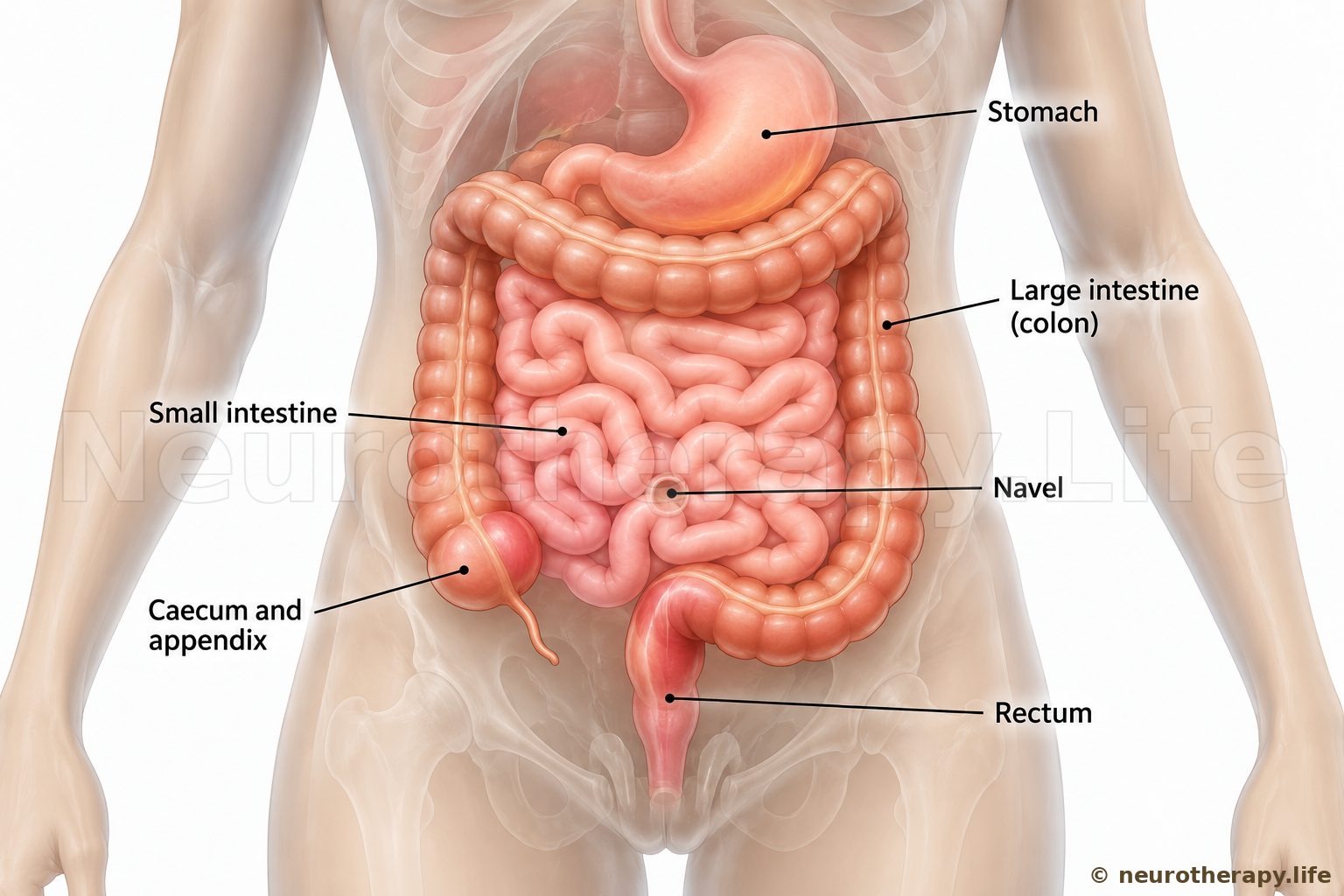
A long, folded tube that finishes digesting your food, soaks the goodness into your blood, takes back the water and hands what is left to the bowel. In Guruji's teaching the order in which its parts are woken up matters as much as the parts themselves.
Overview
What are the intestines?
Your intestines are the part of the digestive tube that begins where the stomach ends and runs all the way to the rectum. They come in two parts: the small intestine, which is long and narrow, and the large intestine, which is shorter but wider.
The small intestine finishes digesting food and absorbs — soaks up — almost all of its nutrients into the blood. The large intestine takes back water and salts, houses trillions of helpful bacteria and slowly shapes what is left into stool.
In Neurotherapy (LMNT) the intestines are read around the navel: several examination points sit over them, and many digestive formulas are written as a walk along the bowel, in the same direction as the wave that moves food forward.
The intestines: a long coiled small intestine in the middle, and the large intestine around it like a frame.
Function
What do the intestines do?
The intestines do three big jobs in a row: they finish digestion, they absorb, and they recover water before sending the rest on. Muscle in their walls squeezes in waves (peristalsis) to carry everything forward.
Finish digestion: bile from the liver and juice from the pancreas meet the food in the first part, the duodenum.
Absorb sugars, amino acids, fats, vitamins, minerals and most of the water into the blood and lymph.
Take up iron and calcium high up, and vitamin B₁₂ and bile salts at the far end of the small intestine (the ileum).
Recover water and salts in the large intestine so that the body does not dry out.
Feed and house the gut bacteria, which ferment fibre and make some vitamins, such as vitamin K.
Guard the body: the gut wall carries a large share of the body's immune cells.
Move the leftovers along and store them as stool until you go to the toilet.
Food arrives from the stomach
The stomach lets out a warm, soupy mix called chyme a little at a time through its exit ring, the pylorus.
Juices join in the duodenum
Bile breaks fat into tiny droplets, and pancreatic juice neutralises the acid and digests protein, fat and starch.
Absorb along the jejunum and ileum
Millions of tiny finger-like villi soak nutrients into the blood, which carries them first to the liver.
Cross the one-way gate
The ileocaecal valve lets the leftovers into the caecum, the start of the large intestine, and stops them flowing back.
Wring out the water
Up the right side, across the top and down the left, the colon takes back water. The contents turn from liquid to paste to formed stool.
Hand over to the rectum
A few strong mass movements a day push stool into the rectum, and you feel the urge to go.
How do the intestines work with other organs?
Liver — Makes bile for fat, and receives the blood from the intestines first, through the portal vein.
Pancreas — Pours its digestive juice into the duodenum; without it, protein and fat pass through undigested.
Gall bladder — Squeezes stored bile into the duodenum when a fatty meal arrives.
Thyroid — Sets the pace: a slow thyroid slows the gut and is a well-known cause of constipation.
Vagus nerve — Carries messages between the brain and the gut's own nerve network in its wall.
Lymph and immunity — Fat is absorbed into tiny lymph vessels called lacteals, and the gut wall holds many immune patches.
Kidneys and urinary system — The intestine and the kidneys share the work of keeping the body's water and salt in balance.
Anatomy
What are the parts of the intestines?
Two tubes joined end to end at a one-way valve, both built from the same four layers of wall.
The small intestine
The long, narrow first part, where most digestion and absorption happens.
Duodenum — The first, C-shaped part, about 25 cm long. Bile and pancreatic juice enter here through a small opening.
Jejunum — The middle part, with a thick, richly folded lining; much of the absorbing happens here.
Ileum — The last and longest part. It absorbs vitamin B₁₂ and bile salts, and ends at the ileocaecal valve.
The large intestine
The wider last part, which frames the small intestine and recovers water.
Caecum and appendix — A pouch at the lower right where the large intestine begins; the thin, finger-like appendix hangs from it.
Ascending colon — Climbs up the right side of the belly to just under the liver.
Transverse colon — Crosses the upper belly from right to left, above the navel, hanging in a loose loop.
Descending colon — Runs down the left side from the bend under the spleen.
Sigmoid colon, rectum and anus — An S-shaped bend in the lower left leads to the rectum, which stores stool, and the anal canal, the exit.
The wall and its lining
Both tubes share the same four layers, but their linings differ.
Mucosa — The moist inner lining. In the small intestine it is raised into villi, each covered with a brush of microvilli; in the large intestine it is flat and full of mucus glands.
Submucosa — A layer of blood vessels, lymph vessels and nerves under the lining.
Muscle layers — An inner ring of muscle and an outer lengthwise layer, which together make the waves of peristalsis.
Serosa and mesentery — A thin, slippery outer skin. The mesentery, a fan-shaped fold, ties the loops to the back wall and carries their blood vessels.
Where are the intestines located?
The intestines fill most of your belly below the stomach and liver. The small intestine lies coiled in the centre and lower belly, around and below the navel. The large intestine frames it: up the right side, across the top just below the stomach, and down the left side into the pelvis.
The appendix usually sits in the lower right of the belly. The rectum lies deep in the pelvis, in front of the sacrum — the triangular bone at the base of the spine.
LMNT's front chart reads this map around the navel. Gas 'I' lies immediately around the navel over the coils of the jejunum and ileum; Mu, to the left of the navel, is named for the mucous lining of the whole gut; Const, in the left upper quarter, is where constipation shows as tenderness.
The small intestine is a soft, pinkish tube about as thick as a finger or a little more, lying in many loose loops. Inside, its lining feels like velvet because of millions of villi.
The large intestine is wider and paler, with three thin bands of muscle running along it that gather it into a chain of small pouches. Little tags of fat hang from its outer surface.
How big are the intestines?
In a living adult the small intestine is roughly 3 to 5 metres long, depending on how tightly its muscle is holding. Measured relaxed after death it stretches to about 6–7 metres, which is why you will see different numbers quoted. It is about 2.5 cm across.
The large intestine is about 1.5 metres long and about 6 cm across at its widest, the caecum.
Folds, villi and microvilli multiply the inner surface many times over: spread flat, the lining of the whole digestive tract covers about 30 square metres — roughly half a badminton court.
Conditions and disorders
What conditions and disorders affect the intestines?
Intestinal problems range from a short bout of loose motions to long-lasting conditions that need regular care. Many show up as a change in how often you go, or in what the stool looks like.
Movement too slow or too fast
ConstipationHard, infrequent stools — often from too little water or fibre, a sluggish colon or a slow thyroid.
Mu° pain (examination sign)Tenderness at Mu° — in LMNT teaching found with hard stools and too little water.
HypothyroidismA slow thyroid — one of the named causes of constipation in the LMNT constipation formula.
What are common signs of an intestinal problem?
Bloating, rumbling or a lot of gas
Cramps or pain around the navel or in the lower belly
Constipation, loose motions, or the two taking turns
Food seen in the stool in its own shape or colour
Mucus in the stool
Tiredness and paleness from poor absorption
Blood in the stool, black stool, weight loss without reason, or pain that wakes you at night — see a doctor
What tests check the intestines?
Stool tests — Look for hidden blood, germs, worms, or signs of inflammation or poor fat digestion.
Blood tests — Blood count, iron, B₁₂, folic acid, thyroid tests, and tests for coeliac disease (a reaction to wheat protein).
Ultrasound or CT scan — Pictures of the belly — useful for appendicitis, blockages or swelling.
Colonoscopy — A thin, flexible camera looks inside the large intestine and the end of the small intestine; small samples can be taken.
Upper endoscopy — A camera through the mouth reaches the duodenum; a small sample can check for coeliac disease.
How are intestinal problems treated?
Food, water and movement — More fibre, enough water through the day, regular meals and daily activity help most bowel problems.
Fluids and ORS — In loose motions, replacing water and salts comes first, especially in children and the elderly.
Medicines — Depending on the cause: laxatives, medicines for loose motions or cramps, anti-worm tablets, antibiotics, or medicines that calm inflammation.
Supplements — Iron, B₁₂, folic acid or calcium when a deficiency is found.
Surgery — For an inflamed appendix, a hernia, a blockage, or some long-standing diseases of the bowel.
Specialist care — A gastroenterologist — a doctor for the gut — looks after long-term conditions.
Neurotherapy (LMNT)
In Guruji's teaching the work on the intestines rests on three ideas. First, blood: pain at a point around the navel means the blood supply to that region is short, and a point increases blood flow not only to the organ it is named after but to every organ in that region. So Spl, named for the spleen, is given in constipation formulas for the bend of the colon that lies beside the spleen — a point's name is an address, not a description. Second, order: the digestive organs are woken in the same order as the wave that carries food forward. The Normal formula walks the large bowel from its beginning towards its end, and if that order is swapped the result is not weaker but opposite — constipation. Third, the whole cause: in constipation Guruji lists water, roughage, a sluggish colon and too little digestive juice, and asks which of these the therapist's hands can correct and which only the patient can. The LSTF for long constipation adds the thyroid, because a slow thyroid slows the gut, and inflammation, because a long constipation breeds infection. All this is support alongside medical care, never instead of it.
Points
Gas 'I' — Gas 'I' — the I is for intestine: the jejunum and ileum, coiled around the navel. Given down both calves to help absorption.
Gas Only — The stomach and duodenum; given down both thighs so that protein is digested before it reaches the intestine.
Mu — Named for the mucous lining of the whole gut. Stimulates the middle of the descending colon and increases lubrication, so the residue moves forward easily.
Const — Left upper quarter, between navel and ribs: whenever there is constipation there is pain here.
Spl — In constipation formulas, given for the end of the transverse colon and the top of the descending colon, which share the spleen's region.
Gal — The gall bladder and the upper part of the ascending colon.
Liv — The liver and the middle part of the ascending colon.
Rt. Ov. — The end of the ileum and the start of the ascending colon — in LMNT teaching where gut bacteria make folic acid.
Lt. Ov. — The lower descending colon, the sigmoid colon and the rectum.
Mu° — The left kidney code; in the constipation formula, to take out the pain of Mu° that comes with drinking too little water.
Pan — Opens the Normal formula: to calm the acid of the food arriving in the duodenum.
Organ Clearance — The general remedy: increases blood flow to the organs, easing the pain of the organs beside the navel; safe daily even for small children and the elderly.
(1) Rt. Ov. (1) Liv (1) Gal (1) Spl (1) Mu (1) Lt. Ov. × 3 — the whole large intestine, ascending to sigmoid, woken in order; for ordinary constipation.
“We cannot provoke the organs in an order of our own choosing.”
— Dr. Lajpatrai Mehra
“It is not enough that one eats proteins. The important thing is to digest them.”
— Dr. Lajpatrai Mehra
“No other drink can be a substitute for water.”
— Dr. Lajpatrai Mehra
Never do this
Keep the written order of every digestive formula. If the order of the Normal formula is changed, the patient can get severe constipation. Normal Treatment Formula
The acid treatment for hard stools is given only while there is pain at Mu°. If there is no pain at Mu°, it is not given. Mu°
Rt. Ov. and Lt. Ov. are not given in cancer, and Rt. Ov. not to children being treated for height. Liv is not given in liver cancer. Gal is not given in leukaemia or other raised white-cell conditions, in asthma, or to those passing little urine. Round Normal
Ulta Normal is a short course: as soon as the stool is formed, stop it and give the Normal formula for at least one day, or the patient may become constipated. Ulta Normal
Keep taking prescribed medicines. Neurotherapy (LMNT) works alongside your doctor's care, not in place of it.
See a doctor soon for: blood or mucus in the stool, black stool, a change in bowel habit that lasts more than a few weeks, weight loss you cannot explain, or loose motions with signs of drying out (little urine, dry mouth, dizziness).
Severe belly pain, a hard swollen belly, repeated vomiting, or no stool and no wind passing: call emergency services (108/112) at once. Do not press on such a belly.
Care
How can I keep my intestines healthy?
Guruji divided the causes of constipation into those a therapist can correct and those only the patient can. These are the patient's share.
Drink water in small amounts through the day
Not all at meals and not in big gulps when thirst gets bad. The colon takes back water between meals, and a body short of water dries the stool first.
Eat plenty of roughage
Vegetables and fresh fruit, with their skins where possible, plus dal and whole grains, give the bowel something to move and feed your gut bacteria.
Move every day
A sluggish colon is often a sedentary one. A daily walk helps the bowel move.
Chew well and eat at regular times
Well-chewed food arrives ready for the intestine's juices; regular meals keep the gut's rhythm.
Go when your body asks
Holding back the urge again and again lets stool dry and harden.
Wash hands and drink safe water
Most loose motions and worms come in through the mouth.
Notice what comes out
Skins, seeds or colours coming out as eaten are worth telling your therapist; blood or black stool is worth a doctor's visit.
Common questions
How long are my intestines really?
In a living adult the small intestine is about 3 to 5 metres and the large intestine about 1.5 metres. The bigger numbers you may have read (7 metres or more) come from measurements taken after death, when the muscle is fully relaxed.
Why does my stomach rumble when I am hungry?
When the stomach and small intestine are empty, a strong 'housekeeper' wave sweeps through them roughly every one and a half to two hours, clearing out leftovers. With little food inside, the air and fluid it pushes make the sound.
Can I live without my appendix or part of my intestine?
Yes. People live normally after the appendix is removed. Many people also live well after part of the intestine is removed, though losing a long stretch, or the end of the ileum, can affect absorption — for example of vitamin B₁₂ — and needs a doctor's follow-up.
Why does a Neurotherapist press on my thighs and arms for a problem in my intestines?
In LMNT teaching, pressure on the legs relieves pain above the navel, and pressure on the arms relieves pain between the navel and the lower pelvis; the left limbs answer the right side of the navel and the right limbs the left. The pressure is aimed at the blood supply of the region, not at the limb itself.
Does a slow thyroid really cause constipation?
Yes, it is a well-known cause. Thyroid hormone keeps the gut moving and the juices flowing. When it is low, food moves slowly, more water is taken back and the stool turns dry and hard. Guruji's constipation formula for long cases includes the thyroid for this reason.
Are gut bacteria good or bad?
Mostly good. Trillions of bacteria in the large intestine break down fibre, make some vitamins such as vitamin K, feed the lining cells of the colon and help keep harmful germs out. A varied, fibre-rich diet keeps them healthy.
What should I ask my doctor or therapist?
Which part of my intestines is causing my symptoms?
Do I need a stool test, blood tests or a colonoscopy?
Should my thyroid, iron, B₁₂ or calcium be checked?
How much water should I drink, and how?
Could any of my medicines be slowing or loosening my bowel?
For my therapist: which points around my navel are tender, and which formula are you giving, in what order?
Surprising facts
1Your gut is shorter alive than after death
Living muscle keeps the small intestine gathered up to about 3–5 metres. After death the muscle relaxes and the same tube measures 6–7 metres. So both numbers you have heard are true — they just measure different states.
Source: Gray's Anatomy (small intestine length at autopsy ~6–7 m); Guyton & Hall and Helander & Fändriks, Scand J Gastroenterol 2014 (shorter length in living tone)
2The mesentery was named a new organ in 2016
The fan-shaped fold that ties your intestines to the back wall was long described as scattered pieces. Careful study showed it is one continuous structure, and in 2016 surgeons proposed it be counted as an organ in its own right.
Source: Coffey JC, O'Leary DP. The mesentery: structure, function, and role in disease. Lancet Gastroenterol Hepatol 2016;1(3):238–247
3Your gut lining is replaced every few days
The cells lining the small intestine live only about 3 to 5 days. New cells rise from tiny pits, climb the villi and are shed at the tips — one of the fastest-renewing surfaces in the body.
Source: van der Flier LG, Clevers H. Annu Rev Physiol 2009;71:241–260 — intestinal epithelium renewed every 4–5 days
4The colon wrings a litre and a half down to a cupful
About 1.5 litres of watery leftovers pass into the large intestine each day, yet only about 100–200 ml of water leaves in the stool. The rest is taken back — which is why a slow bowel means a dry, hard stool.
Source: Guyton & Hall, Textbook of Medical Physiology — about 1.5 L of chyme enters the colon daily; about 100 mL of fluid is lost in the faeces
5A 'housekeeper' wave sweeps your empty gut
Between meals, a strong wave called the migrating motor complex travels from the stomach down the small intestine about every 90 to 120 minutes, sweeping leftovers and bacteria onward. It stops as soon as you eat — and it is often what you hear as hunger rumbles.
Source: Deloose E, Janssen P, Depoortere I, Tack J. The migrating motor complex. Nat Rev Gastroenterol Hepatol 2012;9(5):271–285
6Much of your immune system lives in your gut
The gut wall is packed with immune tissue — patches in the ileum, cells throughout the lining — and it is often estimated to hold around 70% of the body's immune cells. It has to: the gut meets more foreign material every day than any other surface.
Source: Vighi G et al. Allergy and the gastrointestinal system. Clin Exp Immunol 2008;153(Suppl 1):3–6 — GALT about 70% of the immune system (an estimate)
7Your colon runs on fuel made by bacteria
When gut bacteria ferment fibre they make short-chain fatty acids. One of them, butyrate, is the main fuel of the cells that line the colon. Fibre feeds the bacteria, and the bacteria feed the colon.
Source: Roediger WE. Role of anaerobic bacteria in the metabolic welfare of the colonic mucosa in man. Gut 1980;21(9):793–798
A day in the life of your intestines
~8–9 Lof fluid (drink plus digestive juices) passing into the small intestine
~1.5 Lleft to reach the large intestine
~100–200 mLof water leaving in the stool
3–5 hfor a meal to travel the small intestine
1–2 daysin the large intestine, often more
every ~90–120 mina housekeeper wave sweeps the empty gut
Yoga
Pavanamuktāsana — the wind-releasing pose Pavanamuktāsana
Benefits
Gently presses the belly and helps trapped wind move along.
A calm way to start the day for people who tend towards constipation.
The LMNT Abdomen Setting moves the folded knees in a similar way for patients who cannot do it themselves.
How to do it
On an empty stomach, lie on your back.
Draw the right knee to your chest and hold it with both hands; breathe slowly 3–5 times.
Change to the left knee, then bring both knees in together.
Keep the head on the floor and release slowly.
Take care
Not straight after meals. Avoid in pregnancy, with a hernia, after recent belly surgery, or with a slipped disc or severe back pain. With high blood pressure or heart disease, keep the head down and do not strain.
Supta Matsyendrāsana — the lying twist Supta Matsyendrāsana
Benefits
A gentle twist of the belly that many people find eases wind and a heavy feeling.
Relaxes the low back and the sides of the trunk.
Done lying down, so it suits beginners and older people.
How to do it
Lie on your back, arms out to the sides, knees bent and feet flat.
Breathing out, lower both knees slowly to the right.
Keep both shoulders on the floor; stay for 5 slow breaths.
Bring the knees back to the middle, then repeat to the left.
Take care
Move slowly and only as far as is comfortable. Avoid with a slipped disc, recent back or belly surgery, or in late pregnancy. Not straight after a meal.
Bālāsana — the child's pose Bālāsana
Benefits
The thighs press softly against the belly while the body rests.
Slows the breath and calms — and the gut works better in a calm body.
A resting pose between other movements.
How to do it
Kneel with big toes touching and knees a little apart.
Sit back on your heels.
Fold forward and rest your forehead on the mat, arms beside you.
Breathe slowly into the back for 1–2 minutes, then come up slowly.
Take care
Skip it with knee injury or severe knee pain — rest on a chair with the head on folded arms instead. Avoid in pregnancy (or widen the knees a lot) and with high eye pressure. Not straight after meals.
Watch
कमज़ोर पाचन और Gut Health का पक्का इलाज | LMNT Normal Treatment | @neurotherapylife
Shows the Normal treatment given with the feet: (8) Pan at the top of the thighs, then (3) Gal, (3) Spleen, (7) Liv and (5) Mucus on the thighs and forearms, without breaks. It is used to support digestion.
AJAY NORMAL FORMULA
A demonstration of the Ajay Normal formula: (8) Pan, (3) Gal, (7) Liv and (6) Gas 'I' at the three-point form — the Normal formula with Spl left out.
LMNT 1 Gas I Point Practical Training | Dr. Diwakar Shukla |Clinical Guide & Positioning for Student
A practical demonstration of where the Gas 'I' point lies down the calves, how the patient is positioned, and how the six-second presses are given.
The video shows the (1) Gas 'I' count. In Parkinson's the count is (12) Gas 'I' — still exactly six seconds at every place, and never with loose motions.
Loose Motion / Dast ka Neurotherapy Ilaaj | Ulta Normal Treatment (LMNT)
A demonstration of the Ulta Normal formula for loose motions: (8) Pan on both thighs, then Spl before Gal and Mu before Liv — the Normal formula's order reversed to slow the bowel.
The video's counts ((3) Spl, (3) Gal, (5) Mu, (7) Liv) differ from LMNT teaching, which gives (1) Spl, (1) Gal, (1) Mu – 3 points and (1) Liv – 3 points. Ulta Normal is stopped as soon as the stool is formed, and the Normal formula is given for at least one day.
UDF (Anpacha Khaana) ka Neurotherapy Ilaaj | 40+ Bimariyon ki Jad | LMNT
A step-by-step demo of the full UDF (undigested food) treatment: 15 Medulla, Parkhoo at both hips, Half Kundli, 10 Medulla with 1 Gas Only and 1 Gas 'I', then the Gal, Spleen, Liver and Mucus points and Ajay Normal on the thighs and forearms. It is given to support digestion when food passes through undigested.
Test yourself
Research
Strong evidence
Surgeons showed that the mesentery — the fold that holds the intestines — is one continuous structure, and argued it should be studied as an organ in its own right.
A review of the migrating motor complex: the cleaning wave that sweeps the empty stomach and small intestine between meals, and what happens when it fails.
This page explains how the body works; it does not diagnose. Neurotherapy (LMNT) works alongside your medical care — keep taking the medicines your doctor prescribed, and see a doctor for any new or severe symptom.
Ready to begin?
Send COURSE for course details, or your name, age and health issue for a consultation.