Also called: Constipation point, Const point, (1) Const, (4) Const, कब्ज़ पॉइंट, कोंस्टीपेशन
Const is the Neurotherapy (LMNT) point for constipation. It is given in the middle of the right thigh while you lie on your back, and it answers the sore spot that hard constipation makes above and to the left of the navel. It is never given on a day when the bowels are loose.
Overview
What is the Const point?
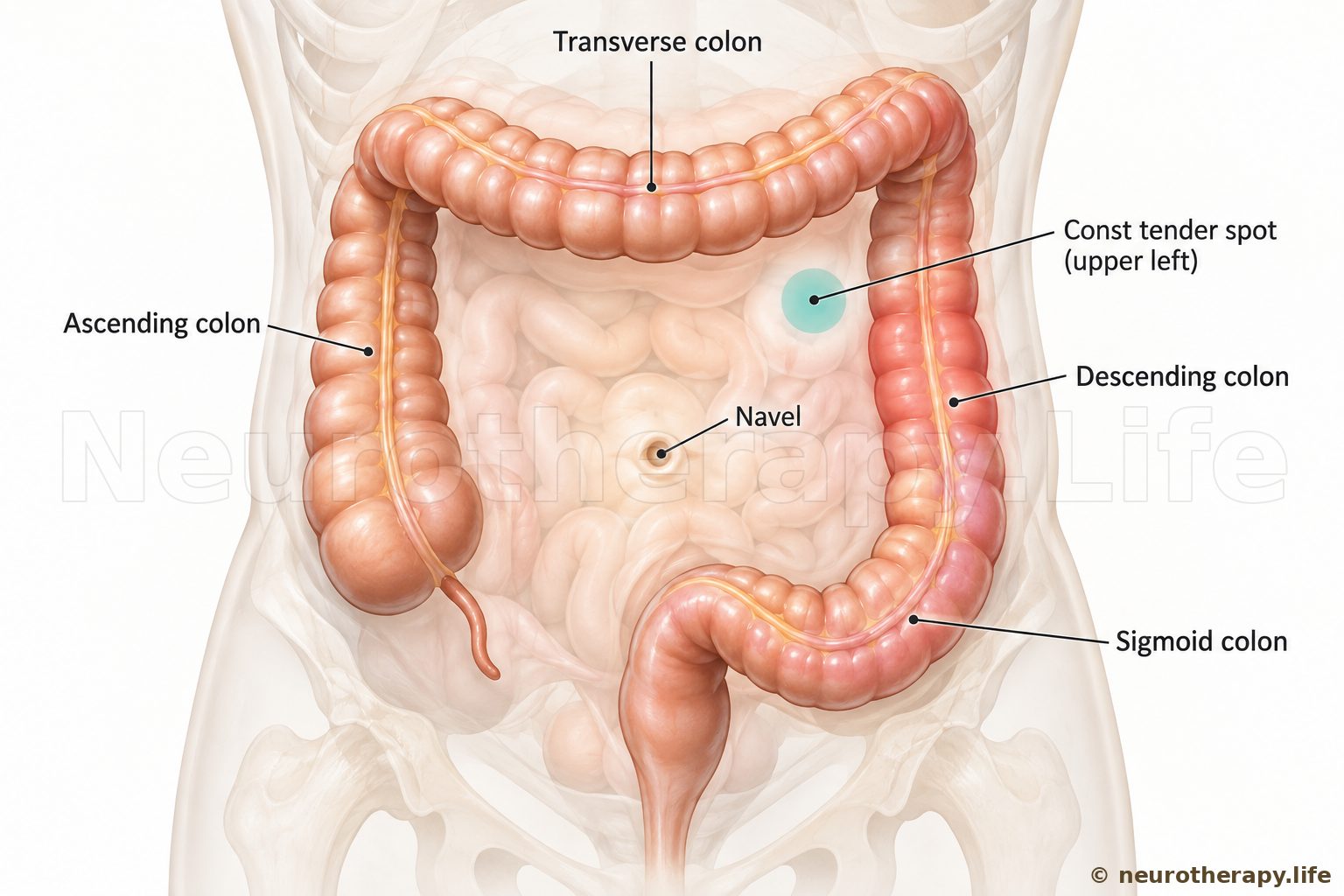
Const is short for constipation. In hard constipation the large bowel moves too slowly; the stool stays longer, more water is drawn out of it, and it becomes dry and hard. LMNT teaching finds that this shows up as a tender spot on the belly — above and to the left of the navel, between the navel and the left rib edge.
That spot sits over the part of the colon that carries waste down the left side of the belly toward the exit. The Const point is chosen when the therapist finds tenderness there — the finding selects the point, not just the word 'constipation'.
Const has a mirror point, Dys, for loose motions. The two sit on opposite thighs and answer opposite corners of the belly — and they must never be confused.
Hard constipation shows as a tender spot above and to the left of the navel, over the left side of the large bowel.
Where it is given
Where is Const given?
PositionLying on the back
Body areaFront of the right thigh, in the middle of the thigh
You lie on your back with one pillow under both thighs. Const is given in the middle of the front of the right thigh.
Why the right thigh, when the sore spot is on the left of the belly? LMNT's map crosses over: the left limb answers the right of the navel, and the right limb answers the left. So Const is felt on the left and treated on the right; Dys is felt on the right and treated on the left.
How it is given
How is Const given?
How this point is given — the tool, the pressure, the count and the exact movement — is deliberately not described here. A demonstration video for this point is being prepared; until it is on this page, learn the method hands-on from a trained Neurotherapist before giving it. Please do not give any point from a written description alone: a point given in the wrong place or the wrong way can do harm.
Chosen byTenderness above and to the left of the navel
The exact technique is taught hands-on in the Neurotherapy (LMNT) course. See the course →
What it does
What does Const do?
The source states its work plainly: it gives relief in constipation, removing the pain that hard constipation makes above and to the left of the navel. How a press on the thigh reaches the bowel is the therapy's own explanation, from long clinical experience.
Gives relief in hard constipation and takes out the matching tender spot on the belly.
Also relieves the constipation that comes with an underactive thyroid, with bamboo spine (ankylosing spondylitis), with Parkinson's disease and with paralysis.
Forms one step of LSTF, the formula for constipation of very long standing, which works the left side of the body.
Organs it reaches
Bowel — The large bowel, whose slow left side causes hard, dry stools.
The Left Side Treatment Formula, for constipation of very long standing — built step by step from the blood supply of the left colon, the water, the thyroid and the inflammation that old constipation leaves.
Safety: when it is held back
Never on a day of loose motions. The caution is checked every session, about today — a patient with lifelong constipation who has been loose since morning is, this morning, a patient with loose motions. Diarrhoea (loose motions)
Do not mix up the thighs. Treating the left thigh for left-sided pain gives Dys — a point that slows the bowel further — to a constipated patient. Dys
If any trouble increases after a point, the chief therapist's opinion is taken at once and written on the card, so the point is not given again, or is given with care. Conditions that block certain points: the six families
New constipation in an older person, blood in the stool, weight loss, or constipation with vomiting and a swollen belly goes to a doctor first. How to tell a patient to see a doctor
Teaching case: the conductor who did not mention his loose motions
A teaching case, put together from several patients: a bus conductor with fifteen years of hard constipation was tender at Const and improved well, going daily without his powder by the third week. Then, after a wedding meal, he was loose for days and said nothing — and was given Const as usual, which made the looseness worse. Const was stopped that day, the session rebuilt round quieting the bowel, and his card was marked to ask about motions every day before Const.
A composite case written to teach the reasoning — not one patient’s file.
Common questions
My constipation is on the left. Why is my right thigh treated?
Because LMNT's map crosses over: the right limb answers the left side of the navel. Treating the left thigh would give Dys, the point for loose motions.
Why does my therapist ask about my motions every time?
Because Const must not be given on a day the bowels are loose. A changed bowel is never a reason to be sent home — it is a reason to be treated differently.
Does drinking water matter?
Yes. Too little water is one of the main causes of constipation. A clear amount, a bottle and a time of day help far more than 'drink more water'.
Can I stop my laxative?
Do not stop any medicine on your own. As the bowel improves, any change is discussed with your doctor.
Surprising facts
1The colon is a water-saver
The large bowel absorbs most of the water left in the food stream. The longer stool stays there, the drier and harder it becomes.
Source: Guyton & Hall, Textbook of Medical Physiology, 14th ed. — absorption in the large intestine.
2The thyroid sets the gut's pace
Thyroid hormone speeds up the movement of the gut. In an underactive thyroid the bowel slows, and constipation is a common sign.
Source: Guyton & Hall, Textbook of Medical Physiology, 14th ed. — thyroid metabolic hormones.
3Constipation is very common
Worldwide, roughly one adult in seven lives with long-term constipation, and it is more common in women and older people.
Source: Suares NC, Ford AC, Prevalence of, and risk factors for, chronic idiopathic constipation in the community: systematic review and meta-analysis, Am J Gastroenterol 2011;106:1582–1591.
This page explains what a Neurotherapy (LMNT) treatment is for; it is not a self-treatment guide and does not diagnose. Neurotherapy (LMNT) works alongside your medical care — keep taking the medicines your doctor prescribed.
Ready to begin?
Send COURSE for course details, or your name, age and health issue for a consultation.