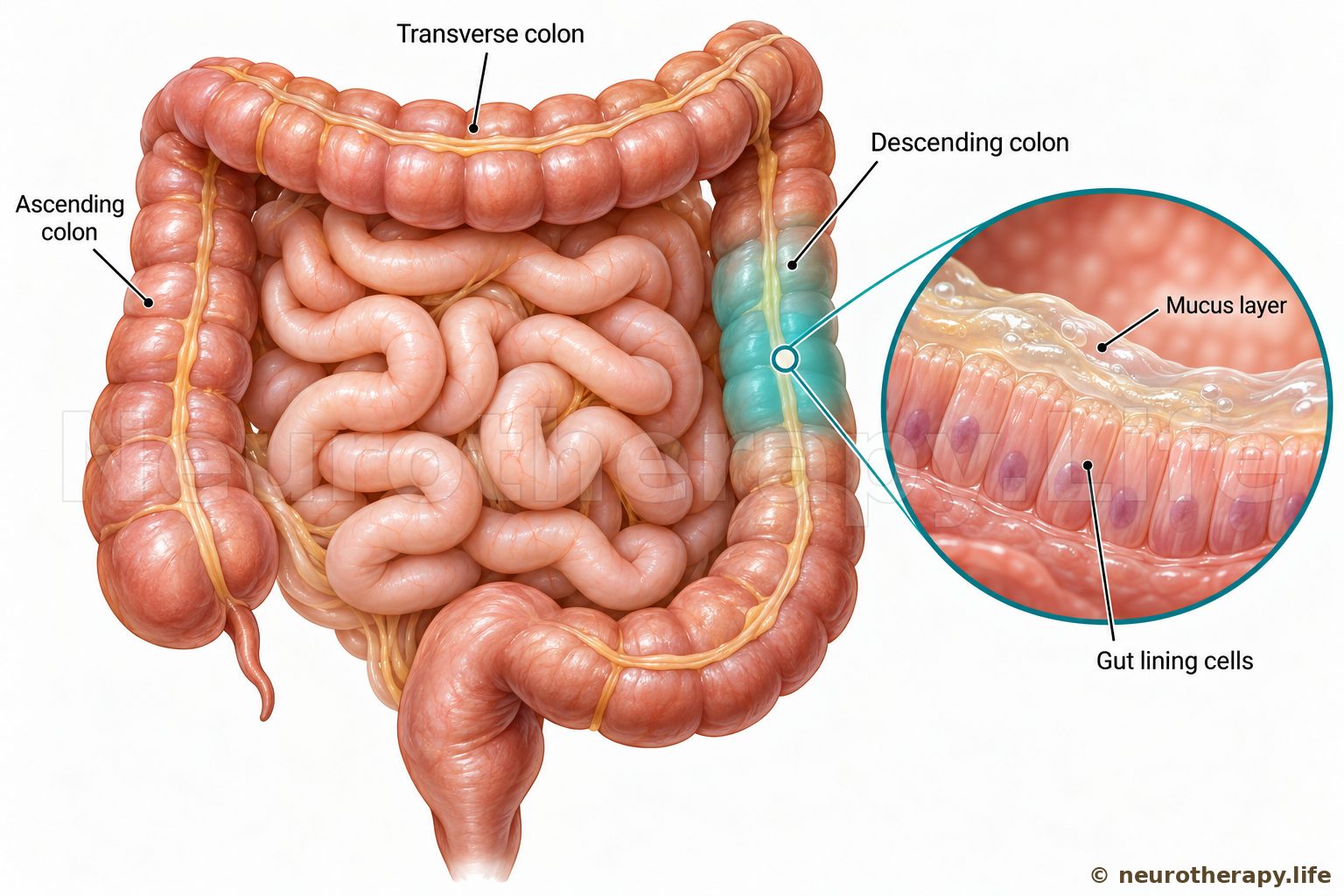
1A two-layer shield
In the colon, mucus forms two layers: a loose outer layer where gut bacteria live, and a firm inner layer that keeps them away from the gut wall.
Source: Johansson MEV, Hansson GC. Nat Rev Immunol 2016;16:639–649.
Also called: Mucus, Mu point, म्यूकस
Mu is the Neurotherapy (LMNT) point named for mucus — the soft, protective membrane that lines the whole digestive tube. It is given lying on your back, on the right arm and right thigh together, and it is the closing step of the Normal treatment, the first formula of the therapy.
Mu is short for mucus. In Neurotherapy (LMNT) the name stands for the mucous membrane — the moist lining of the whole digestive tract, from mouth to bowel, which protects the gut wall and lets food slide along.
In the Normal formula, Mu is said to provoke the mucous membrane of the intestine and the middle part of the descending colon — the last stretch of the large bowel on the left side. Its partner Liv works the liver and the middle of the ascending colon on the right. Given in the right order, the steps walk the large bowel from its beginning towards its end.
Mu is also a finding. Tenderness at the Mu point, on the left side of the navel, is read as inflammation in the intestine, and such people may pass mucus in the stool. Do not confuse Mu with Mu°, a separate point at the back for the left kidney.
You lie flat on your back with a pillow under both thighs and a flat, soft pillow under the right hand and forearm so that the whole hand rests evenly.
Mu is given on the right forearm just below the elbow and the right thigh at the same moment. It is the mirror of Liv, which uses the left forearm and the left thigh.
How this point is given — the tool, the pressure, the count and the exact movement — is deliberately not described here. Watch the demonstration video on this page, and learn the method hands-on from a trained Neurotherapist before giving it. Please do not give any point from a written description alone: a point given in the wrong place or the wrong way can do harm.
The exact technique is taught hands-on in the Neurotherapy (LMNT) course. See the course →
LMNT teaching describes Mu as provoking the mucous membrane of the intestine and the middle of the descending colon, and reads tenderness there as inflammation of the gut. Body science confirms that the gut's mucus layer is a vital barrier; how a press on the arm and thigh reaches it is the therapy's own explanation, from long clinical experience.
Mu is one of the five points of the Normal formula and has a named three-station form.
Mu is rarely given alone. It works inside formulas, chosen from today's findings and the bowel habit.
The first formula of the therapy — Mu is its closing step.
The reversed Normal for loose motions — Mu before Liv.
The same territory swept quickly.
The whole digestive system including the descending colon.
A Normal-family formula used in constipation.
Abdominal pain with loose motions, Mu before Liv.
The lighter whole-body formula for any age.
The long undigested-food formula.
A teaching case, put together from several patients: a retired schoolmistress had years of acidity, bloating and night-time burning, and two tablets a day. She was tender at Pan and at Mu, and surprised to be tender at Mu° too. A normal endoscopy let the work go forward, and her findings were read as one slow digestion rather than four separate complaints — with her own doctor deciding about her tablets.
A composite case written to teach the reasoning — not one patient’s file.No. Mu is the mucus point on the right arm and thigh. Mu° is a separate point at the back for the left kidney.
Because the LMNT map crosses: points are named for what they answer, not for where they are given. Liv and Mu are mirror points across the body.
Usually the pillow under the hand was uneven, or a chair leg touched the hand. Tell your therapist — it is easily put right.
No. Mu is blocked in cold and running nose. Your therapist will leave it out until the cold has passed.
In the colon, mucus forms two layers: a loose outer layer where gut bacteria live, and a firm inner layer that keeps them away from the gut wall.
Source: Johansson MEV, Hansson GC. Nat Rev Immunol 2016;16:639–649.
The digestive tract secretes several litres of fluid a day, much of it mucus-rich, to lubricate and protect the passage of food.
Source: Guyton & Hall, Textbook of Medical Physiology (14th ed.), secretory functions of the alimentary tract.
The mucus is made by goblet cells, named for their wine-glass shape, scattered all along the gut lining.
Source: Gray's Anatomy (41st ed.), the intestinal epithelium.

Shows the Normal treatment given with the feet: (8) Pan at the top of the thighs, then (3) Gal, (3) Spleen, (7) Liv and (5) Mucus on the thighs and forearms, without breaks. It is used to support digestion.

A demonstration of the Ulta Normal formula for loose motions: (8) Pan on both thighs, then Spl before Gal and Mu before Liv — the Normal formula's order reversed to slow the bowel.
The video's counts ((3) Spl, (3) Gal, (5) Mu, (7) Liv) differ from LMNT teaching, which gives (1) Spl, (1) Gal, (1) Mu – 3 points and (1) Liv – 3 points. Ulta Normal is stopped as soon as the stool is formed, and the Normal formula is given for at least one day.
A review of the gut's mucus barrier: mucus forms protective layers that trap bacteria and keep them off the gut lining, working with goblet cells and the immune system to keep the gut healthy.
This page explains what a Neurotherapy (LMNT) treatment is for; it is not a self-treatment guide and does not diagnose. Neurotherapy (LMNT) works alongside your medical care — keep taking the medicines your doctor prescribed.
Send COURSE for course details, or your name, age and health issue for a consultation.