Also called: Pancreas, Pan point, पैंक्रियाज़ पॉइंट
Pan is the Neurotherapy (LMNT) point named for the pancreas, the gland that makes digestive juices and the sugar-controlling hormones insulin and glucagon. It is given at the top of both thighs while you lie on your back, and the number written before it decides which of five quite different treatments you receive.
Overview
What is the Pan point?
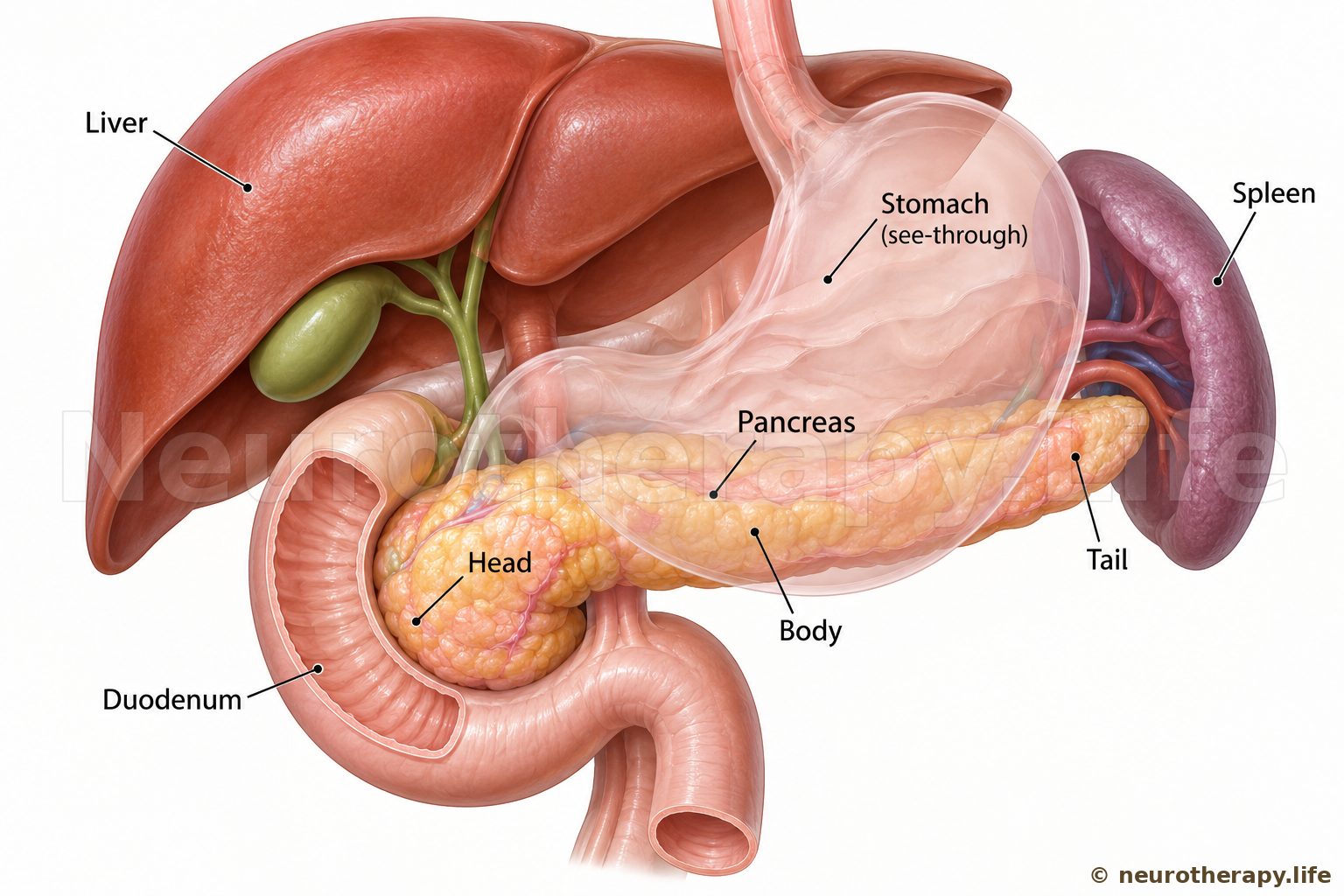
Pan is short for pancreas. The pancreas is a soft, leaf-shaped gland about the length of your hand. It lies deep in the upper belly, behind the stomach, against the back wall of the abdomen.
The pancreas does two jobs. It pours digestive juice into the gut, rich in enzymes (proteins that break food down) and in bicarbonate, a natural alkali that cools down stomach acid. It also makes hormones — chemical messengers carried in the blood — that keep your blood sugar steady.
In Neurotherapy (LMNT), Pan is a chemical point: it is named for a substance the therapy works to move, not for a place. Guruji's teaching is that by Pan we stimulate the pancreas, and that stimulating it in different numbers produces different effects. So (2) Pan, (4) Pan, (8) Pan, (10) Pan and (18) Pan are five separate treatments given at one spot.
Pan matters because it opens more formulas than almost any other point. The very first formula of the therapy, the Normal treatment, begins with (8) Pan, and so do the Heparin, Genes and many digestive formulas.
The pancreas lies deep behind the stomach. The Pan point is named for it, not placed over it.
Where it is given
Where is Pan given?
PositionLying on the back
Body areaFront of both thighs, middle of each thigh, just below the thigh–hip crease
You lie flat on your back, with a pillow under both thighs and nothing under the head or the waist. The pillows are part of the treatment: Guruji's rule is that even if the patient is in a hurry, Pan is never given without placing them properly.
Pan is given on the front of both thighs together, in the middle of each thigh, just below the crease where the thigh meets the hip. It stays in the middle on purpose: further inward lies the groin, where the main artery, vein and nerve of the leg run close under the skin.
Why the thigh, when the pancreas is in the belly? LMNT's map works by a crossing rule: pressure on the legs relieves pains above the navel. The point is named for the pain it answers — the sore spot just below the breastbone that pancreas trouble produces — not for the limb it is given on.
The name Pan also appears in two other places. During examination, the therapist feels for tenderness at the Pan area of the belly, in the soft dip beside the bony tip at the bottom of the breastbone. And in the toe treatments (TF and NNS), the Pan toe is the first toe next to the big toe, on both feet.
How it is given
How is Pan given?
How this point is given — the tool, the pressure, the count and the exact movement — is deliberately not described here. Watch the demonstration video on this page, and learn the method hands-on from a trained Neurotherapist before giving it. Please do not give any point from a written description alone: a point given in the wrong place or the wrong way can do harm.
The number written before a point's name is not a strength setting. Each numbered form is a separate named treatment with its own method and timing, taught hands-on in the course.
Moves along the limb?No — Pan stays at one spot
The number before itChooses the treatment; it is not a strength setting
The exact technique is taught hands-on in the Neurotherapy (LMNT) course. See the course →
What it does
What does Pan do in the body?
LMNT teaching describes Pan as a way of rousing the pancreas, and each numbered form is aimed at a different product of that gland. Body science confirms that the pancreas really does make each of these substances; how a press on the thigh reaches them is the therapy's own explanation, offered from long clinical experience.
(8) Pan — for the digestive enzymes of the pancreas and for sodium bicarbonate, which reduces the acidity of the stomach; used to raise appetite, in indigestion and stomach ulcer, and for pain in the Pan area.
(10) Pan — to stimulate insulin, the hormone that lets sugar and proteins enter the cells; given to diabetic patients to keep the sugar level steady.
(4) Pan — for glucagon, the hormone that raises blood sugar and feeds the cells; used for weakness from lack of sugar, and in small children for appetite and height.
(2) Pan — for somatostatin, a braking hormone; used where a gland or hormone is working too much, and to check unwanted growths such as lipoma (fatty lumps), cysts and fibroids.
(18) Pan — to reduce prolactin (a milk-making hormone) in women; also used for cataract and eye disease.
Organs it reaches
Pancreas — The gland Pan is named for — digestive juice on one side, insulin, glucagon and somatostatin on the other.
Stomach — Pancreatic bicarbonate neutralises the acid that leaves the stomach — the reason (8) Pan is used in acidity and ulcer.
Intestines — Pancreatic enzymes do most of the real digestion of fat, protein and starch in the small intestine.
Blood — Insulin and glucagon pull the blood sugar down and up — the work of (10) Pan and (4) Pan.
Its family
What are the forms of Pan?
Each number is a separate named treatment with its own uses and its own cautions. A caution written against one number does not automatically travel to the others — but the general Pan cautions apply to all.
(2) Pan — Somatostatin — to stop what is overactive and check unwanted growths. Not for children being treated for height.
(4) Pan — Glucagon — for weakness from low sugar; appetite and height in small children. Not in diabetes.
(8) Pan — Digestive enzymes and bicarbonate — the everyday form that opens the Normal and Heparin formulas.
(10) Pan — Insulin — for diabetes, long-standing joint pain and eye disease.
(18) Pan — The highest count — to reduce prolactin in women; cataract and eye disease.
WD — A neighbour on the map: WD lies just below the navel, exactly opposite Pan across it, and follows (8) Pan in the Genes formulas.
What it is used for
What is Pan used for?
Pan is never chosen from the name of a disease alone. The therapist matches the right form to today's findings — and checks the blocked list first.
The six-stage undigested-food treatment, where Pan serves the accessory digestive organs.
Safety: when it is held back
Blocking comes first. Before any treatment, the points not to be given for the patient's disease are marked on the diagnosis card. Where a caution and a use both apply, the caution wins. Conditions that block certain points: the six families
Diabetes: (4) Pan raises blood sugar, so it is never given to a diabetic — (10) Pan is given in its place. Diabetes
Cancer: (4) Pan is blocked, because glucagon nourishes all cells, cancer cells included. (10) Pan is never given in cancer. (2) Pan is the form used in their place, and its timing must be exact: held too long it begins to act like (4) Pan. This is one reason Pan is given only by a trained therapist. Cancer care: Neurotherapy (LMNT) support
Never stimulate the organ the cancer is in: in cancer of the pancreas, (2) Pan is not given either. Nothing in this therapy treats cancer; it is support alongside the oncologist. Cancer care: Neurotherapy (LMNT) support
Fits, convulsions and epilepsy: Pan raises alkali, so it is not given — except where it sits inside a Heparin formula. Epilepsy (fits)
Schizophrenia: Pan is not given. It has been seen to make these patients hear voices. Schizophrenia
Children and height: (2) Pan stops growth hormone, so it is never given to a child who is short or under treatment to increase height — (4) Pan or (10) Pan may be given instead. Children always receive light treatment. Low height in children (short stature)
Emergency: boring pain in the pit of the stomach going through to the back, with vomiting, can mean an inflamed pancreas. Call 108/112 or go to hospital. No abdominal pressure of any kind until a doctor has seen the patient. How to tell a patient to see a doctor
Never stop or change your medicines because of Pan. If your sugar is falling, tell your doctor and let the doctor decide the dose.
Guruji says
“By Pan we stimulate the pancreas. Stimulating in different numbers produces different effects.”
— Dr. Lajpatrai Mehra
“When the patient comes for the first time, then — even before beginning treatment — on their diagnosis card block those points which, according to their disease, are not to be given, so that no harm will come to the patient.”
— Dr. Lajpatrai Mehra
A teaching case
Teaching case: the diabetic clerk who was tender at Pan
A teaching case, put together from several patients: a man in his fifties came with nine years of diabetes and lifelong constipation, and was surprised to be tender at Pan — 'But my problem is sugar.' The therapist did not reach for a treatment for diabetes; Pan said what his digestion was short of, and the constipation said where the work lay. Several days went in digestive work alone, his tablets were never touched, and his sugar came down while his own doctor watched the numbers.
A composite case written to teach the reasoning — not one patient’s file.
Common questions
Does Pan press on my pancreas?
No. The pancreas lies deep behind the stomach, and nothing on the thigh touches it. Pan is named for the pain it answers, not for where it is given — that is the crossing rule of the LMNT map.
Why does my card say (8) Pan and my friend's say (10) Pan?
Because they are different treatments. (8) Pan is chosen for digestion and acidity, (10) Pan for insulin and diabetes. The number is a selector, not a stronger or weaker dose.
I have diabetes. Can I take Pan?
Yes, in the right form. (10) Pan is the form given in diabetes, while (4) Pan is blocked because it raises sugar. Keep taking your medicines and keep checking your sugar; if it falls, your doctor adjusts the dose, not the therapist.
Does Pan hurt?
It should feel like a firm, even pressure, and you should stay comfortable. If it hurts, tell the therapist at once. A tender Pan area in the belly during examination is a finding, not a mistake.
Can I give Pan to myself at home?
Only after you have been taught by a trained teacher and told which form you need. Several forms carry strict cautions — in cancer, epilepsy, schizophrenia and in children treated for height — and one form changes its effect if it is held too long.
Why is a pillow placed under my thighs?
It sets the angle of the thighs so the pressure travels the right way and your low back stays flat. Without it, the same pressure becomes a different treatment and can leave the back sore.
Surprising facts
1The sugar factory is tiny
The hormone-making islets — small clusters of cells scattered through the pancreas — make up only about 1 to 2% of the whole organ. Yet they keep the blood sugar of the entire body in balance.
Source: Röder PV et al., Pancreatic regulation of glucose homeostasis, Exp Mol Med 2016;48:e219.
2Two hormones pull in opposite directions
Insulin from the beta cells lowers blood sugar; glucagon from the alpha cells raises it. Health is the tug-of-war held steady — which is why (10) Pan and (4) Pan are opposite treatments.
Source: Röder PV et al., Exp Mol Med 2016;48:e219.
3A built-in brake
About one islet cell in twenty is a delta cell. It makes somatostatin, which acts as a local brake on both insulin and glucagon. The same hormone, made in the brain, also holds back growth hormone — the reason (2) Pan is kept away from children being treated for height.
Source: Rorsman P, Huising MO, The somatostatin-secreting pancreatic δ-cell in health and disease, Nat Rev Endocrinol 2018;14:404–414; growth-hormone action: Guyton & Hall, Textbook of Medical Physiology.
4About a litre of juice a day
The pancreas pours roughly a litre of digestive juice into the gut every day. Its bicarbonate neutralises the acid arriving from the stomach, so the enzymes of the small intestine can work.
Source: Guyton & Hall, Textbook of Medical Physiology (daily secretion of pancreatic juice about 1,000 mL).
5Its pain goes through to the back
Because the pancreas lies against the back wall of the belly, its pain often bores straight through to the middle of the back and eases when the person leans forward. That is a warning sign worth knowing.
Source: Standard clinical teaching on pancreatitis (e.g. Harrison's Principles of Internal Medicine).
6A Nobel Prize for one hormone
Insulin was isolated in Toronto in 1921, and the discovery won the Nobel Prize in 1923. Before that, type 1 diabetes was a death sentence.
Source: NobelPrize.org, The Nobel Prize in Physiology or Medicine 1923 (Banting and Macleod).
Watch
How to Give 1, 2, and 8 PAN Point in Neurotherapy | Practical Demo for Students - Dr. Diwakar Shukla
A practical demo by Dr. Diwakar Shukla on how to give 1, 2 and 8 Pan — the pancreas point — to support a weak pancreas.
How to Stimulate Pancreas Naturally? | LMNT Pan Point | Diabetes और Indigestion का जादुई इलाज
Shows how to find the Pan (pancreas) point in the fold at the top of both thighs, and how to give 1 Pan, 2 Pan, 2 Pan × 6 and 8 Pan with the feet, holding chairs for support. It is used to support the pancreas in diabetes and indigestion.
कमज़ोर पाचन और Gut Health का पक्का इलाज | LMNT Normal Treatment | @neurotherapylife
Shows the Normal treatment given with the feet: (8) Pan at the top of the thighs, then (3) Gal, (3) Spleen, (7) Liv and (5) Mucus on the thighs and forearms, without breaks. It is used to support digestion.
Test yourself
Research
Strong evidence
A review of how the pancreas controls blood sugar: insulin-making beta cells are most of each islet, glucagon-making alpha cells and somatostatin-making delta cells fewer, and the islets together are only 1–2% of the organ. Insulin lowers sugar and glucagon raises it.
Delta cells make up about 5% of islet cells. Their somatostatin works as a local brake on both insulin and glucagon, and when this brake goes wrong in diabetes, the body's defence against low sugar weakens.
This page explains what a Neurotherapy (LMNT) treatment is for; it is not a self-treatment guide and does not diagnose. Neurotherapy (LMNT) works alongside your medical care — keep taking the medicines your doctor prescribed.
Ready to begin?
Send COURSE for course details, or your name, age and health issue for a consultation.