(18) Pan is the highest-numbered form of the Pan point. It is used to reduce prolactin, a milk-making hormone, in women, and for cataract and eye disease — and it is the step that turns the Heparin formula into F. Heparin, used for old, set clots.
Overview
What is (18) Pan?
Pan is short for pancreas, the gland behind the stomach. Guruji taught that stimulating the pancreas in different numbers produces different effects, and (18) Pan is the highest number in the family.
Its own uses are short: to reduce the amount of prolactin in women, and for cataract and eye disease. Prolactin is the hormone made by the pituitary gland at the base of the brain that makes the breasts produce milk. Too much of it outside of breastfeeding can upset the monthly cycle.
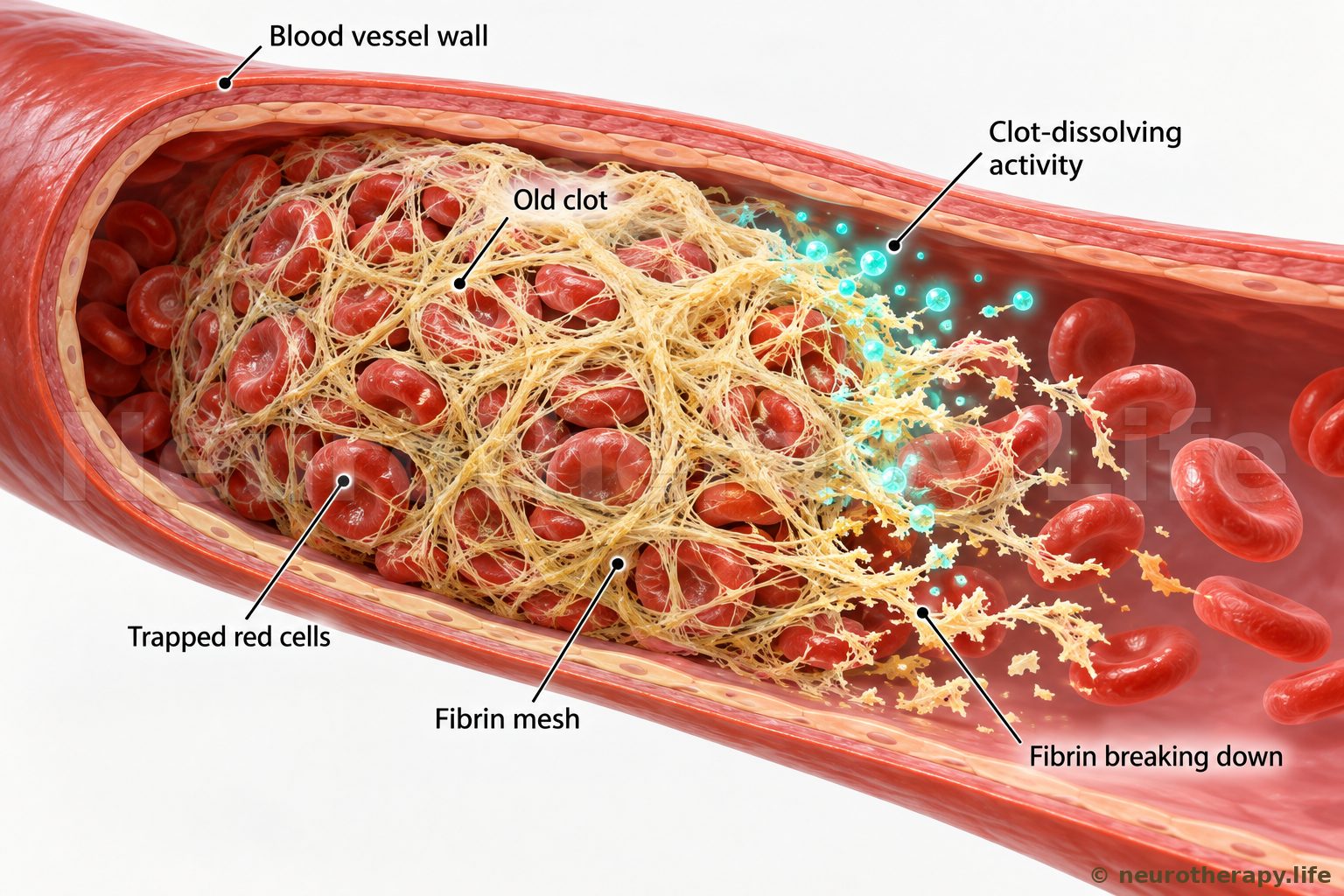
Its bigger role is inside a formula. The Heparin formulas begin with Pan. Raise that Pan to eighteen and the parent P. Heparin becomes F. Heparin — the form used to break fibrin, the tough mesh, that has set inside an old clot.
A high number does not mean a heavy dose. (18) Pan and (2) Pan are opposite errands, not a strong and a weak version of one thing.
Fibrin is the mesh that holds an old clot together — F. Heparin, opened by (18) Pan, is aimed at it.
Where it is given
Where is (18) Pan given?
PositionLying on the back
Body areaFront of both thighs, middle of each thigh, just below the thigh–hip crease
You lie flat on your back, with one pillow under both thighs and nothing under the head or the waist. (18) Pan is given on the front of both thighs together, in the middle of each thigh, just below the crease where the thigh meets the hip.
This is exactly the same spot as every other form of Pan. The place does not change from one number to the next — only the treatment does. The middle of the thigh is chosen on purpose: further inward lies the groin, where the main artery, vein and nerve of the leg run close under the skin.
Why the thigh, when the pancreas lies deep in the belly? The Neurotherapy (LMNT) map works by a crossing rule: pressure on the legs answers pains above the navel. The point is named for what it is meant to move, not for the place it is given on.
How it is given
How is (18) Pan given?
How this point is given — the tool, the pressure, the count and the exact movement — is deliberately not described here. A demonstration video for this point is being prepared; until it is on this page, learn the method hands-on from a trained Neurotherapist before giving it. Please do not give any point from a written description alone: a point given in the wrong place or the wrong way can do harm.
The number written before a point's name is not a strength setting. Each numbered form is a separate named treatment with its own method and timing, taught hands-on in the course.
The number before itNames the treatment; it is not a strength setting
The exact technique is taught hands-on in the Neurotherapy (LMNT) course. See the course →
What it does
What does (18) Pan do in the body?
In Neurotherapy (LMNT) teaching, (18) Pan is named for two uses of its own and one role inside a formula. Body science confirms what prolactin and fibrin are; how a press on the thigh reaches them is the therapy's own explanation, offered from clinical experience.
To reduce the amount of prolactin in women.
For cataract and eye disease — a use it shares with (10) Pan.
As the opening step of F. Heparin: in old disease, to break the fibrin set in clots, and for an infarct (a patch of tissue that died when its blood supply was blocked) with paralysis of many years.
Organs it reaches
Pituitary gland — Makes prolactin, which (18) Pan is used to reduce.
Blood — Through F. Heparin, aimed at the fibrin of old clots.
Pancreas — The gland every form of Pan is named for.
Its family
What are the other forms of Pan?
Every number of Pan is given at the same place, and each is its own treatment with its own uses and its own cautions. A caution written against one number does not travel to the others — but the general Pan cautions apply to all.
Pan — The parent Pan point — the pancreas point and its five numbered forms.
(2) Pan — Somatostatin — to check what is overactive and unwanted growth. Not for children treated for height.
(4) Pan — Glucagon — for weakness from low sugar; appetite and height in small children. Not in diabetes or cancer.
(8) Pan — Digestive enzymes and bicarbonate — the everyday form that opens the Normal and Heparin formulas.
(10) Pan — Insulin — for diabetes, long-standing joint pain and eye disease.
What it is used for
What is (18) Pan used for?
(18) Pan is chosen from the patient's findings, after the blocked list has been checked.
The full Heparin assembly for multiple infarcts or calcification; F. Heparin is one of its parts.
Safety: when it is held back
Blocking comes first. Before any treatment, the points not to be given for the patient's disease are marked on the diagnosis card. Where a caution and a use both apply, the caution wins. Conditions that block certain points: the six families
Inside F. Heparin: if blood is flowing or there is a wound, no Heparin treatment at all until it heals. F. Heparin (fibrinolysin)
Do not mix up F. Heparin and Anti F. Heparin. (18) Pan and (2) Pan are opposite errands, not a strong and a light version. (2) Pan
Cancer: never stimulate the organ the cancer is in — in cancer of the pancreas no Pan is given. Nothing in this therapy treats cancer. Cancer care: Neurotherapy (LMNT) support
Fits, convulsions and epilepsy: Pan raises alkali, so it is not given — except where it sits inside a Heparin formula. Epilepsy (fits)
Schizophrenia: Pan is not given. It has been seen to make these patients hear voices. Schizophrenia
A milky discharge from the breast when not breastfeeding, a sudden change in vision, or a new weakness of the face or limbs needs a doctor first. How to tell a patient to see a doctor
Never stop or change your medicines because of Pan. Neurotherapy (LMNT) works alongside your doctor's care; any change of dose is the doctor's decision.
Guruji says
“By Pan we stimulate the pancreas. Stimulating in different numbers produces different effects.”
— Dr. Lajpatrai Mehra
Common questions
Is (18) Pan the strongest Pan?
It is the highest number, not the strongest dose. Each number is its own treatment with its own job.
My prolactin report is high. Should I ask for (18) Pan?
Show your report to both your doctor and your therapist. (18) Pan is named for reducing prolactin, but a high reading has several causes that a doctor must check first.
What is the difference between F. Heparin and P. Heparin?
Only the number before Pan. P. Heparin is the parent for everyone; F. Heparin raises Pan to eighteen and is chosen for old, set clots and paralysis of many years.
Surprising facts
1Prolactin is held on a leash
Most pituitary hormones are switched on by the brain. Prolactin is the opposite: the brain keeps it held down all the time with dopamine.
Source: Guyton & Hall, Textbook of Medical Physiology (prolactin-inhibiting hormone = dopamine).
2Fibrin is a net
A clot is built on fibrin, long protein threads that knit into a net and trap red blood cells.
Source: Guyton & Hall, Textbook of Medical Physiology (blood coagulation).
3The body's own clot-dissolver
The body breaks clots down with plasmin, an enzyme switched on inside the clot by a signal from the vessel lining.
Source: Guyton & Hall, Textbook of Medical Physiology (plasminogen and tissue plasminogen activator).
This page explains what a Neurotherapy (LMNT) treatment is for; it is not a self-treatment guide and does not diagnose. Neurotherapy (LMNT) works alongside your medical care — keep taking the medicines your doctor prescribed.
Ready to begin?
Send COURSE for course details, or your name, age and health issue for a consultation.