A pea-sized gland hanging on a stalk beneath your brain gives orders to the thyroid, the adrenals, the ovaries and the testes. It sits in a bony saddle, it releases most of its growth hormone in your first deep sleep, and in Guruji's teaching it is the 'foreman' of all the glands.
Overview
What is the pituitary gland?
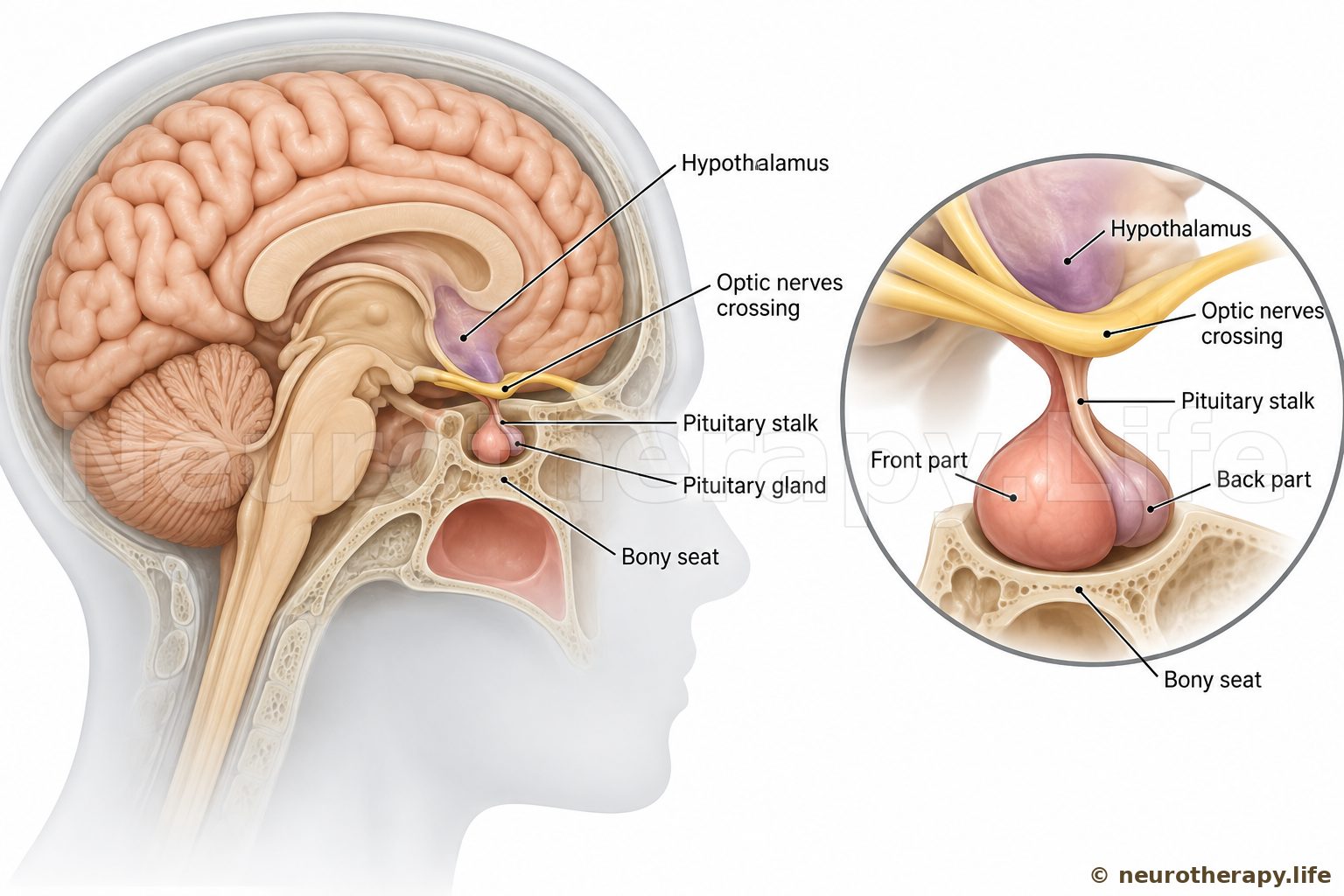
The pituitary is a small, pea-sized gland at the base of the brain, behind the bridge of the nose. It hangs by a thin stalk from the hypothalamus above it and rests in a bony pocket of the skull. Because it controls several other glands, it is often called the 'master gland'.
It has two parts. The front part makes six main hormones — for growth, the thyroid, the adrenals, the ovaries and testes, and breast milk. The back part stores and releases two hormones made in the brain: ADH (vasopressin), which saves water, and oxytocin, which drives labour and the flow of breast milk. The hypothalamus above tells it what to do.
Small lumps in the pituitary (adenomas) are surprisingly common — found in about one person in six on scans or at post-mortem — and almost all are harmless and silent. A few make too much hormone, or grow large enough to press on the nerves of sight.
The pituitary hangs beneath the brain, right behind the bridge of the nose — a pea with two very different halves.
Function
What does the pituitary gland do?
The pituitary is a relay between the brain and the body. The hypothalamus decides what the body needs; the pituitary turns that decision into hormone orders sent through the blood to glands and organs far away.
Growth hormone (GH): makes children grow; in adults keeps muscle, bone and fat in balance.
TSH: tells the thyroid to make its hormones.
ACTH: tells the adrenal glands to make cortisol.
FSH and LH: run the ovaries and testes — eggs, sperm, oestrogen, progesterone and testosterone.
Prolactin: makes breast milk after childbirth.
ADH (vasopressin): tells the kidneys to save water.
Oxytocin: squeezes the womb in labour and lets breast milk flow.
The brain decides
The hypothalamus senses what the body needs — more thyroid hormone, more cortisol, less water loss.
A private road to the front part
It sends 'releasing hormones' down a tiny private network of blood vessels inside the stalk, straight to the front part of the pituitary.
The front part sends its orders
The front part releases its own hormone — TSH, ACTH, FSH, LH, GH or prolactin — into the general blood.
The target gland answers
The thyroid, adrenal, ovary or testis makes its hormone; when there is enough, it tells the hypothalamus and pituitary to ease off.
A nerve road to the back part
Some nerve cells of the hypothalamus make ADH and oxytocin themselves and carry them down their own long fibres into the back part, where they are stored.
Released on demand
When you are short of water, ADH is released within minutes; when a baby suckles, oxytocin lets the milk flow.
How does the pituitary work with other organs?
Brain — The hypothalamus, directly above, gives the pituitary its orders through the stalk.
Thyroid — TSH tells it to work; a raised TSH on a report means the pituitary is pushing a slow thyroid.
Adrenal glands — ACTH tells the adrenal cortex to make cortisol.
Ovaries — FSH and LH run the monthly cycle and release of an egg.
Kidneys — ADH from the back part tells the kidneys to save water.
Eyes — The nerves of sight cross just above the pituitary, so a large lump can affect vision.
Anatomy
What are the parts of the pituitary gland?
The pituitary is really two glands joined together, hanging on a stalk in a bony seat.
The front part (anterior pituitary)
About three-quarters of the gland. It is true gland tissue and makes its own hormones.
Growth hormone cells — The largest group — about half of the front part's cells.
Prolactin cells — Grow in number during pregnancy and breastfeeding.
TSH, ACTH, FSH and LH cells — The cells that send orders to the thyroid, adrenals and reproductive glands.
The back part (posterior pituitary)
Not really a gland at all, but an extension of the brain — the ends of nerve fibres from the hypothalamus.
ADH (vasopressin) store — Released when the blood is too concentrated or the pressure falls.
Oxytocin store — Released in labour, during breastfeeding, and with touch and closeness.
The stalk and the seat
Pituitary stalk — A thin stem joining the gland to the hypothalamus; it carries both the tiny blood-vessel network and the nerve fibres.
Sella turcica — The saddle-shaped hollow in the skull bone where the gland sits — Latin for 'Turkish saddle'.
Cavernous sinuses — Channels of blood on either side, through which run the main arteries to the brain and the nerves that move the eyes.
Where is the pituitary gland located?
The pituitary sits almost in the centre of the head: behind the eyes and the bridge of the nose, below the brain, and just above an air space in the skull bone called the sphenoid sinus. That is why surgeons can reach it through the nose, without opening the skull.
Just above it, the two nerves of sight cross over each other (the optic chiasm). On either side run the main arteries to the brain and the nerves that move the eyes.
In LMNT, nothing is pressed on the head for the pituitary. Pit is given on both arms together, near the elbows and then the shoulders; Thrd 'P' on the left arm; and (6) Medulla, which the teaching links with the hypothalamus, below the ears at the back of the neck.
The pituitary is a small, soft, oval gland, a little like a cherry hanging from its stalk. The larger front part is pinkish-grey; the smaller back part is paler.
On an MRI scan the back part shows up as a small 'bright spot', which doctors look for when they check the gland.
How big is the pituitary gland?
The pituitary is about 1 cm across — roughly the size of a pea or a chickpea — and weighs only about half a gram.
It grows noticeably larger during pregnancy, as the prolactin cells multiply to prepare for breastfeeding, and settles back afterwards. It is also a little larger in the teenage years.
Conditions and disorders
What conditions and disorders affect the pituitary gland?
Most pituitary problems come from a small, non-cancerous growth (adenoma). Some make too much of one hormone — prolactin (stopping periods and causing milky discharge), growth hormone (acromegaly in adults, gigantism in children) or ACTH (Cushing's disease). Others make no hormone but press on the gland or the nerves of sight, so that hormones fall. Head injury, surgery, radiation, severe bleeding after childbirth and, rarely, a sudden bleed into a tumour can also damage the gland.
Headache and migraineA pituitary lump is a rare cause of headache — but a sudden, severe headache with vision change is an emergency.
Where LMNT teaching uses Pit and Thrd 'P'
Dry eyesThe teaching gives Pit for lack of moisture in the eyes.
Vertigo and giddinessPit, followed by (4) Up Arrow, for giddiness in tall buildings, buses or aeroplanes.
Microcephaly(4) Thrd 'P', which the teaching aims at growth hormone, is used for children with a smaller head.
Teenage years (care for teenagers)The growing years carry their own bars — (6) Medulla and the ovary points are withheld from young people treated for height.
What are common signs of a pituitary problem?
Loss of side vision, or bumping into things on one side
Headaches that are new or different
Periods stopping, milky discharge from the breasts, or low sex drive
Hands, feet or jaw slowly getting bigger; rings and shoes no longer fitting
Great tiredness, feeling cold, low blood pressure, pale skin
Great thirst and passing large amounts of urine, day and night
What tests check the pituitary gland?
Paired hormone tests — Each pituitary hormone is read beside its target: TSH with T4, ACTH with cortisol, LH and FSH with sex hormones, and IGF-1 for growth hormone.
Prolactin — Checked when periods stop, fertility is low or there is milky discharge.
Stimulation and suppression tests — The gland is gently pushed or braked, and blood is tested to see how it answers.
MRI of the pituitary — The best scan to see the gland and any lump in it.
Visual field test — Maps how wide you can see to each side.
Water tests — Blood and urine concentration, sometimes after a supervised period without drinking, to diagnose diabetes insipidus.
How are pituitary conditions treated?
Medicines — Some tumours, especially prolactin-making ones, shrink well with tablets; others have medicines that block the extra hormone.
Surgery through the nose — Most pituitary tumours that need surgery are removed through the nose and the sphenoid sinus, often with an endoscope.
Radiotherapy — For tumours that remain or return after surgery.
Hormone replacement — Replacing what the target glands can no longer make: thyroxine, hydrocortisone, sex hormones, growth hormone, or desmopressin for water balance.
Regular follow-up — Repeat blood tests, scans and eye checks over the years.
Neurotherapy (LMNT)
Guruji's teaching calls the pituitary the foreman: a pea-sized gland whose business is to tell the thyroid, the adrenal cortex and the reproductive glands how much to make. One of the teaching's working assumptions is that both parts of the pituitary can be stirred by this treatment, and that the other hormone glands are therefore best approached through it. The front part is reached, in the teaching, by Pit on both arms and by Thrd 'P' on the left arm, which it aims mainly at growth hormone. Given with (4) Thrd, Thrd 'P' works along the pituitary's road to the thyroid; given before an ovary point, along its road to the ovaries. Above the pituitary, the teaching links (6) Medulla — the very first Medulla treatment found — with the hypothalamus and its releasing hormones. The back part is linked with (2) Para and vasopressin. In Formula No. 4, Guruji turned from the organs that do the digesting to those that order it — the vagus nerve and the front of the pituitary — before taking out the pain at Pan. As the teaching itself says, these links are inferences from physiology and from what patients reported, and some are still marked as open questions. This is support alongside your doctor's care, never a replacement for it.
Points
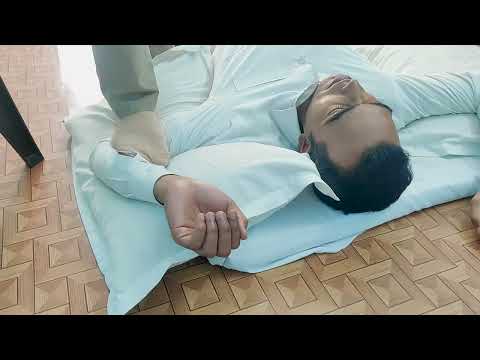
Pit — Given on both arms at once, supine: the therapist, supported on two chairs, places one foot and then the other near both elbows, then both shoulders — six seconds each, four contacts making one. Equal weight on both sides.
Thrd 'P' — The left arm only, elbow then shoulder, four six-second contacts making one. The teaching aims it at the front of the pituitary, mainly growth hormone.
(6) Medulla — Below the ears on both sides of the neck, seated. The teaching links it with the hypothalamus — hunger, thirst and body temperature, and the releasing hormones that reach the pituitary.
(2) Para — Two applications on the right arm. The teaching links it with the back of the pituitary and vasopressin — for long-standing low blood pressure and diabetes insipidus.
(4) Para — The teaching also gives (4) Para to a breastfeeding mother whose milk has recently stopped, linking it with oxytocin.
Up Arrow — The teaching's follow-on after Pit in giddiness: (4) Up Arrow.
Lt. Ov. — Given after (4) Thrd 'P', an ovary point works along the pituitary's FSH and LH road in the teaching's plan for missed or irregular periods.
(10) Medulla — Step one of Formula No. 4 — the teaching's way of reaching the vagus nerve, the supervisor of digestion.
(10) Medulla (4) Thrd 'P' (20) Round Arrow (8) Pan — the 'supervisors' first: the vagus, the front of the pituitary and the spinal pathway, then the pain at Pan.
“We do not give treatment for any one disease; rather we treat according to the condition of the body on that day.”
— Dr. Lajpatrai Mehra
“In the detailed knowledge of the functions of (6) Medulla and (10) Medulla, some further discovery remains to be made.”
— Guruji's teaching
“I am yet to understand the human body. My knowledge is hardly the tip of the iceberg. Neurotherapy (LMNT) is just in its infancy. There is a long way to go.”
— Dr. Lajpatrai Mehra
Never do this
Emergency: a sudden, severe headache with loss of vision, double vision, vomiting or drowsiness — call 108/112. It can be a bleed into the pituitary. A slow loss of side vision needs an eye doctor and a scan soon. How to tell a patient to see a doctor
Pit is not given in diabetes (the teaching says it raises sugar), high blood pressure, cancer or fits — 'do not give Pit to a Fit'. Pit
Young people aged 13 to 20 treated for height: (6) Medulla is not given unless there is special need, and Lt. Ov. and Rt. Ov. are not given — a growth plate that has closed cannot open again. (6) Medulla
Thrd 'P' is not given where bone has grown in the wrong place — bamboo spine, heel spur or any unwanted bone growth. Thrd 'P'
(2) Para is never given in high blood pressure. (2) Para
Pit, Para and Thrd 'P' are given with the therapist's feet on the arms. In small children, very weak persons and anyone with osteoporosis, the teaching allows the hand only, never the foot. Frail and elderly patients (gentle care)
Never stop hormone replacement — thyroxine, hydrocortisone or desmopressin — on your own, and follow your doctor's sick-day rules if you take hydrocortisone.
Cancer: if the person has cancer, (10) Pan, Thymus, Pit, Lu + Sh, Rt. Ov / Lt. Ov and (30) Medulla are never given — the therapist changes the plan. Cancer care: Neurotherapy (LMNT) support
Care
How can I keep my pituitary healthy?
Most pituitary problems cannot be prevented, but good habits support the hormones it controls, and knowing the warning signs gets problems found early.
Protect deep sleep
Growth hormone is released mostly in the first deep sleep of the night. Children and adults alike need regular, sufficient sleep in a dark room.
Protect your head
A serious head injury can damage the pituitary. Wear a helmet on a two-wheeler and a seat belt in a car.
Know the warning signs
Periods stopping without pregnancy, milky discharge, changing side vision, or growing hands and feet are reasons to see a doctor.
No 'height' or hormone products without a doctor
Do not give children products that promise extra height, or take hormone or steroid products bought without a prescription.
Support breastfeeding calmly
Oxytocin flows best when the mother is relaxed; skin-to-skin contact with the baby helps.
Keep digestion in order
Guruji's teaching is that every gland's raw material comes from digestion — the foreman can only pass on orders the workers have the material to carry out.
Common questions
Is a pituitary tumour a brain cancer?
Almost never. Pituitary adenomas are non-cancerous growths. Many are tiny, cause no trouble and are found by chance. Some need treatment because they make too much hormone or press on nearby nerves.
Can a pituitary problem affect my eyesight?
Yes. The nerves of sight cross just above the gland, so a large lump can slowly take away the outer side vision of both eyes, often without the person noticing. A visual field test picks it up.
Why does the doctor check prolactin when my periods stop?
High prolactin — from a small pituitary lump, some medicines or an underactive thyroid — switches off the hormones that run the cycle. It is common, and usually very treatable.
Can the pituitary really be operated on through the nose?
Yes. The gland sits just above an air space behind the nose, so surgeons usually reach it through the nostril with a thin camera, without opening the skull.
Will growth hormone make my child taller?
Only in children who truly lack it, or who have a few specific conditions — and only under a child hormone specialist after proper tests. It is not a general height booster.
Can Neurotherapy (LMNT) be taken with pituitary medicines?
LMNT is given alongside medical care, never instead of it. Tell the therapist about diabetes, blood pressure, fits, cancer and any growth treatment in a teenager, because Pit, (6) Medulla and the ovary points are blocked in these.
What should I ask my doctor or therapist?
Is my problem in the pituitary itself, or in the gland it controls?
Does the lump on my scan make any hormone, and how big is it?
Do I need a visual field test?
Which hormones do I need to replace, and what should I do when I am ill?
How often do I need repeat tests and scans?
(To the therapist) Is Pit, Thrd 'P' or (6) Medulla right for me, or blocked because of my sugar, pressure, fits or age?
Surprising facts
1A pea that runs half a dozen glands
The pituitary weighs only about half a gram, yet its hormones steer the thyroid, the adrenal glands, the ovaries or testes, growth, breast milk and the body's water. Few things in the body do so much with so little.
Source: Gray's Anatomy (about 0.5 g); Guyton & Hall — anterior and posterior pituitary hormones.
2It sits in a 'Turkish saddle'
The pituitary rests in a saddle-shaped hollow of the skull bone that anatomists named the sella turcica — Latin for 'Turkish saddle' — because it looks like a saddle with a high back and front.
Old anatomists, including Vesalius in 1543, believed this gland drained mucus from the brain down into the nose. So it was named after the Latin pituita, meaning phlegm. The idea was wrong, but the name stuck.
Source: Vesalius A. De humani corporis fabrica (1543) — 'glandula pituitam excipiens'; history of endocrinology.
4Half of it began in the roof of your mouth
Before birth, the front part of the pituitary grows upward from the roof of the baby's developing mouth, while the back part grows downward from the brain. The two meet and join. That is why one half is true gland tissue and the other is really brain.
Source: Moore KL, Persaud TVN. The Developing Human — hypophysis: Rathke's pouch (oral ectoderm) and the infundibulum (neuroectoderm).
5You grow in your sleep
The biggest burst of growth hormone of the whole day comes shortly after you fall asleep, during the first period of deep sleep. Children who sleep poorly can miss some of it — one more reason sleep matters for growing children.
Source: Van Cauter E, Plat L. Physiology of growth hormone secretion during sleep. J Pediatr 1996;128(5 Pt 2):S32–S37.
6A pituitary lump steals side vision first
The two nerves of sight cross just above the pituitary. The fibres that cross carry the outer half of what each eye sees. So a lump pushing up from below first takes away vision to the far left and far right — like wearing blinkers — often without the person noticing.
Source: Gray's Anatomy — optic chiasm; standard neuro-ophthalmology (bitemporal hemianopia from pituitary macroadenoma).
7About one person in six has a small pituitary lump
A review of autopsy and scan studies found small pituitary adenomas in about 17% of people — roughly one in six. Almost all were tiny, harmless and never caused any symptom. Finding one by chance is usually not a cause for alarm, but it is checked with hormone tests.
Source: Ezzat S, Asa SL, Couldwell WT, et al. The prevalence of pituitary adenomas: a systematic review. Cancer 2004;101(3):613–619 (overall 16.7%).
8A baby's cry can start the milk flowing
Oxytocin from the back of the pituitary makes the milk 'let down'. In many mothers it is released even before the baby latches on — at the sound, sight or thought of the baby. Guruji's teaching, too, links (4) Para with oxytocin for a mother whose milk has recently stopped.
Source: McNeilly AS, Robinson IC, Houston MJ, Howie PW. Release of oxytocin and prolactin in response to suckling. Br Med J 1983;286:257–259. LMNT line: §25.6 ((4) Para row).
A day and night in the life of your pituitary
1st deep sleepthe biggest pulse of growth hormone
During sleepprolactin rises
Early morningACTH rises, bringing the waking cortisol
Every 1–2 hoursLH is released in pulses
Minutesfor ADH to answer thirst
~0.5 gthe weight of the whole gland
Yoga
Śaśāṅkāsana — the hare Śaśāṅkāsana
Benefits
A quiet, resting fold that slows the breath and settles the mind.
Gently stretches the back, shoulders and arms.
How to do it
Sit in vajrāsana, on your heels, with the back straight.
Breathe in and raise the arms overhead.
Breathe out and bend forward from the hips, keeping the buttocks on the heels, until the hands and forehead rest on the mat.
Stay for 5 to 10 slow breaths.
Breathe in and come up slowly with the arms raised, then lower them.
Take care
Avoid it with knee injury, late pregnancy, glaucoma, or high blood pressure that makes head-down positions uncomfortable. A cushion under the forehead or between heels and buttocks makes it easier.
Paścimottānāsana — the gentle seated forward bend Paścimottānāsana
Benefits
A calming, inward-turning pose often practised in the evening.
Stretches the back of the legs and the lower back.
How to do it
Sit on a folded blanket with both legs stretched forward, knees softly bent.
Loop a strap or towel around the soles and hold its ends.
Breathe in and lengthen the spine.
Breathe out and lean forward from the hips only as far as the back stays long.
Stay for 5 slow breaths, then sit up slowly.
Take care
Never pull hard or round the back to reach the toes. Avoid it with a slipped disc or sciatica that worsens on bending, with osteoporosis, and in pregnancy.
Yoga-nidrā — guided rest at bedtime Yoga-nidrā
Benefits
Helps the body settle into sleep — and the first deep sleep is when growth hormone is released most.
Needs no strength or flexibility; suitable at any age.
How to do it
Lie on your back in bed, with a thin pillow and the arms by the sides.
Take three slow breaths and let the body grow heavy.
Bring attention to the toes, then the feet, calves, knees — moving slowly up to the head, relaxing each part.
If the mind wanders, gently return to the part you were on.
Continue for 10 to 20 minutes, or until you fall asleep.
Take care
If lying flat makes you breathless, raise the head and shoulders on pillows. Yoga-nidrā is not a treatment for sleep problems caused by pain, low mood or breathing pauses — see a doctor for those.
Watch
DELAY MENSUS - LMNT Neurotherapy
A demonstration, in Hindi, of two treatments for late periods: first (6) Medulla, (4) Thrd 'P' and (6) Lt. Ov.; then P. Heparin, (8) Pan, (7) Liv and (8) Ch. Only.
LMNT teaching gives (4) Thrd 'P' followed by (6) Rt. Ov. or (6) Lt. Ov., and names Rt. Ov. (progesterone) for bringing on a late period. No Heparin formula is ever given while the flow is heavy.
ESTROGEN FORMULA - LMNT Neurotherapy
A demonstration of the oestrogen formula: (½) Ku for 40 seconds, (6) Medulla, (4) Thrd 'P', (4) Thrd and (6) Lt. Ov.
Ku is not given during the period or with low blood pressure; ovary points are not given to teenagers or in cancer.
(2) Para vs (4) Para — One Point, Two Powerful Actions | LMNT Neurotherapy Explained
This video explains the Para point and how (2) Para differs from (4) Para, in relation to low calcium, bone pain and blood pressure.
Test yourself
Research
Strong evidence
A systematic review of autopsy and scan studies found small pituitary adenomas in about 17% of people, most of them harmless.
This page explains how the body works; it does not diagnose. Neurotherapy (LMNT) works alongside your medical care — keep taking the medicines your doctor prescribed, and see a doctor for any new or severe symptom.
Ready to begin?
Send COURSE for course details, or your name, age and health issue for a consultation.