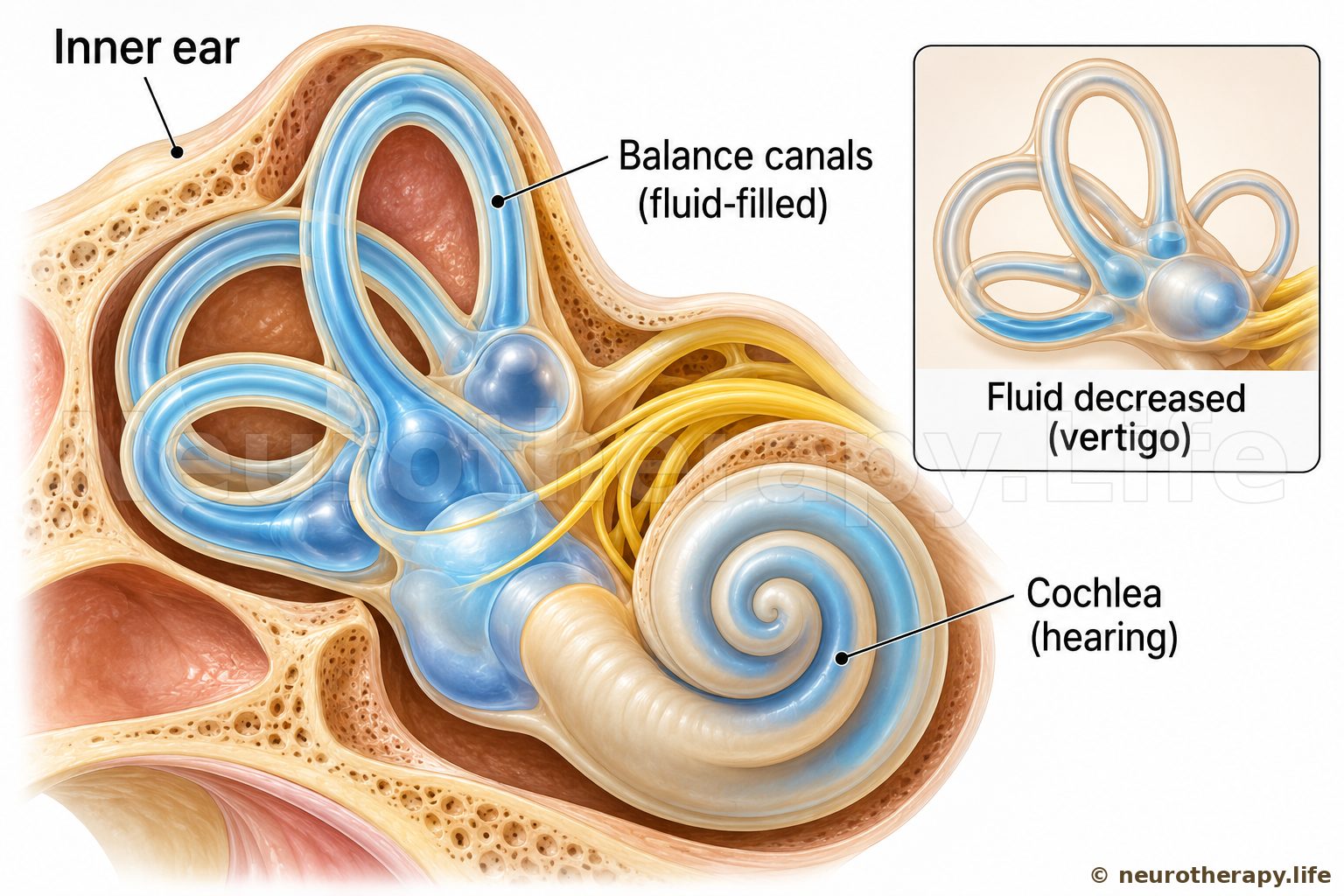
Up Arrow is a Neurotherapy (LMNT) treatment in which the therapist's palm slides slowly up the back, beside the spine, from the low back to the base of the neck. It is used for vertigo — the dizziness that, in this therapy's teaching, comes when the fluid in the ear has decreased — and it is always given lying down.
Overview
What is Up Arrow?
Up Arrow is named for its written sign: a small open ring on a plain stem, read as an arrow entering the circle from below. In this therapy an arrow shows the direction of the therapist's own slide — not a flow inside the patient. Up Arrow and Down Arrow travel over the same strip of back, but they are separate treatments for opposite problems.
Your balance organ sits inside the inner ear. It is a set of tiny tubes filled with fluid — a spirit level in your skull that works by liquid. Vertigo is a false feeling of movement: you, or the room, seem to turn when nothing is turning.
The teaching pairs the two arrows with the two directions of the ear's fluid: Up Arrow when the fluid has decreased (vertigo), Down Arrow when it has increased (Ménière's disease). That link is the therapy's own, from long clinical experience. What is not in dispute is that a dizzy patient is usually a tense, guarding patient, and a slow, even stroke along the spine helps that guarding let go.
The balance organ works by fluid. Up Arrow is used for the vertigo that the teaching links with a decrease of that fluid.
Where it is given
Where is Up Arrow given?
PositionLying on the back
Body areaThe back, along both sides of the spine, from the low back up to the base of the neck
Up Arrow must be given with the patient lying down. Unlike Down Arrow, it is never given seated on a chair — the teaching says must, and that is a rule, not a matter of comfort. The therapist sits near the patient's waist.
It runs along the back, on both sides of the spine, from the low back (the last lumbar bone, L5) up to the base of the neck (the first chest bone, T1).
How it is given
How is Up Arrow given?
How this point is given — the tool, the pressure, the count and the exact movement — is deliberately not described here. A demonstration video for this point is being prepared; until it is on this page, learn the method hands-on from a trained Neurotherapist before giving it. Please do not give any point from a written description alone: a point given in the wrong place or the wrong way can do harm.
Its twinDown Arrow — the downward slide, for Ménière's disease
The exact technique is taught hands-on in the Neurotherapy (LMNT) course. See the course →
What it does
What does Up Arrow do?
In LMNT teaching, Up Arrow carries the tissues and nerves beside the spine upward, and it is useful for setting right the dizziness that comes when the fluid of the ear decreases. That the inner ear's fluid governs balance is textbook physiology; the effect of the stroke is the therapy's own clinical observation.
Used for vertigo, when the fluid in the ear has decreased.
Draws the tissues and nerves on both sides of the spine upward, towards the neck.
Appears at the base of the neck inside the Angina / Athero treatment, beside the clockwise Medulla work.
A long, slow, even stroke along the spine helps a tense, dizzy patient let go of guarding.
Organs it reaches
Ears — The inner ear holds the fluid-filled balance organ.
Spine — The column beside which the slide travels.
Spinal cord — The nerves that leave it run out beside the spine, under the stroke.
Neck — Where the slide ends, at the base of the neck.
Its family
How is it different from its look-alikes?
Up Arrow is easy to mix up — with its twin, and with a back treatment whose sign looks almost the same. The card is always read with care.
Down Arrow — The downward slide, neck to low back, lighter, and allowed seated — for Ménière's disease, when the ear's fluid has increased.
On the Spine — A different point for the back. Its sign is the same ring-and-stem but with an arrowhead pointing down — the head changes the point.
Thoracic T1/T2 — The station at the base of the neck where Up Arrow works inside the Angina / Athero treatment.
Round Arrow — Another of the arrow treatments of the back, with its own sign and purpose.
What it is used for
What is Up Arrow used for?
Dizziness is always sorted before it is treated — the safety notes below come first.
Dizziness from the ear
Vertigo and giddinessVertigo from decreased ear fluid. Ménière's disease, from increased fluid, takes Down Arrow instead.
The treatment for angina and hardened arteries — Up Arrow works at the base of the neck in its first part.
Safety: when it is held back
Sudden dizziness with unsteadiness or staggering, double vision, slurred speech, a drooping face, arm weakness, or the worst neck pain of a person's life is an emergency — ambulance today, and no pressure whatsoever on the neck. How to tell a patient to see a doctor
Sudden hearing loss with dizziness needs a specialist within the week. Hearing loss (deafness)
New dizziness in an older person on several medicines is very often the medicines or the blood pressure — that patient sees their doctor first, and keeps taking their medicines as prescribed. Low blood pressure
Up Arrow is given lying down only — never seated.
Do not swap the arrows, and do not read the bare ring-and-stem as On the spine. Up Arrow is for decreased ear fluid, Down Arrow for increased. Down Arrow
Chest pain, or chest pain with breathlessness or sweating, is an emergency first. The Angina / Athero treatment works alongside the heart doctor's care, never instead of it. In heart disorders (10) Medulla is never given on both sides — only (10) Left Medulla. (10) Medulla
“If the fluid in the ear decreases, that causes dizziness, which is called vertigo; this treatment is useful for putting that right.”
— Dr. Lajpatrai Mehra
Common questions
Can a stroke on my back really change the fluid in my ear?
That claim is the therapy's own, from long clinical experience, and it has not been tested in research. What is well established is that a slow, even stroke along the spine helps a tense, dizzy body relax. Your doctor's treatment continues alongside.
Why must Up Arrow be given lying down?
The teaching says it must be — a firm rule, not a matter of comfort. A dizzy person lying down also cannot fall.
I feel dizzy. Which arrow do I need?
That is decided only after your dizziness is sorted — first by ruling out emergencies and medicine or blood-pressure causes, then by what kind of ear dizziness it is.
Why is Up Arrow part of a heart treatment?
In the Angina / Athero treatment it is given at the base of the neck, the segment the teaching links with the heart. That treatment is always given alongside your heart doctor's care.
Surprising facts
1A spirit level in your skull
Your balance organ has three tiny looping canals set at right angles to each other and filled with fluid. When your head turns, the fluid lags behind and bends tiny hair cells, telling the brain which way you moved.
Source: Guyton & Hall, Textbook of Medical Physiology, 14th ed. — vestibular sensations and equilibrium.
2Loose crystals are the commonest cause
The most common cause of spinning dizziness is benign paroxysmal positional vertigo (BPPV): tiny calcium crystals slip into a balance canal, so brief spins come on turning in bed or looking up.
Source: Bhattacharyya N et al., Clinical Practice Guideline: Benign Paroxysmal Positional Vertigo (Update), Otolaryngol Head Neck Surg 2017;156(3 Suppl):S1–S47.
3The slide crosses most of the spine
From the first chest bone to the last lumbar bone are seventeen vertebrae — all twelve thoracic and all five lumbar — so Up Arrow travels most of the length of the spine.
Source: Gray's Anatomy, 41st ed. — the vertebral column.
This page explains what a Neurotherapy (LMNT) treatment is for; it is not a self-treatment guide and does not diagnose. Neurotherapy (LMNT) works alongside your medical care — keep taking the medicines your doctor prescribed.
Ready to begin?
Send COURSE for course details, or your name, age and health issue for a consultation.