Atherosclerosis (hardened arteries)
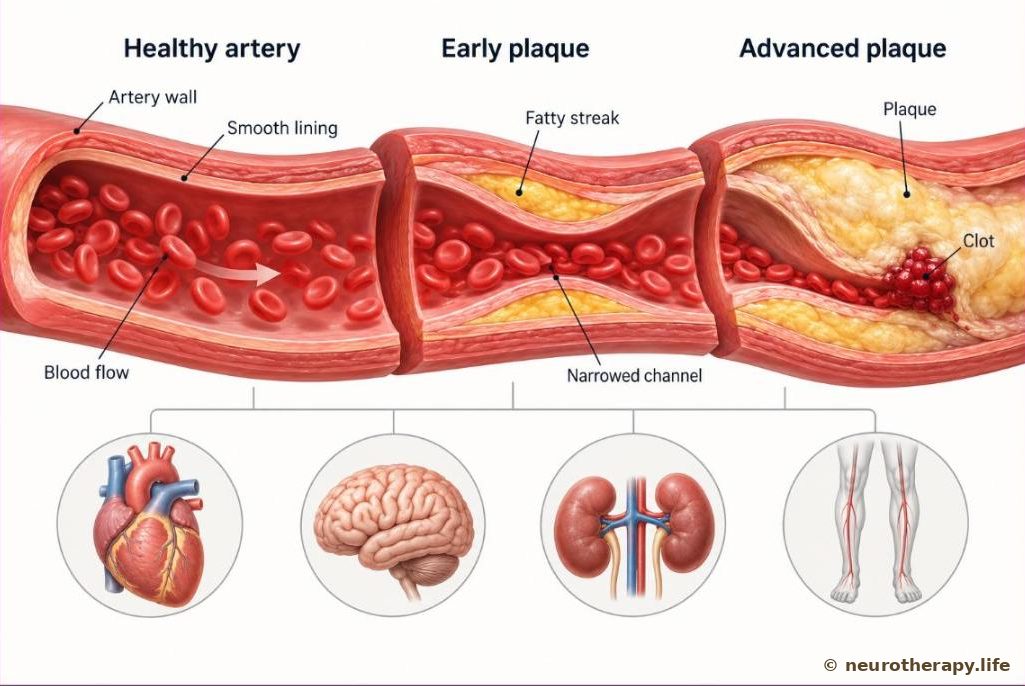
Atherosclerosis is a slow build-up of fatty plaque inside the arteries. It narrows them, so less blood gets through — and it lies behind most heart attacks, strokes and leg-artery disease.
- Plaque can start building up in childhood and gets worse with age
- The risk rises after age 45 in men and after 55 in women
- Atherosclerosis is behind about half of all deaths in Western countries
- Mild atherosclerosis usually causes no symptoms
Source: MedlinePlus (NIH); Mayo Clinic; StatPearls (NIH NCBI)
What is Atherosclerosis (hardened arteries)?
Arteries carry oxygen-rich blood from the heart to every part of the body. In atherosclerosis, cholesterol, fat, calcium and blood cells collect in the artery wall as plaque. Over the years the plaque hardens and bulges inward, and the artery becomes stiff and narrow.
What it does depends on which artery is narrowed. In the heart it causes angina; in the neck and brain, strokes; in the legs, pain on walking; in the kidneys, high blood pressure. If a plaque cracks, a clot can form on it and block the artery suddenly — a heart attack or a stroke.
What are the symptoms?
- Often none for years, until an artery is badly narrowed
- Chest pain or pressure on effort (angina), or breathlessness
- Leg pain or cramping when walking that eases with rest
- Sudden numbness or weakness, slurred speech or loss of vision — signs of a stroke
- High blood pressure that is hard to control
What causes it, and who is more likely to get it?
Blood fats and sugar
Pressure on the artery walls
- High blood pressure
- Smoking or tobacco of any kind
Way of life
- Food high in saturated and trans fats
- Too little exercise
- Being overweight
Things you cannot change
- Getting older
- Heart disease in the family
How is it found?
Atherosclerosis is found by a doctor through your history, an examination, blood tests and heart and artery tests.
Blood tests
Cholesterol, triglycerides and blood sugar — the main fuels of plaque.
ECG and stress test
Show whether the heart muscle runs short of blood, at rest or on effort.
Ankle-brachial index and Doppler ultrasound
Compare blood pressure at the ankle and the arm, and show blood flowing through the neck and leg arteries.
CT scan or angiogram
Pictures of the arteries, using a dye, that show exactly where they are narrowed.
The therapist asks for the lipid report, the ECG, the blood pressure record and — for a heart patient — the discharge summary. Whether there is heart disease decides which points are blocked before anything is planned.
How Neurotherapy (LMNT) sees Atherosclerosis (hardened arteries)
LMNT teaching writes one treatment for heart disease, atherosclerosis, raised cholesterol and raised triglycerides together: the Angina / Athero treatment, in four parts. Its third part is P. Heparin, the parent formula of the Heparin family, which LMNT gives to support blood flow and the opening of clots. Guruji also traced a path from hardened arteries to raised blood pressure, through the kidney.
Guruji's path from a hardened artery to a raised lower BP number
- Atherosclerosisthe arteries narrow
- A clot in the kidney arteryGuruji estimated that a clot can form in the renal artery too
- A starved kidneywith too little blood flowing in, it cannot filter properly
- Reninthe kidney releases renin, which squeezes blood vessels all over the body
- Raised diastolic BPthe lower number of the blood pressure rises
On this reading, a raised lower number is the kidney calling for blood, and P. Heparin is given to support the flow to it. Therapists report the diastolic figure coming down after a few treatments in many patients — a clinical observation. LMNT uses no medicine and never tells a patient to stop theirs; any change in a tablet is for the doctor who prescribed it.
Whenever there is an obstruction or blockage in the blood circulation of any part of the body, then pain or numbness is felt in that part.
Neurotherapy (LMNT) treatment for Atherosclerosis (hardened arteries), step by step
Examine first
The therapist checks Liv° and Mu°, reads the lipid report, ECG and blood pressure record, and asks about chest pain. New, worse or resting chest pain goes to a doctor, not to the mat.
Heart patient: write the blocks first
Where there is heart disease, the heart list is blocked on the card before any plan, with its substitutes beside it — (2) Thrd for (4) Thrd, (10) Left Medulla, J. or P. Heparin in place of G. Heparin. The Angina treatment is given alone for two to four days before anything further.
Angina / Athero treatment — parts I and II
Part I, seated: (4) Medulla clockwise, the Up Arrow at T1/T2 and Raman over the shoulders, then (10) Pan and (2) Thrd. Part II: (1) Single point liver, two treatments.
Parts III and IV — the Heparin part
Part III: P. Heparin — (8) Pan, (7) Liv, (8) Ch. Only — with Sulta Ulta, the hands kept up at 135°. Where Mu° hurts and the stool is hard, Mild ATF is given instead. Part IV: A. Heparin with Sulta Ulta at 135°.
Points and formulas used
Angina / Athero treatment
The four-part treatment LMNT writes for heart disease, atherosclerosis and raised cholesterol or triglycerides — neck and upper back, the liver, then a Heparin part chosen by the findings.
Works through
Open →P. Heparin (plasmin)
The parent Heparin formula — LMNT lists atherosclerosis and angina among its uses, to support blood flow and the opening of clots.
Works through
Open →Never do this
- Emergency: chest pain or pressure lasting more than a few minutes, or spreading to the arm, jaw or back, or with sweating or breathlessness; or sudden weakness, a drooping face, slurred speech or loss of vision — call 108 / 112 at once. Nothing is given on the mat.
- Never in heart patients: (10) Medulla on both sides, (20) Medulla, (30) Medulla, G. Heparin, Lu + Sh, Swt, Katka, Loveleen, Thymus and (4) Thrd. Heart disorders
- High blood pressure: (2) Adr and (6) Adr are not given — this includes the (6) Adr that can end A. Heparin. (6) Adr
- The bars of P. Heparin's own points: Pan never in schizophrenia, and in fits only inside the Heparin formula; Liv not in liver cancer; Ch. Only not in lung cancer. If tingling or numbness runs into the hand during Liv, the therapist lets go at once — numbness is not a sign the point is working. P. Heparin (plasmin)
- Cancer: if the person has cancer, (10) Pan, Thymus, Pit, Lu + Sh, Rt. Ov / Lt. Ov and (30) Medulla are never given — the therapist changes the plan.
- Keep taking the medicines your doctor prescribed. Neurotherapy (LMNT) works alongside your medical care, never instead of it.
Watch

This video shows the right way to give (4) Medulla, Raman and the T1–T2 point for neck and shoulder pain and numbness.

Shows the P. Heparin formula: (8) Pan at the top of the thighs, (7) Liv on the thigh and forearm, and (8) Chest Only with the palms on the chest. In the video it is given as the last part of the Angina treatment, to support circulation.
Parts of the Angina / Athero treatment: (4) Medulla, Raman and T1/T2 (part I), and P. Heparin (part III).
From practice
The stent that wrote the plan
A teaching case — a composite from practice, not one patient's file
61 years · retired bus conductor · angina for three years, with one stent · came for weakness and legs that swell by evening
- What was found
- Tiredness, years of hard stools, a coated tongue and marked pain at Mu° pointed in the acid direction. The evening ankle swelling and the heart history were kept apart from that picture — in a man with known heart disease they belong to his physician as well.
- What was done
- The discharge summary naming angina and the stent decided the plan: before anything else, the heart list was blocked on his card, with each substitute written beside it — (2) Thrd, (10) Left Medulla, J. or P. Heparin, and Sulta Ulta at 135° in place of Loveleen. An old kidney report was asked for again through his own doctor.
- What it teaches
- In hardened arteries with heart disease, the blocks come first and the plan is built inside them. Write both columns: what may not be given, and what is given in its place.
From Ayurveda and the kitchen
Test yourself
What research says
- Strong evidence
Explains how plaque grows, from fatty streaks in childhood to hard plaques with a thin cap, and how a cracked plaque can set off a clot that blocks the artery. The clot on the plaque is what turns slow narrowing into a sudden heart attack or stroke.
- Strong evidence
When blood flow to the kidney falls, the kidney releases renin; the renin–angiotensin chain then narrows blood vessels and holds salt and water, raising blood pressure. Narrowing of the kidney artery by atherosclerosis is the most common cause — the same path Guruji described.
No clinical trial of Neurotherapy (LMNT) in atherosclerosis has been published yet. Improvements reported by neurotherapists are clinical observations.
For you
Stop tobacco
Smoking and chewing tobacco damage artery walls. Stopping is the single biggest step you can take.
Move and eat well
Walk or exercise regularly, keep a healthy weight, and cut down on fried food and ready-made snacks.
Know your numbers
Get blood pressure, sugar and cholesterol checked, and keep them in the range your doctor sets.
This page explains; it does not diagnose. Neurotherapy (LMNT) works alongside your medical care — keep taking the medicines your doctor prescribed, and see a doctor for any new or severe symptom.