Gangrene
Gangrene means body tissue dying because it has lost its blood supply, often with infection on top. It usually starts in the toes or feet, most of all in people with diabetes — and it needs a doctor or hospital at once.
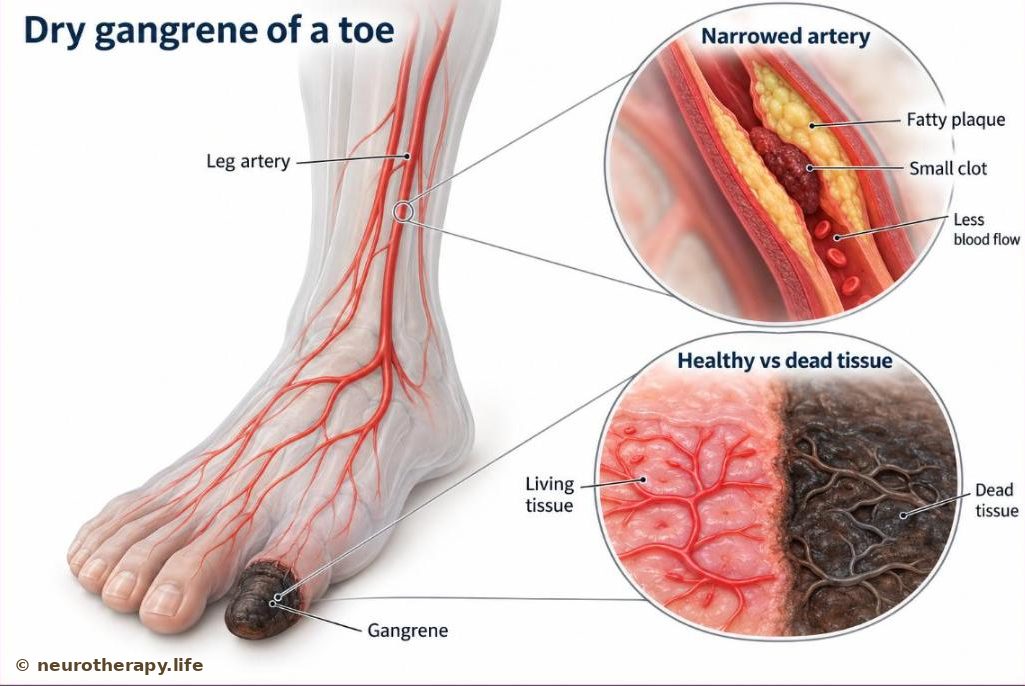
- Gangrene is tissue that has died because its blood supply was cut off
- Within a year of a severe loss of blood flow to a leg, up to half of people with diabetes may need an amputation
- Gas gangrene spreads fast — without prompt treatment it can kill within 48 hours
Source: MedlinePlus (NIH); NHS; StatPearls (NIH NCBI)
What is Gangrene?
Every part of the body lives on the blood that reaches it. When the blood stops coming — because an artery has narrowed, a clot has blocked it, or an injury has crushed it — the tissue starves of oxygen and dies. Dead tissue cannot heal, and germs grow in it easily.
Doctors describe three main kinds. Dry gangrene comes from poor blood flow: the part turns cold, dry and black. Wet gangrene is dead tissue that has become infected: it swells, blisters and leaks foul-smelling pus. Gas gangrene is a fast, deep infection that is an emergency. Infection from gangrene can spread into the blood (sepsis), which is life-threatening.
What are the symptoms?
- Skin turning dark red, purple, blue or black
- The part feels cold or numb
- Pain, often throbbing or burning — though a numb diabetic foot may feel little
- Swelling, blisters or sores that leak foul-smelling pus or blood
- Fever and feeling very unwell — signs the infection may be spreading
What causes it, and who is more likely to get it?
Poor blood flow
- Hardened, narrowed arteries (atherosclerosis)
- Blocked arteries in the legs (peripheral arterial disease)
- A blood clot cutting off the flow
Diabetes
Injury and infection
- A serious injury that damages blood vessels, or an operation wound
- A wound that becomes badly infected
- A weakened immune system
Habits
- Smoking
- Heavy drinking or injecting drugs
How is it found?
Gangrene is diagnosed and treated in hospital. Doctors look at the part, then test the blood flow and look for infection.
Blood tests
Show signs of infection and check blood sugar.
Swab or tissue sample
Fluid or a tiny piece of tissue is tested to find which germ is growing.
Ankle-brachial index and Doppler ultrasound
Compare the blood pressure at the ankle and the arm, and show how well blood flows down the leg.
X-ray, CT, MRI or angiography
Show gas or damage deep in the tissue, and exactly where an artery is blocked.
Gangrene goes to a doctor or hospital before any Neurotherapy (LMNT). Later, the therapist asks for the sugar reports and the doctor's notes, checks whether any wound is still open, and checks the feet for feeling before touching them.
How Neurotherapy (LMNT) sees Gangrene
LMNT teaching describes gangrene where therapists most often meet it — in the diabetic foot. It sees the root as blood not reaching the far end of the leg, and it writes A. Heparin — a formula of the Heparin family, which supports blood flow — for the diabetic who is at risk of gangrene in the toes.
How a diabetic foot reaches gangrene
- Diabetesthe feet swell up or go numb
- A small woundsometimes appears on one toe
- Too little bloodfor want of blood, the place turns blue or black
- Spreading infectionthe infection keeps spreading — this is gangrene
- Amputationthe doctor may need to remove the toe so the poison does not spread
So the LMNT aim is early: to support blood flow in the diabetic foot before a wound turns black. Gangrene that has already set in is a hospital matter first; Neurotherapy (LMNT) is support alongside the doctor's treatment, never in place of it.
Whether or not the patient gets immediate benefit from our treatment, let no harm reach him through our carelessness — attend to this.
Neurotherapy (LMNT) treatment for Gangrene, step by step
Hospital first
A toe or foot turning blue or black, a wound with pus or a bad smell, spreading redness or fever goes to a doctor or hospital at once. Neurotherapy (LMNT) comes later, alongside the doctor's treatment.
Examine, and check the gate
The therapist checks Liv° and Mu°, reads the sugar reports, and looks at both feet for feeling and for any open wound. While a wound is open, no Heparin formula is given at all.
A. Heparin with Bottom of Feet
For the diabetic who is at risk of gangrene in the toes, LMNT teaching gives A. Heparin — the parent Heparin formula with the Acid point — with (6) Adr at the end, and adds Bottom of Feet (BOF).
Ask the next day about (6) Adr
Most people do better with (6) Adr at the end of A. Heparin, but some diabetic patients did not feel well after it. So at the next visit the therapist asks how the rest of that day went and writes the answer on the card. If the person felt heavy or low, (6) Adr is not given again.
Points and formulas used
Never do this
- Emergency: a toe or foot turning black or blue, spreading redness or swelling, pus or a foul smell, fever, confusion or fast breathing — go to hospital at once or call 108 / 112. Infection from gangrene can spread into the blood. Septicaemia
- No Heparin formula at all while a wound is open. open Wounds
- The therapist never presses on a toe or patch of skin that is black, broken or infected, and checks a numb foot for feeling first — a numb foot cannot report pain.
- (6) Adr lowers immunity and acid: it is not given in septicaemia, AIDS, HIV or cancer, not in high blood pressure, and not to a diabetic who felt unwell after it. (6) Adr
- Cancer: if the person has cancer, (10) Pan, Thymus, Pit, Lu + Sh, Rt. Ov / Lt. Ov and (30) Medulla are never given — the therapist changes the plan.
- Keep taking the medicines your doctor prescribed. Neurotherapy (LMNT) works alongside your medical care, never instead of it.
Watch

A podcast conversation with a senior neurotherapist on what gangrene is, its dry, wet and gas types, the warning signs and the risk of sepsis. It explains that Neurotherapy (LMNT) may support blood flow as a complementary therapy alongside medical care — no formula or point is shown.
The talk quotes Indian prevalence figures that are the speaker's own; the facts on this page come from medical sources. It shows no LMNT formula.
A talk on the types, warning signs and risks of gangrene, and how Neurotherapy (LMNT) may support blood flow alongside medical care. No formula is shown.
From Ayurveda and the kitchen
Test yourself
What research says
- Strong evidence
A medical review of gangrene. It explains how narrowed arteries, high blood sugar and tiny clots in the small vessels starve tissue of blood, and how diabetes also dulls the nerves, so people notice gangrene late.
No clinical trial of Neurotherapy (LMNT) in gangrene has been published yet. Improvements reported by neurotherapists are clinical observations.
For you
If you have diabetes
Look at your feet every day — between the toes too. Tell your doctor at once about any cut, blister or colour change.
Protect the feet
Wear soft, well-fitting footwear, never walk barefoot outside, and keep the skin clean and dry.
Look after your blood vessels
Stop smoking, keep active, and keep sugar, blood pressure and cholesterol in the range your doctor sets.
This page explains; it does not diagnose. Neurotherapy (LMNT) works alongside your medical care — keep taking the medicines your doctor prescribed, and see a doctor for any new or severe symptom.