1A fifth of every heartbeat
The two kidneys weigh less than half a percent of the body, yet they receive about a fifth of all the blood the heart pumps out.
Source: Guyton & Hall, Medical Physiology, 14th ed. (renal blood flow).
Also called: Mu Zero, Mucus Zero, the left kidney, म्यूकस जीरो, बाईं किडनी
Mu° is the Neurotherapy (LMNT) code name for the left kidney. Its tenderness at the left low back is one of the two key findings that tell the therapist whether the body has tilted towards acid, and as a treatment it is used to reduce the acid of the blood and support the left kidney.
Mu° stands for the left kidney. The kidneys are two bean-shaped organs, each about the size of a fist, tucked high against the back wall of the belly behind the lowest ribs. They clean the blood, make urine, and keep the body's water, salt and acid in balance.
Why a code name? Guruji gave the kidneys nicknames for two reasons. The word kidney frightens many patients — it brings to mind dialysis and hospital wards — and it would otherwise be spoken all day across the treatment room. And the name is a memory aid: the Mu pain point lies just left of the navel with the left kidney behind it, so the left kidney became Mu°. The right kidney, in the same way, is Liv°.
The small ring is not a zero and not decoration. It records two changes from Mu: Mu° is given at a single place instead of a pass along the limb, and the arm contact moves up near the shoulder instead of the elbow. Losing the ring on a card changes the treatment.
Mu° matters as much as a finding as a treatment. Comparing Mu° with Liv° is how the therapist reads which of the two directions — acid or alkali — the body has moved in, and that reading decides whole formulas.
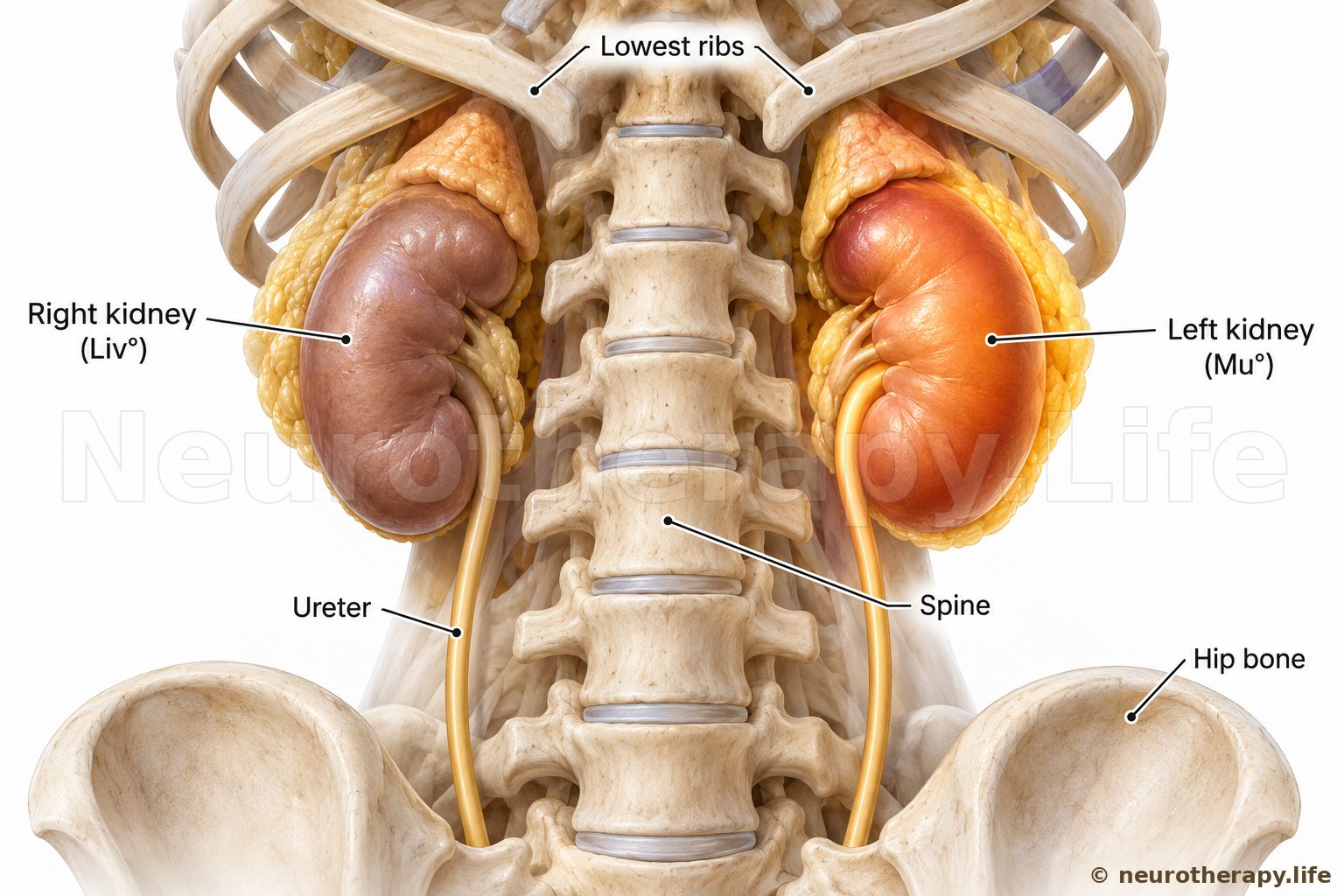
As a finding, Mu° is felt at the low back while you lie face down: in the soft gap on the left, below the last rib and above the rim of the hip bone, just outside the band of muscle beside the spine. The therapist presses this side and the matching right side (Liv°) one after the other and asks which is worse. People who cannot lie face down are checked lying on the side.
As a treatment, Mu° is given while you lie on your back, with two pillows: one under the thighs and one under the right shoulder so the shoulder joint rests well on it. The contact is just outside the right shoulder joint, together with the right thigh. The crossing is easy to reverse in a hurry: Mu° is given on the right side of the body and is for the left kidney.
How this point is given — the tool, the pressure, the count and the exact movement — is deliberately not described here. Watch the demonstration video on this page, and learn the method hands-on from a trained Neurotherapist before giving it. Please do not give any point from a written description alone: a point given in the wrong place or the wrong way can do harm.
The exact technique is taught hands-on in the Neurotherapy (LMNT) course. See the course →
In the teaching, Mu° and Liv° pull the body's chemistry in opposite directions: Mu° reduces acid, Liv° reduces alkali. Body science confirms the kidneys really do balance the blood's acid; how a press at the shoulder and thigh reaches them is the therapy's own explanation, from long clinical experience.
Mu° is always read as one half of a pair, and it shares its placement with the Mu family.
Mu° is chosen from what the fingers find — more pain at Mu° than at Liv° — not from a disease name. It is then given inside a formula.
The Acid Treatment Formula — given only when Mu° is clearly painful and Liv° is quiet.
The same acid formula with a Thymus + Chest ending.
The graded formula that rouses both kidneys, with balancing steps.
The reversed form for the alkali side, given for a limited time.
The lightest grade, also part of the light Jeevan Dhara.
For blood pressure that drops suddenly.
The vitamin D activation formula.
Joint pain from acid, gout and spondylitis — never without Mu° pain.
1,25 DCC joined with vitamin B₁₂ work.
“Today the same treatment was given a second time, so in her body the acid became very much reduced — or say that the alkali increased, one chief symptom of which is an increase of pain in the body. When I checked, today I found pain in Liv°.”
A case recorded in Guruji's own account: at a camp, a woman with low spirits had tremendous pain at Mu°, was given the Acid treatment, and did beautifully. The next day she asked for the same treatment and received it without a fresh examination — and wept from new pain. When Guruji checked, the pain was now at Liv°: the body had already moved, and the repeat had pushed it past the middle. From that afternoon comes the rule: check Mu° before every acid treatment.
A composite case written to teach the reasoning — not one patient’s file.No. Tenderness at Mu° is a Neurotherapy (LMNT) finding about the direction of your body's chemistry, not a diagnosis of kidney disease. Kidney disease is diagnosed by a doctor with blood and urine tests.
Because the Neurotherapy (LMNT) map crosses. Mu° is answered from the right side of the body; nothing on the shoulder or thigh touches the kidney itself.
Because the body moves. A treatment that was right yesterday can be wrong today, so Mu° and Liv° are compared again before an acid or alkali treatment is repeated.
Not in kidney failure or kidney cancer, and not over a transplant, stent or recent biopsy. Tell your therapist about every kidney report, and stay under your doctor's care.
The two kidneys weigh less than half a percent of the body, yet they receive about a fifth of all the blood the heart pumps out.
Source: Guyton & Hall, Medical Physiology, 14th ed. (renal blood flow).
Every day the kidneys get rid of the fixed acid made by the body's metabolism and win back almost all the bicarbonate — the body's own alkali — that they filter.
Source: Hamm LL, Nakhoul N, Hering-Smith KS. Acid-base homeostasis. Clin J Am Soc Nephrol 2015;10:2232–2242.
When oxygen in the blood falls, cells in the kidney release erythropoietin, which tells the bone marrow to make more red blood cells. That is why kidney disease so often brings anaemia.
Source: Guyton & Hall, Medical Physiology, 14th ed. (erythropoietin).
The left kidney usually sits slightly higher than the right, because the large liver above the right kidney pushes it down.
Source: Gray's Anatomy, 41st ed. (kidneys).

Dr. Diwakar Shukla shows students where the Mu° point lies and how it is pressed, both to examine the body and as part of treatment.

An overview of LMNT's diagnostic pain points — the places around the navel that the therapist presses to read the body before choosing a treatment.

A demonstration of the Angiotensin No. 2 formula — (7) Liv, (7) Mu° and (6) Lu + Sh — for low blood pressure that comes on suddenly after very heavy bleeding in a period.
The video suggests using the formula at the moment of fainting. In LMNT teaching, a person who is still bleeding, cold, pale or fainting is taken to hospital first; this formula is for after the bleeding has been stopped. Lu + Sh is not given in cancer.
This page explains what a Neurotherapy (LMNT) treatment is for; it is not a self-treatment guide and does not diagnose. Neurotherapy (LMNT) works alongside your medical care — keep taking the medicines your doctor prescribed.
Send COURSE for course details, or your name, age and health issue for a consultation.