Also called: Acid Treatment Formula, Thymus + Chest version, ATF with Thymus Chest
ATF form (b) is the Thymus + Chest version of the Neurotherapy (LMNT) Acid Treatment Formula. It keeps the same opening as form (a) but ends with the thymus and chest instead of the adrenal point, and it is chosen when the body is already fighting something — an injury, an infection, pimples or boils, or a new rash or allergy.
Overview
What is ATF, form (b)?
ATF, the Acid Treatment Formula, is the chief Neurotherapy (LMNT) formula for acidosis — too much acid in the blood, which this therapy links with a shortage of water and reads as pain at Mu°, the left-kidney point beside the navel. It is written in two forms that share one opening and differ only in how they end.
Form (b) ends with the thymus and chest taken together as one step, and the patient is not turned face down at all. The ending is said to reduce pain anywhere in the body, and allergy that comes from infection.
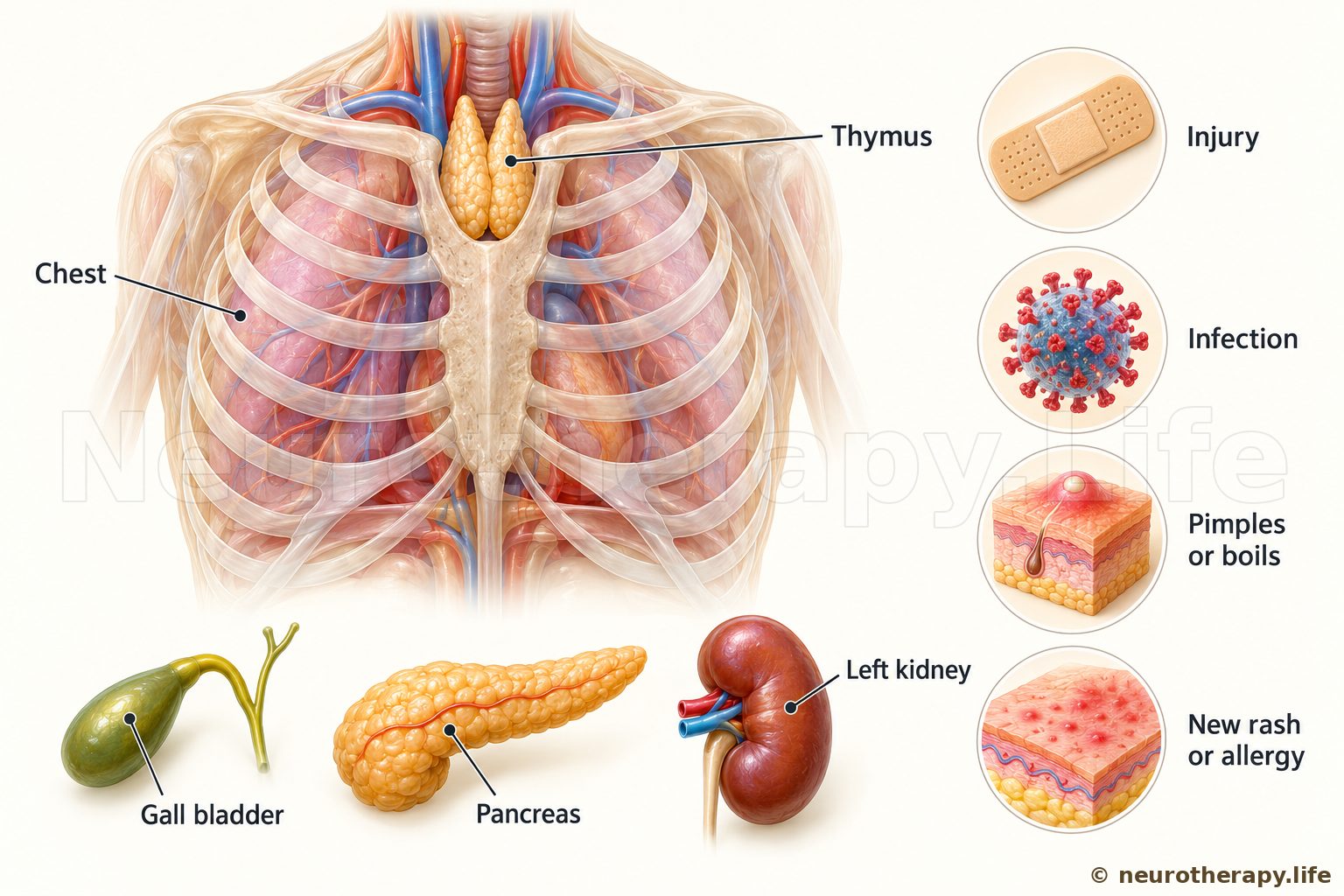
The thymus sits behind the breastbone and trains the body's defence cells. Form (b) recruits it in a body that is already fighting, instead of pushing the adrenal glands.
Form (b) ends with the thymus and chest. Any one of the four circumstances shown selects it.
What it is for
What is ATF form (b) used for?
For the same acid picture as form (a), when Mu° is tender on the day — plus any one of four circumstances.
After a recent injury.
After a recent infection from a virus or bacteria.
When there are pimples on the face or boils on the body, or itching, allergy or a skin problem that came up recently.
When a patient has said that Adr did not suit them.
Points it works through
Which points does ATF form (b) work through?
(8) Pan (1) Gal (3) Mu° (1) acid (4) Thymus+Chest
Form (b) works through five points. They are listed here as a set, with what each contributes. The exact method is taught hands-on in the Neurotherapy (LMNT) course. This page lists the points of the formula and what each one contributes; it does not describe how any point is given. For the method, watch the demonstration video of each point on its own page and learn hands-on from a trained Neurotherapist. Please do not give a formula from a written description alone.
Thymus with chest, as one step — to reduce pain anywhere in the body and allergy from infection. In some people it also lowers alkali.
Position:Lying on the back (supine), turning on the side for the Acid point and back again. The patient is not turned face down.
The exact technique is taught hands-on in the Neurotherapy (LMNT) course. See the course →
How it works
How does ATF form (b) work?
The opening is the same as form (a): the pancreas and gall bladder to neutralise acid in the gut, then the left-kidney point and the Acid point. The difference is the ending. Where form (a) uses the left chest and the adrenal point, form (b) uses one combined step, thymus with chest.
The four circumstances are really one idea: something is already being fought — a bruise, a fever, a boil, a rash from last week. In those bodies the formula does not push the adrenal glands; it calls on the thymus. In every other body with Mu° pain, form (a) is the choice.
The therapist asks four plain questions in the patient's own language: has anything hurt you recently, have you had a fever or infection, any boils or pimples, any itching or rash in the last few weeks? One 'yes' is enough.
Its family
Which formulas are related to ATF form (b)?
Form (b) is the trunk on which two other formulas are built.
ATF, form (a) — The default sister form, ending with the left chest and the adrenal point.
No pain at Mu°, no ATF — checked by hand on the day. Never give ATF in alkalosis. Mu°
Thymus and Thymus Chest are not given in diabetes, which this therapy holds to be an autoimmune state with an overactive thymus. Not every diabetic is harmed by it; the question is reopened only for a diabetic who has already had Adr and said it did not suit them — and that decision is written down. Diabetes
Thymus Chest has been seen to lower blood sugar in some patients. Anyone on insulin or sugar tablets keeps checking their sugar; only the doctor changes the dose.
Pan is not given in fits or schizophrenia; Gal is not given in leukaemia, a raised white count or asthma. Gal
An infection with high fever, chills, confusion, breathlessness or spreading redness needs a doctor that hour — not a session. How to tell a patient to see a doctor
Keep taking the medicines your doctor prescribed. Neurotherapy (LMNT) works alongside your medical care, never instead of it.
Guruji says
“Before giving Acid treatment one must certainly check the pain of Mu°. If there is no pain in Mu° then Acid treatment is not to be given!”
— Dr. Lajpatrai Mehra
Common questions
Why not just give form (a) to everyone?
Form (a) suits most people. But when the body is already fighting an injury, infection, boils or a new rash, the teaching is to call on the thymus rather than push the adrenal glands.
I have diabetes. Can I have form (b)?
Usually not — Thymus is withheld in diabetes. The one exception is a diabetic patient who has already been given Adr and found it did not suit them. Your therapist decides this, and you keep checking your sugar.
Why am I not turned on my front for this one?
Because the adrenal point on the back is not part of form (b). The thymus and chest are worked from the front.
Surprising facts
1The thymus is largest in childhood
The thymus is at its biggest in early life and then slowly shrinks, much of it turning to fat by middle age. As it shrinks, it makes fewer new defence cells.
Source: Palmer DB. The effect of age on thymic function. Front Immunol. 2013;4:316. doi:10.3389/fimmu.2013.00316
2A school for defenders
T cells — a kind of white blood cell — are 'taught' in the thymus to tell your own body from invaders. Those that would attack the body itself are removed there before they leave.
Source: Janeway's Immunobiology, 9th ed., T-cell development in the thymus
3Lymph nodes are battle stations
When you have an infection, nearby lymph nodes swell because trained defence cells are multiplying inside them.
Source: Janeway's Immunobiology, 9th ed.
Test yourself
Research
Strong evidence
A review of thymus ageing explains that the thymus loses mass and structure from early in life, making fewer new T cells, which is linked with more infection and autoimmune disease in later years.
This page explains what a Neurotherapy (LMNT) treatment is for; it is not a self-treatment guide and does not diagnose. Neurotherapy (LMNT) works alongside your medical care — keep taking the medicines your doctor prescribed.
Ready to begin?
Send COURSE for course details, or your name, age and health issue for a consultation.