1Bone is living, changing tissue
Your skeleton is constantly broken down and rebuilt; roughly a tenth of adult bone is replaced every year.
Source: Guyton and Hall Textbook of Medical Physiology, 14th ed., bone remodelling
Also called: Calcium-deposit formula I, Thymus version of the calcium-deposit order
Version I of the calcium-deposit order is a Neurotherapy (LMNT) acid-family formula for calcium that has settled where it should not — between the joints or in the tissues, as in bamboo spine or a bone spur. It ends with thymus and chest. It has a twin, version II, which ends with the adrenal point; the two are alternatives and are never merged.
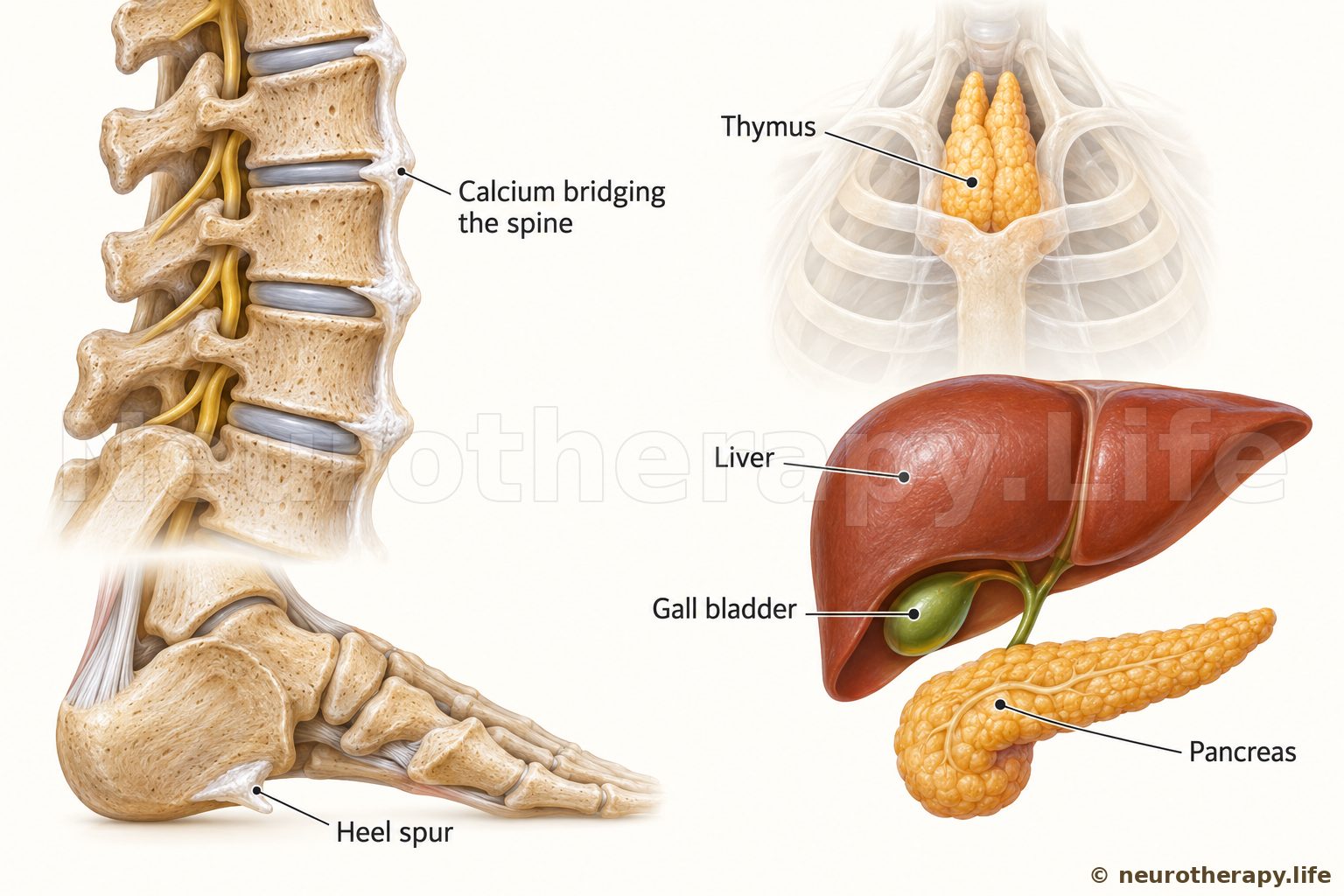
Among the problems on the acid side, Neurotherapy (LMNT) names a group where calcium is deposited between the bones or joints — bamboo spine (ankylosing spondylitis, where the spine stiffens and fuses) and spur (a bone growing outward). For these patients the ordinary endings of the Acid Treatment Formula were not enough.
The teaching states it in one line: those who have deposits of calcium between the joints or in the tissues need both Thymus and Adrenal. So a new order was made — as two complete orders, not one. Version I supplies the Thymus half.
Version I also borrows a step from the digestive Normal family: the liver point, Liv, takes the place where the left-kidney point Mu° usually stands, and Mu° does not appear at all.
(8) Pan (3) Gal (7) Liv (4) acid (4) Thymus+Chest
Version I works through five points. They are listed here as a set, with what each contributes. The exact method is taught hands-on in the Neurotherapy (LMNT) course. This page lists the points of the formula and what each one contributes; it does not describe how any point is given. For the method, watch the demonstration video of each point on its own page and learn hands-on from a trained Neurotherapist. Please do not give a formula from a written description alone.
The pancreas point, on both thighs — the unchanged opening of the acid family.
The gall bladder point, on the left thigh — given here at the stronger, older level.
The liver point, on the left arm and thigh — a Normal-family step that stands where Mu° usually would.
The Acid point, side-lying — given more fully here than in ordinary ATF, because Mu° is absent.
Thymus with chest — the ending, which supplies the Thymus half of the stated need.
Position: Lying on the back (supine), turning on the side for the Acid point, then back again. The patient is not turned face down.
The exact technique is taught hands-on in the Neurotherapy (LMNT) course. See the course →
It keeps the acid-family frame — digestive opening, the Acid point on the side — but rebuilds the middle around a different target. The liver point replaces Mu°, and the work at the Acid point moves with that change. The ending is thymus with chest.
Version I and version II are alternatives, not two halves of one treatment. A therapist reading 'both Thymus and Adrenal' may be tempted to give one after the other, or to splice them into one long line. Neither is written anywhere. Give one order, write down which, and change it next time if needed.
Version I belongs to the acid–alkali family and has one twin.
Calcium in the wrong place.
Because two complete orders were made, and the teaching never joins them. Running one into the other creates a formula nobody has taught, in a patient with bone disease. One order is chosen at a time.
The order is rearranged around a different target than ordinary acidosis. The liver step comes from the digestive Normal family; the exact reasoning for each step is taught in the course.
No promise is made. It is used to support the body in this condition, alongside your doctor's care and any exercises they advise.
Your skeleton is constantly broken down and rebuilt; roughly a tenth of adult bone is replaced every year.
Source: Guyton and Hall Textbook of Medical Physiology, 14th ed., bone remodelling
In long-standing ankylosing spondylitis, new bone bridges grow between vertebrae, so the spine on X-ray can look like a stalk of bamboo.
Source: Sieper J, Poddubnyy D. Axial spondyloarthritis. Lancet. 2017;390:73–84
The thymus is largest in childhood and gradually turns to fat, making fewer new T cells as we age.
Source: Palmer DB. The effect of age on thymic function. Front Immunol. 2013;4:316
This page explains what a Neurotherapy (LMNT) treatment is for; it is not a self-treatment guide and does not diagnose. Neurotherapy (LMNT) works alongside your medical care — keep taking the medicines your doctor prescribed.
Send COURSE for course details, or your name, age and health issue for a consultation.