1Your adrenal glands sit like caps
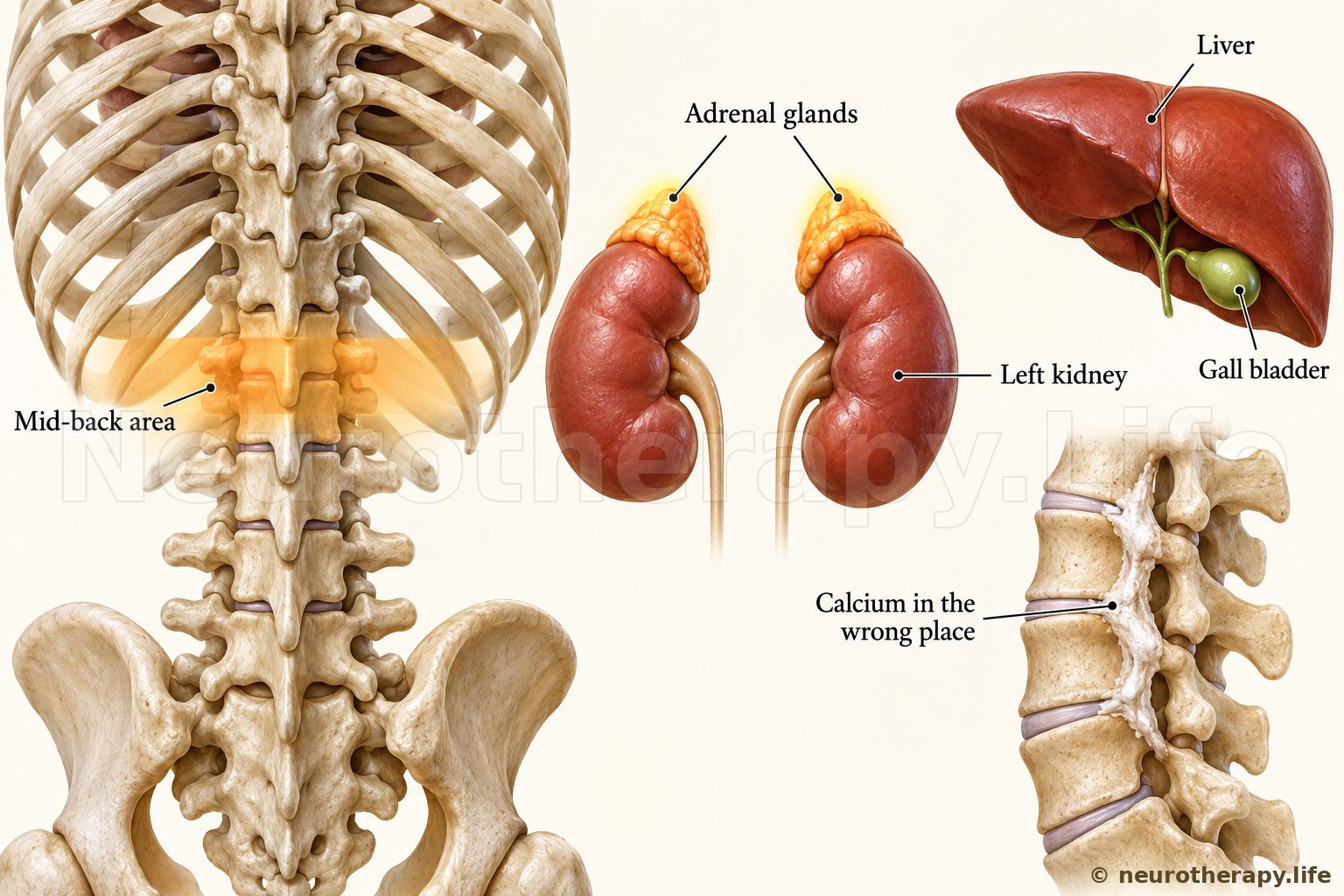
Each adrenal gland sits on top of a kidney like a small cap and weighs only a few grams, yet it makes cortisol, adrenaline and other vital hormones.
Source: Gray's Anatomy, 41st ed., suprarenal glands
Also called: Calcium-deposit formula II, Adrenal version of the calcium-deposit order
Version II of the calcium-deposit order is the Neurotherapy (LMNT) acid-family formula for calcium deposited between the joints or in the tissues that ends with the adrenal point. It is the twin of version I, which ends with thymus and chest. Some Parkinson's patients, children with cerebral palsy who have hard constipation, and people whose muscles have stiffened with age are reported to have benefited.
The teaching says that those with calcium deposited between the joints or in the tissues — as in bamboo spine or a bone spur — need both Thymus and Adrenal. Two complete orders were made for them. Version I supplies the Thymus half; version II supplies the Adrenal half.
Version II shares its opening with version I, including the liver point borrowed from the digestive Normal family. Unlike version I, it brings back Mu°, the left-kidney point, and it ends with the patient face down for the adrenal point — the strongest adrenal work in the acid family.
The two versions are choices, not halves. One is given; it is written down; it may be changed next time.
(8) Pan (3) Gal (7) Liv (4) Mu° (3) acid (10) Adr
Version II works through six points. They are listed here as a set, with what each contributes. The exact method is taught hands-on in the Neurotherapy (LMNT) course. This page lists the points of the formula and what each one contributes; it does not describe how any point is given. For the method, watch the demonstration video of each point on its own page and learn hands-on from a trained Neurotherapist. Please do not give a formula from a written description alone.
The pancreas point, on both thighs — the acid family's unchanged opening.
The gall bladder point, on the left thigh — as in version I.
The liver point, on the left arm and thigh — the Normal-family step shared with version I.
Mu°, the left-kidney point — restored in version II.
The Acid point, side-lying — given more lightly than in version I, because Mu° is present.
The adrenal point, face down — the ending, which supplies the Adrenal half of the stated need.
Position: Lying on the back (supine), on the side for the Acid point, and face down (prone) for the adrenal point, with the chest supported by pillows.
The exact technique is taught hands-on in the Neurotherapy (LMNT) course. See the course →
Like version I, it rebuilds the acid formula around a different target, with the liver step in the middle. Where version I drops Mu° and leans on the Acid point, version II keeps Mu° and gives the Acid point more lightly. The work at the acid point moves with the presence or absence of Mu°.
It ends with heavy adrenal work. The adrenal glands make cortisol, the body's own inflammation-calming hormone. Because this ending is the strongest adrenal work in the family, dose discipline matters most here — and the patients named for it are among the most fragile.
Version II belongs to the acid–alkali family and has one twin.
Calcium in the wrong place, and the stiff patients named for it.
Version II keeps the left-kidney point Mu°, gives the Acid point more lightly, and ends with the adrenal point face down. Version I drops Mu° and ends with thymus and chest.
Some Parkinson's patients are reported to have benefited. It is given alongside the neurologist's treatment, and the medicines are never reduced because of it.
Adr is not given in high blood pressure, so your therapist will not use this version for you.
Each adrenal gland sits on top of a kidney like a small cap and weighs only a few grams, yet it makes cortisol, adrenaline and other vital hormones.
Source: Gray's Anatomy, 41st ed., suprarenal glands
Steroid medicines for inflammation are copies of cortisol, the hormone your adrenal glands release every day.
Source: Guyton and Hall Textbook of Medical Physiology, 14th ed., adrenocortical hormones
Constipation affects many people with Parkinson's disease and can appear years before the tremor.
Source: National Institute of Neurological Disorders and Stroke, Parkinson's disease
This page explains what a Neurotherapy (LMNT) treatment is for; it is not a self-treatment guide and does not diagnose. Neurotherapy (LMNT) works alongside your medical care — keep taking the medicines your doctor prescribed.
Send COURSE for course details, or your name, age and health issue for a consultation.