Your heart is a fist-sized muscle that beats about 100,000 times a day without ever taking a holiday. It runs on its own electricity, feeds itself through its own private arteries, and even burns the tiredness chemical that other muscles throw away.
Overview
What is the heart?
Your heart is a hollow, muscular pump about the size of your fist. It sits in the middle of your chest and pushes blood through your blood vessels to every part of your body, every second of your life.
The heart is the centre of your circulatory system — the heart, the blood and the blood vessels working together. It beats about 100,000 times a day on its own built-in electricity, and a nerve from the brain constantly adjusts its speed.
Heart disease is one of the leading causes of death in India and worldwide, yet many of its causes — high blood pressure, high sugar, high cholesterol, tobacco — can be checked and managed early.
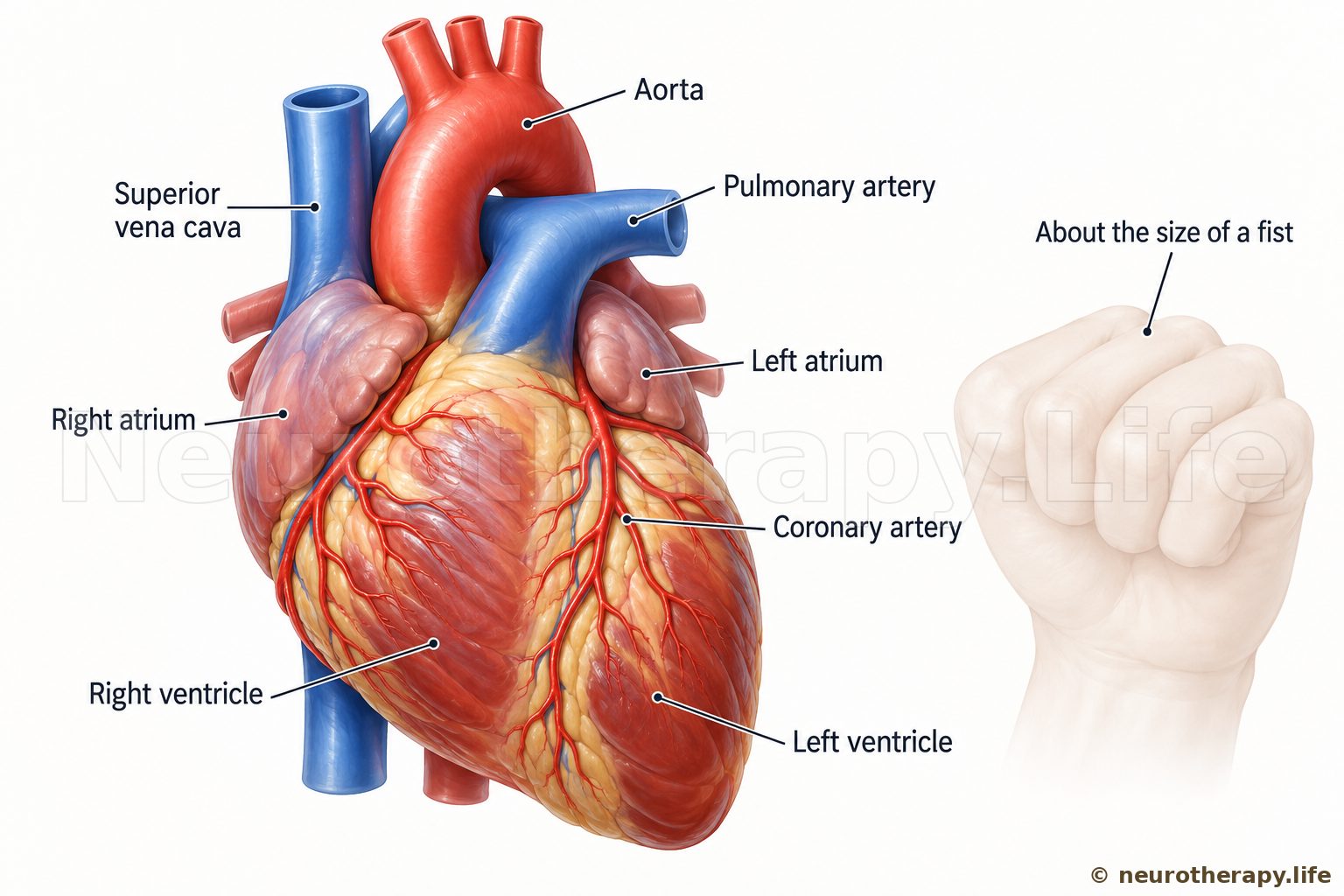
The heart from the front: four chambers, the great vessels on top, and the coronary arteries that feed the heart muscle itself. It is roughly the size of your own closed fist.
Function
What does the heart do?
The heart is really two pumps joined side by side. The right side sends tired, used blood to the lungs to pick up oxygen. The left side sends fresh, oxygen-rich blood out to the whole body. Each side has a small upper room (atrium) that collects blood and a strong lower room (ventricle) that pushes it out.
Pumps oxygen-rich blood to every organ, muscle and cell.
Sends used blood to the lungs to drop carbon dioxide and pick up fresh oxygen.
Carries food (nutrients), hormones and water to the tissues, and waste to the kidneys and liver to be cleared.
Keeps up blood pressure — the push that moves blood through the whole body.
Speeds up or slows down in seconds to match what you are doing — resting, walking, climbing stairs or digesting a meal.
Used blood comes home
Blood that has given away its oxygen returns through two large veins into the right atrium.
Off to the lungs
The right ventricle squeezes and sends this blood a short distance to the lungs, where it drops carbon dioxide and picks up oxygen.
Fresh blood returns
Bright red, oxygen-rich blood flows back from the lungs into the left atrium, then down into the left ventricle.
The big push
The left ventricle, the thickest and strongest part of the heart, pushes the blood into the aorta, the body's main artery, and on to every organ from brain to toe.
The spark that times it all
Each cycle is timed by the SA node's spark. It makes the upper rooms squeeze first, pauses a split second at the AV node, then makes the lower rooms squeeze.
Lub-dub: the doors closing
The 'lub-dub' a doctor hears is not the muscle. It is the sound of the heart's one-way valves snapping shut, first between the upper and lower rooms, then at the exits.
How does the heart work with other organs?
Blood vessels — Arteries carry blood away from the heart; veins bring it back; tiny capillaries do the exchange in the tissues.
Lungs — The right side of the heart pumps blood through the lungs to load oxygen; the left side sends it on to the body.
Blood — Blood is what the heart moves — red cells carry oxygen, plasma carries food and hormones.
Vagus nerve — The vagus nerve slows the heart; other nerves and adrenaline speed it up.
Kidneys — The kidneys filter about a fifth of the heart's output and control blood pressure through salt and water.
The heart has walls, four chambers, four valves, the blood vessels that enter and leave it, and its own electrical wiring.
Walls
The heart wall has three layers, and the whole heart sits in a protective sac.
Endocardium — The thin, smooth inner lining of the chambers and valves, so blood flows without sticking.
Myocardium — The thick middle layer of heart muscle that squeezes. It is thickest around the left ventricle.
Epicardium — The thin outer layer, where the coronary arteries and some fat lie.
Pericardium — A tough two-layered bag around the heart, with a little fluid inside so the heart can beat without rubbing.
Chambers
Four rooms: two small upper collecting rooms (atria) and two strong lower pumping rooms (ventricles). A muscle wall, the septum, divides left from right.
Right atrium — Receives used blood from the body.
Right ventricle — Pumps that blood to the lungs.
Left atrium — Receives oxygen-rich blood from the lungs.
Left ventricle — The strongest chamber; pumps blood out to the whole body through the aorta.
Valves
Four one-way doors keep blood moving forward. Their closing makes the 'lub-dub' sound.
Tricuspid valve — Between the right atrium and right ventricle.
Pulmonary valve — Between the right ventricle and the artery to the lungs.
Mitral valve — Between the left atrium and left ventricle.
Aortic valve — Between the left ventricle and the aorta.
Blood vessels
Large vessels bring blood in and take it out; the coronary arteries feed the heart muscle itself.
Superior and inferior vena cava — The two large veins that bring used blood from the upper and lower body into the right atrium.
Pulmonary artery — Carries blood from the right ventricle to the lungs.
Pulmonary veins — Bring fresh, oxygen-rich blood from the lungs into the left atrium.
Aorta — The body's largest artery, leaving the left ventricle.
Coronary arteries — The left and right coronary arteries branch from the aorta and wrap over the heart like a crown, feeding the heart muscle. Narrowing here causes angina and heart attacks.
Electrical system
Special cells make and carry the spark that times every beat.
SA node (sinoatrial node) — The natural pacemaker in the right atrium; it fires first and sets the rate.
AV node (atrioventricular node) — A relay station between the upper and lower chambers; it holds the signal for a split second so the atria can empty first.
Bundle of His and bundle branches — Wiring that runs down the septum to the left and right ventricles.
Purkinje fibres — Fine branches that spread the signal through the ventricle walls so they squeeze together.
Where is the heart located?
Your heart sits in the middle of your chest, behind the breastbone (sternum), inside a tough, slippery bag called the pericardium. It is tilted so that its pointed lower tip points down and to the left — that is why you feel the beat best a little left of centre.
The two lungs wrap around it on both sides. Below it lies the diaphragm, the dome-shaped breathing muscle, and just under that the stomach and the liver. Behind it run the food pipe and the spine. In front and above, in children, sits the thymus gland.
This closeness matters in LMNT teaching. The places where the Loveleen and Thymus treatments are given lie very close to the heart, so Guruji's teaching does not give them to heart patients.
A real heart does not look like a Valentine card. It is a reddish-brown, cone-shaped muscle, wider at the top (the base, where the big vessels join) and narrowing to a blunt tip (the apex) that points down and to the left.
Its surface is smooth and shiny, crossed by the coronary arteries and veins, with some yellow fat along their grooves. The left side is noticeably thicker and firmer than the right, because it has to push blood around the whole body.
How big is the heart?
An adult heart is about the size of the owner's closed fist — roughly 12 cm long, 8–9 cm wide and 6 cm thick.
It weighs about 250–350 grams — usually a little less in women than in men. It has 4 chambers and 4 valves, and at rest it beats 60 to 100 times a minute, moving about 5 litres of blood every minute.
Conditions and disorders
What conditions and disorders affect the heart?
Heart problems can affect its arteries, its muscle, its valves, its electrical rhythm, or be present from birth. Many build up silently for years before causing symptoms.
AnaemiaWith too little haemoglobin, the heart must beat faster to carry enough oxygen.
DiabetesHigh blood sugar over years damages blood vessels, including the heart's own.
ObesityExtra body weight raises blood pressure, cholesterol and the heart's daily workload.
Chest pain from indigestionChest pain from indigestion can feel like heart pain — only a doctor can tell them apart safely.
What are common signs of a heart problem?
Chest pain, pressure, tightness or heaviness — especially on effort
Pain spreading to the left arm, jaw, neck or back
Breathlessness on walking, on lying flat, or waking you at night
A racing, pounding or irregular heartbeat (palpitations)
Swelling of the feet, ankles or legs
Dizziness, fainting, unusual tiredness, or cold sweat
What tests check the health of the heart?
Blood pressure and pulse — The simplest checks, done at every visit.
ECG (electrocardiogram) — Stickers on the chest record the heart's electrical signal to find rhythm problems and signs of damage.
Echocardiogram (echo) — An ultrasound scan that shows the heart moving, its valves and how well it pumps (the ejection fraction).
Stress test (TMT) — An ECG taken while walking on a treadmill, to see how the heart copes with effort.
Blood tests — Cholesterol (lipid profile), blood sugar, and troponin — a marker released when heart muscle is damaged.
Holter monitor — A small recorder worn for a day or more to catch rhythm problems that come and go.
Coronary angiography / CT angiography — Dye and X-rays or CT show whether the coronary arteries are narrowed or blocked.
How are heart conditions treated?
Lifestyle changes — Stopping tobacco, less salt, regular activity, weight and sugar control — the base of every heart treatment.
Medicines — For example to lower blood pressure or cholesterol, thin the blood, steady the rhythm or ease the heart's workload — prescribed and adjusted by a doctor.
Angioplasty and stents — A thin tube with a balloon opens a narrowed coronary artery, and a small mesh tube (stent) holds it open.
Bypass surgery (CABG) — Surgeons use a vessel from elsewhere in the body to route blood around blocked arteries.
Pacemaker and other devices — A small device under the skin keeps the heartbeat regular when the natural pacemaker or wiring fails.
Valve repair or replacement — A leaking or narrowed valve can be repaired or replaced by surgery or through a catheter.
Cardiac rehabilitation — A supervised programme of exercise, diet and education after a heart attack or surgery.
Neurotherapy (LMNT)
In LMNT teaching, a heart patient's plan begins with what is not given. A whole list of points is blocked, and most blocks come with a named substitute. Then the Angina / Athero treatment is given — and it starts at the neck and the T1/T2 level of the upper back, because that is where the heart 'reports' its pain. Guruji's teaching also sets a gate: a heart patient first receives the Angina treatment only, for two to four days, until he is a little better, before the heart form of the Vater treatment may be given. This is support for a stable, medically managed heart patient — alongside the heart doctor, never instead.
Points
Thoracic T1/T2 — The station at the base of the neck. The heart's pain nerves enter the spinal cord at this upper back level, so the Angina treatment works here first.
(4) Medulla — Given clockwise, with the Up Arrow at T1/T2, Raman, (10) Pan and (2) Thrd — part I of the Angina treatment.
(10) Medulla — The vagus nerve slows the heart, so in heart patients (10) Medulla is never given on both sides — only (10) Left Medulla is given.
Sulta Ulta — Sulta eases pain at the front of the chest; Ulta eases pain at the back behind it. In heart patients the arms are raised to 135°, the left side first, then the right. The teaching says the chest pain or suffocation eases.
Raman — Part of the first step of the Angina treatment, given over the shoulders.
(2) Thrd — Given in place of (4) Thrd. (4) Thrd raises metabolism and puts a load on the heart; (2) Thrd is used in angina to help reduce cholesterol.
(1) point Liv × 6 treatments — Given in place of (3) Gal (7) Liv. Those points speed fat digestion, which the teaching links with more cholesterol — a burden in heart disease.
(4) Para — Given separately, by itself, LMNT teaching uses it in heart disease to open unwanted clots, especially where blood calcium is low.
Folic — The teaching records that pain has been found at the Folic acid point in children with heart problems present from birth, such as a hole in the heart. It is an observation, not a claim about the cause.
The four-part heart treatment: I — (4) Medulla clockwise with T1/T2, Raman, (10) Pan (2) Thrd; II — (1) Single point liver × 2; III — P. Heparin with Sulta Ulta at 135° (or Mild ATF where Mu° hurts and stool is hard); IV — A. Heparin with Sulta Ulta at 135°. For heart disease, atherosclerosis, raised cholesterol and triglyceride, and cardiac asthma.
(8) Pan (7) Liv (8) Ch. Only — part III of the Angina treatment, and one of the two forms given to heart patients in place of (30) Medulla and G. Heparin.
Only after two to four days of the Angina treatment alone, and in its heart form: (10) Left Medulla instead of (10) Medulla, and Gal and Liv cut to (1).
“Whenever there is an obstruction or blockage in the blood circulation of any part of the body, then pain or numbness is felt in that part.”
— Dr. Lajpatrai Mehra
“Whether or not the patient gets immediate benefit from our treatment, let no harm reach him through our carelessness — attend to this.”
— Dr. Lajpatrai Mehra
“In this therapy we do not treat the disease; rather, we improve the body.”
— Dr. Lajpatrai Mehra
Never do this
Emergency: chest pain or pressure that lasts more than a few minutes, spreads to the arm, neck, jaw or back, or comes with sweating, breathlessness, nausea or faintness — call 108/112 at once and do not drive yourself. LMNT is never first aid for a heart attack. Heart attack (myocardial infarction)
Chest discomfort, jaw or arm ache, or breathlessness that comes on after meals or on effort is a question for a doctor first — not a digestion complaint to manage on the mat. How to tell a patient to see a doctor
Never in heart patients: (10) Medulla on both sides (give (10) Left Medulla), (20) Medulla (give (2), (4) or (6) Medulla), (30) Medulla and G. Heparin (give J. or P. Heparin), (4) Thrd (give (2) Thrd), and (3) Gal (7) Liv (give (1) Single point liver × 6 treatments). Conditions that block certain points: the six families
Also never in heart patients: Lu + Sh, Swt and Katka, because they need force that presses on the heart (and Swt can raise BP); Loveleen and Thymus, because they are given very close to the heart. Lu + Sh
Sulta Ulta in a heart patient: only with the arms raised to 135°, one side at a time, left first — never with the arms level with the shoulders, never both sides together. Sulta Ulta
The Vater treatment waits: first the Angina treatment only, for two to four days, and only when the patient is a little better is the heart form of Vater given. Vater Treatment
Multivitamin formula 2 is not given to heart patients or high BP patients; (6) Adr is not given in high blood pressure. Multivitamin formula 2
No Heparin treatment while a wound is open — including a fresh angiography or surgery site. P. Heparin (plasmin)
Cancer: if the person has cancer, (10) Pan, Thymus, Pit, Lu + Sh, Rt. Ov / Lt. Ov and (30) Medulla are never given — the therapist changes the plan.
Keep taking the medicines your doctor prescribed, and never stop or cut down a heart medicine or blood thinner on your own. Neurotherapy (LMNT) works alongside your medical care, never instead of it.
Care
How can I keep my heart healthy?
Most heart disease builds slowly, so small daily habits add up over years.
Sit for 20 minutes after a meal
Guruji's teaching: do not walk about or do heavy work for twenty minutes after eating; sitting in vajrāsana is very good. Straight after a meal the gut needs extra blood, and walking asks the heart to feed the legs too. This matters most for heart patients and anyone who gets breathless on walking.
Move most days
Aim for at least 150 minutes a week of brisk walking or similar activity, as the WHO advises for adults. Heart patients should ask their doctor how much is right for them.
Go easy on salt
The WHO advises less than 5 grams of salt a day — about one level teaspoon, including the salt already in pickles, papad, namkeen and packaged food.
Stay away from tobacco
Smoking, bidi and chewing tobacco all damage the arteries that feed the heart. Stopping helps the heart at any age.
Know your numbers
Get your blood pressure, blood sugar and cholesterol checked regularly. High numbers often cause no symptoms until the heart is already affected.
Sleep well
Most adults need 7 to 9 hours of sleep. Loud snoring with pauses in breathing is worth telling a doctor about, as it strains the heart.
Common questions
Is the heart on the left side of the chest?
Mostly in the middle. The heart sits behind the breastbone, but it is tilted so its tip points left and about two-thirds of it lies left of the midline. That is why you feel the beat just left of centre.
What is a normal heart rate?
For most adults at rest, 60 to 100 beats a minute. Fit people and athletes may rest lower. A pulse that is often above 100 or below 50 at rest, or feels irregular, is worth showing a doctor.
Can heart pain feel like acidity?
Yes. Heart pain can feel like burning or heaviness in the upper stomach or chest, and indigestion can feel like heart pain. Only tests such as an ECG can tell them apart safely — never assume it is gas.
Can a damaged heart repair itself?
Only a little. Heart muscle cells renew very slowly — about 1% a year in young adults — so muscle lost in a heart attack is replaced by scar. That is why fast treatment and prevention matter so much.
Can Neurotherapy (LMNT) be taken with heart medicines?
LMNT is given alongside medical care, never instead of it. A trained therapist first reads your reports, then blocks the points that are not given in heart patients before planning anything. Never stop or change a heart medicine on your own.
Why should heart patients not walk right after a meal?
After eating, the gut needs extra blood. Walking at once asks the heart to feed the legs as well. Guruji's teaching advises sitting for twenty minutes — vajrāsana is very good — especially for heart patients and anyone who gets breathless on walking.
What should I ask my doctor or therapist?
What are my blood pressure, sugar and cholesterol numbers, and what should they be?
What is my heart's pumping strength (ejection fraction) on the echo?
Which symptoms mean I should call 108/112 straight away?
How much exercise is safe for me, and which kind?
Which of my medicines must never be missed, and which interact with each other?
(To the therapist) Which points and formulas are blocked for me because of my heart, and what is given instead?
Surprising facts
1It beats about 100,000 times a day
At 60 to 100 beats a minute, your heart beats about 100,000 times a day. Over an average lifetime that adds up to more than 2.5 billion beats — and it never gets a day off.
Source: Cleveland Clinic, 'Heart' (about 100,000 beats a day); lifetime figure is simple arithmetic (100,000 × 365 × ~70 years).
2It pumps about 7,000 litres a day
At rest the heart moves about 5 litres of blood a minute. That is about 7,000 litres a day — some 350 buckets of 20 litres each, lifted every single day by a muscle the size of a fist.
Source: NHLBI, 'How the Heart Works' (about 2,000 gallons a day); Guyton & Hall, cardiac output about 5 L/min at rest.
3It makes its own electricity
Every beat starts with a tiny electrical spark in the heart's own natural pacemaker, the sinoatrial (SA) node — a small patch of special cells in the upper right chamber. The brain does not have to send an order for each beat. That is why a heart can keep beating even after doctors move it into another person.
Source: Guyton & Hall, Textbook of Medical Physiology — rhythmical excitation of the heart (SA node as pacemaker); NHLBI, 'How the Heart Beats'.
4A nerve keeps its foot on the brake
Left to itself, the heart's pacemaker would run faster than a normal resting pulse. The vagus nerve, a long nerve from the brainstem, keeps gently braking it all day. When a heart is transplanted, those nerve links are cut — so a transplanted heart usually beats faster at rest, around 90 to 110 a minute (on average about 93).
Source: Moscato F et al., Frontiers in Physiology 2020;11:579449 (pooled resting rate of transplanted hearts about 93 bpm, due to loss of vagal tone); OpenAnesthesia, 'Denervated heart'; Guyton & Hall on vagal tone.
5Heart pain is often felt somewhere else
When the heart is short of blood, its pain signals enter the spinal cord at the upper back — the same level that carries feeling from the chest wall and the inner arm. The brain gets confused about the address. So heart pain is often felt in the chest, the left arm, the jaw or the back. Doctors call this referred pain.
Source: Foreman RD, Qin C. Cleveland Clinic Journal of Medicine 2009 (convergence of cardiac and somatic pain signals in upper thoracic spinal cord); Guyton & Hall, referred pain.
6It feeds on the 'tiredness acid'
Hard-working arm and leg muscles release lactic acid, the chemical linked with that heavy, tired feeling. Most muscles cannot use it. The heart muscle can: it pulls lactic acid out of the blood, turns it into pyruvic acid and burns it for energy. Guruji's teaching tells this same story to explain why you stop on a staircase landing.
Source: Gertz EW et al., J Clin Invest 1988 (myocardial lactate uptake during exercise); Guyton & Hall — cardiac metabolism. LMNT story: heart.md §35.9.
7It pumps all the blood — but keeps only a little for itself
The heart muscle does not drink from the blood rushing through its chambers. It has its own private supply lines, the coronary arteries, which wrap around its surface like a crown. They take only about 4 to 5 percent of the blood the heart pumps. When one of them narrows or blocks, you get angina or a heart attack.
Source: Guyton & Hall — coronary blood flow about 225 mL/min, about 4–5% of cardiac output at rest.
8Its muscle cells are almost as old as you are
Skin and gut lining renew themselves every few days or weeks. Heart muscle cells do not. A famous study found that only about 1 percent of them are replaced each year at age 25, falling to under half a percent by 75. Most of the heart cells you have now will stay with you for life — which is why saving heart muscle matters so much.
Source: Bergmann O et al., 'Evidence for cardiomyocyte renewal in humans', Science 2009.
A day in the life of your heart
~100,000beats in 24 hours
~7,000litres of blood pumped
~70 mLof blood pushed out with each beat at rest
~5 Lpumped every minute at rest — your whole blood supply
~1 minfor blood to make a full round of the body at rest
0days off in a lifetime
Yoga
Vajrāsana after meals Vajrāsana
Benefits
Guruji's teaching names it as the good way to sit for twenty minutes after eating.
Keeps you still while the gut takes its larger share of blood, so the heart is not asked to feed the legs as well.
Encourages an upright, relaxed posture and calm breathing.
How to do it
Fold a blanket on the floor and kneel on it with your knees together.
Let the big toes touch and the heels part slightly; sit back onto your heels.
Keep the back straight and rest your hands on your thighs.
Breathe normally. Start with 5 minutes and build up to 20 minutes after meals.
To come out, lean forward onto your hands and straighten one leg at a time; stand up slowly.
Take care
Skip it, or sit on a chair instead, if you have knee or ankle pain, a recent knee injury or surgery, or varicose veins that ache. Get up slowly afterwards — some older people feel dizzy when standing after a meal.
Slow breathing — about six breaths a minute Anuloma-Viloma (slow)
Benefits
At about six breaths a minute the heart's rhythm becomes more supple and the blood-pressure reflex more responsive.
Calms the mind and eases the stress response.
Simple and gentle: it can be done sitting on a chair.
How to do it
Sit comfortably, on the floor or a chair, with a straight back.
Breathe in gently through the nose for about 4 seconds.
Breathe out slowly for about 6 seconds — through the nose or gently pursed lips.
If you like, do it as Anulom-Vilom: close one nostril with the thumb, breathe in, switch, breathe out — at the same slow pace.
Continue for 5 to 10 minutes.
Take care
Never force or hold the breath. Heart patients and people with high blood pressure should avoid breath-holding (kumbhaka) and fast practices like kapālabhāti and bhastrikā unless their doctor agrees. Stop if you feel dizzy, and never practise this during chest pain — call 108/112.
Śavāsana — the resting pose Śavāsana
Benefits
Gives the heart a few minutes of the lightest possible workload.
Relaxes the muscles and calms the breath; many heart-rehabilitation and yoga classes end with it.
How to do it
Lie on your back on a mat, with a thin pillow under the head if needed.
Place the arms a little away from the body, palms up; let the feet fall apart.
Close your eyes and breathe slowly.
Relax the body part by part, from the toes up to the face.
After 5 to 10 minutes, turn onto your right side and get up slowly.
Take care
If lying flat makes you breathless, or you are in late pregnancy, lie with your head and shoulders raised on pillows or on your left side instead. Breathlessness when lying flat is itself a reason to see a heart doctor.
Watch
How to Give 4 Medulla, Raman & T1 T2 in Neurotherapy | LMNT Cervical, Shoulder pain & Numbness
This video shows the right way to give (4) Medulla, Raman and the T1–T2 point for neck and shoulder pain and numbness.
P HAPARIN FORMULA
Shows the P. Heparin formula: (8) Pan at the top of the thighs, (7) Liv on the thigh and forearm, and (8) Chest Only with the palms on the chest. In the video it is given as the last part of the Angina treatment, to support circulation.
Test yourself
Research
Strong evidence
Using carbon-14 left in the air by nuclear tests, researchers dated human heart muscle cells. About 1% are renewed each year at age 25, falling to about 0.45% at 75 — so most heart muscle cells last a lifetime.
Pain signals from the heart meet pain signals from the chest wall and arm on the same nerve cells in the upper back part of the spinal cord. That is why heart pain is felt in the chest, arm and jaw — the level where LMNT's Angina treatment starts.
Measuring what goes into and out of the heart in healthy people during exercise showed that the heart takes up lactate (lactic acid) from the blood and uses it as fuel, more so as exercise gets harder.
This page explains how the body works; it does not diagnose. Neurotherapy (LMNT) works alongside your medical care — keep taking the medicines your doctor prescribed, and see a doctor for any new or severe symptom.
Ready to begin?
Send COURSE for course details, or your name, age and health issue for a consultation.