Also called: Light ATF, Light Acid Treatment Formula, Mild Acid Treatment Formula
Mild ATF is the light form of Neurotherapy (LMNT)'s Acid Treatment Formula, used to bring raised acid down gently. It is given only when the left navel kidney point, Mu°, is clearly painful, and it can take the place of P. Heparin in the Angina treatment when there is Mu° pain with hard constipation.
Overview
What is Mild ATF?
Neurotherapy (LMNT) sees many illnesses as leaning one of two ways: towards acid or towards alkali. ATF, the Acid Treatment Formula, is the chief treatment for the acid side — called acidosis, a rise of acid in the blood that Neurotherapy (LMNT) links with a shortage of water in the body.
ATF once existed in a heavier form. Guruji later lightened the very steps aimed at the acid itself, reasoning that a gland which is already weak should first be roused less, so that it slowly begins to work. Mild ATF is that light form. It keeps the same points in the same shape; only the strength at the acid-related points came down.
The idea came from the pulse-polio campaign: a very mild first dose, then a second whose effect lasts much longer. In the same way, two or three light treatments are preferred over one heavy one.
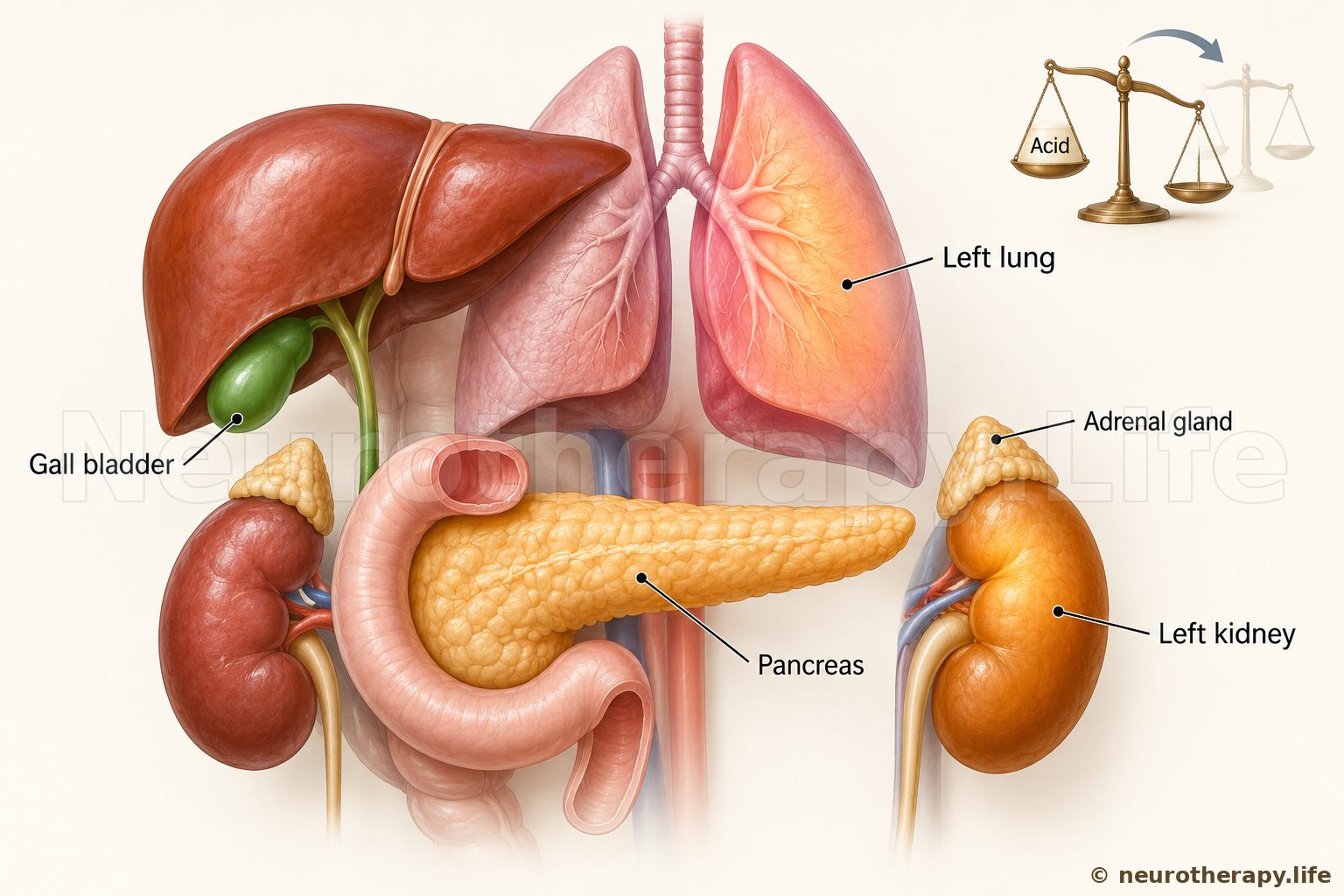
Mild ATF works through the digestive glands, the left kidney, the left lung and the adrenal to bring raised acid gently back towards balance.
What it is for
What is Mild ATF used for?
To reduce raised acid when Mu° is clearly more painful than Liv°.
For the acid picture Neurotherapy (LMNT) describes: hard constipation, piles, fissure, dry skin, hair fall, a slow thyroid, and diseases linked with degeneration.
For patients with severe or long-standing disease, in whom many glands are weak, as the light treatment preferred over the heavy one.
Inside the Angina treatment for heart patients, in place of P. Heparin, when there is pain at Mu° and hard constipation.
Points it works through
Which points does Mild ATF work through?
(8) Pan (1) Gal (3) Mu° (1) acid (4) Lt. Ch. Only (6) Adr
Mild ATF works through six points on the thighs, the navel area, the side, the chest and the upper back. They are listed here as a set, with what each contributes. The exact method is taught hands-on in the Neurotherapy (LMNT) course. This page lists the points of the formula and what each one contributes; it does not describe how any point is given. For the method, watch the demonstration video of each point on its own page and learn hands-on from a trained Neurotherapist. Please do not give a formula from a written description alone.
The adrenal point on the upper back, to settle inflammation anywhere in the body and reduce the acid of the blood.
Position:Lying on the back for most of it, turned onto the side for the Acid point, and face down for the adrenal point.
The exact technique is taught hands-on in the Neurotherapy (LMNT) course. See the course →
How it works
How does Mild ATF work, and why is it lighter?
The formula comes at the acid from several sides at once. The pancreas and the gall bladder quieten the acid arriving from the stomach. The work at Mu° and the Acid point takes out the pain that marks acid. The left chest lets carbon dioxide — which forms acid in the blood — leave through the breath. The adrenal point settles inflammation.
Side matters in this family. The left side answers to acid and the right side to alkali, which is why the chest step here is the left chest only.
The lightening fell exactly on the steps aimed at the acid. A treatment that is right today can overshoot tomorrow, so the finding is checked again every single day.
Its family
Which formulas are related to Mild ATF?
Mild ATF belongs to the ATF line, with a heavier ancestor, a sister ending, and a place inside the heart treatment.
ATF, form (a) — ATF form (a), the default form with the adrenal ending. Mild ATF is written in the same way.
ATF, form (b) — The same opening, ending with Thymus + Chest — chosen after an injury, an infection, boils or a new skin rash.
ATF, old heavy form — The older, heavier ATF, kept for information. Its acid-related steps were stronger.
Angina / Athero treatment — The heart treatment in which Mild ATF replaces P. Heparin when there is Mu° pain with hard constipation.
The gate: if there is no clear pain at Mu°, ATF is not given — not even 'the same as yesterday'. Mu° and Liv° are examined on the day, every day. Mu°
Never give ATF in alkalosis. A treatment repeated on a body that has already corrected can push acid too low, which shows as pain moving from Mu° to Liv°. Alkalosis
The Acid point is not given if there are loose motions, or if there is no pain at Mu°. Acid
Pan raises alkali, so it is not given in fits, convulsions or seizures, and never to people with schizophrenia. Pan
Gal is not given in leukaemia or other diseases with a raised white cell count, in asthma, or to those passing little urine. Chest Only is not given in lung cancer. Gal
The adrenal point used here lowers immunity and raises alkali: it is not given where immunity is low, in septicaemia, HIV or high blood pressure. Whether it may be given in cancer must be decided by a senior teacher. (6) Adr
In diabetes, a diabetic patient's medicines stay exactly as the doctor set them, and blood sugar is checked. Diabetes
Bleeding from the back passage, a change of bowel habit with weight loss, a hard or painful hernia, or chest pain at rest need a doctor first — not a session. How to tell a patient to see a doctor
A heart patient keeps every prescribed medicine. Neurotherapy (LMNT) works alongside medical care, never instead of it.
Guruji says
“Before giving Acid treatment one must certainly check the pain of Mu°. If there is no pain in Mu°, then Acid treatment is not to be given.”
— Dr. Lajpatrai Mehra
Common questions
Is Mild ATF weaker, and so less useful?
No. Guruji moved to the light form himself and reported good results from it. A weak gland responds better to a gentle signal, and two or three light treatments are preferred over one heavy one.
How does the therapist know I need it?
By feeling the two kidney points beside the navel on the day. More pain at Mu° on the left, and little or none at Liv° on the right, opens the gate. Pain in the left ring finger and in left-sided organs can confirm it.
Why is it used inside a heart treatment?
In the Angina treatment, P. Heparin is the usual third stage. When the heart patient also has pain at Mu° and hard constipation, Mild ATF is given in its place.
Can it be given every day without checking?
No. A correct treatment repeated onto a body that has already corrected moves it too far the other way. The points are checked before every session.
Surprising facts
1Every breath you exhale carries acid away
Carbon dioxide combines with water in the blood to form carbonic acid. By breathing it out, the lungs remove a large acid load every day and help keep blood pH steady within minutes.
Source: Hopkins E, Sanvictores T, Sharma S. Physiology, Acid Base Balance. StatPearls. 2022 (NBK507807).
2The pancreas is an acid neutraliser
Food leaves the stomach very acidic. The pancreas pours bicarbonate-rich juice into the duodenum to neutralise it, protecting the intestine and letting its enzymes work.
Source: Guyton and Hall Textbook of Medical Physiology, 14th ed., pancreatic bicarbonate secretion.
3Your kidneys rebuild buffer every day
The kidneys take back almost all the bicarbonate they filter and make new bicarbonate as they pass acid into the urine, replacing what the day's acids used up.
Source: Hamm LL, Nakhoul N, Hering-Smith KS. Acid-Base Homeostasis. Clin J Am Soc Nephrol. 2015;10(12):2232–2242.
Watch
शरीर में Acid बढ़ जाए तो क्या करें? | Blood pH Balance Treatment | LMNT Acid Treatment Formula
Shows the Acid Treatment formula step by step: (8) Pan, (3) Gal, (5) Mu°, 3 Acid on the side of the right thigh, (4) Chest Only, and (6) Adr on the upper back, given without breaks. It is used to support the body's acid–alkali balance when acid is raised.
Note: the Acid Treatment formula is given only when the Mu° point is tender, and (6) Adr is not given in high BP, diabetes, cancer or HIV — the therapist checks first.
Test yourself
Research
Strong evidence
This reference explains how the lungs and kidneys keep blood pH steady: the lungs by breathing out carbon dioxide, which forms carbonic acid, and the kidneys by passing acid into the urine and taking back bicarbonate.
This page explains what a Neurotherapy (LMNT) treatment is for; it is not a self-treatment guide and does not diagnose. Neurotherapy (LMNT) works alongside your medical care — keep taking the medicines your doctor prescribed.
Ready to begin?
Send COURSE for course details, or your name, age and health issue for a consultation.