Also called: Angina treatment, Athero treatment, Atherosclerosis treatment
The Angina, or Athero, treatment is the Neurotherapy (LMNT) treatment for heart patients, hardened arteries and raised cholesterol. It is built from four blocks of work, and it is also the gate a heart patient passes through before certain other formulas may be given.
Overview
What is the Angina / Athero treatment?
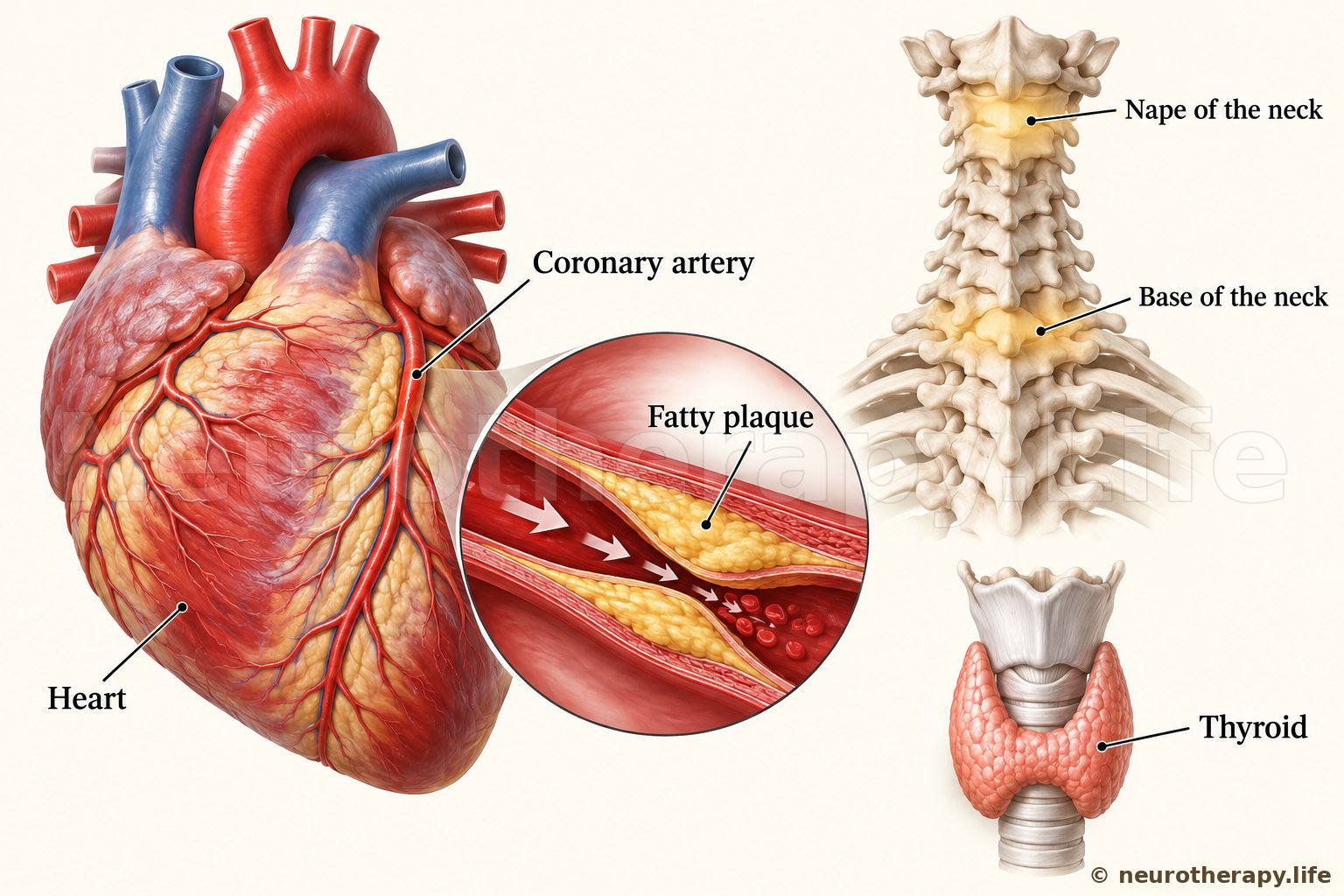
Angina is chest pain that comes when the heart muscle is not getting enough blood. Atherosclerosis is the slow build-up of fatty, hardened patches inside the arteries that narrows them. This treatment was written for both, and for the conditions that travel with them — raised cholesterol and triglyceride, cardiac asthma (breathlessness that comes from a weak heart), and the nerve-squeezing problems called carpal and tarsal tunnel syndrome.
It is one of the weightiest treatments in Neurotherapy (LMNT), for two reasons. First, for what it does. Second, because it is the gate: a heart patient for whom the Vater formula is planned is given this treatment alone for a few days first.
It brings together work at the neck and upper back, the thyroid, the pancreas and liver, and two formulas of the Heparin family — the family that helps keep blood flowing freely.
The Angina / Athero treatment is aimed at narrowed arteries, and works through the neck, upper back, thyroid, pancreas and liver.
What it is for
What is it used for?
Heart disease and angina, alongside the cardiologist's treatment.
Atherosclerosis — hardened, narrowed arteries.
Raised cholesterol and raised triglyceride.
Cardiac asthma, and carpal or tarsal tunnel syndrome.
As the gate treatment for a heart patient, given first for a few days before the Vater formula.
Points it works through
Which points and formulas does it work through?
I (4) Medulla Clockwise ↑ T1/T2 + Raman trt + (10) Pan (2) Thrd · II (1) Single point liver × 2 trts. · III P. Heparin + Sulta Ulta at 135° — or Mild ATF · IV A. Heparin + Sulta Ulta at 135°
The treatment brings together the points and formulas below, listed as a set with what each contributes. Which heparin block is used depends on one finding, explained further down. The exact method is taught hands-on in the Neurotherapy (LMNT) course. This page lists the points of the formula and what each one contributes; it does not describe how any point is given. For the method, watch the demonstration video of each point on its own page and learn hands-on from a trained Neurotherapist. Please do not give a formula from a written description alone.
Sulta Ulta — a light stroke along the forearm, palm up and palm down. For heart patients the arms are kept raised higher than usual.
Position:Several positions: seated for the neck and upper back, and lying on the back, on the side and face down for the other blocks.
The exact technique is taught hands-on in the Neurotherapy (LMNT) course. See the course →
How it works
How does it work?
The treatment works on three fronts. The neck and upper-back work is given at the nape and the base of the neck — close to the brainstem, where, in body science, the centres that steady the heartbeat and blood vessels sit. The thyroid, pancreas and liver work deals with fat and cholesterol, which are made and handled by these glands. And the Heparin formulas help the body keep its blood thin and moving.
Why (2) Thrd and not (4) Thrd? LMNT teaching gives (2) Thrd to heart patients to reduce cholesterol, and holds back (4) Thrd, because (4) Thrd raises metabolism, and a metabolism pushed too high can cause trouble for a weak heart.
One block changes with a finding. Ordinarily P. Heparin is used. But if the patient has pain at Mu°, the left kidney point that shows raised acid, and hard constipation, Mild ATF is used in its place. Sulta Ulta on the arms is said to ease the pain at the front of the chest, and its reverse stroke the matching pain at the back.
Its family
Which formulas are related?
The Angina treatment borrows whole formulas from the Heparin and acid families, and opens the door to the Vater formula.
Vater Treatment — In a heart patient, Vater is given in its cardiac form only after this treatment has been given alone for a few days.
New, severe or worsening chest pain, pain at rest, sweating, breathlessness or fainting is an emergency. Call emergency services (108/112) at once — Neurotherapy (LMNT) works alongside medical care, and emergency services always come first. Heart attack (myocardial infarction)
(4) Thrd is not given to heart patients; this treatment uses (2) Thrd instead. Thrd
Heparin treatments are not given while there is bleeding or an open wound. P. Heparin (plasmin)
No treatment is given without first examining that day's pain points — not even 'the same as yesterday'.
Keep taking every heart medicine your doctor prescribed, including blood thinners. Neurotherapy (LMNT) works alongside your cardiologist's care, never instead of it.
Common questions
Why is it called both Angina and Athero?
Angina is the chest pain; atherosclerosis is the narrowing of the arteries that usually causes it. The treatment is written for both, so it carries both names.
Why must I have this treatment before the Vater formula?
In LMNT teaching, a heart patient passes through this treatment for a few days first. Only then is Vater given, in its cardiac form. The gate protects the heart.
Can I stop my cholesterol or heart tablets?
No. Never stop or change heart medicines on your own. Show your reports to your doctor, and let your doctor decide any change.
Why is my hand in the air during the arm stroke?
For heart patients, LMNT teaching keeps the arms raised higher than usual during Sulta Ulta. Your therapist will place your arms comfortably.
What should I ask my therapist?
Is there pain at Mu°, and does that change which block I get?
Which points are blocked for me as a heart patient?
(To the doctor) Which of my reports — lipid profile, ECG — should I share with my therapist?
Surprising facts
1Artery disease can start in the teenage years
The first fatty streaks inside arteries are often present by early adulthood, decades before any chest pain. Atherosclerosis is a slow, lifelong process driven by cholesterol-carrying particles and inflammation in the artery wall.
Nerves from the heart enter the spinal cord at the same levels as nerves from the left arm and chest wall. So the brain often 'reads' heart pain as coming from the arm, shoulder or jaw — this is called referred pain.
Source: Guyton & Hall, Textbook of Medical Physiology, 14th ed. — referred pain from the heart.
3Thyroid hormone sets the body's pace
Thyroid hormone raises the rate at which almost every cell burns fuel, and it speeds the heart. Too much makes the heart race; too little lets cholesterol rise.
Source: Guyton & Hall, Textbook of Medical Physiology, 14th ed. — metabolic and cardiac effects of thyroid hormone.
4The carpal tunnel is crowded
At the wrist, the median nerve shares a narrow tunnel of bone and ligament with the tendons that bend the fingers. Any swelling in that tight space squeezes the nerve and causes numbness in the thumb and fingers.
Source: Gray's Anatomy, 41st ed. — contents of the carpal tunnel.
Test yourself
Research
Strong evidence
This major review explains how atherosclerosis forms: cholesterol-carrying particles enter the artery wall, inflammation builds a fatty, fibrous plaque, and the plaque narrows the artery or breaks open to cause a heart attack or stroke.
This page explains what a Neurotherapy (LMNT) treatment is for; it is not a self-treatment guide and does not diagnose. Neurotherapy (LMNT) works alongside your medical care — keep taking the medicines your doctor prescribed.
Ready to begin?
Send COURSE for course details, or your name, age and health issue for a consultation.