Raman and Mukha Dhauti: a shoulder lift and a healing breath, chosen by the navel check
Raman lifts and holds the shoulder muscles from behind; Mukha Dhauti is a breath the patient learns to take. Both act on the acid-alkali balance, so the therapist first checks the Liv° and Mu° points before choosing them.
Overview
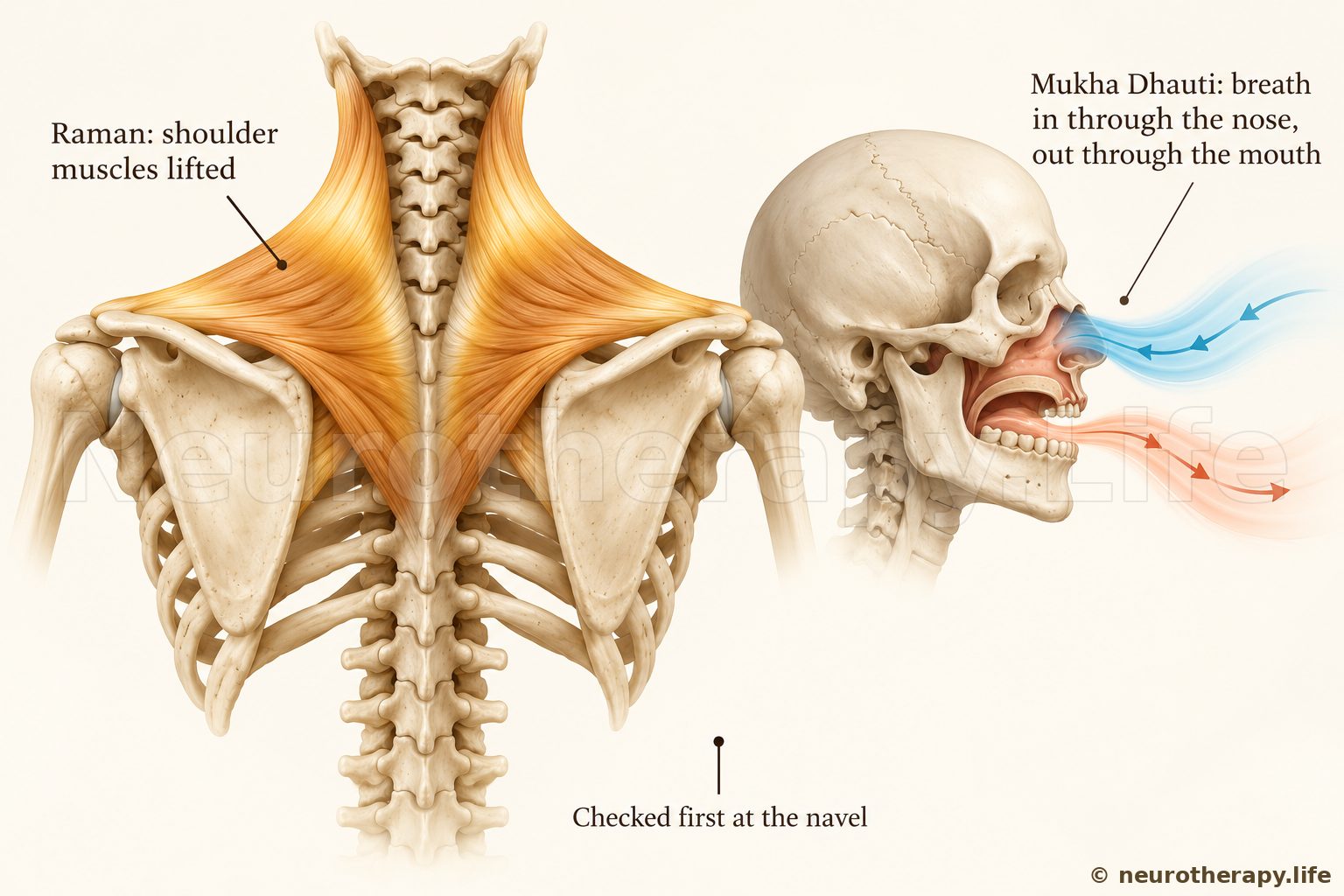
Raman is given seated, with the therapist standing behind. Both hands rest over the tops of the shoulders, and the thick muscle running from the base of the skull to the point of the shoulder is lifted, held and released slowly. A few easy breaths afterwards are part of the treatment, turning a squeeze into a settling.
Raman looks like a muscle treatment but it is a chemical decision. It reduces acid, so alkali rises a great deal. It is given only after checking the Liv° and Mu° points, to people with more pain at Mu° and little or none at Liv°. The side is also chosen by that check: Left Raman, Right Raman, or both sides when the pain is equal.
Mukha Dhauti asks nothing of the therapist's hands. The patient takes a long breath in through the nose and lets it out through the mouth. There are two forms, an open-mouthed out-breath and a closed, whistling one, and the navel check decides which one the patient is taught. It can be taken home and used whenever pain rises. Slow breathing with a long out-breath is known to calm the heart rhythm.
In the same seated group, Endorphin runs down the back of the neck and lessens the feeling of pain, and Subclavian circles the collar bone. In one teaching case, Raman given at a camp without the check made a woman's shoulder pain much worse; weeks later, when her findings had turned, it was given and helped.
Key points
- Raman lifts and holds the shoulder muscles, then a few easy breaths follow.
- Raman reduces acid, so Liv° and Mu° are checked first.
- Left, Right or both-side Raman is chosen from that check.
- Mukha Dhauti is a breath with two forms, also chosen by the navel check.
- A withheld point is written on the card so it stays withheld.
Go deeper
Raman
The Raman point in full
Mukha Dhauti
Mukha Dhauti, the healing breath
Endorphin
Endorphin, which lessens the feeling of pain
Subclavian
Subclavian, around the collar bone
Mu° (Mucus Zero): the treatment point for the left kidney, and the care it needs
What pain at Mu° means
The Two Kingdoms: Acidic and Alkaline Bodies
Acid and alkali: the two kingdoms
Shoulder blade pain
Shoulder and shoulder-blade pain
Seated Treatments I: The Back of the Head and the Neck
The seated points for the brain and neck
Read the full guide
This topic is part of: Seated Treatments I: The Back of the Head and the Neck
Safety: when it is held back
- Never give Raman without first checking Liv° and Mu°. In a person with pain at Liv° and none at Mu°, the pain can increase sharply, because rising alkali brings muscle stiffness. Liv° (Liver Zero): the treatment point for the right kidney, and the care it needs
- If the patient feels light-headed or the fingers tingle during Mukha Dhauti, they are breathing too hard. Stop, breathe normally for a while, then begin again more gently.
- A point that dulls pain can hide a warning. New or unusual headache, or neck pain with unsteady walking or a change in the voice, goes to a doctor first. How to tell a patient to see a doctor
- A lump above the collar bone or at the side of the neck that has not been checked is referred, not rubbed.
- The exact method is taught hands-on in the course, under a trained therapist. Please do not try it on yourself or others from this page.
Watch

This video shows the right way to give (4) Medulla, Raman and the T1–T2 point for neck and shoulder pain and numbness.
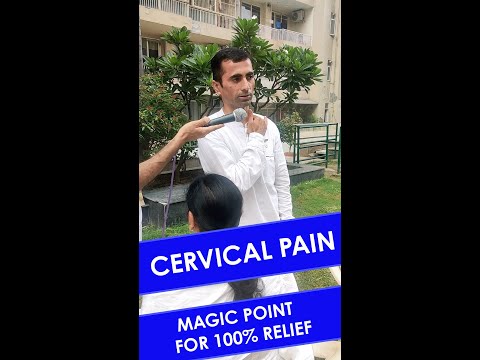
Shows a seated routine for neck pain: zig-zag fingertip massage from the base of the skull to the shoulder blades and down the arm, cross-rubbing, rounds of breathing out through the mouth, and a gentle grip massage at the back of the neck. It is shared for relief in cervical pain and tingling in the hands.
This page explains what a Neurotherapy (LMNT) treatment is for; it is not a self-treatment guide and does not diagnose. Neurotherapy (LMNT) works alongside your medical care — keep taking the medicines your doctor prescribed.