1A lining as big as your skin
Spread out flat, the peritoneum that lines the belly and wraps its organs has a surface area close to that of the whole skin — nearly two square metres in an adult.
Source: Gray's Anatomy, 41st edition, the peritoneum.
Also called: Raman treatment, Left Raman, Right Raman, Rt. Raman Only, Lt. Raman, रामन ट्रीटमेंट
Raman is a seated Neurotherapy (LMNT) treatment in which the therapist, standing behind you, lifts the muscles over both shoulders and lets them go slowly, followed by a few easy breaths. It is taught as the treatment of the peritoneum and of many of the body's pains — and it is never added without first checking the two kidney points, Liv° and Mu°.
Raman is not a press with the thumb or the foot. It is a lift: a handful of the big muscle that runs from the base of the skull out to each shoulder is raised, held and released slowly. Then you breathe in and out comfortably a few times. The breaths belong to the treatment.
In Neurotherapy (LMNT) teaching, by Raman we provoke the peritoneum — the thin, smooth lining that wraps the organs of the belly and lines its walls. It is called a rāmbāṇ, a sure-shot treatment, with the capacity to ease many of the body's pains, and useful in all problems of the uterus and the testes.
Raman also shifts the body's chemistry: it reduces acid, so alkali rises. That one fact is why Raman has a gate, and why it is now written with a side — Left Raman, Right Raman, or both.
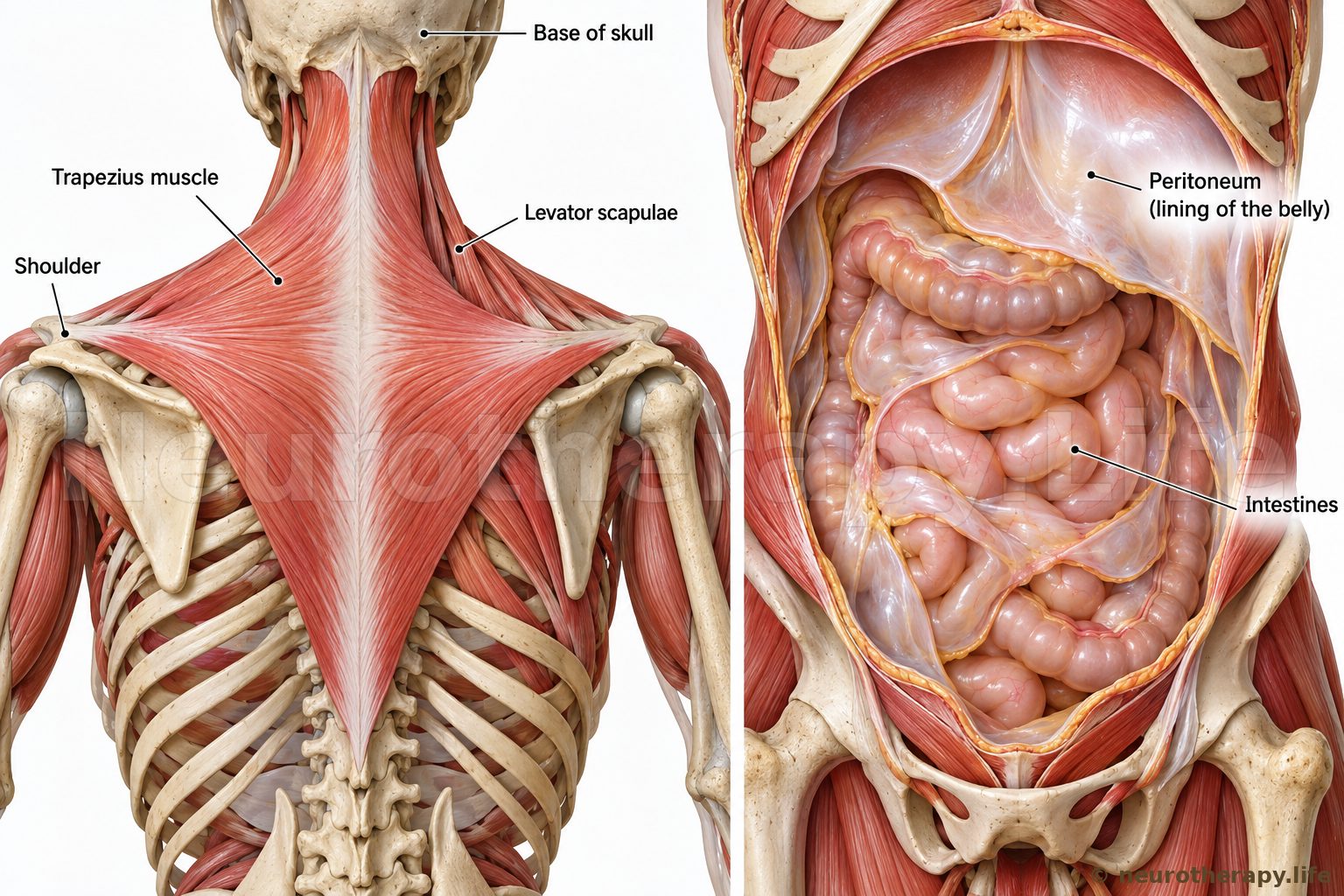
You sit on a chair and the therapist stands behind you. Both hands come over the tops of your shoulders from behind, close to the neck, and the muscles of the upper back are lifted upward from both sides.
The grip is on the thick belly of the muscle, not out on the bony point of the shoulder, and never on the front of the neck. For Left or Right Raman, only that side is lifted.
How this point is given — the tool, the pressure, the count and the exact movement — is deliberately not described here. Watch the demonstration video on this page, and learn the method hands-on from a trained Neurotherapist before giving it. Please do not give any point from a written description alone: a point given in the wrong place or the wrong way can do harm.
The exact technique is taught hands-on in the Neurotherapy (LMNT) course. See the course →
Raman reaches far beyond the shoulders. Teaching gives it three written forms and one powerful combination, each with its own territory.
Raman is taught with Mukha Dhauti as 'the lift and the breath', and its side is read from the kidney points.
Raman is chosen by the finding, not by the complaint alone — the side of the pain and the kidney points decide.
The three written forms — both sides, right only, left only — and their uses.
Raman added to (4) Medulla clockwise — after the Liv° and Mu° check.
Raman sits in the opening stage of this heart treatment.
The stage 'for the peritoneum — so that all the organs work properly'.
This UDF formula opens on Raman.
One of its numbered stages.
A teaching case from a centre's records: a woman in her forties with knee osteoarthritis could walk only by swaying from side to side, and the usual knee treatments had brought no special benefit. Her therapist chose Raman — not a knee treatment at all, but the one written against many of the body's pains. Her gait improved straight after the treatment, and within a few days she felt well. The lesson taught is to watch the walk, and to change level when the obvious treatment has not worked.
A composite case written to teach the reasoning — not one patient’s file.To check Liv° and Mu°. Raman shifts the body towards alkali, and in the wrong patient it can make muscle pain much worse. The check takes seconds and decides whether, and on which side, Raman is given.
No. It is a lift and slow release of one muscle, closed by easy breaths, with effects taught far beyond the shoulders.
Only the right side is lifted. It is the form written for right-sided pains — the right shoulder and arm, the right chest, the right forehead.
Tell your therapist before the next session. Stiffness and pain after Raman can be a sign of rising alkali; the kidney points will be checked again and the plan changed.
Spread out flat, the peritoneum that lines the belly and wraps its organs has a surface area close to that of the whole skin — nearly two square metres in an adult.
Source: Gray's Anatomy, 41st edition, the peritoneum.
The trapezius, the muscle Raman lifts, is a flat diamond — a kite shape — stretching from the base of the skull down to the middle of the back and out to both shoulders.
Source: Gray's Anatomy, 41st edition, muscles of the back.
The diaphragm, whose sudden spasms are hiccups, is driven by the phrenic nerve, which leaves the spinal cord high in the neck — a link that explains why neck-level work is used for hiccups.
Source: Gray's Anatomy, 41st edition, the diaphragm and phrenic nerve.

This video shows the right way to give (4) Medulla, Raman and the T1–T2 point for neck and shoulder pain and numbness.
This page explains what a Neurotherapy (LMNT) treatment is for; it is not a self-treatment guide and does not diagnose. Neurotherapy (LMNT) works alongside your medical care — keep taking the medicines your doctor prescribed.
Send COURSE for course details, or your name, age and health issue for a consultation.